

California:
Potassium nitrate pricing in California remained at $1,235/st FOB Stockton for bulk, $1,340/st FOB for bulk bags, and $1,360/st FOB for 50-pound bags.
California:
Potassium nitrate pricing in California remained at $1,235/st FOB Stockton for bulk, $1,340/st FOB for bulk bags, and $1,360/st FOB for 50-pound bags.
Eastern Cornbelt:
Potassium thiosulfate remained at $700/st FOB Terre Haute for the latest offers.
Potassium thiosulfate pricing was unchanged at $700/st FOB Waterloo.
California:
The latest potassium thiosulfate offers were confirmed at the $700/st level FOB Sacramento.
Eastern Cornbelt:
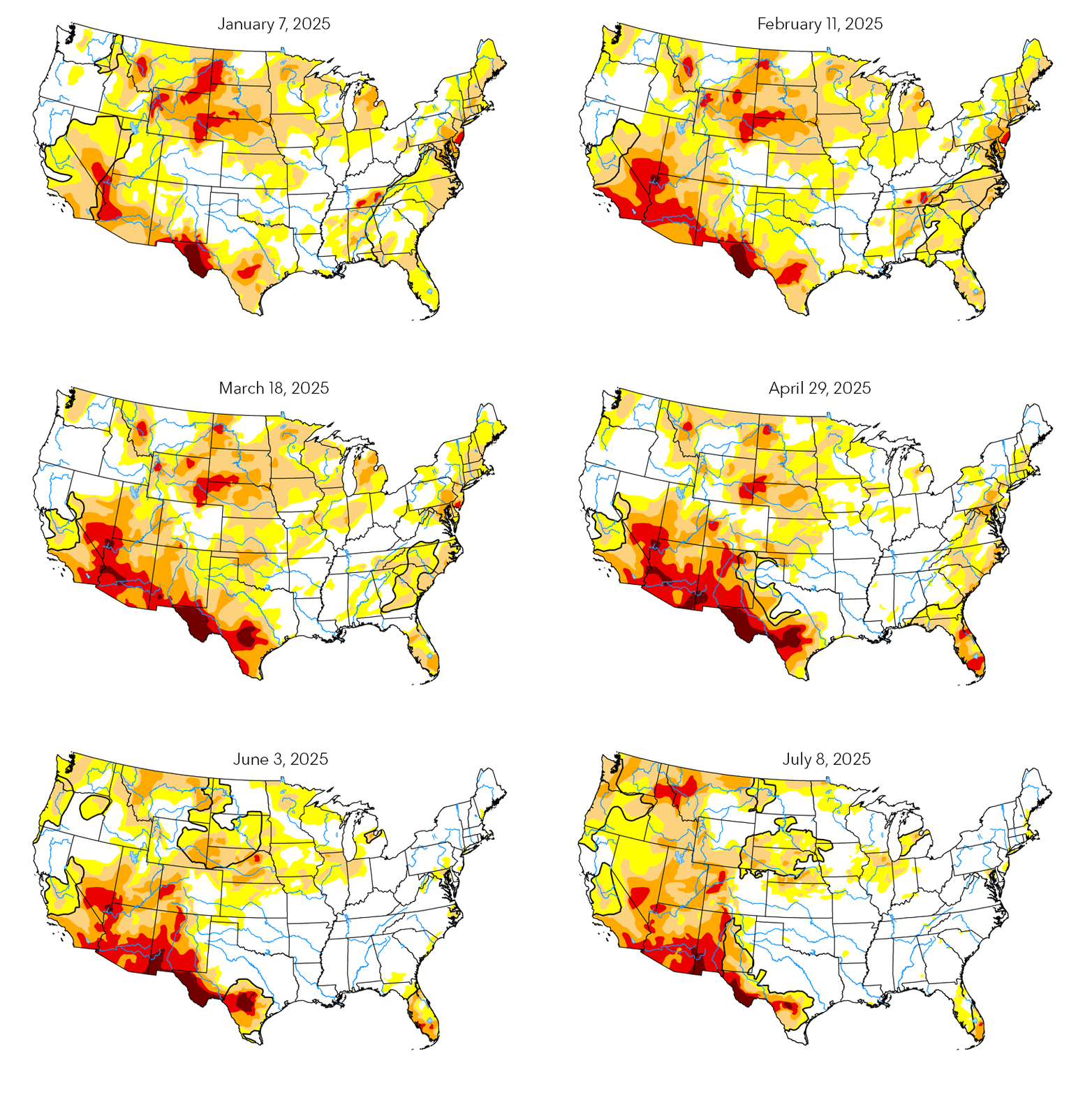
Clear, cool weather allowed growers to make significant strides on the fall harvest, and also apply fall fertilizer at a brisk pace in the region.
Temperatures in the 50s and 60s were reported in central Illinois, with lows falling to near freezing. Central Indiana experienced similar conditions, along with 15-20 mph winds at midweek. Highs were reported in the upper-40s and low-50s across northern Ohio, reaching the 50s and low-60s in southern areas of the state.
The corn harvest as of Nov. 5 was 90% complete in Illinois, 68% in Indiana, 45% in Ohio, and 40% in Michigan, with only Illinois tracking ahead of its five-year average. The soybean harvest was 95% complete in Illinois, 87-89% in Indiana and Ohio, and 70% in Michigan. Michigan growers also had 80% of the sugar beets harvested by Nov. 5.
Western Cornbelt:
Much of Iowa and Nebraska saw highs in the mid- to upper-50s and lows down to the 30s and upper-20s during the first full week of November. Gusty winds were also reported in northern Iowa at midweek.
Missouri was the exception, where St. Louis temperatures soared to a record 83 degrees on Nov. 8. Much cooler weather was on tap for the balance of the week, however, with highs falling to the low-60s on Nov. 9-10.
The fall harvest continued to track ahead of the average pace for most crops in the region. Regional growers had 84-89% of the corn in the bin by Nov. 5, while the soybean harvest had progressed to 97% complete in Iowa, 95% in Nebraska, and 84% in Missouri. Missouri’s cotton harvest was 84% complete, with Nebraska’s sorghum harvest rated at 82% complete.

California:
Heavy rain hit parts of Northern California early in the week, with up to six inches of snow reported in the Sierra Nevada. Another system is expected to bring more precipitation to the state on Nov. 13-15, with up to a foot of snow expected in the Sierra and an inch or more of rain in the valleys.
Gusty Santa Ana winds sparked a number of red flag fire warnings in Southern California during the week, but the Nov. 9 US Drought Monitor showed California as largely drought-free, with only small patches of dryness reported on the extreme northern and southern edges of the state.
The cotton harvest as of Nov. 5 was 35% complete in California and 44% in Arizona, with both states trailing the average pace. California’s winter wheat crop was 35% planted and 15% emerged by that date.
The fertilizer market was fairly quiet in the state as growers finish the fall harvest. “We expect to see some activity in orchards in the next several weeks with growers applying some blends,” said one contact. “Most fall tons are in place and likely won’t see much replacement activity for the next couple of weeks, or perhaps December.”
Pacific Northwest:
Western Oregon and Washington were hit with rain in the valleys and snow in the Cascades during the week. Breezy weather with highs in the 40s was common across western Montana and Idaho in early November.
Idaho growers had 92% of the sugar beets harvested by Nov. 5, while winter wheat planting had progressed to 88% complete in Oregon, 97% in Montana, and 100% in Idaho and Washington.
Western Canada:
Winter weather hit parts of southern Manitoba and Saskatchewan at midweek, with light snow, freezing rain, and 20-40 km/h winds causing poor road conditions and prompting several school closures across the region. Up to 10 cm of snow was in the forecast for parts of southeastern Saskatchewan.
Alberta experienced gusty winds and mild temperatures during the week, with wind advisories also in effect for the central and northern British Columbia coasts. Rain was in the weekend forecasts for coastal areas of southern British Columbia as the week advanced.
US Gulf:
Algiers Lock is closed for gate repairs through Dec. 1, leaving tows to detour through the Port Allen Route. Corps data showed delays in the 24-48 hour range for the week.
Guidewall repairs were underway at Bayou Sorrel Lock from 7:00 a.m. to 4:30 p.m. daily, prompting waits up to 43 hours. In an effort to mitigate the long wait times, tows arriving before 4:30 p.m. were allowed to lock before the site closes the following morning. The shutdowns were said to be temporarily suspended whenever wait times push above the 24-hour mark.
Low head conditions continued to create long backups at Harvey Lock. Corps data showed delays up to 43 hours, below the 5.5 days reported last week. Tows will remain limited to 300-foot lengths and 70-foot widths whenever head conditions track below the 1.5-foot mark, sources said. The site was closed to navigation from June 15 to Oct. 16 due to reverse head conditions.
Brazos Lock access was limited from 7:00 a.m. to 7:00 p.m. daily for repairs and maintenance, resulting in intermittent 5-14 hour wait times. The project is slated to run through Nov. 29. Slow-travel restrictions were in place at Bayou Chene through Nov. 30 due to dredging in the area.
Travel through the Ellender Bridge, located at Mile 243 of the West Canal, will be unavailable between 8:00 a.m. and 8:00 p.m. on Nov. 11-12. The closures will repeat on Nov. 18-19.
Wait times at Port Allen Lock were noted up to 30 hours. Industrial Lock saw intermittent 5-16 hour delays during the week.
Mississippi River:
Improved conditions allowed for lighter travel limits on the Lower Mississippi River during the week. Restrictions on northbound loading drafts were noted at 20-25% below normal, down from 25-30% at last report, while downriver drafts softened to 15-20% from 20-25% one week earlier. Maximum towing widths increased to six barges from the prior five-barge limit.
Forecasts from the National Weather Service hinted at an imminent return to tighter restrictions, however. The river gauge at Vicksburg, Miss., was above the 5.00-foot low stage at 5.54 feet on Nov. 9, but was projected to slide to 2.90 feet on Nov. 23.
At Memphis, Tenn., levels returned to a low-stage (-)5.4 feet at midweek following a (-)4.81-foot crest on Nov. 6, and forecasts indicated a (-)9.50-foot reading on Nov. 23. Restrictions on towing widths are anticipated to tighten to five barges once the Memphis gauge falls below (-)8.0 feet, expected on Nov. 15.
Dredging was reported on the lower river at Miles 710 and 486-488, while potential travel delays were noted in the Baton Rouge, La., harbor due to dredging.
Maximum loading drafts were reported at 10-15% on travel through the St. Louis harbor, while loading weights were reduced by 5-10% between St. Louis and Cairo, Ill. The gauge at St. Louis, reported at 1.58 feet on Nov. 9, was forecast to recede to (-)1.70 feet on Nov. 23. Dredges were noted working at Miles 481 and 40 of the upper river.
Upper-river locks are tentatively scheduled to close for the winter navigation season between Dec. 5 and March 11, 2024.
Illinois River:
Loading drafts continued to see 5-10% reductions on the Illinois River due to low water levels. Drafts were reportedly capped at 9.5 feet at Miles 1-152, and at 9.25 feet for Miles 153-230. Maximum tow lengths were set at 15 barges for both north- and southbound travel.
Sources noted raised wickets at Peoria Lock and LaGrange Lock due to low water, forcing lockages at both locations.
Ohio River:
Southbound loading drafts continued to see a 10-15% reduction. Drafts remained at 8.5 feet on the Monongahela River.
Repair and maintenance operations at the John T. Myers Lock primary chamber, previously scheduled to wrap up on Nov. 6, were extended through at least Nov. 9. Delays were quoted in the 3-5 day range, steady from the prior report.
The main chamber at Montgomery Lock is closed to navigation through Nov. 22. The auxiliary chamber will shut on Nov. 22-26, followed by an additional main chamber outage on Nov. 26-Dec. 22.
Dredging continued at Miles 967-975, sources said, forcing staggered one-way travel through the area. Southbound tows were permitted to pass during daylight hours, while northbound boats passed overnight. The project was previously expected to conclude on Oct. 31.
The river chamber at Smithland Lock is closed through Nov. 22, forcing detours through the land chamber. Boats traveling downriver through Smithland were required to use an assist boat. The Olmsted Lock river chamber is scheduled to close Nov. 13-23 for maintenance, leaving the land chamber open to traffic.
Delays were noted up to 15 hours at the Tennessee River’s Kentucky Lock. Intermittent 5-18 hour waits were observed at Wilson Lock.
Yara France has announced plans to transform its site in Montoir-de-Bretagne into a state-of-the-art blending and coating unit to offer tailor-made fertilizer products. It would also be modernized into a fertilizer import terminal.
The company said it plans to offer a more complete portfolio of products in France, including ammonium nitrate fertilizers, calcium ammonia nitrate, urea + sulfur, organic-based fertilizers, and biostimulants. The company said the trend away from NPK consumption has taken a toll on the site’s operations.
“The main driver behind this very difficult decision is related to the decline of the NPK fertilizers market in France,” said a Yara spokesperson. “The consumption of compound NPK fertilizers has been divided by four in the last 20 years and fell by 50% during the last agricultural season. At the end of September 2023, the site posted a loss of nearly €40 million in EBITDA. It has been in deficit for five years out of the last six years.”
The company
said this transformation and modernization project aims to safeguard Yara
France’s competitiveness and adapt its organization to the profound changes of
a
volatile market. Yara’s other sites in France at Ambès, Le Havre, and La
Défense will not be impacted.
The company told Green Markets that Montoir will continue running until an agreement is signed with the unions’ representatives. “We are committed to ensuring business continuity throughout and to fulfilling our order book as part of our ongoing dedication to serving our customers in France,” said the spokesperson.
Once an
agreement is made, Montoir’s ammonia tanks, as well as the nitric acid and
ammonium nitrate solution production lines, would be kept and mothballed. The
company said this would allow it the flexibility to reassess the production of
nitrate-based fertilizers depending on future market developments.
Yara
said the transformation means some 139 jobs out of 171 jobs would become
redundant, though another 12 will be created. “We deeply regret that this
project has the consequence of exposing employees to the risk of dismissal,”
said the spokesperson. “We will do everything in our power to support them, in
the most respectful and transparent way possible, in agreement with the union representatives.”
Russian fertilizer tycoon Dmitry Mazepin lost his legal challenge to European Union sanctions imposed on him soon after the invasion of Ukraine, according to a Bloomberg report.
The EU cited “a set of sufficiently specific, precise, and consistent” indicators to show “that Mr. Mazepin is a leading businessperson involved in a sector providing a substantial source of revenue to the Russian Government,” the EU’s General Court ruled in Luxembourg on Nov. 8. “Consequently, the sanctions imposed on Mr. Mazepin are such as to increase the costs of Russia’s actions in Ukraine.”
Dozens of wealthy Russian business bosses, including Roman Abramovich, and family members have taken to the EU’s Luxembourg-based courts in an attempt to break free from sanctions and regain control of their assets, mansions, and superyachts.
Mazepin, the founder of fertilizer maker UralChem, was added to the EU’s sanctions list in March last year (GM March 11, 2022). He was one of the last Russian businessmen to meet with President Vladimir Putin before the invasion, according to the Kremlin website.
The two men also met in November 2022 to discuss the fertilizer market, which Mazepin used as an opportunity to complain about the sanctions and thank Putin for his support. Last month Putin awarded Mazepin with the Order of Alexander Nevsky, one of the oldest Russian state awards, for his work.
Mazepin, whose fortune was estimated at $900 million in 2022 by the Bloomberg Billionaires Index, had to give up control of UralChem and Uralkali PJSC after the sanctions hit.
The EU also targeted Mazepin’s son Nikita, a former Russian Formula 1 driver. The bloc has sanctioned close to 1,800 people and entities since Russia’s attacks on Ukraine, starting with the annexation of Crimea in 2014 and followed by the invasion of its neighbor in February 2022.
Two other Russian fertilizer executives were sanctioned at the same time as Mazepin: Andrey Melnichenko, the founder and controlling shareholder of Zug, Switzerland-based EuroChem Group AG, and Andrey A. Gurvey, the CEO of PhosAgro PJSC.
The USDA’s Nov. 9 Crop Production report boosted the corn production forecast to a record high 15.2 billion bushels, up 1% from the previous forecast and up 11% from 2022. Based on conditions as of Nov. 1, yields are expected to average 174.9 bushels/acre, up 1.9 bu/a from the previous forecast and up 1.5 bu/a from last year.
Corn area harvested for grain is forecast at 87.1 million acres, unchanged from the previous forecast but up 10% from the last year.
With supply rising more than use, corn ending stocks were up 45 million bushels, to 2.2 billion, according to the latest World Agricultural Supply and Demand Estimates (WASDE) report, also released on Nov. 9. The season-average corn price was lowered 10 cents, to $4.85 per bushel.
Soybean production is estimated at 4.13 billion bushels, up 1% from the previous forecast but down 3% from last year. Soybean yields are expected to average 49.9 bu/a, up 0.3 bu/a from both the previous forecast and 2022. Total harvested area in the US is estimated at 82.8 million acres, unchanged from the previous forecast but down 4% from 2022.
With crush and exports unchanged, the WASDE report raised soybean ending stocks to 245 million bushels. The U.S. season-average soybean price for 2023/24 was forecast at $12.90 per bushel, unchanged from last month.
Cotton production is forecast at 13.1 million 480-pound bales, up 2% from the previous forecast but down 10% from 2022. Cotton yields are expected to average 783 pounds/a, up 16 pounds/a from the previous forecast but down 167 pounds/a from 2022. All cotton area harvested is forecast at 8.02 million acres, unchanged from the previous forecast but up 10% from 2022.
Yara North America Inc. has announced that on Oct. 18 it transferred the operations of its Tampa Ammonia Terminal to Tampa Port Services LLC (TPS). As a part of the terminal transfer, TPS purchased all of Yara’s operating assets at the terminal.
The terminal transfer is the result of the upcoming expiration of the terminal ground lease between Yara and TPS. On-site Yara employees have transitioned to TPS.
Swedish green technology company Cinis Fertilizer on Nov. 10 said it has decided to prioritize the construction of its planned $89.4 million, 300,000 mt/y sulfate of potash (SOP) facility in Hopkinsville, Ky., before a facility in Skellefteå, Sweden. The company attributed the decision to the extensive investments that are being made in green industrial projects in North America.
In September, Cinis signed an agreement for the supply of sodium sulfate from Ascend Elements, an independent manufacturer of advanced engineered battery materials (GM Sept. 22, p. 1). In connection with this agreement, Cinis decided to establish an SOP production facility in Hopkinsville.
Cinis said the preparatory work and contacts with partners and authorities have taken place at a high pace, which is the background for the decision to accelerate the Kentucky plant.
“The rapid handling of important contractual issues and the great interest key players have demonstrated have made us choose to shift our schedule,” said Cinis CEO and Founder Jacob Liedberg. “Ascend Elements’ battery material manufacturing facility is being built quickly and we have already managed to establish a strong local network. The market for production of electric vehicle batteries is growing very fast in North America on the back of favorable government incentive programs introduced in the US and Canada, thus many battery manufacturers are now shifting their focus from Europe to North America.”
“Cinis Fertilizer wishes to take part in this growth and therefore we choose to focus on Hopkinsville as our second facility,” he added. “This means that we are waiting a bit with the planning of the Skellefteå facility, and thus it will now be number three of our planned six facilities.”
Ascend Elements is currently building its largest facility in Hopkinsville. The agreement with Cinis means that Ascend Elements will deliver up to 240,000 mt/y of sodium sulfate beginning in 2024. Cinis has also entered into a letter of intent regarding the sale of its SOP to K+S and the purchase of potassium chloride from K+S’ production facilities in Saskatchewan. The Cinis facility in Hopkinsville is to be ready in 2025.
Cinis is currently building its first production facility outside of the town of Örnsköldsvik in Sweden, with a planned startup in early 2024. Cinis plans six facilities, with a total production capacity of about 1.5 million mt/y, to be in operation by 2030.
Yara International ASA has announced plans to divest its fertilizer import and distribution subsidiary in Ivory Coast.
“The decision to divest is driven by the acknowledgment that Yara’s ambition to become a true leader in the Food Systems Transformation in Africa can only be reached in a phased approach,” said Luis Alfredo Pérez, SVP Yara Africa. “A necessary first step is to right-size our geographical footprint and prioritize those specific crops and regional segments offering the highest opportunity to establish closed-loop partnerships, which will secure a sustainable improvement in the Sub-Saharan smallholder farmer’s productivity and profitability.”
The divestment transaction is anticipated to be finalized by the end of April 2024. Yara said it would reveal the name of the buyer when the transaction closes.
“Yara has always put its employees at the forefront of its decision-making and this point we can assure our employees that no jobs will be lost due to this decision, we value our talented workforce, and understand that they are instrumental in our success,” said Taz Hassim, Human Resources Business Partner, Yara Africa.
The Ivory Coast news follows Yara International France’s finalization in July of the sale of its 65% stake in Yara Cameroon to NJS Group, the local historical minority shareholder. NJS is now the only shareholder.
Yara said that deal paved the way for NJS on ambitious expansion projects. Yara said with NJS Group’s extensive presence in not only Cameroon but also neighboring countries, it is well positioned to support food security, growth, and innovation.
Yara said it concluded an exclusive distribution agreement with NJS to provide premium NPK fertilizers, YaraMila, and YaraLiva Nitrabor Calcium Nitrate, assuring farmers and retailers an assured supply of these products. Yara will also provide technical and operational support to NJS.