All posts by hlancey@bloomberg.net

Sulfur

Tampa:

Fourth-quarter Tampa molten sulfur contracts were valued at $102/lt CFR, up 85% from $55/lt CFR in the third quarter and nearly matching the 2Q price of $103/lt CFR.

US Gulf:

The US Gulf market continued at $100-$105/mt FOB, with market players reportedly focused on negotiating contracts for the upcoming year.

Brazil:

Sources confirmed numerous Brazil spot transactions in the $125-$135/mt CFR range, off from the week-ago $130-$135/mt CFR. A single cargo rumored to change hands below $125/mt CFR went unconfirmed on Oct. 26.

Vancouver:

Prices remained stable at $95-$100/mt FOB, with most business falling toward the lower end of the range. Players reported closely monitoring China’s climbing sulfur inventories.

Alberta:

Alberta netbacks were steady at (-)$13-$30/mt FOB. The range included molten sulfur cargoes contracted into the US market and solid tons sold through the Vancouver export market.

West Coast:

West Coast prilled spot pricing mirrored Vancouver at $95-$100/mt FOB. Molten sulfur contracts were reported at $85-$90/lt FOB for loading in the fourth quarter.

China:

Import prices at China were noted at $118-$125/mt CFR, falling from the previous $125-$130/mt CFR. High port sulfur inventories that were reportedly nearing 3 million mt during the week are exerting downward pressure on the market.

ADNOC:

Solid sulfur produced by the Abu Dhabi National Oil Co. (ADNOC) was priced at $111/mt FOB Ruwais for October.

Qatar:

October sulfur prices from Muntajat were steady at $104/mt FOB Ras Laffan, sources said.

Sulfuric Acid

US Gulf:

As the negotiation season for 2024 contracts pressed on, the US Gulf import sulfuric acid market continued in the $105-$120/mt CFR range. Some buyers have opted to delay their purchasing decisions, sources said.

Brazil:

Brazil imports were noted at $145-$150/mt CFR, rising from the week-ago $130-$138/mt CFR. Market players cited rising freight rates and firmer price levels in Europe as contributing to the increase.

Ammonium Thiosulfate

Eastern Cornbelt:

The ammonium thiosulfate market remained at $245-$270/st FOB in the Eastern Cornbelt, with the low reported at Terre Haute, Ind., and the high out of inland terminals in Ohio. The Cincinnati market was unchanged at the $255/st FOB level in late October.

Western Cornbelt:

Ammonium thiosulfate was unchanged at $225-$260/st FOB in the Western Cornbelt, with the low reported at Waterloo, Iowa.

Northern Plains:

The last reported ammonium thiosulfate offers fell in the $260-$280/st FOB range in the Northern Plains.

Eastern Canada:

The ammonium thiosulfate market remained in a broad range at C$465-$545/mt FOB for the last confirmed offers in Eastern Canada.

Crops/Weather

Eastern Cornbelt:

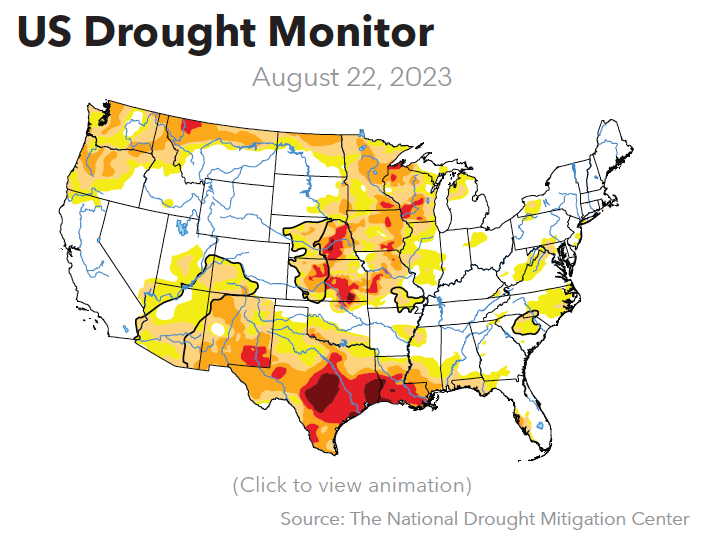
US Drought Monitor

Rainfall across central Illinois at midweek put a halt to what was described as a fairly brisk start to the fall ammonia application season.

After highs reached the mid-70s across much of the Eastern Cornbelt at midweek, much colder weather was on tap for the weekend, with highs expected only in the low- to-mid-50s in northern Ohio. Rain was also in the weekend forecast for Ohio and southern Michigan, with snow possible in northeastern Michigan by Halloween.

The corn harvest as of Oct. 22 was 70% complete in Illinois, well ahead of Indiana’s 42%, Ohio’s 20%, and Michigan’s 24% progress. The soybean harvest was 80% complete in Illinois, 64-65% in Ohio and Indiana, and 43% in Michigan, while Michigan growers also had 22% of the sugar beets picked by that date.

Western Cornbelt:

Warm temperatures blanketed much of the Western Cornbelt during the last full week of October, but colder weather was in the weekend forecast.

Highs in Iowa were expected to drop to the 40s and 50s on Oct. 27-28 after reaching the upper-60s and low-70s during the week. The weekend also promised a mix of rain, freezing rain, and snow in Iowa, with mostly rain in southern areas and light snow accumulation in northwestern Iowa on Oct. 28. Highs in the 40s were expected on Oct. 29.

Nebraska was also preparing for a wintry mix of precipitation over the weekend, with northwestern areas of the state expecting 1-4 inches of snow and temperatures in the 30s.

The fall harvest continued at a brisk pace in late October, with progress tracking ahead of the five-year average for all crops in the region. Missouri growers had 75% of the corn in the bin by Oct. 22, compared with 62% in Iowa and Nebraska. Iowa’s soybean harvest was 87% complete, ahead of Nebraska’s 83% and Missouri’s 61%.

Missouri’s rice harvest was fully 93% complete, along with 67% of the state’s cotton crop. Nebraska growers also had 54% of the sorghum crop in the bin by Oct. 22.

Northern Plains:

Corn Wheat Soybean Index

The first winter storm warnings and advisories were issued for parts of the Northern Plains on Oct. 26-27 as a strong storm moved into the region from the Pacific Northwest.

Forecasts warned of as much as 8-12 inches of snow possible in southwestern and northeastern North Dakota, while Fargo was expected to get just two inches. Accumulation in western South Dakota was predicted at 1-3 inches, and the northwestern corner of Minnesota was also bracing for up to 3-5 inches of snow, along with 35 mph winds.

The harvest of corn, soybeans, sugar beets, and sorghum continued in the Northern Plains, with progress tracking ahead of the average pace thanks to favorable weather in mid-October. The corn harvest was 62% complete in Minnesota and 45-48% in the Dakotas as of Oct. 22, with the soybean harvest estimated at 85-90% complete in the region.

South Dakota’s sorghum crop was 65% harvested by Oct. 22, while the sugar beet harvest had progressed to 87% complete in North Dakota and 92% in Minnesota. Harvest was lagging slightly on sunflowers, however, with 23-24% of the Dakota crop in the bin by Oct. 22.

Northeast:

While parts of the Pacific Northwest and upper Midwest were bracing for the first significant snowfall of the season, much of the Northeast enjoyed summer-like heat and near-record temperatures in late October.

Highs in the upper-70s were reported in eastern Massachusetts during the week, while temperatures in Philadelphia were expected to reach the low-80s on Oct. 27-28. A weather change was in store for Halloween, however, with rainfall and a nearly 30-degree temperature drop expected in New England.

Just 26% of Pennsylvania’s corn crop was in the bin by Oct. 22, some 10 points behind the five-year average, while the state’s soybean harvest had progressed to 36% complete. About half of the state’s fall tillage was also complete by that date.

Eastern Canada:

Favorable October weather allowed growers to move quickly on the fall harvest across Eastern Canada, but parts of Ontario were bracing for the first significant snowfall of the season.

While mild temperatures continued over much of southern Ontario, northwestern areas of the province were expecting 10-20 cm of snow on Oct. 26-27.

Unseasonably warm weather also continued across much of Quebec and the Maritimes during the week, with high reaching the teens and low-20s. Increased showers were likely over the weekend in New Brunswick and Prince Edward Island, however.

Transportation

US Gulf:

Algiers Lock is closed for gate repairs through Dec. 1. Vessels were reported detouring through the Port Allen Route, adding 24-48 hours to travel times.

Guidewall repairs shut Bayou Sorrel Lock from 7:00 a.m. to 4:30 p.m. daily, resulting in 15-25 hour delays for the week. Tows arriving before 4:30 p.m. were permitted to lock before the next morning’s shutdown, regardless of the hour. The closures, scheduled until March 2024, will be temporarily suspended whenever wait times exceed the 24-hour mark, sources said. Concrete work is scheduled to completely close the site on Oct. 31.

Low head conditions continued to limit Harvey Lock movements following the site’s Oct. 16 reopening. Tows were limited to 300-foot lengths and 70-foot widths during the week, resulting in waits up to 32 hours. Harvey had been shut since June 15 due to reverse head conditions.

Brazos Lock saw limited availability between 7:00 a.m. to 7:00 p.m. daily, scheduled to continue until Nov. 29. Intermittent wait times were noted up to 20 hours through the week. Dredging at Bayou Chene, slated to run through Nov. 30, prompted slow-travel warnings in the area.

Planned maintenance at the Ellender Bridge, located at Mile 243 of the West Canal, will block navigation from 8:00 a.m. to 8:00 p.m. on Nov. 11-12, and again on Nov. 18-19.

Port Allen Lock delays were observed at 2-3 days due to congestion from the Algiers Lock shutdown, falling from 2-4 days at last report. Industrial Lock waits topped out at five hours.

Mississippi River:    

Low water levels continued on the Mississippi River during the week, though forecasts hinted at improving conditions headed into November.

The river gauge at Memphis, Tenn., was posted at a low-stage (-)9.44 feet and rising slowly on Oct. 26, above the (-)11.85-foot record low set on Oct. 16. The river gauge at Vicksburg, Miss., reported at (-)0.18 feet at midweek, was predicted to cross above the 0.00-foot mark on Oct. 30.

As a result of the slightly improved conditions, restrictions on southbound loading drafts softened to 20-25% on travel between the Gulf and Cairo, Ill., down from 25-30% reported previously, while restrictions on northbound loading weights continued in the 25-30% range.

Tows were capped at five-barge widths between Cairo and Mile 303 of the lower river, equating to a 5-15 barge reduction from typical towing lengths, depending on vessel horsepower. The smaller barge counts, combined with reduced loading weights, were expected to stretch delivery times by 48-72 hours.

Dredging and delays were reported on the lower river at Miles 703, 437, and in the Baton Rouge, La., area. Dredging at Mile 293 did not impact navigation during the week, sources said.

Forecasts showed the largest potential for improvement in the St. Louis area, where depths of (-)0.55 feet recorded on Oct. 26 were projected to rise to 6.8 feet on Nov. 8. Loading drafts continued to see 30-35% reductions through the St. Louis harbor, while maximum four-barge towing widths and a 5-10% reduction in loading drafts persisted on travel between St. Louis and Cairo. Dredging was reported at Miles 481, 221, 158-159, and 38.

Upper-river locks are scheduled to close for the winter navigation season between Dec. 5 and March 11, 2024.

Illinois River:

Maximum loading drafts were reported at 9.0 feet on the Illinois River, while towing lengths were limited to 15 barges during the week. Wickets were reported in the raised position at Peoria Lock and LaGrange Lock, forcing tows to lock through both locations. Dredging previously reported at Miles 226-228 concluded on Oct. 25, sources said.

Ohio River:

Southbound loading drafts were cut by 10-15% on the Ohio River due to low water levels. Drafts were previously reported at 9-10.5 feet, depending on location. Draft limits continued at a maximum 8.5 feet on the Monongahela River.

Dredging underway at Miles 967-975 was scheduled to wrap up on Oct. 31. The project has required one-way travel through the area, restricting northbound tows to overnight transits, while southbound movements passed during daylight hours.

The primary chamber at John T. Myers Lock is shut for repairs and maintenance through Nov. 6, prompting detours through the secondary chamber. Delays stretched into the 2-5 day range, according to Corps data, above 51-84 hours at last report.

The main chamber at Montgomery Lock is shut through Nov. 22. Following the current closure, the site’s auxiliary chamber will shut on Nov. 22-26. The main chamber will close once more on Nov. 26-Dec. 22.

Arkansas River:

Montgomery Point Lock has been shut to navigation since Oct. 16 due to low water levels, effectively closing the Arkansas River. Dredging to reopen the site began on Oct. 21, sources said, and was expected to wrap up on Oct. 27-28.

ICL Employees Among Killed and Missing, CEO Confirms; Ashdod and Ashkelon Ports at High Risk

ICL Group Ltd., which has production assets in southern Israel, said its business activities continue to function nearly two weeks after the deadly attack by Hamas (GM Oct. 13, p. 1). However, ICL President and CEO Raviv Zoller in a Linkedin post this past weekend shared news of several employees who were killed or remain missing after the attack.

Zoller said Evgeny Kapchiter, 36, a company electrician at the ICL Rotem site, was killed along with his wife and five-year-old son, while their eight-year-old daughter is considered missing. Tali Bartik, a member of ICL’s Industrial Products (IP) division supply chain, also remains missing, while the sons of two other employees and the daughter of another employee were killed in the attack.

“The agony of their loss is immeasurable, and our hearts ache for their family and friends,” Zoller said. “In these challenging times, our primary focus is on providing unwavering support to our employees and those among us who have been directly affected by the ongoing hostilities. At the same time, ICL is reaching out to the communities affected by the horrific tragedy, offering vital support. We are providing all possible immediate aid to those affected.”

Stocks with exposure to Israel, especially those tied to technology, generic drugs, and defense, may move as the US seeks to head off a widening of the conflict, with the exchange of fire growing more intense on Israel’s northern border with Lebanon, Bloomberg reported earlier this week.

The US and its allies are ratcheting up efforts to prevent the war between Israel and Hamas from engulfing the wider region, driven by concerns that a ground invasion of the Gaza Strip by Israeli forces could prompt Iran to enter the conflict.

US President Joe Biden met with Israeli Prime Minister Benjamin Netanyahu in Israel on Oct. 18, a trip that originally had been scheduled to also include meetings in Amman with Jordan’s King Abdullah, Egyptian President Abdel Fattah el-Sisi, and Palestinian Authority President Mahmoud Abbas. The Arab leaders cancelled their meetings, however, following the deadly blast on Gaza’s Al-Ahli Arab hospital on Oct. 17, which killed nearly 500 people.

ICL’s shares early this week were up the most in almost 10 weeks. While the fertilizers and chemicals group on Oct. 9 said there was no impact on its production or exports, there are concerns about potential disruptions, particularly for its potash supply to global markets.

Israel’s port of Ashdod, which is some 40 kilometers north of the Israel-Gaza border, is a key hub for ICL’s potash exports, putting as much as 3% of global potash supply at risk, according to Scotiabank analyst Ben Isaacson. The port has been operating in “emergency mode” since the attack on Oct. 7, and in some cases “war risk” surcharges on cargo are being implemented.

According to a research report last week from S&P Global Market Intelligence, as cited by Bloomberg, the risk levels at five Israeli ports range from “very high to severe,” with Ashdod and Ashkelon “very likely” to see unscheduled closures on short notice due to security issues. Ashkelon is an energy port and pipeline terminal located 15 kilometers south of Ashdod.

“Ashdod commercial port and the Ashkelon energy port and pipeline terminal are the most vulnerable to rockets launched by Hamas and the Islamic Jihad from Gaza,” wrote S&P Global principal analyst for the Middle East and North Africa, Kevjn Lim, as cited by Bloomberg.

According to the latest update by the UK-based North Standard P&I Association, citing representatives of Israel’s Harpaz P&I and M. Dizengoff P&I clubs, the ports of Ashdod, Haifa, and Eilat are operating “as usual,” though there are restrictions at Ashdod on vessels carrying hazardous materials.

The port of Ashkelon, however, is not operating as usual, with decisions related to mooring vessels and discharging cargoes subject to change at any time based on the security situation.

Several analysts are doubtful that there is any serious risk of transport disruptions in the region that would widen to include vessel traffic through the Suez Canal, however. Egypt controls the canal, and there would be little incentive to restrict such a critical shipping lane, said Ziad Daoud, Chief Emerging Markets Economist with Bloomberg Economics in Dubai.

“The big risks are the Straits of Hormuz and Bab el-Mandab because those passageways are key for energy shipments,” Daoud said. The Bab el-Mandab waterway connects the Red Sea to the Gulf of Aden.