All posts by hlancey@bloomberg.net

Potassium Sulfate

US Imports:

August SOP imports were counted at 3,562 st, up 31.6% from 2,706 st in August 2022. July-August imports stood at 6,928 st, rising 10.5% from the year-ago 6,270 st. Imports from Canada totaled 6,161 st in July-August, ahead of 220 st from Taiwan. Belgium sent 160 st.

US Exports:

SOP exports dropped 56.7% in the July-August period, to 3,910 st from the year-ago 9,038 st. August shipments were 2,689 st, off 45.7% from 4,955 st in the previous August. Mexico purchased 3,501 st of US product in July-August, followed by Canada with 219 st and 120 st to Costa Rica.

California:

The SOP market remained at $630-$650/st FOB in California, with the high reported at Stockton and the low at Turlock and Chico.

Pacific Northwest:

SOP pricing in the Pacific Northwest remained in a broad range at $665-$735/st FOB, depending on grade and location.

Crops/Weather

Eastern Cornbelt:

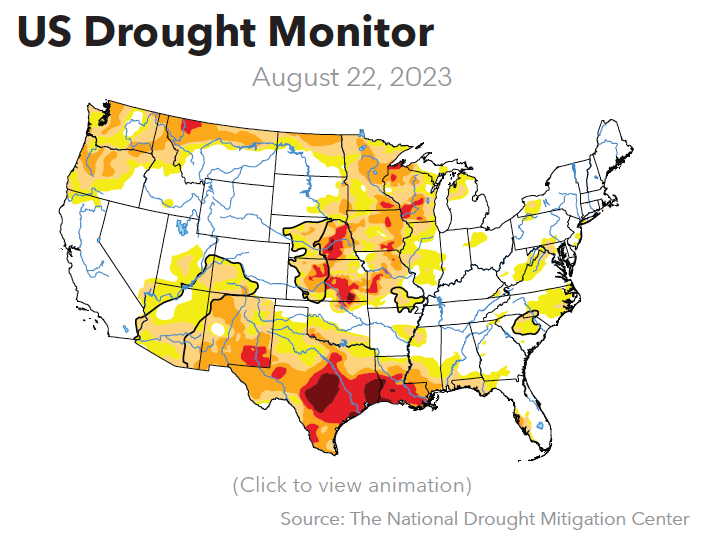
US Drought Monitor

Scattered rains across the Eastern Cornbelt were followed by clear skies and temperatures in the 60s and 70s as the week progressed. Northern Ohio was bracing for more moisture over the coming weekend, with highs falling to the 40s and 50s.

The regional corn harvest was tracking equal to or slightly behind the average pace, with progress as of Oct. 15 estimated at 52% complete in Illinois, 30% in Indiana, and 17% in Ohio. The soybean harvest was ahead of schedule at 61% complete in Illinois, 52% in Indiana, and 49% in Ohio.

Ohio remained the region’s garden spot, with fully 81-87% of the corn and soybeans rated as good or excellent at mid-month, compared with 67% in Indiana and 56-60% in Illinois.

Western Cornbelt:

Last week’s rains contributed to a reduction in drought conditions across Iowa. Although nearly the entire state remained in drought ranging from moderate to extreme at mid-month, the areas of exceptional drought were no longer evident in the Oct. 19 US Drought Monitor.

Favorable fall weather aided the region’s harvest activities at mid-month, with harvest progress tracking ahead of average for most crops. The corn harvest as of Oct. 15 was 65% complete in Missouri and 42-44% complete in Iowa and Nebraska, with good or excellent ratings assigned to 51% of the acreage in Iowa and Nebraska and 33% in Missouri.

The soybean harvest had jumped to 70-74% complete in Iowa and Nebraska, compared with 46% in Missouri, with 42-48% of the regional crop rated as good or excellent. Growers also had 90% of Missouri’s rice and 45% of the state’s cotton in the bin by Oct. 15, with 57% of the cotton crop rated as good or excellent. Nebraska’s sorghum harvest was 35% complete with 59% of the crop rated as good or excellent.

California:

Corn Wheat Soybean Index

Harvest activities continued in California under favorable weather conditions. The state was almost entirely drought-free as of Oct. 19 following one of the wettest years on record.

According to the Western Regional Climate Center, California received 141% of its average annual rainfall for the Oct. 1 to Sept. 30 water year, its 10th wettest year since record keeping began 128 years ago. California’s snowpack this spring reached the deepest level recorded in at least 40 years. The surplus precipitation was fueled by back-to-back atmospheric rivers last winter and the heavy rainfall from Hurricane Hilary in August.

California’s cotton harvest was 10% complete as of Oct. 15, with 95% of the crop rated as good or excellent. Growers were also harvesting corn for silage, as well as rice, dry beans, and sunflowers in the Sacramento Valley. The harvest of a variety of fruit crops also continued, as did harvest activities on almonds, pistachios, and walnuts.

Pacific Northwest:

Pleasant weather was reported across much of the Pacific Northwest during the week, with only spotty rainfall and mostly clear, sunny skies.

The harvest of small grains and potatoes was mostly complete in the region by mid-October. Idaho growers had 31% of the sugar beets picked by Oct. 15, while winter wheat planting had progressed to 84-87% complete in the region.

Western Canada:

The fall harvest was starting to wind down in Western Canada and fall fertilizer application was going strong.

Manitoba’s overall harvest progress was 90% complete by mid-month, ahead of the average pace, with canola rated at 94% complete, soybeans at 81%, dry beans at 98%, flax at 54%, and sunflowers at 22%.

In Saskatchewan, the canola harvest was 90% complete, with soybeans and flax estimated at 68% complete across the province. Alberta farmers were approximately 88% finished harvesting all crops, with only a few acres of potatoes, flax, and canola left.

Transportation

US Gulf:

Ongoing gate repairs at Algiers Lock will block navigation through the site until Dec. 1. Tows are detouring through the Port Allen Route during the closure, adding an estimated 24-48 hours to transit times. The project, needed to repair damage from a July vessel collision, began on Oct. 2.

Bayou Sorrel Lock is shut from 7:00 a.m. to 4:30 p.m. daily for guidewall repairs. Extended wait times have forced lock operators to delay morning closing hours, however, allowing any vessel that arrived before 4:30 p.m. the prior day to complete the locking process. The Corps announced plans to suspend restrictions entirely at the site once wait times reach the 24-hour mark. The project is scheduled to run into March 2024. Delays topped out at 17 hours during the week.

Harvey Lock returned from an extended shutdown on Oct. 16, with intermittent 7-21 hour delays reported. Length and width restrictions will continue as long as the risk of reverse head conditions remains, sources said, limiting tows to 300-foot lengths and 70-foot widths during periods of low positive head conditions. Harvey had been shut to navigation since June 15.

Brazos Lock is offline from 7:00 a.m. to 7:00 p.m. daily through Nov. 29, with waits noted up to 20 hours. Dredging at Bayou Chene, in progress through Nov. 30, forced slow-travel warnings in the area.

Sources reported considerable delays at Port Allen Lock, largely due to excess traffic from the Algiers Lock shutdown. Wait times were posted at 2-4 days on Oct. 19 with 52 tows in the queue. Industrial Lock waits ran up to 23 hours. Delays to vessel berthings in the Gulf continued due to slowdowns in the Panama Canal.

Mississippi River:    

Historic low water levels reported on sections of the Mississippi River forced slowdowns and capacity reductions during the week, sources said.

The river gauge at Memphis, Tenn., fell to a record (-)11.85 feet on Oct. 16, surpassing the prior (-)10.81-foot record set on Oct. 21, 2022. Restrictions on loading drafts were hiked to 25-30% of capacity on both north- and southbound travel between Cairo, Ill., and Vicksburg, Miss., while loading weights were reduced by 20-25% between Vicksburg and the Gulf. Vicksburg depths were posted at a low-stage (-)0.92 feet on Oct. 19.

Towing widths were reduced to five barges between Cairo and Mile 303 of the lower river, down from the typical 6-8 barges, depending on horsepower, adding an estimated 48-72 hours to transit times.

Dredging was reported at Miles 742, 480-481, 437, 293, and in the Baton Rouge, La., harbor during the week, with intermittent 24-hour shutdowns noted at Miles 742 and 437. One-way traffic restrictions were in place at Miles 924-926 and 920-921 due to multiple groundings in the area. On the upper river, dredging was noted at Miles 221, 158-159, and 38.

Low levels at St. Louis held draft restrictions to 30-35% below normal in the harbor, while tows were limited to four-barge widths between St. Louis and Cairo, off from area’s typical five barges. Sources reported 5-10% reductions in loading capacity for the mid-Mississippi River. St. Louis depths were reported at 0.44 feet at midweek, though forecasters expected a decline to (-)2.90 feet on Nov. 2.

Final releases from NOLA for upper river delivery were expected in the next several days. Most upper river locks are scheduled to close to navigation between Dec. 5 and March 11, 2024.

Illinois River:

Loading draft restrictions persisted at 5-10% of normal capacity on Illinois River travel due to low water levels. Dredging underway at Miles 226-228 was expected to conclude on Oct. 25. Wickets were raised at Peoria Lock and LaGrange Lock due to low water levels, forcing tows to lock through both locations. Delays ran up to nine hours at LaGrange.

Ohio River:

Draft limits on the Ohio River were reported at 9-10.5 feet, depending on location, stretching from 10-10.5 feet the week before. Low flows held Monongahela drafts to a maximum 8.5 feet, sources said.

Dredging at Miles 967-975 is scheduled through the end of the October. Southbound tows have been allowed to pass during daylight hours, while northbound tows are restricted to overnight transits.

The John T. Myers Lock main chamber is closed to navigation through Nov. 6 for repairs and maintenance, forcing detours through the secondary chamber. Delays were observed in a wide 51-84 hour range during the week.

The Montgomery Lock auxiliary chamber returned from repairs on Oct. 17. Following the reopening, the site’s main chamber closed on Oct. 17 and will remain unavailable through Nov. 22. The auxiliary chamber will shut once more on Nov. 22-26, followed by an additional main chamber shutdown on Nov. 26-Dec. 22.

Arkansas River:

The Arkansas River was effectively closed to navigation during the week due to low water levels at Montgomery Point Lock. Dredging to restore movement through the site was expected to begin on Oct. 21.

ICL Business Activities Continue to Function After Attack; Concerns Raised Over Potash Supply

ICL Group Ltd. said its business activities continue to function following the deadly attack on Israel from Hamas, and that it remains committed to its customers from a business perspective “while acknowledging the toll of the circumstances on all involved,” as cited by a Dow Jones report.

ICL has production assets in southern areas of the country that have been affected by the recent events, but on Oct. 9 said there was no impact on its production or exports.

The Port of Ashdod, just 20 miles north of the Gaza Strip and a key hub for ICL’s potash exports, is in emergency mode as a result of the escalating conflict. This is putting as much as 3% of global potash supply at risk, according to Scotiabank analyst Ben Isaacson, as cited by a Bloomberg report.

ICL in August said it was targeting the production of 4.7 million mt of potash this year and was expecting its third- and fourth-quarter potash sales volumes to be “relatively similar” to the second quarter, when it sold 1.26 million mt (GM Aug. 11, p. 27).

Some freight insurers on Oct. 9 suspended coverage in Israel and Palestine on the transport of freight and on third-party civil liability policies following Israel’s declaration of war on Hamas, according to a notice from Grupo Raminatrans, an international logistics company.

Several fertilizer stocks saw significant jumps earlier in the week as Wall Street weighed the prospect of potash supply problems stemming from the Middle East crisis. Nutrien Ltd., the world’s biggest potash producer, rose as much as 4.2%, the most since July, according to Bloomberg.

CF Industries Holdings Inc., the leading nitrogen producer, gained as much as 6.2%, the most in a month. Mosaic Co. climbed as much as 6.7%, the stock’s biggest intraday gain in almost a year.

The potential involvement of Iran, a key Middle East exporter of nitrogen, could lead to a spike in nitrogen fertilizer prices due to limited supply and potential premiums in benchmark Dutch TTF natural gas, Isaacson warned.

TTF natural gas futures reached their highest level since mid-June after Israel on Oct. 8 ordered the shutdown of the Tamar gas field in the Mediterranean Sea, citing safety concerns amid the escalating conflict. Halting the Tamar field resulted in a roughly 20% reduction of Israel’s gas shipments to Egypt, according to Bloomberg.

So far, the larger Leviathan gas field, which also supplies gas to Egypt, is continuing to operate. Should Leviathan keep operating at normal rates and output is ramped up at the Karish field, Israeli gas should continue to flow to Egypt, Bloomberg reported, citing Energy Aspects Ltd. analyst Leo Kabouche.

Kabouche said the key unknown is the duration of the outage, adding that Israeli gas is critical to feedgas availability in Egypt given the slide in domestic production there.

There already are concerns that the halt in supplies from Tamar will further impact Egypt’s ability to export LNG. Egypt’s oil minister said last week that the country will resume exports of LNG this month following a break over the summer. But the stoppage at Tamar could result in lower shipments to buyers in Europe, who are increasingly reliant on alternatives to Russian natural gas.

Iran’s possible involvement in the conflict could also endanger movement of vessels though the Strait of Hormuz, through which one third of traded liquefied natural gas passes, Kabouche said.

Kenyan Green Ammonia Plant in Start-Up Mode; Iowa Facility Planned with Landus Cooperative

The world’s first commercial modular green ammonia plant is starting up in Kenya and the company behind the technology plans to deploy the facilities as far away as Iowa’s Landus Cooperative in Des Moines, according to a Bloomberg report. 

The Kenyan plant, which was designed and will be run by US-based Talus Renewables, Austin, is sited near Naivasha just outside Kenya’s capital, Nairobi. Under a 15-year offtake agreement, Talus will supply Kenya Nut Co. Ltd., which grows a variety of crops.  

It uses electricity, which in Kenya Nut’s case will be supplied from an onsite solar farm, to split water atoms, freeing up hydrogen to be mixed with nitrogen to create the fertilizer. By doing so it removes the need for the fertilizer to be imported from countries like Russia, cutting costs, securing supply, and reducing emissions of climate-warming gases. 

“The average bag of fertilizer in sub-Saharan Africa travels 10,000 kilometers,” Hiro Iwanaga, Talus’ Founder, said in an interview. With this plant “you can locally produce a critical raw material, carbon free,” he said.

While the plant at Kenya Nut is small, producing 1 mt/d of fertilizer, the company plans to eventually have Talus produce 200 mt/d from larger plants on its sites to supply 95% of its needs, said Graeme Rust, Kenya Nut’s CEO.

The plants currently come in two sizes, the one deployed at Kenya Nut and a 10 mt/d facility. The larger ones need about 11.5 megawatts of power. Iwanaga said the company is currently raising money in a funding round and plans a larger one next year, which will include securing project finance.

Talus also reported that it has an agreement with Landus Cooperative. Landus lists Talus as one of the cooperative’s Innovation Connector Partners for the 2023 season.

“The green ammonia that Talus’s systems produce is both reliable and locally produced, which reduces costs by addressing supply chain insecurity and challenges,” said Matt Carstens, Landus CEO and President. He added that green ammonia is “an exciting innovation to consider.”

Talus is seeking to set up its plants in a number of locations across Africa such as sugar plantations. It also plans to work with mining companies to make the ammonia used in blasting. 

Talus reports that representatives from Yara Africa & Asia, USDA, and the US Agency for International Development were recently onsite at the Kenyan plant. “We had the chance to show off our technology and talk about the unprecedented opportunity it presents for difficult-to-decarbonize industries like agriculture,” Talus said.

IFC Green Loan to Fund Solar Plants for OCP Low-Carbon Fertilizer Production

The International Finance Corp. and Morocco’s OCP Group on Oct. 10 announced a green loan to fund construction of solar power plants to produce low-carbon fertilizer. IFC will provide OCP with a €100 million green loan towards the €360 million construction of two solar power plants that will provide clean energy to its operations in the Moroccan mining towns of Benguerir and Khouribga.

The plants will have a combined capacity of 400 megawatts peak (MWp) and up to 100 megawatt hours (MWh) of battery storage, making this the first large scale solar photovoltaic project with integrated storage infrastructure in Morocco, and the largest in North Africa. The power generated by the plants will be environmentally friendly with zero carbon emissions, and more cost-effective than grid electricity during both daytime and evening peak periods.

A green loan is a form of financing for eligible projects that contribute to environmental objectives such as climate change mitigation or adaptation.

“Today’s agreement is a major milestone towards our target of using 100% renewable energy in our fertilizer production by 2027,” said OCP Group Chairman and CEO Mostafa Terrab. “Our deepening collaboration with IFC reflects our alignment on the urgency of addressing the global challenges of food security and climate change simultaneously.”

The announcement marks IFC’s second green loan to OCP this year. In April, as part of the first phase of OCP’s 1.2 gigawatts peak (GWp) solar program, IFC provided a €100 million loan for the construction of four solar power plants, also in Benguerir and Khouribga, for a combined capacity of 202 MWp.

OCP’s solar program is implemented by OCP Green Energy SA, a wholly owned subsidiary of OCP created in 2022 to develop the company’s renewable energy generation activities. It is part of OCP’s $13 billion Green Investment Program.

The program will also leverage the expertise of INNOVX, a multi-sectorial venture platform launched by Mohammed VI Polytechnic University (UM6P) that is dedicated to building innovative and sustainable businesses and ecosystems with a strong local impact.

IFC said the project aligns with its Global Food Security Platform, a $6 billion financing facility launched in 2022 to strengthen the private sector’s ability to respond to the food crisis and help support the sustainable production of food.

FuelPositive Awarded C$1.9 M in Government Funding for Green NH3 System

Clean technology developer FuelPositive Corp., Waterloo, Ont., on Oct. 10 announced that it will receive a funding grant of up to C$1.9 million through the Research and Innovation Stream of the Agriculture Clean Technology (ACT) Program, delivered by Agriculture and Agri-Food Canada (AAFC).

AAFC has made the commitment to FuelPositive’s “Green NH3 Demonstration Phase Project” in support of the commercialization of the FP300 Green Ammonia system.

“This funding will accelerate getting the FP300 system to market,” said Jeanne Milne, FuelPositive’s Senior Government Relations Advisor. “Our iterative technological approach allows FuelPositive to adapt to meet farmers’ needs. The Government of Canada’s vote of confidence is a testament to our shared dedication and commitment to make agriculture cleaner and Canada healthier.”

The Green Ammonia Demonstration Phase consists of building and testing three demonstration systems. The FP300 on-farm, containerized green ammonia plants produce 300 kg per day, or more than 100 mt/y, of anhydrous ammonia. The company plans to deliver the first batch of commercial systems beginning in 2024 (GM June 2, p. 26).

FuelPositive’s decentralized Green Ammonia system consists of a nitrogen generator to produce nitrogen from the air, an electrolyzer to produce hydrogen and oxygen from water, and a patent-pending Green Ammonia synthesis converter that operates with sustainable sources of electricity, eliminating the need for fossil fuels.