All posts by hlancey@bloomberg.net

Ammonium Thiosulfate

Eastern Cornbelt:

The ammonium thiosulfate market remained at $245-$270/st FOB in the Eastern Cornbelt, with the low reported at Terre Haute, Ind., and the high out of inland terminals in Ohio. The Cincinnati market was steady at the $255/st FOB level in mid-September.

Western Cornbelt:

Ammonium thiosulfate was unchanged at $225-$260/st FOB in the Western Cornbelt, with the low reported at Waterloo, Iowa.

Northern Plains:

The latest ammonium thiosulfate offers in the Northern Plains were quoted at $260-$280/st FOB.

Great Lakes:

The ammonium thiosulfate market in mid-September remained at $285-$300/st FOB in the Great Lakes region.

NPKS

Poland:

Grupa Azoty said it produced an estimated 54,000 mt of compound fertilizers in August, up from 47,000 mt in July. The company’s production of specialty fertilizers was just 9,000 mt in August compared with 22,000 mt in July, according to a Sept. 12 statement.

Sulfate of Potash

US Imports:

SOP imports for July moved 5.5% lower year-over-year, to 3,366 st from 3,564 st. Imports from Canada totaled 3,002 st, ahead of 127 st from Germany, while Taiwan sent 66 st.

US Exports:

July SOP exports were noted at 1,221 st, a 70.1% decrease from the year-ago 4,083 st. Mexico purchased 912 st of US product in July, followed by Canada with 134 st, and Costa Rica with 100 st.

Crops/Weather

Eastern Cornbelt:

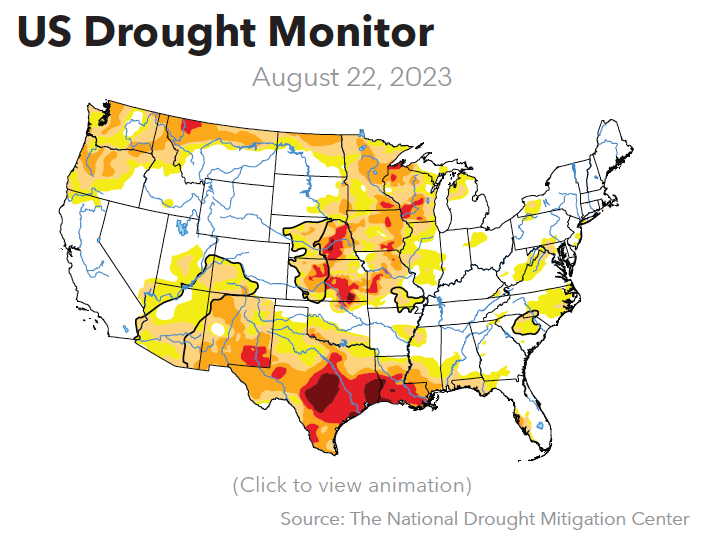
US Drought Monitor

After spotty showers earlier in the week, dry weather and cooler temperatures settled in for most of the Eastern Cornbelt in mid-September. Highs in the mid-70s were reported at midweek in Illinois and Indiana, with lows dropping to the 40s in central and northern Ohio.

Illinois growers had 2% of the corn harvested by Sept. 10, with 42% of the crop rated as mature. Crop maturation was lagging in Indiana and Ohio, where just 11-12% of the corn was mature by that date. USDA rated fully 75-82% of Ohio’s corn and soybeans as good or excellent on Sept. 10, compared with 65% in Indiana and 58% in Illinois.

Western Cornbelt:

Cooler weather moved into much of the Western Cornbelt during the week, with parts of Iowa picking up needed rain showers as the week began.

Several Iowa locations received more than two inches of rain on Sept. 10, including Centerville, Eldon, Allerton, and Promise City. Des Moines received nearly an inch as the system worked through the state, with Iowa City posting just above a half-inch of rain. Temperatures hit the high-70s and low-80s across the state for the balance of the week.

With 38-51% of the regional corn crop mature by Sept. 10, USDA assigned good or excellent ratings to 51% of the acreage in Nebraska, 46% in Iowa, and 35% in Missouri. Iowa growers had 9% of the corn crop in the bin by Sept. 10, compared with 2% in Missouri and Nebraska.

Some 44-46% of the regional soybean crop fell in the good or excellent categories at mid-month, along with 80% of Missouri’s rice, 60% of Nebraska’s sorghum, and 67% of Missouri’s cotton crop. Missouri’s rice crop was 14% harvested by Sept. 10, while 16% of Nebraska’s sorghum was rated as mature.

Northern Plains:

Corn Wheat Soybean Index

After a sunny week with highs in the 80s, central Minnesota was bracing for spotty showers on Sept. 14-15. Similar conditions were reported in South Dakota, where western areas of the state were expecting a 60% chance of rainfall and lows dipping into the 50s late in the week.

All of Minnesota remained locked in drought, with a broad swath of severe-to-extreme drought stretching across the midsection of the state from north to south. Drought conditions also covered the northern half of North Dakota at mid-month.

Just 1% of the corn in Minnesota and South Dakota was harvested by Sept. 10, with good or excellent ratings assigned to 39% of the acreage in Minnesota, 41% in South Dakota, and 66% in North Dakota. South Dakota’s sorghum crop was 55% good or excellent, while soybeans in those two categories totaled 43-51% of the regional crop.

The harvest of oats, spring wheat, and barley had progressed to 99-100% complete in South Dakota, 94-98% in Minnesota, and 82-93% in North Dakota as of Sept. 10.

Great Lakes:

Sunny weather was reported across Michigan and Wisconsin during the week, with highs in the 70s. Parts of Michigan reported scattered showers during the week, and the state was largely drought-free in mid-September. Drought was widespread in Wisconsin, however, with severe-to-extreme drought covering much of the state.

The regional corn crop was 10-16% mature as of Sept. 10, with good or excellent ratings assigned to 56% of the acreage in Michigan and 50% in Wisconsin. Soybean conditions were similar, with 53% of Michigan’s crop and 47% of Wisconsin’s rated as good or excellent.

Northeast:

Parts of New England were under a tropical storm warning late in the week as the remnants of Hurricane Lee were expected to bring damaging winds, heavy rain, flooding, and power outages to the region.

A flash flood warning was also in effect for parts of Maryland at midweek, but the major impact from Lee was expected north of the Mid-Atlantic region, from Rhode Island to Nova Scotia. A tornado was confirmed in Connecticut on Sept. 13.

Corn conditions continued to excel in Pennsylvania, thanks to plenty of moisture and heat units this summer. Fully 80% of the state’s acreage fell in the good or excellent categories on Sept. 10, with 4% of the acreage rated as mature. “A lot of the corn for silage is off as it dried down quickly with the hot dry weather,” said one contact.

Transportation

US Gulf:

Leland Bowman Lock operators continued to enforce two-hour wait times between lockages due to low water levels, leading to 24-56 hour delays. A reported 33 tows were queued to pass the site on Sept. 14.

Reverse head conditions kept Harvey Lock closed for the week, sources said. Daytime shutdowns began on Sept. 11 in the Morgan City, La., area for bridge repairs, leaving transit unavailable at Mile 1 of the Port Allen Route between 7:00 a.m. and 7:00 p.m. through Sept. 25.

A planned repair closure at Algiers Lock was pushed back to Oct. 2 and will run through Dec. 1. Guidewall work at Bayou Sorrel Lock, underway through March 2024, slowed navigation from 7:00 a.m. to 4:00 p.m. daily.

Brazos Lock repairs, reported blocking travel daily between 7:00 a.m. and 7:00 p.m., resulted in delays up to 23 hours. The project is scheduled through Nov. 29. Dredging at Bayou Chene, set to run through Nov. 30, prompted ongoing slow-travel warnings in the area.

Port Allen Lock waits ran up to five hours during the week, according to Corps data, while intermittent 20-hour waits were observed at Industrial Lock. Travel delays reported up to two weeks or more in the Panama Canal could continue into mid-2024 due to drought conditions, according to reports.

Mississippi River:   

Low-water conditions on the Lower Mississippi River intensified during the week, sources noted, forcing tighter towing restrictions. Loading drafts on northbound tows traveling between the Gulf and Cairo, Ill., were reduced by 25-30%, increasing from 20% one week earlier. Tows traveling downriver saw draft reductions of 20-25%, up from 15-20% at last report.

In addition, maximum barge counts were reduced by 15-40% on the lower river, depending on location and vessel horsepower, jumping from 10-15% noted previously. Altogether, the restrictions stretched delivery windows by 48-72 hours, above last week’s 24-48 hours.

Drafts continued to be reduced by 15% in the St. Louis area as well as on travel between St. Louis and Cairo. Towing widths were limited to four barges on the mid-Mississippi.

The river gauge at Vicksburg, Miss., was reported at a low-stage (-)2.37 feet and falling on Sept. 14, while the Memphis, Tenn., gauge returned a low-stage (-)10.22-foot reading. On the upper river, St. Louis was recorded at (-)3.47 feet and holding steady on Sept. 14.

Following numerous reported groundings, several dredges were working on the lower river, including at Miles 527-538 and 925-928, with delays reported at 24-36 hours through both locations. Dredging was expected in the Vicksburg area starting on Sept. 16.

Upper-river locks are scheduled to begin closing for the winter navigation season on Dec. 5, with spring reopening projected to commence on March 5-11, 2024. Barges destined for Clinton, Iowa, or higher are expected to conclude 2023 departures from NOLA during the first week of October, while cargoes delivered to ports below Clinton will continue loading into the third week of October. Locks 18-27 are scheduled to remain open throughout the winter season.

Illinois River:

Draft reductions on the Illinois River continued at 15% due to low water levels. Wickets at both Peoria Lock and LaGrange Lock were noted in the raised position during the week, forcing tows to lock through both locations.

Repairs and maintenance at Brandon Road Lock, Dresden Island Lock, and Marseilles Lock are scheduled through Sept. 30, closing the river to commercial navigation.

Ohio River:

Maximum loading drafts remained at 10.0-10.5 feet on the Ohio River due to low water levels. Monongahela River drafts were capped at 8.5 feet.

Sources reported a temporary shutdown at Miles 967-975 during the week due to dredging. The area was partially reopened by Sept. 13, allowing southbound vessels to run during daytime hours and northbound tows to pass overnight. The project is tentatively scheduled through Sept. 24.

The John T. Myers Lock auxiliary chamber returned from miter gate repairs on Sept. 10, sources said. The main chamber subsequently closed on Sept. 11, forcing detours through the newly reopened auxiliary chamber until Nov. 17. Waits were reported up to 17 hours.

The primary chamber at Montgomery Lock is closed for repairs and maintenance through Sept. 25. Travel through the secondary chamber will be unavailable on Sept. 25-Oct. 17 and Nov. 22-26, while additional main chamber outages are planned for Oct. 17-Nov. 22 and Nov. 26-Dec. 22.

The Smithland Lock land chamber will shut from Sept. 22 through Oct. 21 for repairs, followed by a river chamber closure on Oct. 22-Nov. 20. Assist boat usage was compulsory on southbound lockages through Smithland during the week due to strong outflows.

Arkansas River:

Travel through the Port of Catoosa will be restricted to daytime hours until further notice, sources said. Joe Hardin Lock was closed for repairs on Sept. 11-15, and passage through Webbers Falls Lock was scheduled to be unavailable on Sept. 11-17.

Itafos Inks MAP Sales/Offtake Agreement with Simplot

US phosphate and specialty fertilizer producer Itafos Inc. announced on Sept. 7 that it has entered into an agreement with J.R. Simplot Company under which Itafos will sell 100% of the MAP produced at its Conda, Idaho, manufacturing facility to Simplot. The offtake agreement will begin on Jan. 1, 2024, with a five-year term.

The new offtake agreement replaces an earlier one that Houston-based Itafos had with Nutrien Ltd. Itafos agreed in 2018 to pay $100 million for the Conda Phosphate Operations from Agrium Inc., a wholly owned subsidiary of Nutrien. The sale was required by the US Federal Trade Commission as a condition for its approval of the merger of Agrium and Potash Corp. of Saskatchewan (GM Jan. 19, 2018).

As part of the 2018 deal, Agrium and Itafos entered into long-term supply and offtake agreements, with Agrium supplying Conda with 100% of its ammonia requirements and agreeing to purchase 100% of the MAP produced, with pricing formulas based on major phosphate benchmarks.

Itafos did not announce whether it will continue buying ammonia from Nutrien for Conda’s MAP production. Itafos also has a long-standing partnership with MacroSource (formerly Gavilon) to supply the distributor with phos acid from Conda (GM Dec. 6, 2019). No mention was made of the Gavilon agreement in Itafos’ announcement.

Itafos reported earlier this year that its Board of Directors had commenced a process to explore various strategic alternatives to enhance value, including a merger with another strategic partner, the sale of the company, and a recapitalization or continued execution of the company’s long-term business plan (GM March 17, p. 1).

Itafos puts Conda’s phosphate production capacity at 550,000 mt/y, which includes MAP, MAP with micronutrients, superphosphoric acid, merchant-grade phosphoric acid, and ammonium polysulfate. Approximate MAP capacity has been put at 340,000 /mt/y, with 170,000 mt/y for the other phosphate products. The company also has hydrofluorosilicic acid capacity of approximately 27,000 mt/y (GM July 1, 2022).

Boise-based Simplot has phosphate production capacity of 500,000 mt/y at its Rock Springs, Wyo., facility, 450,000 mt/y at its Pocatello, Idaho, plant, and 100,000 mt/y at its production site in Lathrop, Calif., according to the Green Markets database.

Genesis Eyes Tisdale for Fertilizer Distribution Center

Saskatoon-based Genesis Fertilizers LP announced last month that it is working with Invest Tisdale and local industry to create a future fertilizer distribution center at the newly established agricultural industrial park in Tisdale, Sask.

If completed, this would be one of seven “SuperCenters” that Genesis has planned for Western Canada. The first was in Belle Plaine, Sask. (GM June 11, 2021; Feb. 3, 2017).

Genesis said the new location presents an opportunity to streamline the storage, blending, and direct distribution of fertilizer to farmers across northeast-central Saskatchewan, with potential expansion into western Manitoba. It said the town’s status as a transportation hub, offering road-to-rail connectivity linking national rail companies and primary truck routes in all directions, positions it as an attractive location for companies aiming to grow their presence and export across North America and the world.

“Tisdale is a good fit for Genesis Fertilizers due to its access to railways, vibrant agricultural community, and proactive business engagement,” said Terry Drabiuk, Vice President of Business Development at Genesis Fertilizers.” He added that the location will be an advanced fertilizer distribution hub, capable of loading a significant quantity of blended product in under eight minutes, and it will employ cutting-edge technologies, including automation, to minimize loading and unloading times. An indoor loading facility is also being planned to ensure product quality even in extreme weather conditions.

Genesis plans to host an open house in Tisdale following the 2023 harvest season, providing farmers an opportunity to engage with the company’s leadership team and agri-business experts, to deepen their understanding of the project.

Genesis in 2021 leased land for a SuperCenter in Rycroft, Alta. (GM Oct. 22, 2021). Genesis on Jan. 11 announced that it has chosen Belle Plaine as the site for its long-proposed 700,000 mt/y $1.7 billion urea plant (GM Jan. 13, p. 1). The project will also include ammonia production to supply the urea plant.

Farmers of North America (FNA) launched Genesis in October 2014 (GM Oct. 27, 2014) as the vehicle through which its farmer members could pledge funds to develop the new distribution business. Genesis is similar to the limited partnership that FNA created in 2012 to fund the development of ProjectN (GM Oct. 1, 2012), an earlier proposal for a nitrogen fertilizer production facility in Belle Plaine.

Genesis is a privately held limited partnership, and its securities do not trade on any exchange.

Co-Alliance Showcases $15 M Upgrade in Indiana

Indianapolis-based Co-Alliance Cooperative Inc. welcomed some 100 farmers on Aug. 28 for a tour of the $15 million in upgrades at its Mt. Summit facility in Henry County, Ind. Co-Alliance said some 16 agronomy locations in east central Indiana will benefit from this improved technology.

The upgrades include a dry fertilizer hub that will hold 26,000 st and should be completed and operational by the end of October 2023, providing supply for local growers and other Co-Alliance retail locations in the eastern Indiana trade area. 

The hub will service farmers in a 45-60 mile radius of New Castle, Ind., and has two rail spurs and the capacity to unload 400 st/h. A state-of the-art mixing system on the blend tower allows the loading of a semi in under eight minutes. 

In addition, the upgrades include a new liquid terminal, which Co-Alliance said will provide faster, more efficient, and environmentally friendly product distribution to farmers within a 25-mile radius. It will also eliminate human error and afford the grower precise mixing capabilities. Herbicides, insecticides, and fungicides will all be housed and distributed through the facility.   

“We are very excited to be able to show off these new assets to help our team better service and support our farmer-owners,” said Kevin Still, Co-Alliance President and CEO. “At Co-Alliance, we understand that we must grow with our customers. Our growers are covering more acres, more quickly, in a more complex marketplace. We must meet their needs today and prepare for their needs of the future. This investment in east central Indiana is proof of that commitment.”  

Still also highlighted a new feed mill under construction in Millville, Ind., which will have 1.5 million bushels of grain storage and the capacity to produce 300,000 tons of pelleted hog feed. The mill will need to source 6 million bushels of corn each year from local farmers. He said when all the projects are completed, the cooperative will have added 30 new agriculture-based jobs to the workforce of Henry County.

On Aug. 25, Co-Alliance and Ceres Solutions Cooperative, Crawfordsville, Ind., announced they are pursuing a three-month due diligence (GM Sept. 1, p. 1).