

| 7/15/2022 | Last Week | |
| Memphis | 15.50-17.50 | 14.00-16.00 |
| St. Louis | 16.50-17.50 | 15.00-16.00 |
| Peoria | 21.50 | 20.00 |
| Cincinnati | 23.00-23.50 | 21.50-22.00 |
| St. Paul | 24.00-26.00 | 22.50-24.50 |
| Catoosa/Inola | 27.00-28.00 | 25.50-26.50 |
All posts by hlancey@bloomberg.net
CommoditAg Acquired by Farmers Edge
Online farm inputs retailer CommoditAg, Effingham, Ill., has been purchased by Farmers Edge Inc., a pure-play digital agriculture company based in Winnipeg, Man., according to an Aug. 12 announcement from Farmers Edge.
The purchase price was reported at US$4.6 million of cash on closing, normal closing adjustments, and an earn-out to a maximum of US$7.2 million of additional cash based upon the business meeting certain performance targets over the next three years. Under terms of the deal, CommoditAg will function as a wholly-owned subsidiary of Farmers Edge, led by the existing CommoditAg leadership team.
“We are thrilled to join a company that shares our vision and mission,” said John Demerly, CommoditAg CEO. “Farmers Edge brings together all parties in the supply chain to the digital ecosystem, so farmers get seamless, transparent, and secure connections to their vendors and trusted advisors. We look forward to growing together, bringing new digital capabilities to the market, and driving innovation that supports our customers’ success.”
Subscription-based Farmers Edge said the acquisition will allow it to expand and diversify its revenue, while also significantly expanding its roster of services to growers and advancing the company’s connected digital ecosystem strategy. At the company’s Aug. 13 earnings call, Board Chair R. William McFarland said the acquisition accelerates acre growth in the U.S. and will add new customers to the company’s Progressive Growers Program and capabilities to the FarmCommand digital platform.
“As a farmer myself, I know how important relationships with vendors are in the agriculture business,” said Wade Barnes, Farmers Edge CEO and Founder. “CommoditAg is a trusted marketplace that thousands of farmers rely on every day, and we are incredibly excited to welcome them to the Farmers Edge family. By combining its robust e-commerce solution with the FarmCommand platform, we can deliver a best-in-class omnichannel experience, bring more value to our customers, reach a wider footprint, and accelerate Farmers Edge growth.”
Farmers Edge was founded in 2005 as a digital agriculture company that uses connected field sensors, artificial intelligence, big data analytics, and agronomic expertise to provide growers with field-level analysis and predictive modeling on its FarmCommand digital platform.
The company launched an initial public offering in March, and continues to add Digital Agronomy acre subscriptions, mostly through its Progressive Grower Program, which does not add revenue until a one-year free period expires. Over the first six months of 2021, Farmers Edge said it added 2.4 million new Digital Agronomy acres in North America, 0.5 million new Digital Agronomy acres in Brazil, and 0.2 million in Australia.
Since its launch in December 2017 (GM Jan. 8, 2018) by founding partners The Equity in Effingham, Ill., and Sunrise Cooperative in Norwalk, Ohio, CommoditAg has grown its e-commerce platform to include 14 retail distribution partners with more than 500 locations in the U.S., servicing approximately 170,000 customers representing a 70-million-acre footprint.
CommoditAg’s digital platform offers a broad portfolio of more than 200 brand and products from more than 25 suppliers, including crop protection, seed, fertilizer, micronutrients/biologicals, agricultural lubricants, and animal nutrition. CommoditAg currently has more than 40 local fulfillment centers covering 13 states, with plans to expand its footprint to over 75 percent coverage of the U.S. business by the end of 2021.
Farmers Edge said it and the current owners of CommoditAg are concurrently entering into agreements committing the group of partnering cooperatives, on a best-efforts basis, to provide introductions to farmers with the goal of signing at least 14.5 million new Progressive Grower Program acres to the company’s FarmCommand platform by Dec. 31, 2023. Farmers Edge said the owners will be paid a commission incentivizing them to identify strategic farmers and for the conversion of such farmers to paid acres after the one-year free period.
Farmers Edge launched a Smart Carbon program in June in Canada, and it expects to have an equivalent program for U.S. customers operational in 2022.
“The launch of our Smart Carbon program has been a significant event for the company, positioning us as a leader of aggregating agricultural carbon offsets and supporting our digital platform subscriptions,” said Barnes. “The June launch has created a lot of interest which is evident from having 1.5 million acres under contract for Smart Carbon and we expect to sign up over 1 million more Smart Carbon acres in Canada over the next couple of months. Most growers will also have access to multiple years of carbon offsets to serialize, aggregate and sell in the coming months. This program will generate significant revenue while supporting the environment. It is a win-win as growers will get a new carbon revenue stream that may exceed the cost of our top subscription fertility products.”
Farmers Edge recently released second-quarter results, showing a net loss of C$10 million ($.024 per diluted share) on revenues of $6.15 million, compared to the year-ago loss of $19 million and $9.05 million, respectively. Adjusted gross profit was a positive $3.06 million, up from the year-ago loss of $2.8 million. EBITDA was a negative $9 million, an improvement over the year-ago negative $13.5 million.
The company reported a six-month net loss of $27.3 million ($0.86 per share) on revenues of $16 million, compared to a year-ago loss of $47.7 million ($4.84 per share) and $16.4 million, respectively. Adjusted gross profit was a positive $2.7 million, up from the year-ago negative $7.9 million. EBITDA was a negative $17.4 million, compared to the year-ago negative $30.2 million.
Crops/Weather
Eastern Cornbelt:
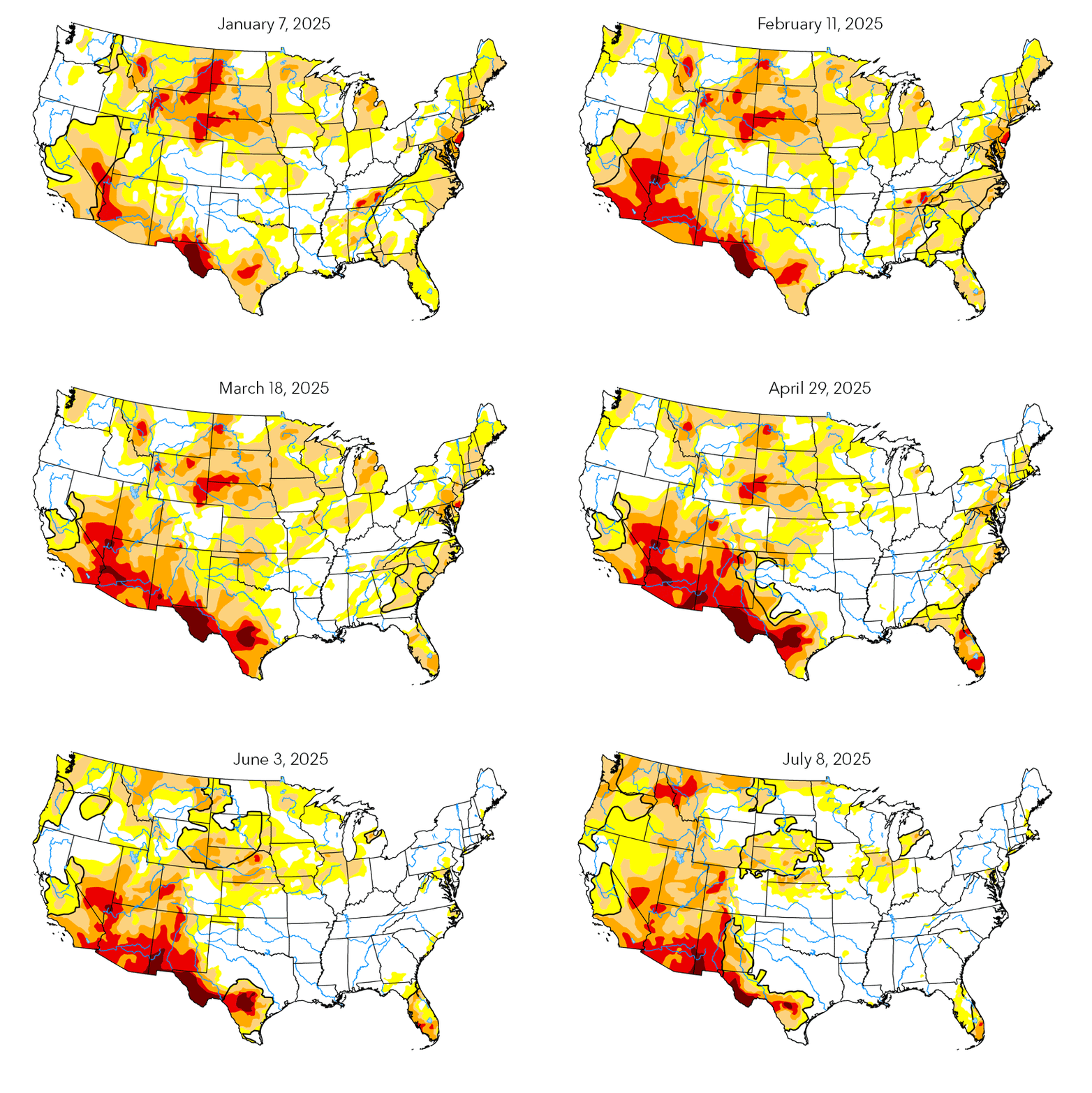
Hot, humid weather continued across much of the Eastern Cornbelt in mid-August, along with scattered thunderstorms. Heavy moisture from Tropical Depression Fred hit parts of northeastern Ohio at midweek, pushing monthly rainfall totals to more than five inches for some locations.
Highs in the mid- to upper-80s continued to benefit corn and soybeans at mid-month. USDA on Aug. 15 rated 75-81 percent of the Ohio corn and soybean crops as good or excellent, compared with 71-74 percent of the acreage in Illinois and 68-71 percent in Indiana.
Western Cornbelt:
Most of the Western Cornbelt experienced high heat and humidity in mid-August, although forecasts called for slightly cooler weather and an increased chance of showers by the coming weekend.
Midweek temperatures across Nebraska and Iowa were reported in the upper-80s to low-90s, with head index values climbing into the mid-90s. Sources also reported hazy skies in western Nebraska from wildfires burning in the western states.
Areas of severe-to-extreme drought were expanding across northern Iowa in mid-August, with much of Nebraska also experiencing some form of drought at mid-month. While crop conditions remained generally favorable in the region, ratings were down from the previous week for most crops.
USDA rated 58 percent of the corn and soybeans in Iowa as good or excellent on Aug. 15, compared with 65-67 percent in Missouri and 69-72 percent in Nebraska. Missouri’s cotton was 66 percent good or excellent, while 68 percent of the state’s rice crop fell into those two categories. Nebraska’s sorghum crop remained at 59 percent good or excellent, unchanged from the prior week.
Northern Plains:
High heat and humidity persisted across the Northern Plains in mid-August, along with a thick layer of smoke in parts of the Dakotas. Highs in Minnesota were reported in the upper-80s and low-90s during the week. Temperatures in the Dakotas climbed to the mid-90s at midweek, with heat index values near or in the low-100s.
The entire Northern Plains region was experiencing drought conditions ranging from moderate to exceptional in mid-August, with the worst drought reported across North Dakota, northern Minnesota, and north-central South Dakota. The parched conditions speeded the harvest of small grains in the region, but crop conditions were deteriorating rapidly.
Good or excellent ratings on Aug. 15 were assigned to 29-35 percent of the soybeans and corn in Minnesota, compared with 22-24 percent in South Dakota and 14-20 percent in North Dakota. The corn and soybean acreage rated as poor or very poor totaled 26-28 percent of the crops in Minnesota, 39 percent in South Dakota, and 47-52 percent in North Dakota.
Minnesota growers already had 86-92 percent of the oats, barley, and spring wheat harvested by Aug. 15, compared with 80-88 percent in South Dakota and 43-57 percent in North Dakota. USDA placed 16-19 percent of Minnesota’s spring wheat and barley in the good or excellent categories at mid-month, with 37-40 percent of the acreage rated as poor or very poor.
North Dakota’s spring wheat and barley was in considerably worse shape, with just 8-12 percent rated as good or excellent and 60-61 percent as poor or very poor. South Dakota’s spring wheat crop was just 7 percent good or excellent, with fully 73 percent of the acreage rated as poor or very poor on Aug. 15.
Northeast:
Temperatures in the 80s were reported across much of the Northeast during the week, with high humidity giving way to an increased chance of thunderstorms later in the week.
Flash flood watches were in effect for portions of central, northern, and northeastern Maryland on Aug. 17 after multiple bands of thunderstorms developed across the central and upper Chesapeake Bay coastal areas.
More rain was expected across Pennsylvania and New England on Aug. 19 as the remnants of Tropical Depression Fred pushed into the region. The storm dumped heavy rain over portions of the Florida panhandle and southern Georgia, prompting widespread flood watches. Forecasts warned of 1-2 inches possible in parts of southern and central New England, along with flash flooding.
Crop conditions remained favorable across the Northeast, thanks to plentiful rain and summer heat. Some 37 percent of Pennsylvania’s corn crop was in the dough by Aug. 15, slightly behind the average for this time of year, with fully 87 percent of the crop rated as good or excellent.
Eastern Canada:
High heat and humidity were reported across Eastern Canada at mid-month, along with an influx of moisture from Tropical Depression Fred.
Heat warnings were issued for all of the Maritimes over the previous weekend. Highs in the upper-20s C were reported in southern Ontario at midweek, with humidex values climbing to the mid- to upper-30s C. In southern Quebec, temperatures were expected to reach 30 C again late in the week, with humidex values reaching 40 C in some areas.
The remnants of Fred moved into the region at midweek, producing heavy rainfall in parts of southern Ontario and Quebec. Many of those areas have already experienced an unusually wet summer, which has benefited corn crops but hampered the harvest of winter wheat in some locations.
Data Signals


Fertilizer Futures


Dry Fertilizer Barge Rates
| 8/6/2021 | Last Week | |
| Memphis | 11.00 | 11.00 |
| St. Louis | 11.00 | 11.00 |
| Peoria | 15.00 | 15.00 |
| Cincinnati | 16.50 | 16.50 |
| St. Paul | 19.50 | 19.50 |
| Catoosa/Inola | 20.50 | 20.50 |
Data Signals


Fertilizer Futures


