

Cornbelt:
NPSZ pricing in the Cornbelt was steady at $690-$730/st FOB, depending on location.
Pacific Northwest:
The 40-Rock market remained at $780-$790/st FOB or DEL in the Pacific Northwest.
Cornbelt:
NPSZ pricing in the Cornbelt was steady at $690-$730/st FOB, depending on location.
Pacific Northwest:
The 40-Rock market remained at $780-$790/st FOB or DEL in the Pacific Northwest.
California:
The SOP market was quoted at the $640/st level FOB Stockton in mid-June.
Pacific Northwest:
The SOP market was steady at $640-$650/st FOB for the last offers in the Pacific Northwest.
California:
Granular SOP Magnesia was unchanged at $450-$455/st FOB for the latest offers in California.
Pacific Northwest:
The SOP Magnesia market remained at $440-$455/st FOB for granular tons in the Pacific Northwest, with rail-DEL offers pegged at the $450/st level on a spot basis.
California:
Potassium nitrate pricing in California remained at $1,145/st FOB Stockton for bulk, $1,240/st FOB for bulk bags, and $1,260/st FOB for 50-pound bags.
Eastern Cornbelt:
The potassium thiosulfate price continued at $680/st FOB Terre Haute, Ind.
Western Cornbelt:
Potassium thiosulfate pricing remained at $680/st FOB Waterloo in mid-June.
California:
The potassium thiosulfate market was steady at $680/st FOB Sacramento.
Eastern Cornbelt:
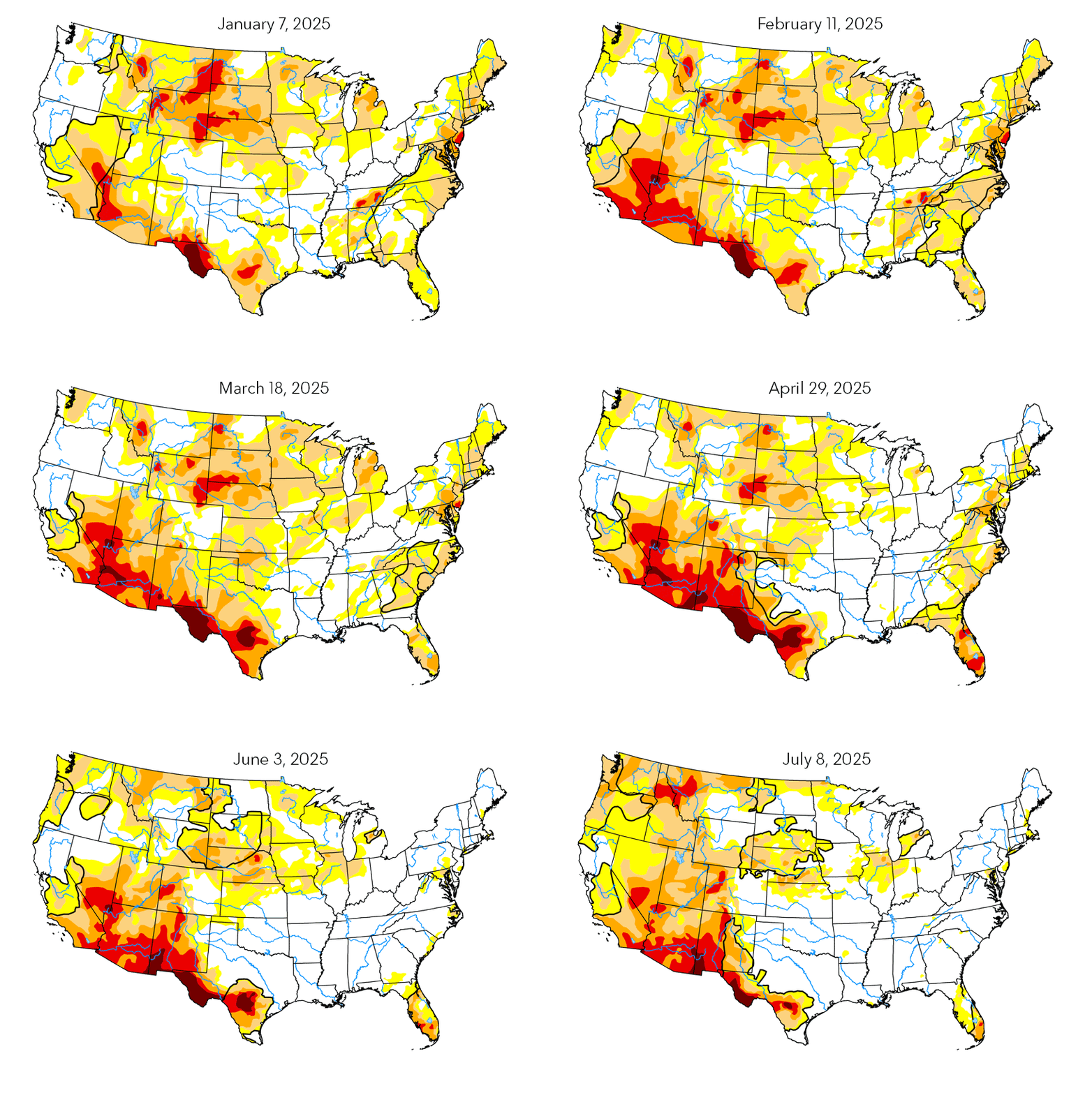
High heat and humidity sparked strong thunderstorms across northern Illinois as the week progressed, with forecasts for June 13 warning of damaging winds and hail, flash flooding from heavy rain, and possible tornado activity. Highs were approaching the 90-degree mark across much of Illinois, Indiana, and Ohio late in the week.
Corn planting had progressed to 93-95% complete in the region by June 9, with soybean planting estimated at 87-89% complete.
Western Cornbelt:
Severe thunderstorm warnings were in effect for multiple counties in eastern Nebraska and western Iowa on June 12, with reports of large hail and damaging winds that caused widespread power outages. An EF-0 tornado was confirmed near Decatur, Neb.
A second storm hit central and southern Iowa on June 13, sparked by temperatures in the 90s and heat index values approaching the triple digits. A heat advisory was in effect for parts of northern and central Missouri on June 13, with heat index values climbing to 104-105 degrees.
Corn planting was 97-98% complete in the region by June 9, with soybean planting rated at 96% complete in Nebraska, 92% in Iowa, and 79% in Missouri. Nebraska growers also had 75% of the sorghum crop seeded by that date.
California:

Hot weather blanketed much of California in mid-June, with triple-digit highs reported across the state and heat advisories in effect for multiple locations, including the Bay Area and Central Valley. The high heat reportedly sparked some strong thunderstorm activity in the Sierra Nevada in Northern California as the week progressed.
Pacific Northwest:
After heavy rain earlier in June, most of Oregon saw warming temperatures and plenty of sunshine at mid-month, with highs in the 80s as the week progressed. Gusty winds and dry conditions in eastern Washington fueled a 75-acre wildfire at midweek that forced the evacuation of dozens of homes southwest of Spokane.
Much cooler weather was expected in Idaho and Montana by the coming weekend, along with gusty winds and rain for many areas and the possibility of snow at higher elevations.
Fully 79-86% of Idaho’s spring wheat and barley was rated as good or excellent as of June 9, compared with 61-68% in Montana and 57-63% in Washington.
Western Canada:
Strong thunderstorms rolled through southern Manitoba at midweek, producing large hail and damaging winds in some locations and prompting tornado warnings, with reports of funnel clouds spotted in southwestern areas of the province on June 12.
East-central Saskatchewan and central Alberta were also in the storm’s path, with severe thunderstorms and tornado warnings posted for a wide swath of both provinces on June 11-12. Forecasts warned of large hail, damaging winds, and torrential rain in some locations.
Most of the spring planting was complete in the region, though sources said parts of eastern Manitoba have been delayed by wet weather.
US Gulf:
Bayou Boeuf Lock repairs reportedly kicked off on June 10, halting Monday-Friday travel between 7 a.m. and 6 p.m. for approximately 30 days. In addition to the weekday closures, the lock was scheduled to shut entirely from 7 a.m. on June 11 to 6 p.m. on June 14, with a repeat scheduled on June 18-21.
Ongoing repairs at Brazos Lock blocked weekday navigation between 7 a.m. and 7 p.m. Most delays fell in the 13-23 hour range, according to Corps data, though a handful of 39-52 hour wait times were also reported. The project was estimated to run through October.
Bayou Sorrel Lock guidewall repairs scheduled through Oct. 30 blocked weekday travel from 7 a.m. to 4 p.m. Delays were quoted up to 51 hours on June 13, up from 29 hours at last report.
Repair work underway at the San Jacinto River Bridge in the Houston area was projected to run into July or August. Traffic is limited to singlewide tows through the western side of the channel, while the channel’s eastern side is completely shut to navigation.
Port Allen Lock delays were reported up to 19 hours at midweek, and tows waited up to 67.5 hours to transit Industrial Lock during the week. Harvey Lock transits stretched to as high as 79 hours, and intermittent waits peaked around nine hours for both Calcasieu Lock and Colorado Lock.
Mississippi River:
High water levels at Savage, Minn., continued to force a complete stop to navigation between Savage and St. Paul, Minn., during the week, sources said. The Savage river gauge showed depths at a minor-flood 702.9 feet on June 13. Levels were forecast to fall out of the minor-flood stage on June 15 but remain above the area’s 697-foot action stage through at least June 20.
In the St. Louis area, loading drafts were capped at 11.5 feet for northbound tows while southbound drafts were permitted up to 12.5 feet.
On the lower river, high water levels continued to prompt reduced tow lengths based on location and vessel horsepower, resulting in 2-3 day delays. Tows traveling downriver were required to run a minimum 240 horsepower per standard loaded barge – up to a maximum of 36 barges – or 550 horsepower per oversized barge. Tows moving in the upriver direction were required to maintain a minimum speed of 3 mph through the bridges at Memphis, Tenn., and Vicksburg, Miss.
River levels were on the decline on the lower river. The Vicksburg gauge was posted at an action-stage 35.6 feet at midweek, with forecasts expecting a fall below action stage on June 15. Baton Rouge, La., posted at an action-stage 32.0 feet on June 13 but was projected to fall below the area’s 30-foot action-stage threshold on June 18.
Intermittent five-hour waits were reported at Lock 25.
Illinois River:
Loading drafts on the Illinois Waterway continued at a maximum 10 feet in both the northbound and southbound directions below Mile 231. Draft limits were noted at nine feet above Mile 231, however.
Sporadic 4-6 hour wait times were reported at Starved Rock Lock, and raised wickets at Peoria Lock pushed late-week wait times to nearly five hours.
Ohio River:
Maximum drafts on the Ohio River continued to be reported in the 10-11 foot range, depending on location and direction of travel, while tow lengths were permitted up to 15 barges.
Sources said primary chamber repairs underway at Hannibal Lock forced detours through the auxiliary chamber for 18 hours daily, with wait times reported up to 13 hours. The project is slated to run through Nov. 8.
Markland Lock repairs, previously scheduled to begin on June 10, were pushed back to July 8, a Corps posting indicated. Main chamber access is expected to be unavailable for 19 hours daily through Aug. 2, forcing traffic through the auxiliary chamber. The main chamber is due to close once more on Aug. 12 through Sept. 6.
Auxiliary lock machinery repairs reportedly in progress at Racine Lock are scheduled through July 11. Minimal delays were reported during the week.
The primary lock at John T. Myers Lock is projected to close to navigation between Aug. 21 and Nov. 9. A similar shutdown in October 2023 resulted in four-day delays. Both chambers at Belleville Lock are expected to go offline for 30 days apiece during the second half of the year.
Delays were posted up to 31 hours at Kentucky Lock on the Tennessee River, while tows waited as much as 20 hours to pass Wilson Lock.
Arkansas River:
The Van Buren Bridge, located at Mile 300.8 of the Arkansas River, is scheduled to close for repairs on Aug. 16-Sept. 8. Queued vessels will be cleared to pass following the ninth day of work, sources said.
Multiple industrial plants in Egypt have been temporarily idled as a heat wave grips the country, causing energy shortages and rolling blackouts that impacted petrochemical and fertilizer producers. Temperatures across the country rose to 104 F during the week and were expected to climb in the coming days.
At least six companies – Sidi Kerir Petrochemicals Co., Abu Qir Fertilizers and Chemical Industries, Egypt Kuwait Holding, Misr Fertilizers Co., Methanex Egypt, and Egyptian Chemical Industries Corp. – said on June 5 that they had idled plants as a result of fluctuating pressure in the gas network, Bloomberg reported.
The oil and electricity ministries said Wednesday that supplies to the fertilizer plants would gradually resume on June 6 after maintenance work has been completed, but the temporary closure jolted the global urea industry, pushing prices up in the Arab Gulf, Europe, Asia, Brazil, and New Orleans.
North American fertilizer equities retreated Wednesday following Egypt’s announcement that resume nitrogen output would resume at idled facilities. Bloomberg reported. CF Industries Holdings Inc. dropped 4.6% and was among the worst performers in the S&P 500 Index, while The Mosaic Co. shares fell 2.1%, Nutrien Ltd. dropped 1.6%, and Yara International’s US-listed shares fell 4.4%.
“Liquefied natural gas supply cuts are ending for Egyptian nitrogen producers, easing pressure in a market reeling from supply shocks,” Bloomberg Intelligence Analyst Alexis Maxwell said, adding that prices had been trending higher on expectations of further Egyptian shortages “which now look unlikely.”
Egypt said it expects to import more than 20 liquefied natural gas (LNG) cargoes this summer to ease energy shortages. State-run Egyptian Natural Gas Holding Co. will buy the shipments via tenders through October, a person familiar with the plan told Bloomberg, asking not to be identified because the information is private.
The LNG purchases would boost Egypt’s imports to the highest level since 2018, according to ship-tracking data. So far, the country has bought at least four shipments for delivery to Jordan, from where it is rerouted to Egypt. The demand is likely to tighten the global LNG market and drive prices higher, especially if Asia and Europe have hotter-than-usual summers.
Egypt is flush with cash from a $57 billion international bailout package that helped it avert a crisis and pushed foreign currency reserves to a record high. President Abdel-Fattah El-Sisi’s administration may have to dip into those funds to avoid a repeat of the power blackouts that gripped the nation last year and avert widespread public discontent, Bloomberg reported.
The energy shortage comes despite Egypt buying some LNG volumes earlier this year to supplement electricity generation. The country’s gas importer last month signed a deal with Norway’s Hoegh LNG to rent its Hoegh Galleon LNG floating terminal starting in June.
Authorities have already increased the price of some fuels but have yet to decide whether they’ll further lift subsidies on electricity prices.
GROWMARK, Bloomington, Ill., announced on June 4 that it has signed a letter of intent to acquire AgraForm LLC, an agrichemical manufacturing company located in St. Louis, Mo. The deal is expected to close at the end of June. Terms were not disclosed.
AgraForm provides bulk formulation, agrichemical processing, spray drying, milling, packaging, and storage services for chemical manufacturers. The company has two locations in S. Louis, one for manufacturing insecticides, fungicides, and biological products for agricultural use and another for dry storage.
“This purchase enables us to grow efficiently in these product lines while providing the opportunity to produce proprietary product offerings in the future,” said GROWMARK Chief Operating Officer Wade Mittelstadt.
“We can also strengthen our relationships with key suppliers who currently utilize AgraForm’s state-of-the-art manufacturing facilities, Mittelstadt added. “AgraForm employs a talented team and is a very well-run operation with strong commitments to safety, environmental responsibility, and customer service. GROWMARK is pleased to be part of continuing their legacy of success.”
“The AgraForm Team is extremely excited to partner with GROWMARK to couple formulation processing with distribution for additional long-term value and growth for our current clients, GROWMARK customers, and FS Cooperatives,” said Ron Cunningham, President of AgraForm.
The Fertilizer Institute (TFI) President and CEO Corey Rosenbusch on June 4 provided testimony to the House Subcommittee on Energy and Mineral Resources in support of adding phosphate and potash to the US Critical Minerals list.
The hearing focused on several bills related to critical minerals including the bipartisan H.R. 8450, the Phosphate and Potash Protection Act of 2024, introduced by Reps. Kat Cammack (R-Fla.) and Elissa Slotkin (D-Mich.).
If enacted, the legislation would direct the US Geological Survey (USGS) to conduct an immediate review to determine the need for adding phosphate and potash to the Critical Minerals list. The USGS defines a critical mineral as essential to the economic or national security of the US, susceptible to supply chain disruptions, and having significant consequences for the economy or national security if absent.
“We are here today to ensure this committee understands that phosphate and potash meet all three of those criteria and should, without a doubt, be included on the USGS list of critical minerals,” Rosenbusch said.
“Half of all global crop yields can be attributed to fertilizer, but as the world population continues to grow it is imperative that the sustainable production and use of fertilizers continues to provide the ability of growing more food without needing more land on which to grow it,” Rosenbusch testified.
“But the majority of phosphate and potash resources are concentrated in only a few countries, leaving them vulnerable to supply chain vulnerabilities and geopolitical instability,” he said. “The events of the past few years have shown us that food security is national security and now is the time to protect our nation by including phosphate and potash on the USGS Critical Minerals list.”
TFI said only 14 countries produce potash, with Belarus and Russia comprising nearly 40% of global production. While the US produces potash domestically, TFI said it imports roughly 95% of its needs. Regarding phosphate, 11 countries produce significant amounts with China accounting for more than 40% of global production.
“Without these two minerals, modern agricultural systems would crumble and the ability to feed our growing population would be nearly impossible,” Rosenbusch said. “It is vital that we take proactive steps to secure our own agricultural future by recognizing the role these minerals play in putting food on our tables.”