All posts by hlancey@bloomberg.net

Crops/Weather

Eastern Cornbelt:

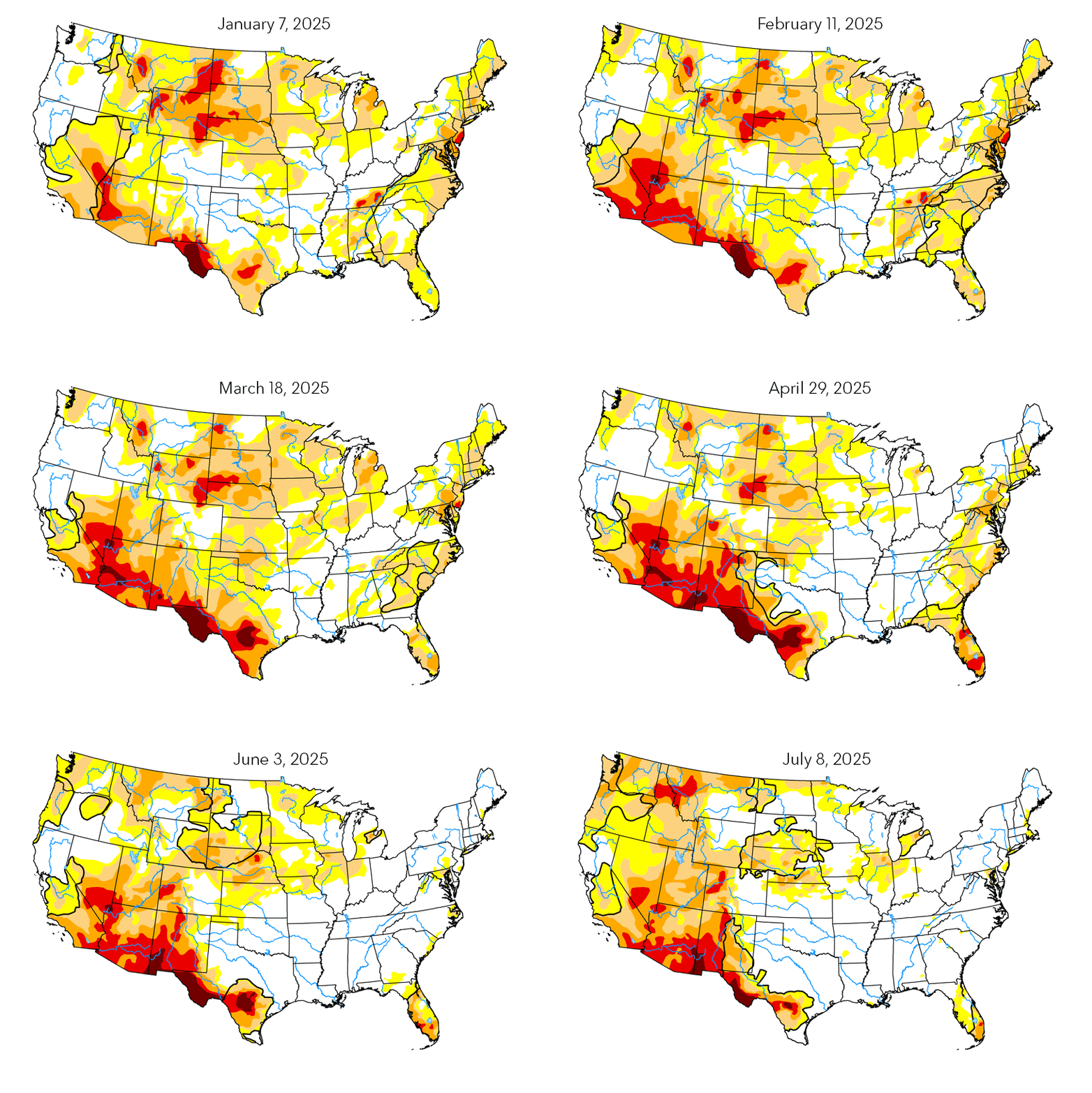
US Drought Monitor

Strong storms left thousands without power in Illinois on May 21 and prompted road closures due to blowing dust, with tornado watches in effect for multiple counties in the state. Severe weather was also reported in central Ohio on May 22, with forecasts warning of strong winds and hail.

Indiana recorded unseasonably hot and humid conditions at midweek, with highs approaching the 90s in central portions of the state.

Illinois growers had 58-67% of the corn and soybeans planted by May 16, compared with 49-54% in Indiana and 41-46% in Ohio. Planting progress in Michigan was estimated at 50% complete for corn and 42% for soybeans by that date.

Western Cornbelt:

Powerful storms churned through Nebraska and Iowa on May 21, producing large hail, torrential rains, and several deadly tornadoes.

Omaha, Neb., was hit with 90 mph winds and more than five inches of rain in less than two hours, causing flooding and widespread power outages. Iowa saw more intense tornado activity from the storm, causing multiple fatalities and leveling the town of Greenfield, southwest of Des Moines, with what was estimated as an EF-3 strength tornado.

Parts of Missouri were also in the storm’s path, with reports of tornado warnings in effect on May 21 after heat indexes climbed into the 90s.

Wet weather has slowed planting in the region. Corn planting was trailing the five-year average at 79% complete in Nebraska, 78% in Iowa, and 76% in Missouri as of May 19, with soybean planting estimated at 60-61% complete in Iowa and Nebraska and 42% in Missouri. Sorghum planting in Nebraska was particularly delayed at just 14% complete by May 19.

Missouri growers were tracking ahead of schedule on cotton and rice planting, however, with the former estimated at 75% and the latter at 91% complete.

California:

Corn Wheat Soybean Index

Cooler temperatures were reported across much of California as the week advanced. Northern California posted midweek highs in the upper-80s, but was expecting weekend temperatures in the 70s before possibly touching the low-90s again on Memorial Day.

Cool, cloudy weather was reported across Southern California during the week, with highs struggling to break out of the 60s and possible rain over the weekend.

Cotton planting had progressed to 95-96% complete in California and Arizona by May 19, with both states tracking ahead of their five-year averages. Rice planting in California was lagging slightly at 70% complete, however.

Pacific Northwest:

A May storm blanketed much of western Montana with heavy, wet snow at midweek, causing road closures, downed power lines, and power outages. Rain was in the weekend forecast for parts of the state before a general warmup after Memorial Day.

Planting was rapidly winding down in the Pacific Northwest. Idaho growers had 98% of the sugar beets planted by May 19, while the seeding of spring wheat and barley had progressed to 89-93% complete in Idaho, 79-81% in Montana, and 98-99% in Washington.

Western Canada:

Heavy rain was expected to hit southern Manitoba late in the week, with forecasts warning of 50-60 mm of total precipitation and localized flooding in low-lying areas. Much cooler weather was on tap for the region by the weekend, with snow possible at higher elevations in British Columbia.

Spring seeding was 47% complete in Manitoba by May 22, trailing the 52% five-year average. Field pea planting was 90% complete in the province, while cereals were 70% planted, corn 65%, soybeans 34%, sunflowers 26%, and canola 20%.

Saskatchewan’s crops were 56% planted, below the 76% five-year average, while Alberta’s planting progress was estimated at 32.5% complete as of May 14. Alberta growers had 62.1% of the dry peas planted by mid-month, along with 44.9% of the spring wheat, 32.6% of the barley, 14% of the oats, and 14.9% of the canola.

“We are probably just starting to wind down in our area,” said one Saskatchewan contact at midweek. “Seeding conditions have been favorable. We had some nice moisture throughout May for a nice seed bed, and hopefully it keeps coming.”

Transportation

US Gulf:

High winds and strong storms on May 16 damaged shipping equipment, sources said, impacting area movements throughout the Gulf. Normal operations were expected to resume late in the week.

Extended delays continued at Industrial Lock on May 23 in part due to a closure at Demopolis Lock, on the Warrior-Tombigbee Waterway, that was scheduled to end on May 22. Wait times peaked at 70 hours on May 22, down from 73 hours at last report, but remained above the 60-hour mark on May 23.

Repairs at Bayou Boeuf Lock are scheduled to begin in late May and continue for roughly 30 days, halting weekday travel from 7 a.m. to 6 p.m. Two full shutdowns expected during the project will completely block travel for 83 hours at a time.

Daytime travel outages continued at Brazos Lock due to a project underway since August 2023. Navigation was limited between 7 a.m. and 7 p.m., producing delays ranging from five hours to five days, according to Corps data. Just five vessels were in line to lock on May 23, though sources reported more than 50 tows unofficially queued on May 21.

A guidewall repair project in progress at Bayou Sorrel Lock is set to run through Oct. 30, slowing travel from 7 a.m. to 4 p.m. daily. Most delays were noted in the 25-38 hour range, rising from 5-11 hours last week. Repairs and maintenance at Calcasieu Lock, said to shut the site to weekday travel from 6 a.m. to 6 p.m., were expected to wrap up on May 31.

Port Allen Lock delays ran up to 19 hours, and most Algiers Lock wait times topped out around the 10-hour mark, Corps data showed. Calcasieu Lock travel ran up to 13 hours, and intermittent 4-7 hour waits were noted at Colorado Lock during the week.

Mississippi River

High water levels extended towing restrictions on the Mississippi River, sources said. Tow lengths were reduced by 20% at Miles 1-200 of the upper river, and some shippers were reported voluntarily limiting navigation to daylight hours due to the difficult conditions.

The Rock Island Railroad and Highway Drawbridge, located at Mile 482.9 on the upper river, will be close to marine travel during the morning of June 8 for the Quad Cities Heart Walk.

Loading drafts firmed to 11.5 feet on northbound travel through the St. Louis area, sources said, while southbound barges were capped at 12.5 feet. Drafts were previously limited to 9.5 feet and 10.5 feet, respectively.

Tow sizes remained limited on the lower river due to high water levels, however. Sources noted reductions based on horsepower, with southbound tows required to maintain a minimum of 240 horsepower per loaded barge, up to a maximum of 36 barges. Northbound tows were required to hold a minimum speed of 3 mph through the bridges at both Memphis, Tenn., and Vicksburg, Miss.

Following a crest at 40.3 feet on May 20-21, the Vicksburg river gauge was noted at an action-stage 40.2 feet and receding at midweek, with forecasts predicting a fall below the 35-foot action stage on May 30. The gauge at Baton Rouge, La., was cresting at 33.6 feet on May 23, with levels predicted to sink below the region’s 30-foot action stage on May 31. A flood warning at Baton Rouge was slated to expire on June 1.

Dredging at Mile 107 is scheduled to conclude on May 26. Intermittent 7-15 hour delays were reported at Lock 15, and Corps data showed a handful of vessels waiting 5-14 hours to pass Lock 27 during the week.

Illinois River:

Loading drafts were limited to 10 feet in both the north and southbound directions below Mile 160, sources said. Drafts were capped at 9.5 feet for Miles 160-231 and nine feet above Mile 231. Maximum tow lengths were reduced to 12 barges on May 14, sources said.

Starved Rock Lock wait times were pegged at 4-6 hours during the week. Wickets remained in the lowered position at Peoria Lock and LaGrange Lock, allowing tows to pass both locations without locking.

Ohio River:

Draft reductions continued in the 10-15% range on the Ohio River, with sources referencing maximum 10-11.5 foot drafts, depending on location and direction of travel. Tow lengths were permitted up to 15 barges in both directions.

Scheduled maintenance running through June 7 at Cannelton Lock and Markland Lock produced minimal delays during the week. Markland Lock will see an additional shutdown on June 10-28 for miter gate repairs, with delays expected.

Machinery repairs are slated for June 1-July 11 at Racine Lock, and slowdowns are likely at Hannibal Lock from June 15 to Nov. 7 due to planned dewatering and miter gate repairs. In addition, players expect intermittent 12-hour delays at Racine in the weeks preceding the project.

Belleville Lock will see alternating 30-day main and auxiliary chamber shutdowns during the second half of the year. The John T. Myers Lock primary chamber will close to navigation from Aug. 21 through Nov. 9, sources noted. A similar closure in October 2023 produced delays up to four days in length.

Delays were noted up to 17 hours at the Tennessee River’s Kentucky Lock during the week. Boats waited up to seven hours to pass Pickwick Landing Lock.

Arkansas River:

Navigation impacts reported since May 5 on the Arkansas River due to high flows continued during the week, sources said, though the conditions continue to slowly improve.

Van Buren Bridge repairs scheduled for Aug. 16-Sept. 8 will completely shut the site to navigation. The Corps is reportedly planning a single opening to pass queued vessels following the ninth day of work. The bridge is located at Mile 300.8.

Anglo Rejects Second BHP Offer, Plans Restructure; Keeps Fertilizer, Cuts Spending

Anglo American Plc has now twice rejected all-share approaches from BHP Group Ltd. that would require it to spin off listed South African businesses, arguing the proposal created “significant uncertainty” for shareholders (GM April 26, p. 1), according to Bloomberg.

Instead, to counter the latest $43 billion (£27.53 billion) offer made on May 10, Anglo has said it will restructure and exit diamonds, platinum, coal, and nickel, turning into a miner focused on copper and iron ore — the crown jewels for the group. It would also retain, but sharply cut costs at its giant fertilizer mining project in the UK as it seeks a partner to continue the project.

Anglo has been spending about $1 billion a year on the giant $9 billion Woodsmith fertilizer mine, but will cut spending to about $200 million in 2025 and plans to spend nothing on it in 2026. About 1,650 British jobs are hanging in the balance, according to The Times.

Beyond the massive spending commitments, investor concerns about Woodsmith are heightened because it will produce a relatively obscure fertilizer product called polyhalite, which contains potassium, sulfur, magnesium, and other nutrients, and Anglo will need to create a massive new global market for it almost from scratch. The existing timeline had first production in 2027.

Shareholders in both companies interviewed by Bloomberg, some of whom declined to be named as they are not authorized to speak to the media, said there was still likely to be some room for a sweetened offer before a May 22 regulatory cutoff.

“I reckon they’ll go back to Anglo and say look, we’re going to come back with 5% more,” said Daniel Sullivan, Head of Global Natural Resources at Janus Henderson, which holds both BHP and Anglo stock. “That’ll be it, and we’re going to take it straight to the shareholders. And the shareholders will rush at it faster than you’ve ever seen.”

A takeover of Anglo would need to be pitched at more than £30 ($37.60) per share, according to analysts and traders surveyed by Bloomberg. Of the 12 survey participants who gave an acceptable price for a possible deal, the average value was £30.43 per share, with a range in responses between £28 and £35. BHP’s initial proposal had a value of about £25.08, according to Bloomberg, citing a BHP report on April 25.

“Anglo American’s planned divestment of Anglo Platinum, De Beers, Metallurgical Coal, and Nickel may take at least 18 months to complete, and has much of the same execution and timing risk as the BHP bid it rejected,” according to Bloomberg Intelligence. “Yet a smaller, more-focused portfolio could draw a wider range of potential suitors once the divestments are completed.”

In the meantime, for now, possible Anglo suitors Rio Tinto Group and Glencore Plc are more focused on waiting for opportunities to snap up specific parts of Anglo’s business as BHP’s bid unfolds, rather than pursuing rival offers for the entire group.

Major Ag Impact Expected from Historic Flooding in Brazil

Historic flooding in southern Brazil has left at least 100 dead and displaced 160,000, while also devastating crops and impacting port operations and fertilizer distribution. The floods will have long-lasting impacts for agriculture, with saturated soil making it harder for farmers to plant crops such as rice and wheat for next season, according to a Bloomberg report.

Growers in Rio Grande do Sul will likely be forced to shift away from their traditional crops and into new cultures, according to Silvia Massruhá, Head of Agricultural Research agency Embrapa. Wheat output, already forecast to drop 4.3% in the state in the season that was supposed to start this month, could be even lower after the floods.

The historic weather has already hurt this season’s soybean harvest and paralyzed plants that process the crop into cooking oil and animal feed. Some meat factories have also halted operations in the state, which is among the biggest growers of soybeans, wheat, and rice, as well as a large producer of pork and poultry.

“There will be a need for rearranging agriculture and feedstock activities in that region,” Massruhá said in an interview this week. “The soil has soaked up a lot of water, so we don’t know what share of rice or wheat farmers will be able to plant [for] the next crop, or if they will need to plant something else before the soil recovers.”

About 1 million mt of soybeans may have been lost in Rio Grande do Sul, the USDA said in a May 10 report. Brokerage StoneX Group Inc. said the impact could be three times bigger.

Carlos Cogo, an independent agricultural adviser, said tractor and truck losses will also prevent farmers from planting wheat as previously planned. That would mean an even bigger loss than the 4.3% decline – to almost 4.2 million mt – that supply agency Conab predicted on May 14 for the 2024/25 season. 

Embrapa plans to send researchers to the affected areas to run soil analysis and diagnose the crop situation when water levels drop. 

In the meantime, Bunge Global SA has suspended operations at its Rio Grande soybean-crushing plant and halted operations at a terminal at Rio Grande port. Cargill Inc. resumed soybean crushing at its Cachoeira do Sul facility after two days of interruptions. Some activities such as biodiesel production remain halted as flood-blocked roads constrain shipments.

Soybean processor Bianchini SA’s facility in Canoas has been flooded, putting at risk almost 100,000 mt of oilseed in storage. The company also suspended production at the plant. Additionally, at least two chicken and pork facilities remain suspended, with others facing partial interruptions, industry group ABPA said.

On May 6, Brazil President Luiz Inacio Lula da Silva signed a decree to exempt emergency relief from 2024 fiscal rules, paving the way for his economic team – led by Finance Minister Fernando Haddad and Planning Minister Simone Tebet – to develop specific aid measures.

The government is currently planning to extend cheap credit, tax relief, and financial aid to help rebuild homes and businesses, Tebet told Bloomberg News on May 7. It is also finalizing a proposal to provide debt relief to the state of Rio Grande do Sul to assist its road and infrastructure reconstruction needs.

IPL Posts First-Half Loss; Announces Potential Sale to Pupuk Kalimantan Timur

March 31, 2024, compared with A$354 million in profit for the same period in 2023. The loss included A$312 million in one-off items in its fertilizer business, partially offset by a gain on the sale of the ammonia facility in Waggaman, La.

EBITDA came in 55% lower year-over-year, to A$249 million. The fertilizer segment saw a sharp decline in EBITA, to A$10 million from A$108 million last year. The distribution business reported earnings of A$27 million, up from A$12 million last year due to increased demand for fertilizers following above-average rainfall on Australia’s east coast.

Despite the robust distribution earnings, the closure of the Gibson Island facility in Brisbane, reduced manufacturing at Phosphate Hill in northwest Queensland, and lower fertilizers prices affected the company’s performance. Domestic sales volumes showed a 15% increase, while total sales volume declined 6%, to 1 million mt.

IPL also announced that it is in advanced negotiations with Indonesian PT Pupuk Kalimantan Timur (PKT) for the potential sale of its fertilizer business. Pupuk Kalimantan Timur has ammonia capacity of 2.7 million mt/y, urea capacity of 3.4 million mt/y, and NPK capacity of 300,000 mt/y.

“They are one of the largest urea, ammonia, and NPK fertilizers producers in Asia with a strong global footprint and an existing supply chain into Australia,” said IPL CEO Mauro Neves. “The next steps are to complete a binding agreement and then necessary regulatory approvals.”

IPL reported in December that it might have to “walk away” from the deal due to complications (GM Dec. 22, 2023). IPL has been in negotiations with Pupuk Kaltim since last summer (GM July 28, 2023) and shedding the fertilizer unit has been under consideration for some time (GM Sept. 6, 2019).

Analysts have suggested several possible sticking points to the sale of IPF (GM Aug. 11, 2023), including availability and supply of natural gas and sulfur for the company’s Phosphate Hill ammonium phosphate plant; gaining approval from Australia’s Foreign Investment Review Board for the sale of Australia’s only phosphate producer; and farmer fears that the Australian phosphates might go to Indonesia instead of Australia.

Itafos 1Q Revenues Up on Increased Volumes; Strategic Review Complete with No Transaction

Itafos Inc. reported first-quarter revenues of $128 million, up 7% from the year-ago $119.6 million, driven by increased sales volumes. Adjusted EBITDA saw a slight increase at $43.2 million versus the year-ago $43 million.

Net income for the quarter was off at $23.7 million from $28.2 million, with the reduction primarily due to higher taxes, partially offset by lower selling, general, and administrative expenses, and finance expenses.

“During Q1 2024, we have continued to make progress on a number of key initiatives related to the company’s asset portfolio,” said CEO G. David Delaney. “On April 29, 2024, we released our updated NI 43-101 Technical Report for Conda, confirming our 2037 mine life for the Husky 1/North Dry Ridge (H1/NDR) mine. We also acquired the Dry Ridge lease that is adjacent to Husky 1 and continued work on the build-out of infrastructure associated with the H1/NDR project, which remains on schedule and on budget.”

“In Brazil, we continue to make progress on our Fertilizer Restart Program and commissioning has commenced associated with our Partially Acidulated Phosphate Rock (PAPR) product,” he added. “Additionally, we successfully negotiated a 25-year extension to the mining contract and mining lease associated with the Farim (Guinea-Bissau Phosphate Project) asset, which is now valid until 2048.”

Delaney said the process to explore and evaluate various strategic alternatives to enhance value for Itafos shareholders has concluded without an announced transaction. “The Board of Directors and the management team have and will continue to operate the business with the objective of creating shareholder value and will review strategic opportunities as they arise,” he said.

First-quarter Conda adjusted EBITDA was $46.6 million on revenues of $122.8 million, off slightly from the year-ago $47.5 million and $116 million, respectively. The decrease was attributed to lower realized prices, partially offset by higher sales volumes. Production was up at 90,246 mt P205 versus the year-ago 82,145 mt.

Adjusted EBITDA at the Arraias facility in Brazil was $400,000, up from the year-ago $200,000, with the increase due to higher sulfuric acid and Direct Application Phosphate Rock (DAPR) sales volumes. Sulfuric acid production was up at 33,216 mt from 20,614 mt, with the increase attributed to higher customer demand.

Itafos is maintaining current guidance of 320,000-340,000 mt of P205 mt in 2024. The company said first-quarter phosphate prices were comparable to year-ago levels and that application through the fall and now into the spring of 2024 has remained strong, supporting higher prices despite softer crop prices.

Going forward, the company expects softening second-quarter pricing due to seasonal factors, including a summer reset and lower crop prices. It said expectations of supply adjustments in the overall phosphate import market into North America continue to create some uncertainty in the market.

Itafos noted, however, that the North American market has low inventory levels and there is continued strength in global demand, as well as ongoing export restrictions from China, partially offset by constructive crop prices that have softened from historical highs.

ICL 1Q Income Off 61%; Limits Impact of War-Related Disruptions

ICL Group reported first-quarter net income attributable to shareholders of $109 million on sales of $1.74 billion, down 61% from the year-ago $280 million and $2.1 billion, respectively. Operating income was down at $203 million from $465 million, while adjusted EBITDA was $362 million, down from $610 million.

“ICL delivered solid first quarter results, with sequential improvement in quarterly sales and adjusted EBITDA, as global demand stabilized and the majority of our end-markets began to show signs of recovery,” said President and CEO Raviv Zoller. “Additionally, we have been able to limit the impact for most of the war-related disruptions.”

Zoller said the company continued to focus on innovation during the first quarter, expanding its specialties product portfolio and entering into new strategic partnerships, while executing its efficiency program and achieving further cost reductions.

“These efforts help us to provide consistent strong cash generation and industry leading dividend distributions to our shareholders,” he said.

The company reiterated its guidance for full-year 2024, which calls for the specialties-driven segment’s adjusted EBITDA to be between $0.7-$0.9 billion. For potash, the company continues to expect 2024 sales volumes of 4.6-4.9 million mt. 

First-quarter Potash segment sales volumes were 1.084 million mt, up more than 120,000 mt from the year-ago quarter. The average price was $324/mt CIF, which was down 6% sequentially but 40% year-over-year. EBITDA was $124 million on sales of $423 million, down from the year-ago $298 million and $600 million, respectively.

Phosphate Solutions EBITDA were $131 million on sales of $559 million, down from the year-ago $171 million and $675 million, respectively. The company said there was increased competition for most markets, including North and South America, China, and Europe.

The Growing Solutions segment reported EBITDA of $42 million on sales of $479 million, down from the year-ago $45 million and $564 million, respectively. ICL said specialty agriculture sales decreased versus the prior year, as stronger volumes were offset by lower prices.

Turf and ornamental saw a recovery in ornamental horticulture, with good demand, while turf saw some impact from a wet spring in Europe. The polysulfate market remained challenged, as lower prices impacted profitability in Europe and North America due to lower overall volumes and higher logistics costs.

Industrial Products reported EBITDA of $72 million on sales of $335 million, down from $105 million and $361 million, respectively.

France To Build Low-Carbon Fertilizer Plant

French President Emmanuel Macron announced on May 13 that a new low-carbon fertilizer plant will start construction in the country in 2027 for a commissioning date of 2030.

The project, estimated at €1.3 billion ($1.4 billion) in capital expenditure, will produce 500,000 mt of nitrogen fertilizers in the Hauts de France region, which will cover approximately 10% of France’s total fertilizer consumption. The plant will use electricity generated from nuclear and renewable sources, emitting reduced levels of CO2.

“This is a world first for the decarbonization of our agriculture and for our food sovereignty, which will make it possible to avoid the emission of nearly one million tons of CO2 per year, and to reduce our imports of nitrogen fertilizers by 30%,” said Industry and Energy Minister Roland Lescure.

The project is led by Spanish company FertigHy and comprises a consortium of investors and manufacturers from the energy and agri-food sectors, including Spanish solar energy specialist RIC Energy, Italian engineering firm Maire Tecnimont, Germany’s Siemens Financial Services, French agricultural trading group In Vivo, the Soufflet group, and Dutch brewer Heineken.

“Running on renewable and low-carbon electricity, this plant is a decisive step towards the production of European-made fertilizers and towards reducing imports of mineral nitrogen fertilizers,” said FertigHy CEO José Antonio de las Heras.

France imported 1.7 million mt of UAN, 800,000 mt of CAN, and 150,000 mt of ammonium nitrate in 2023.

YCA Signs Term Sheet with India’s AM Green

Yara Clean Ammonia (YCA) announced on May 13 that it has signed a term sheet with Greenko ZeroC, the green ammonia production arm of India-based AM Green, for the supply of renewable ammonia from Phase 1 of AM Green’s ammonia production facility in Kakinada, India.

YCA said the term sheet and the subsequent offtake agreement covers the long-term supply of up to 50% of renewable ammonia from Phase 1 of the Kakinada facility, which aims to produce and export renewable ammonia by 2027. YCA said the renewable ammonia supply will contribute to produce low-emission fertilizer and for de-carbonizing other industries like shipping, power, and energy intensive industries.

“We are delighted to partner with Yara Clean Ammonia to propel the transformation of various industries and several OECD economies,” said AM Green President Mahesh Kolli. “Continuous focus on innovation combined with execution reinforces AM Green’s leadership position as a global clean energy transition solutions platform for low-cost green molecules such as hydrogen, ammonia, fuels, and other chemicals.”

AM Green’s Kakinada facility is one of world’s largest green ammonia platforms, starting in Phase 1 with 1 million mt/y of green ammonia production capacity and ramping up to 5 million mt/y by 2030 in Phase 2.

“The AM Green Kakinada project expands our portfolio of ammonia produced with renewable energy and consolidates Yara Clean Ammonia’s position as a reliable supplier of low-emission ammonia to established and emerging markets like fertilizer production, cracking of clean ammonia to hydrogen, shipping fuel, power generation, and other industrial applications,” said YCA CEO Hans Olave Raen.

Headquartered in Oslo, YCA operates the largest global ammonia network with 15 ships and has, through Yara, access to 18 ammonia terminals and multiple ammonia production and consumption sites globally. Revenues and EBITDA for FY 2023 were $1.9 billion and $101 million, respectively.

ITOCHU, Hive Eye Green Ammonia Agreement

Japanese-based ITOCHU is reported to be nearing an agreement with Hive Hydrogen South Africa, a unit of Hive Energy Ltd., for the purchase of green ammonia from the Hive facility located in the port of Coega, South Africa.

ITOCHU and Hive Hydrogen previously signed a Memorandum of Cooperation to work together on green hydrogen and ammonia development, production, operation, marketing, offtake, and distribution.

The planned facility is expected to cost $5.9 billion and utilize South Africa’s abundant renewable resources and good harbors. The green ammonia produced will be exported to the Far East, Europe, and the US, according to Hive Energy’s website.

Hive Energy South Africa is backed by UK-based Hive Energy and Built Africa. Hive Energy has been involved in the development, construction, and operation of several large-scale renewable energy projects, including a 1,200 mt/d green hydrogen and ammonia production plant in Spain, which is being developed with thyssenkrupp Udhe’s engineering services (GM Oct. 13, 2023).