All posts by hlancey@bloomberg.net

Ammonium Polyphosphate

Eastern Cornbelt:

10-34-0 was quoted at $545-$575/st FOB for the latest offers in the Eastern Cornbelt.

Western Cornbelt:

10-34-0 was unchanged at $515-$550/st FOB in the Western Cornbelt, depending on location, with the upper end of the range reported in the Iowa market.

Southern Plains:

10-34-0 was pegged at a firm $535/st FOB in the Southern Plains, with the 11-37-0 market reported at $560-$580/st FOB in Texas, depending on location.

Muriate of Potash

US Gulf:

The NOLA potash market slipped to $295-$305/st FOB for new business this week, down from the prior $305-$310/st FOB range. The drop at NOLA was accompanied by softer inland warehouse pricing as well.

Eastern Cornbelt:

Potash terminal prices remained under pressure in late April, with the latest offers falling to $340-$370/st FOB in the Eastern Cornbelt, down from last week’s $365-$375/st FOB range. The low was quoted out of Ottawa and LaSalle, Ill., with the Cincinnati market holding at the $365-$370/st FOB level.

Western Cornbelt:

Potash was quoted at $350-$370/st FOB in the Western Cornbelt, depending on location, with the St. Louis market reported at the $355-$360/st FOB level in late April.

Southern Plains:

Potash slipped to $355-$370/st FOB Catoosa/Inola for prompt truck tons, down from the previous $370-$380/st FOB range. Potash postings from Intrepid FOB Carlsbad, N.M., were steady at $460/st for 60% white granular and $468/st for 62% white standard.

South Central:

South Central potash pricing fell $5/st from last week, to $350-$365/st FOB.

Southeast:

Potash widened to $330-$350/st FOB in the Southeast, depending on location and timing, with the higher numbers reported later in the week due to tight supply at some terminals. Rail-DEL offers were pegged at the $345-$365/st in the region, with the low reported in Virginia.

Northwest Europe:

Granular potash prices in Northwest Europe declined once again this week amid lackluster demand. Standard potash was unchanged at €320-€340/mt CIF for now, but sources expect these prices will soon succumb to downward pressure as well, following global trends.

Southeast Asia:

The expectation of renewed demand momentum and price support after the Eid holiday fell flat in Southeast Asia, where standard potash prices declined $10/mt at the low end of the range, to $285-$315/mt CFR. With several standard potash import tenders yet to be settled in Malaysia, market updates were scarce this week.

Granular potash prices in the region were also down slightly at $335-$355/mt CFR. No updates on the status of the Indian potash contract were reported despite rumors that an agreement is imminent. The previous contract was settled at $319/mt CFR, with expectations that the new contract will conclude below the $300/mt mark.

China:

First-quarter potash imports in China totaled 3.9 million mt, Trade Data Monitor reported,up 50% from the year-ago 2.6 million mt. Russia sent 1.4 million mt, Canada added 999,000 mt, and Belarus followed with 758,000 mt. March imports were pegged at 1.2 million mt, up 26% from the 956,000 mt received in March 2023.

India: 

Potash imports in India totaled 457,000 mt in January-March, according to Trade Data Monitor, a73% increase from the year-ago 265,000 mt. Russia supplied 183,000 mt, followed by Canada with 173,000 mt. March imports were 250,000 mt, up significantly from 97,000 mt in March 2023.

Brazil:

Potash prices remained at $300-$310/mt CFR, unchanged for a seventh consecutive week. Attempts to sell at $320/mt CFR were unsuccessful, players said.

Prices were stable at $420-$435/mt FOB Rondonópolis, unchanged from the prior report. A large section of the market has already covered its potash needs for the season, and sources reported fewer volumes under negotiation during the week.

Sulfur

Tampa:

Second-quarter Tampa molten sulfur contracts settled at $81/lt CFR, a 17.4% increase from $69/lt CFR in the first quarter.

US Gulf:

US Gulf prices firmed to $90-$95/mt FOB, above the prior $87-$90/mt FOB range.

Brazil:

Brazil imports continued at $115-$120/mt CFR, with transactions confirmed at both ends of the range.

Vancouver:   

Vancouver prices were steady at the week-ago $77-$80/mt FOB level, players said.

Alberta:

Alberta netbacks were unchanged at (-)$34-$11/mt FOB, and included both molten sulfur cargoes contracted into the US market and prilled tons exported through the Vancouver market.

West Coast:

West Coast solid sulfur prices remained in line with Vancouver at $77-$80/mt FOB. Molten sulfur contracts were valued at $60-$62/lt FOB for the second quarter, above $50-$55/lt FOB in 1Q.

China:

China sulfur prices pressed slightly higher, to $108-$111/mt CFR from $105-$109/mt CFR at last report.

ADNOC:

Abu Dhabi National Oil Co. (ADNOC) solid sulfur postings were noted at $85/mt FOB Ruwais for April loading, an 8.9% increase from $78/mt FOB in March.

Qatar:

Sources noted Muntajat posted prices for April at $83/mt FOB Ras Laffan, up 6.4% from March’s $78/mt FOB offer.

Crops/Weather

Eastern Cornbelt:

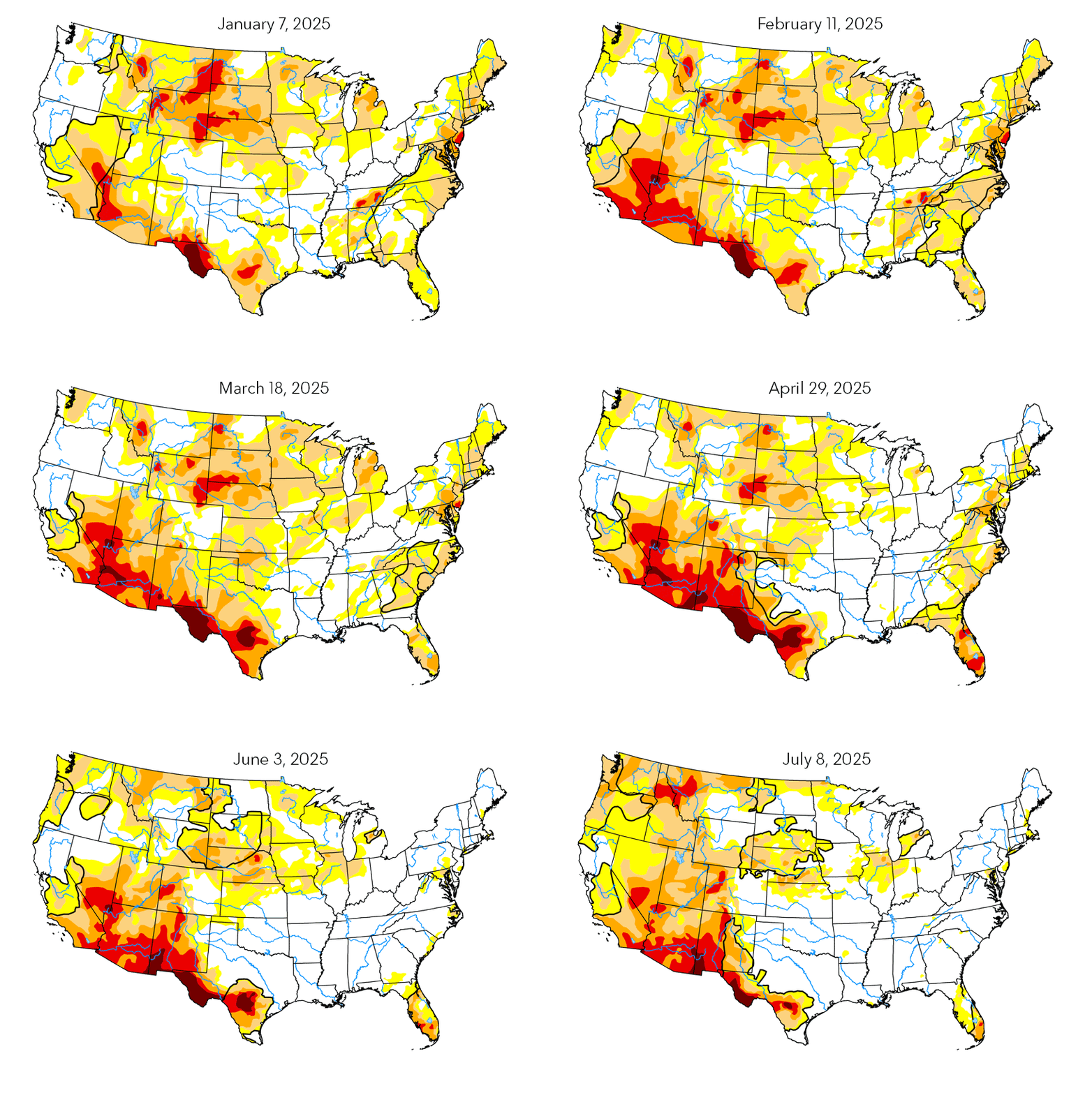
US Drought Monitor

Illinois was bracing for much warmer weather late in the week, with highs climbing from the 60s on April 26 to the 80s by the weekend. The surge of warm air was also expected to spark some thunderstorms, however, with forecasts warning of strong to severe storms on April 28.

Cool weather and spotty showers were reported across Indiana for the first half of the week, with frost reported in northern Indiana after midweek lows dropped to the 20s and highs struggled to reach the 40s and 50s. Much warmer weather was on tap for the coming weekend, however, with highs in the 70s and 80s expected across the state.

A frost advisory was also in effect for much of northern Ohio on April 25-26 after a cold front brought frequent showers to the region, with highs only reaching the 40s at midweek. A freeze warning extended across much of Michigan as well, with temperatures dropping to the mid- to upper-20s late in the week.

Illinois growers had 11% of the corn and soybeans planted by April 21, compared with 2% in Indiana and 1% in Michigan. Ohio growers had 27% of the oats planted by that date but had yet to register any planting progress on corn and soybeans.

Western Cornbelt:

Most of Iowa and Nebraska were at risk for severe thunderstorms on April 26, with forecasts warning of large hail, damaging winds, and tornado activity. The unsettled weather was expected to continue into the weekend. Much of Missouri was also bracing for a stormy weekend, with heavy rain expected in some locations.

Corn planting as of April 21 had progressed to 47% complete in Missouri, 13% in Iowa, and 6% in Nebraska, with soybean planting estimated at 16% in Missouri, 8% in Iowa, and 2% in Nebraska. Missouri growers also had 56% of the rice and 3% of the cotton planted by that date, while oats planting had progressed to 71-78% complete in Nebraska and Iowa.

Southern Plains:

Corn Wheat Soymeal Index

Forecasts warned of severe weather for much of western Kansas late on April 25, including large hail, damaging winds, and a high potential for tornadoes. The warning also extended down into Oklahoma and western Texas, with baseball-sized hail possible from multiple bands of supercells moving through the region on April 25-27.

Kansas growers had 1% of the sorghum, 6% of the soybeans, and 26% of the corn planted by April 21, with corn planting estimated at 1% complete in Colorado and 68% in Texas. Texas growers also had 16% of the cotton and 60% of the sorghum planted by that date.

“We’ve had lots of heat for April, no rain and a lot of wind that has dried things out,” reported one Kansas source at midweek. “Wheat has gone backwards from a potential outstanding crop to below average, and in some areas it is past recovery.”

South Central:

Scattered showers were reported in Arkansas, Tennessee, and Kentucky at midweek, along with cooler temperatures. Lows dipped to the freezing mark in some parts of Kentucky, but much warmer weather was on tap as the week progressed.

Potentially severe weather was in the forecast for parts of Arkansas late in the week, with forecasts warning of high winds, hail, and the threat of tornadoes on April 26. Another round of severe weather was possible in central and northern Arkansas again on April 28.

Corn planting was 31% complete in Tennessee and 23% in Kentucky by April 21, with soybean planting tracking ahead of the average pace at 43% complete in Arkansas, 42% in Louisiana, 28% in Mississippi, 17% in Tennessee, and 14% in Kentucky. Arkansas growers also had 6% of the cotton planted by that date, compared with 5% in Louisiana and 1% in Mississippi and Tennessee.

Rice planting was well advanced in the region by April 21, with progress estimated at 87% complete in Louisiana, 72% in Texas, 67% in Arkansas, and 27% in Mississippi.

Southeast:

Warm, dry weather was reported for much of the Southeast during the week, resulting in a brisk planting pace. “Everything is going on at once it seems,” commented one Carolina source at midweek. “Things are really picking up now with fieldwork,” added another contact.

North Carolina growers had 51% of the corn and 6% of the soybeans planted by April 21, while cotton planting had progressed to 12% complete in Virginia, 4% in Georgia and South Carolina, 3% in Alabama, and 1% in North Carolina. Peanut planting was 11% complete in Florida, 4% in South Carolina, 3% in Georgia, and 1% in Alabama and North Carolina.

Ammonium Thiosulfate

Eastern Cornbelt:

The ammonium thiosulfate market in the Eastern Cornbelt strengthened to $300-$310/st FOB, up from last week’s $270/st FOB low. The upper end of the range was reported at Cincinnati, with the low at Ottawa and Terre Haute, Ind., though no new orders were being taken at Terre Haute.

Western Cornbelt:

Ammonium thiosulfate firmed to a solid $300/st FOB in the Western Cornbelt, with limited availability reported.

Southern Plains:

Ammonium thiosulfate prices firmed to $240-$250/st FOB for the latest offers in the Southern Plains, up from the previous $200-$225/st FOB range.

South Central:

Ammonium thiosulfate pricing was pegged at $280-$290/st FOB Memphis, up another $10-$15/st from last report.

CAN

Germany:

CAN prices in Germany declined €5/mt this week, to €255-€265/mt CIF as the current season draws to a close. Market participants expect further price corrections following the downtrend in urea, compounding the low ebb of the season.

While some suppliers remain hopeful for a small wave of just-in-time demand, many have begun discussions for next season, with prices heard as low as €220/mt CIF.