

Cornbelt:
The NPSZ market was unchanged at $850-$885/st FOB in the Cornbelt, depending on location.
Cornbelt:
The NPSZ market was unchanged at $850-$885/st FOB in the Cornbelt, depending on location.
Eastern Canada:
The SOP market in Eastern Canada was pegged in a broad range at C$1,375-$1,480/mt FOB in early October, depending on location and supplier.
Eastern Canada:
The SOP Magnesia market remained at C$950-$1,035/mt FOB in Eastern Canada, depending on grade, location, and supplier.
Eastern Cornbelt:
Potassium thiosulfate pricing was unchanged at $780/st FOB Terre Haute, Ind., for the last confirmed offers.
Eastern Cornbelt:
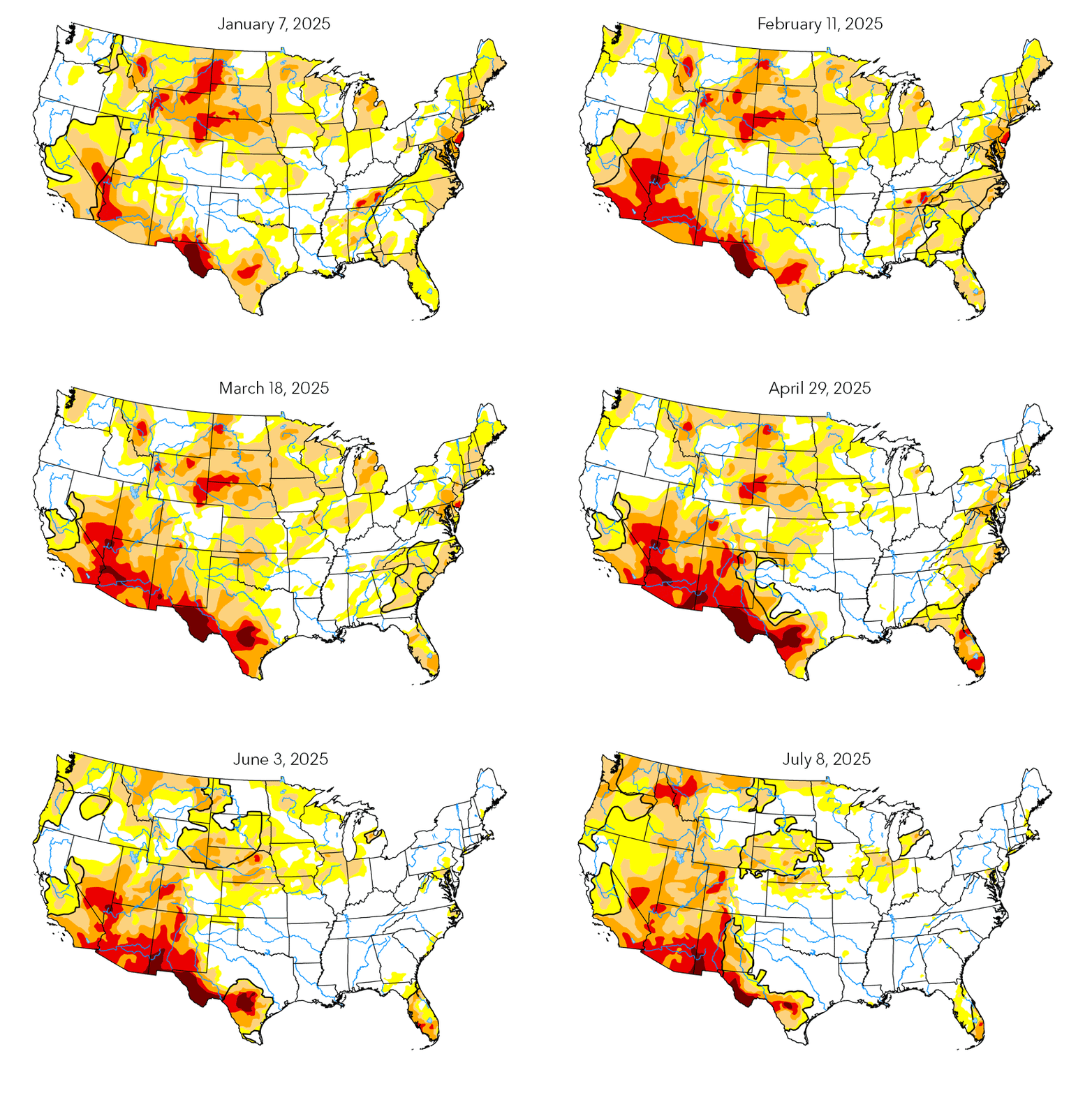
Temperatures in the mid-70s were reported across Illinois and Indiana during the week, with spotty rains reported over central and northern Illinois at midweek, and also across northern Indiana. A stronger cold front was expected to bring heavier rain to portions of northern Illinois and northern Indiana later in the week.
Similar conditions were reported in Ohio and Michigan, with highs reaching the 70s at midweek before cooler temperatures moved in on Oct. 6-7, along with an increased chance of rain and thunderstorms.
Harvesting was off to a good start on corn and soybeans in the region. “We are just now finally getting going on harvesting, mostly beans and a little corn getting started,” said one Ohio contact at midweek. “Yields have been good so far.”
“We have had phenomenal weather to start harvest off on the right foot,” added a Michigan source. “We are seeing corn yields down a bit from what was projected in our neighborhood, but still solid at $7/bushel. Our customer base has outperformed the neighborhood by 30+ bu so far. We are expecting a strong fertilizer run this fall.”
The corn harvest as of Oct. 2 was 16% complete in Indiana, 13% in Illinois, 10% in Michigan, and 7% in Ohio, while the soybean harvest had progressed to 17% complete in Indiana, 14% in Michigan, 13% in Ohio, and 10% in Illinois. Good or excellent ratings were assigned to 67-69% of the corn and soybeans in Illinois, 66-68% in Michigan, 64% in Ohio, and 57-58% in Indiana. Michigan growers also had 26% of the sugar beets in the bin by Oct. 2.
Western Cornbelt:

Highs in the mid- to upper-70s were reported across Iowa for the first half of the week, with temperatures reaching the low-80s in some western parts of the state, creating ideal harvest conditions. Scattered showers moved through the state at midweek, however, followed by cooler weather.
Similar conditions were reported in Nebraska, although a continued absence of rain caused extreme-to-exceptional drought areas to expand across southwestern and northeastern areas of the state. Drought conditions were also expanding across Missouri, with a wide area of severe-to-extreme drought covering west-central areas of the state in early October.
Corn harvesting had progressed to 34% complete in Missouri by Oct. 2, compared with 24% in Nebraska and 11% in Iowa. The soybean harvest was 26-29% complete in Iowa and Nebraska by that date, ahead of Missouri’s 9% progress. USDA placed 61% of Iowa’s corn and soybeans in the good or excellent categories, compared with 49-50% in Missouri and 35% in Nebraska.
Harvest was also progressing on cotton, rice, and sorghum in the region. Missouri’s rice was 56% harvested, along with 6% of the state’s cotton crop, with 56% of the cotton rated as good or excellent. With 11% of the sorghum crop harvested in Nebraska, fully 65% of the acreage was rated as poor or very poor in early October.
Northern Plains:
High temperatures across central and southern Minnesota dropped from the 70s to the 50s as the week progressed, with a band of severe-to-extreme drought impacting southern areas of the state.
The Dakotas saw even lower temperatures late in the week, with highs in parts of South Dakota dropping to the 40s on Oct. 6. A freeze warning was in effect for much of South Dakota on Oct. 6-7, with lows expected to fall to the upper-20s in many locations.
The corn harvest as of Oct. 2 was 15% complete in South Dakota, 5% in Minnesota, and 3% in North Dakota, while the soybean harvest was reported at 26-30% complete in the Northern Plains. Good or excellent ratings were assigned to 61-64% of Minnesota’s corn and soybeans, compared with 58-61% in North Dakota and 37-38% in South Dakota.
South Dakota growers had 2% of the sunflowers and 16% of the sorghum crop harvested by Oct. 2, with 40% of the sorghum rated as good or excellent. The sugar beet harvest was estimated at 13% complete in Minnesota and 18% in North Dakota by that date.
Northeast:
The last remnants of Hurricane Ian brought widespread rainfall to New England early in the week, with heavy precipitation still reported on Oct. 5 in some locations. Drier weather was on tap for the balance of the week, however, with high temperatures climbing from the 50s up to the 70s by Oct. 7.
Pennsylvania and Maryland also experienced rainfall through the middle of the week due to energy from Ian, with strong wind gusts also reported in some locations. The accumulated precipitation over multiple days was enough to prompt some flood advisories in Pennsylvania, including a “minor” flood stage warning for the Delaware River in Philadelphia.
The wet conditions slowed corn harvesting in the Northeast. “We’ve had some rain the last three days, which we really needed in July/August, so harvesting is at a standstill,” commented one Pennsylvania source. Just 2% of Pennsylvania’s corn crop was in the bin by Oct. 2, well behind the 15% average pace, with 67% of the crop rated as good or excellent.
Eastern Canada:
Less than two weeks after Tropical Storm Fiona hammered the Maritimes with heavy rain and powerful winds, parts of Eastern Canada were bracing for the first freezing temperatures of the fall, with snow possible for some areas of northern Ontario by the weekend.
Fiona caused widespread damage and power outages in Nova Scotia and New Brunswick on Sept. 24-25, prompting some local communities to issue states of emergency due to flooding, downed power lines, and road closures.
Warmer and drier weather returned to much of the region after Fiona, but a strong cold front was expected to push temperatures down to the single digits across Ontario and Quebec on Oct. 7-9, and also produce showers and gusty winds. Wet snow was possible in some higher elevations in northern Ontario.
“Harvest is in full swing,” said one regional contact at midweek. “Yields will be good on average – some areas very poor due to drought, and others are harvesting great crops.” Added another source: “Harvest is proceeding well, with beans about 60-80% off with yields ranging from 35-65 bu/acre. Corn is just starting. Wheat will be mostly planted by this weekend.”
US Gulf:
Hurricane Ian’s Sept. 28 landfall north of Fort Myers, Fla., as a Category 4 storm reportedly had little impact on commercial navigation in the Gulf and Canals. The Port of Tampa was moved to Port Condition Normal on Sept. 30, marking a return to full operation. The port was set to Port Condition Zulu in advance of the storm on Sept. 27, halting operations at the site.
Ongoing guidewall construction at Bayou Sorrel Lock was expected to sporadically limit Monday-through-Friday movements between 6:30 a.m. and 5:00 p.m., until February 2023. Delays were noted peaking around 14 hours on Oct. 2.
Daytime travel was unavailable through Mile 34 of the Port Allen Route on Oct. 1-5 due to dredging, sources said, shutting the area from 6:00 a.m. to 6:00 p.m. daily.
Low water conditions were reported shutting Harvey Lock to navigation starting on Oct. 2. With no reopening timeline available on Oct. 5, tows were advised to detour through Algiers Lock.
On the Atchafalaya River, commercial travel was completely unavailable through Little Island Pass, Middle Island Pass, and Riverside Pass due to the presence of exposed underwater pipelines, according to a Coast Guard posting.
Tows passing Algiers Lock without industry assistance were subject to length and width restrictions, effectively limiting tows to four standard barges or two 30,000 mt tankers per turn. Tows with larger barge counts were permitted to lock when accompanied by an assist tug. Wait times were noted up to 7.5 hours early in the week.
Intermittent travel stoppages were anticipated through Belle Chasse Bridge due to a construction operation, scheduled to run through the end of the year. Travel outages had the potential to last up to 12 hours. The bridge is located at Mile 3 in the West Canal.
Most Port Allen Lock delays topped out around seven hours for the week, while Industrial Lock transits were posted up to nine hours. Fourteen-hour waits were recorded through the Colorado Lock’s western chamber, while boats traveling through the site’s eastern lock were delayed up to 25 hours.
Mississippi River:
Reduced water levels continued to affect barge movements on the lower Mississippi River, with some describing the level of impact as unseen since the late 1980s.
Tows traveling in both the northbound and southbound directions were restricted to 9.5 feet of draft, effectively reducing towing capacity by 20% or more per barge. Additionally, tows traveling in the southbound direction were limited to a maximum 25 barges. Barge limits on the lower river typically span 30-40 barges, depending on location.
Taken together, the conditions were estimated to reduce total southbound towing capacity by upwards of 50% in some areas. Vessel groundings were noted stopping traffic for 12-48 hour stretches.
The river gauge at Baton Rouge, La., was posted at 6.66 feet on Oct. 5, while the Vicksburg, Miss., gauge returned a 3.14-foot reading. A (-)1.38-foot depth reading reported on Oct. 5 for St. Louis was projected to fall to (-)2.30 feet on Oct. 12.
Dredging work at Mile 485 was delayed to Oct. 1 due to a vessel grounding in the area. The area was reported as completely shut to navigation on Oct. 1-4. A planned reopening on Oct. 5 was expected to see staggered one-way operation, with northbound vessels tentatively slated to pass during overnight hours. Dredging at the site was expected to require 14 days of work.
Channel maintenance in progress at Mile 618 since Sept. 26 was expected to halt southbound navigation during daytime hours through Oct. 10.
Pipeline removal operations at Mile 167 were expected to limit daylight-hour travel on Oct. 6-23. Additional work scheduled at Mile 189 from Oct. 17 to Nov. 8 will trigger overnight stoppages from 7:00 p.m. to 7:00 a.m.
Intermittent shutdowns were anticipated on Oct. 5-7 at Miles 232-234, blocking travel daily from 8:00-11:00 a.m. and 2:00-5:00 p.m.
A blanket safety advisory has reportedly been in place since Aug. 1 at Miles 228-230 due to repair work at the I-10 bridge. The effort is anticipated to continue through June 2023, with intermittent navigation delays predicted for the duration of the project.
Old River Lock is closed through Nov. 13 for planned miter gate replacement, blocking access to the Red River. Vessels were advised to detour through the Atchafalaya River instead.
The Mississippi River’s impending winter navigation shutdown was expected to trigger last-call on NOLA barge loadings in October, sources indicated. Barges traveling to Dubuque, Iowa, or above were generally slated for final release in the second week of October, while tons scheduled for delivery below Dubuque were projected to continue loading through the third week of October.
Delays at Lock 18 were reported up to nine hours on Oct. 5.
Illinois River:
Drawbridge repairs reported at Mile 160.7 on the Illinois River were expected to block navigation between 6:00 a.m. and 4:00 p.m. daily on Oct. 4-6. A single daytime opening was planned every day between 11:00 a.m. and 12:00 p.m.
Wickets remained raised at Peoria Lock and LaGrange Lock due to reduced river depths, requiring tows to lock through the sites. Waits were posted up to six hours at both locks. Lockport Lock wait times peaked at five hours on Oct. 4.
Looking into 2023, a series of full 90-120 day shutdowns beginning in June at Brandon Road Lock, Dresden Island Lock, Marseilles Lock, and Starved Rock Lock will effectively close the Illinois River to commercial navigation. Fertilizer suppliers managed a similar shutdown in the third quarter of 2020 by filling warehouses and terminals ahead of the shutdown, supplementing inventories as needed via rail and truck deliveries.
Ohio River:
Low water levels on the Ohio River prompted nine-foot draft limits throughout the waterway during the week. Drafts were also cut to nine feet on the Tennessee and Cumberland Rivers.
Intermittent shutdowns at Belleville Lock since Sept. 7 due to lock maintenance were reported concluding on Sept. 30.
An ongoing miter gate replacement project at the Cannelton Lock main chamber forced tows to lock through the secondary chamber. The project is scheduled to end on Nov. 11. Wait times were reported at 24-48 hours during the week.
Primary chamber miter gate and quoin repairs at Hannibal Lock were scheduled to end on Oct. 8. Lockages were limited to the secondary chamber while work is underway. Minimal delays were reported during the week, but intermittent 3-8 hour waits were reported at Meldahl Lock.
On the Tennessee River, Kentucky Lock delays ran up to 12 hours during the week. Most Wilson Lock wait times were noted at five hours or less.
Daytime shutdowns were anticipated from Oct. 13 through Nov. 4 at the Cumberland River’s Barkley Lock due to dive inspections, halting movements daily from 6:00 a.m. to 6:00 p.m.
Arkansas River:
Norrell Lock is closed to daytime navigation through Nov. 30 for planned maintenance, blocking movements daily between 7:00 a.m. and 7:00 p.m. Navigation is available during overnight hours with a 70-foot width limit. The lock is scheduled to undergo a complete travel shutdown on Jan. 30-31, 2023.
Joe Hardin Lock is reportedly closed to navigation until Oct. 9. Emmet Sanders Lock will shut completely for planned electrical work on Oct. 2-6, sources indicated.
Gavilon Fertilizer LLC, Savannah, changed its name to MacroSource LLC effective Sept. 26. In a letter to customers, vendors, and industry partners, MacroSource CEO and President Brent Harlander noted that in January, parent company Marubeni announced the sale of Gavilon Grain Co. (GM Jan. 28, p. 1), including the Gavilon trademark.
“While our name is new, our roots run deep,” added Harlander. “Over the past 44 years, MacroSource has grown to over 350 employees, sourcing and selling nearly 7 million tons of fertilizer through over 70 dry and liquid facilities in the USA, Mexico, Peru, and South Africa. Throughout the decades, our commitment to provide trade outlets and best-in-class service has not waivered.”
More details are available at the company’s new website, www.macrosource.com.
Energy infrastructure company Tallgrass, Houston, and international energy company Equinor, Stavanger, Norway, on Sept. 27 announced a Memorandum of Understanding (MOU) to collaborate on efforts to pursue opportunities for the development of large-scale, low-carbon hydrogen and ammonia projects in North America.
They will assess the production and market potential for hydrogen and ammonia, as well as associated distribution infrastructure, to help facilitate broad decarbonization.
Under the MOU, the partners have agreed to initial co-development activities, including the joint funding of a front-end engineering and design (FEED) study. The study will be focused on large-scale hydrogen production, incorporating the capture of a minimum of 95% of the CO2 for permanent sequestration, coupled with ammonia for efficient transportation and storage. As part of the study, Tallgrass and Equinor are evaluating multiple regional energy centers across the US.
“The joint initiative with Tallgrass to launch plans for a large-scale clean ammonia value chain in the US is fully in line with the roadmap of making Equinor carbon neutral by 2050,” said Grete Tveit, Equinor Vice President for Low Carbon Solutions. “It builds on complementary experience in both companies and the common aspiration to take a leading role in the global energy transition.”
“The magnitude of annual emissions reductions from our potential regional energy centers equates to eliminating the CO2 emissions of over one-third of the total automobiles on the road in states as populous as Colorado, Arizona, and Massachusetts,” said Dustin Bashford, Tallgrass’ Segment President. “It is this type of meaningful decarbonization that we are committed to rapidly advancing.”
After 64.5 years in the fertilizer business, undoubtedly a record, industry veteran Robert (Bob) Taliaferro is retiring from the fertilizer business and closing the door of his company, American Fertilizer Exchange, Brandon, Fla., effective Sept. 30.
After graduating from Virginia Tech with a degree in agronomy, he began his career with the American Agricultural Chemical Co. (Agrico) and went on to also work for Swift Co. and Usamex, before starting American Fertilizer Exchange in 1987.
Taliaferro told Green Markets that his company has made a profit each year since it started and that over the years it has dealt with all basic fertilizer materials, procuring them direct from the producer and selling them to the independent dealer.
Morocco’s OCP Group announced on Sept. 26 that it has signed a definitive agreement to initially acquire 50% of GlobalFeed SL from Spanish fertilizer producer Fertinagro Biotech SL, further expanding its ties to Fertinagro.
It owns a 20% stake in Fertinagro (GM Oct. 19, 2018) and has 50% stakes in two other joint ventures – Fertinagro OCP Organic Biosolutions (GM June 3, p. 28) and OCP Fertinagro Advanced Solutions (GM Jan. 25, 2019), which produces NPKs, as well as products including urease inhibitors, biostimulants, and micronutrients.
“This acquisition confirms OCP’s objective to diversify its phosphate solutions and become a leading player in the animal nutrition sector, addressing growing demand and expanding its offerings to specialty sustainable and customized products” said Marouane Ameziane, Managing Director for Specialty Products and Solutions at OCP.
The company noted that the animal feed market has been strong in recent years as livestock production has grown to feed the world’s increasing needs for adequate meat and protein products.
GlobalFeed operates in the animal nutrition segment and manufactures and distributes a wide range of products, including phosphate-based commodities and solutions dedicated to several species. The company owns flexible production units with a capacity of 200,000 mt of phosphate-based products and 30,000 mt of iron sulfate located in Huelva, Spain. It also has a large global sales footprint.
“This even closer alliance with OCP will accelerate our industrial capabilities and market growth, offering sustainable and advanced phosphates to the world’s most demanding nutritionists, as well as better access to our cutting-edge technologies and reliable alternative on the market,” said Javier Martin, GlobalFeed CEO.
The GlobalFeed transaction is subject to customary closing conditions, including regulatory approvals.