

Cornbelt:
The NPSZ market was pegged in a broad range at $850-$885/st FOB in the Cornbelt, depending on location.
Cornbelt:
The NPSZ market was pegged in a broad range at $850-$885/st FOB in the Cornbelt, depending on location.
Southeast:
The SOP market was pegged at $930/st FOB for the last reported business in Florida, but sources said a move to $980/st FOB is slated for Oct. 1.
Southern Plains:
The last reference prices for Trio FOB Carlsbad included $480/st for standard, $515/st for granular, $540/st for premium, $555/st for OMRI standard and fine standard, and $590/st for OMRI granular.
Eastern Cornbelt:
Potassium thiosulfate pricing was unchanged at $780/st FOB Terre Haute, Ind., for the last confirmed offers.
Eastern Cornbelt:
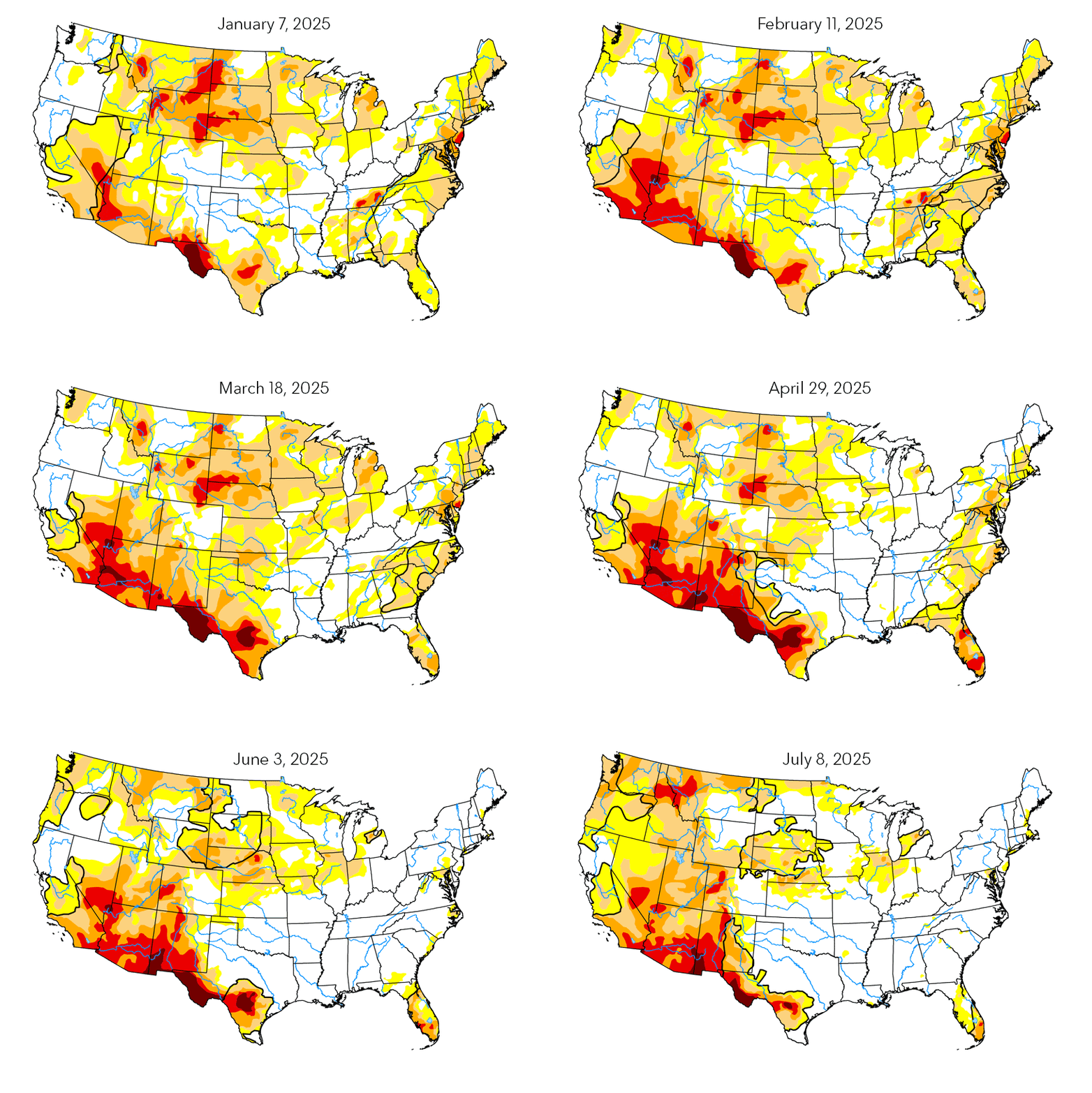
Strong thunderstorms pushed through parts of all three Eastern Cornbelt states during the week, producing large hail on Sept. 18 in northern Illinois and damaging winds on Sept. 21 in central Illinois.
Severe weather also hit parts of eastern Ohio during the week, prompting warnings of potentially damaging winds, large hail, and localized flooding. Much cooler weather followed, with highs only reaching the 60s in northern Ohio as the week progressed.
Strong thunderstorms also rolled through Indiana on Sept. 18, but summer weather returned as the week progressed, with highs climbing into the 80s and even low-90s in some locations.
Combines were just starting to roll on corn and soybeans in the region. The corn harvest as of Sept. 18 was 1-2% complete in Illinois and Indiana, with 1% of Indiana’s soybeans harvested by that date. Good or excellent ratings were assigned to 67-71% of the corn and soybeans in Illinois, 59% in Ohio, and 54% in Indiana.
Sources reported little interest in fertilizer while the harvest accelerates. “Harvest has started, but they will not fertilize until completely done and only do wheat acres to start with,” commented one Indiana source.

Western Cornbelt:
After temperatures rose to near record highs on Sept. 20 in parts of Iowa and Nebraska, much cooler weather moved in for the balance of the week, with lows falling to the upper 30s in parts of Iowa early on Sept. 22. That was a drastic change from highs that approached or exceeded the 100-degree mark, including a record 102 degrees in Sioux Falls, S.D., on Sept. 20.
The region also saw some thunderstorm activity during the week, prompting a tornado watch on Sept. 18 for 26 counties in central and southern Iowa. Another system brought strong winds to parts of eastern Missouri at midweek, and showers and thunderstorms were in Nebraska’s forecast on Sept. 22.
Drought conditions continued to take a toll on Nebraska’s crop. Just 37-40% of the state’s corn and soybeans were rated as good or excellent on Sept. 18, compared with 48-50% in Missouri and 63-64% in Iowa. With 3% of the sorghum crop harvested in Nebraska, fully 66% of the acreage was rated as poor or very poor at mid-month.
“We shouldn’t be too optimistic on fall application, all due to dry conditions that are in the field,” said one contact. “Wheat fields that are wheat-on-wheat and conventionally tilled have had fertilizer applications go down and incorporated with more tillage, but there is no moisture there to start the wheat. Areas that have caught the spot showers/rain, it may be enough to plant something, but will there be more moisture to follow and sustain the wheat?”
The corn harvest as of Sept. 18 was 11% complete in Missouri, 6% in Nebraska, and 2% in Iowa, while 5% of Nebraska’s soybeans were in the bin by that date. Missouri’s rice harvest was 15% complete, with 58% of the crop rated as good or excellent. Missouri’s cotton crop was 52% good or excellent at mid-month.
Southern Plains:
Cool, rainy weather was reported across much of Kansas at midweek. One source said the precipitation “will get wheat planting started next week.” Scattered showers were also moving through western, central, and northern New Mexico during the week.
Oklahoma, by contrast, was hit with a heat wave in mid-September. Temperatures soared to the mid- to upper-90s in Oklahoma City and other locations, exacerbating drought conditions that cover fully 97% of the state. Nearly half of Oklahoma and Kansas were experiencing extreme-to-exceptional drought at mid-month.
Northern Texas was also battling intense heat at mid-month. Highs in the mid- to upper-90s were common during the week, and expected to linger through the coming weekend.
Crop conditions continued to deteriorate in the Southern Plains due to the pervasive drought conditions. The corn harvest was 68% complete in Texas and 27% in Kansas, with poor or very poor ratings assigned to 52% of the acreage in Texas, 54% in Kansas, and 48% in Colorado. The Kansas soybean crop was 48% poor or very poor, with just 2% of the harvest completed by Sept. 18.
Cotton conditions were even worse. Texas growers had 20% of the crop picked by mid-month, with fully 56% of the acreage rated as poor or very poor, compared with 63% in Oklahoma and 44% in Kansas.
“Folks are getting into cotton harvest and a lot of the dryland is being zeroed out,” commented one Texas source. “We thought maybe the rains a few weeks ago might grow a top crop to save it, but that did not pan out.”
The sorghum harvest was 78% complete in Texas, 7% in Oklahoma, and 2% in Kansas, with poor or very poor ratings assigned to 53% of the acreage in Kansas, 50% in Oklahoma, and 42% in Texas. Colorado was the region’s green spot, with 45% of the state’s sorghum rated as good or excellent at mid-month.
South Central:
Summer heat returned to the South Central region at mid-month. Temperatures at midweek hit the triple digits in Little Rock, Ark., the 17th time this year, with highs climbing to the mid- to upper-90s across Louisiana and Mississippi. Strong thunderstorms were reported in northern Kentucky at midweek, with reports of damaging winds in some locations.
Harvesters were rolling on corn, soybeans, cotton, and rice in the region. The corn harvest was 26-27% complete in Kentucky and Tennessee by Sept. 8, with 28-38% of the acreage rated as good or excellent.
Soybean growers had 48% of the crop harvested in Louisiana, 34% in Mississippi, 9% in Arkansas, 6% in Tennessee, and 2% in Kentucky, with good or excellent ratings assigned to 27% of the acreage in Louisiana and 49-58% in the rest of the region.
The cotton harvest was 13% complete in Louisiana, 5% in Mississippi, and 1% in Arkansas and Tennessee. Louisiana’s cotton crop was just 26% good or excellent, compared with 53% in Tennessee and 64-65% in Mississippi and Arkansas.
The rice harvest was well advanced by Sept. 18, with 87-92% of the crop in Louisiana and Texas already in the bin, compared with 60% in Mississippi and 41% in Arkansas. Good or excellent ratings were assigned to fully 87% of Louisiana’s crop, compared with 74% in Arkansas, 66% in Mississippi, and 51% in Texas.
Southeast:
Late summer heat was baking much of the Southeast during the week, with highs reaching the upper-80s and low-90s in Alabama and Georgia. Highs in Virginia were expected to drop from the 90s to the 70s as the week progressed, and Hurricane Fiona was expected to produce dangerous rip currents along the Georgia and Carolina coasts through the weekend.
Although conditions were “on the dry side” in the Carolinas at mid-month, Florida sources reported “lots of rain” that has benefited fertilizer application on citrus, vegetables, pastures, and golf courses.
Growers were harvesting corn, soybeans, cotton, and peanuts in the Southeast, with mixed yields reported. With 62% of the corn crop in the bin in North Carolina, just 29% of the acreage fell in the good or excellent categories on Sept. 18, with 46% rated as poor or very poor. The state’s soybean harvest was 4% complete, with 61% rated as good or excellent.
The cotton harvest was just 1-3% complete across the region, with good or excellent ratings assigned to 59% of the acreage in Georgia, 65% in North Carolina, 73% in South Carolina, 78% in Alabama, and 82% in Virginia.
The peanut harvest was 14% complete in Florida and 1-4% in the rest of the Southeast. Peanut conditions were described in favorable terms, with 88% of Alabama’s crop rated as good or excellent, compared with 77% in Virginia, 76-82% in the Carolinas, 68% in Georgia, and 63% in Florida.
US Gulf:
Bayou Sorrel Lock guidewall construction was reported in progress through February 2023, prompting intermittent transit shutdowns between the hours of 6:30 a.m. and 5:00 p.m., Monday through Friday. Normal transit hours resumed on Saturday and Sunday. Delays were seen spiking to the 24-48 hour range starting on Sept. 17.
Dredging that started in early September to correct shoaling at Miles 113-117 of the Atchafalaya River was extended through at least Sept. 18, according to a Sept. 16 Coast Guard safety bulletin. The project was previously slated to conclude on Sept. 15. Vessels were required to check in with the VTS Berwick Bay at Mile 110 prior to arrival in the area.
Until mariners are given the all-clear, draft limits through the area were set at a maximum 10 feet, while length and width limits were established at 600 feet and 55 feet, respectively. Travel with an assist boat was mandatory for tows longer than 400 feet. In addition to the dredging restrictions, commercial travel was completely unavailable through Little Island Pass, Middle Island Pass, and Riverside Pass due to the presence of exposed underwater pipelines.
Limits on towing lengths and widths at Algiers Lock continued to restrict unassisted passes to four standard barges or two 30,000 mt tankers per turn. Tows traveling with an assist vessel were reportedly permitted to lock with longer strings, however. Intermittent 3-10 hour delays were observed for the week through Sept. 19.
An ongoing construction project underway at Belle Chasse Bridge, situated at Mile 3 of the West Canal, caused intermittent navigation stoppages of up to 12 hours in length during the week. The effort was scheduled to continue through the end of the year.
Most Port Allen Lock delays were reported up to 22 hours through the week. Intermittent 10-26 hour waits were observed at Industrial Lock.
Mississippi River:
Persistent low water levels continued to drag on lower Mississippi River commercial travel, with both draft reductions and cuts in the maximum number of allowable barges remaining reduced from typical levels.
Tows were reportedly cut by 10-15% from normal capacity, while tows traveling in the northbound direction saw drafts capped at 10.5 feet. Tows moving downriver saw 11.0-foot draft limits between Cairo, Ill., and Rosedale, Miss., followed by 11.5-foot limits from Rosedale to Greenville, Miss.
The river gauge at St. Louis returned a 1.55-foot reading on Sept. 21 after flirting with the 0.00-foot mark on Sept. 18. Levels there were expected to slide to zero feet and below starting on Sept. 24.
Channel work at Miles 643-644, scheduled for Sept. 21-23, was expected to block both northbound and southbound travel daily between 7:00 a.m. and 5:00 p.m.
A safety advisory was in effect at Miles 228-230 of the lower river due to a repair project underway at the I-10 bridge. Work at the site was slated to run 24 hours per day through June 2023, with sporadic transit stoppages predicted throughout.
A full travel shutdown at Old River Lock, in progress since Aug. 30, was anticipated to block navigation 24 hours per day through Nov. 13. Tows looking to access the Red River during the closure were recommended to detour through the Atchafalaya River.
Due to the upper Mississippi River’s impending seasonal navigation shutdown, barges releasing from NOLA and slated to unload at Dubuque, Iowa, or points north were expected to see final departure dates during the second week of October. Tows headed to ports south of Dubuque will likely load through the third week of October, sources indicated.
Illinois River:
The Corps was noted wrapping up testing of the Peoria Lock invasive carp deterrent system on Sept. 20. Originally slated to continue through Oct. 7, the effort was reported blocking travel between 7:00 a.m. and 3:00 p.m. on Monday, Tuesday, Thursday, and Friday, since Aug. 29.
Wickets were raised at both Peoria Lock and LaGrange Lock during the week in response to persistent low water levels, necessitating vessel lockages at both locations. Minimal delays were reported through the week.
Starved Rock Lock waits were noted peaking around the eight-hour mark on Sept. 20-21.
Ohio River:
Belleville Lock was shut to daytime navigation on Sept. 7-30 due to repairs and maintenance, sources indicated. Most delays were noted in the 4-11 hour range through the week.
At Cannelton Lock, the main chamber was reported closed for miter gate installation through Nov. 11, triggering detours through the auxiliary chamber. With most tows requiring at least two lockages to pass the site, delays were posted up to 41 hours during the week.
The primary chamber at Hannibal Lock was shut to navigation through Oct. 8 due to miter gate and quoin repair, although passage remained available through the secondary chamber. The project was reported kicking off on July 5.
Lock equipment repair work was underway at Kentucky Lock on the Tennessee River on Sept. 6-26, blocking travel through location daily from 6:00 a.m. to 6:00 p.m. Most delays were quoted in the 15-26 hour range, although intermittent waits were observed as high as 41.5 hours. Wilson Lock saw sporadic 4-9 hour wait times during the week, Corps data indicated.
Dive inspections were scheduled to limit navigation at the Cumberland River’s Barkley Lock from Oct. 13 to Nov. 4. Transit will reportedly be unavailable daily from 6:00 a.m. to 6:00 p.m. while the operation is underway.
Arkansas River:
Norrell Lock remains shut to daylight-hour navigation through Nov. 20 for planned repairs, halting vessel traffic daily between 7:00 a.m. and 7:00 p.m. Tow widths were limited to 70 feet on all passes. The lock is scheduled to undergo a complete travel shutdown on Jan. 30-31, 2023.
Joe Hardin Lock navigation is scheduled to shut from 7:00 a.m. through 7:00 p.m. on Sept. 12-29. A complete lock shutdown will run from Sept. 30 through Oct. 9. Electrical repairs are expected to necessitate a total shutdown of Emmett Sanders Lock on Oct. 2-6.
The U.S. Department of Energy (DOE) on Sept. 22 announced that it has opened up applications for $7 billion to establish up to 10 regional hydrogen hubs, part of a broader road map that officials described as essential to lowering emissions in industrial sectors, according to Bloomberg Law. The hub program was established by Congress in the infrastructure bill that passed last November.
“This is one of the largest investments in DOE history, going to what we believe will be a generational opportunity,” said David Turk, Deputy Secretary of Energy. “There is no part of that [infrastructure] bill that has gotten more attention and more interest than the hydrogen hubs piece.”
Hydrogen has drawn bipartisan interest from states. A group of Midwestern governors this week unveiled a coalition aimed at developing hydrogen as an alternative energy source to boost the region’s decarbonization efforts.
The department plans to select at least four regional hubs, with at least one from “green” hydrogen produced by renewable energy; one from “blue” hydrogen sourced from natural gas and using carbon capture and storage; and one “pink” hydrogen project from nuclear power.
“The department is seeking geographic diversity and expects to see applications that include broad groups of hydrogen stakeholders: companies, government agencies, producers and consumers, pipelines, and transportation companies,” said Kelly Cummins, Acting Director and Principal Deputy Director for the Office of Clean Energy Demonstrations, which is managing the program.
No major changes were made to the department’s hydrogen hub strategy compared with a notice of intent released in June, Cummins said. Concept papers are due by Nov. 7, 2022, and full applications are due by April 7, 2023.
The department also released a draft of the National Clean Hydrogen Strategy and Roadmap for public feedback. The roadmap provides an overview of the potential for hydrogen to “contribute to national decarbonization and economic development goals,” the department said.
A final version of the strategy and roadmap will be released in the coming months and updated at least every three years.
The hub program was advanced as the industry is poised to grow with a hydrogen tax credit established by the climate and tax bill passed by Congress last month.
Permitting overhaul legislation unveiled by Sen. Joe Manchin (D-W.Va.) on Sept. 21 includes giving oversight of hydrogen pipelines to the Federal Energy Regulatory Commission, which currently regulates interstate natural gas pipelines.
Turk said the Biden administration was sensitive to concerns from environmental justice communities that hydrogen could lead to local impacts and climate emissions.
“We are doing this in a full, rigorous, environmental integrity way,” Turk said, adding he has engaged in conversation with advocacy groups and community leaders, meeting recently with the Environmental Defense Fund to talk about how to define clean hydrogen.
Corteva Inc., Indianapolis, announced on Sept. 22 that it has signed an agreement to acquire Symborg, Murica, Spain, a microbiological technologies company. Corteva said Symborg possesses a diversified existing portfolio, an emerging biocontrol pipeline, and a skilled employee base with robust technical knowledge and demand generation expertise.
“Acquiring Symborg is a significant next step in Corteva’s strategy to accelerate the development of a best-in-class biologicals portfolio, as a valuable part of our integrated solutions we offer to our customers,” said Robert King, Executive Vice President, Crop Protection Business Unit, Corteva Agriscience.
“Over the past three years, Corteva has established licensing and distribution agreements with the top biological companies, which we selected after evaluating technologies and demonstrating customer acceptance,” he added. “This acquisition shows Corteva’s progression towards further establishing itself as a technology leader in this rapid growth segment.”
Corteva first collaborated with Symborg to scale up and bring farmers Utrisha™ N and BlueN™ nutrient efficiency optimizer as part of a distribution agreement between the two companies. The natural-origin biostimulant enables plants to fix nitrogen from the air and make it available to the plant, providing an alternative, supplemental nitrogen source and potentially reducing greenhouse gas emissions from fertilizer use.
Corteva said the transaction continues its commitment to build a more differentiated and sustainably advantaged portfolio that provides cost-effective solutions for farmers. Corteva will leverage the combined organizations to scale up Symborg’s current solutions, as well as new products in development.
Corteva said Symborg locations in Spain and subsidiaries in the US, Mexico, Peru, Chile, Brazil, France, Turkey, China, and Australia will become key elements of Corteva’s Biologicals Portfolio.
Closing of the acquisition is subject to customary closing conditions. Financial terms and conditions of the agreement were not disclosed.
The United Nations (UN) confirmed that it is in negotiations to reopen the ammonia pipeline from Russia through Ukraine to the port of Odessa. International ammonia trader Trammo Inc., New York City, also confirmed that it had been approached by the UN to assist in the project.
“Trammo is happy to cooperate with efforts of the United Nations to allow shipments of ammonia from Ukraine to resume,” said Trammo CEO Ed Weiner. “Ammonia is an essential ingredient in fertilizer production. The absence from the market of ammonia formerly shipped through Ukraine has caused substantial hardship in countries dependent on that product. We believe that resumption of shipments will help to stabilize fertilizer prices worldwide and to avoid a global food crisis.”
The 2,471 km (1,535 mile) pipeline from Togliatti to Odessa can carry approximately 2.5 million mt/y of ammonia.
The ammonia, reportedly to be supplied by Russian producer Uralchem, would be purchased by Trammo at the Russia/Ukraine border. It would travel on down the pipeline and be exported from the ports of Odessa.
Russia has complained that its own products were not being exported under the Black Sea Grain Initiative that was signed on July 22. The Initiative was signed by Russia, Ukraine, the UN, and Turkey, and was to provide for the safe export of “grain, foodstuffs, and fertilizers, including ammonia.”
The 120-day Initiative expires in November, and UN Secretary-General Antonio Guterres said in an interview that it was clear that a successful ammonia deal could create conditions for the extension of the Initiative beyond November.
Market watchers offered quick concern over the safety of ammonia being transported through a war zone and whether ship owners would risk picking up the product (see Ammonia Market Section). However, if Russia is benefiting from the ammonia sale, it is arguable that it would avoid damaging the pipeline or vessels.
Tentative contract agreements were reached early on Sept. 15 with the remaining three unions representing approximately 60,000 railroad employees, averting a potential rail strike that was scheduled to commence as early as Sept. 16. Earlier agreements were negotiated with nine of the 12 unions, which collectively represent roughly 115,000 rail workers.
“Thanks to the dedication of all members involved in the collective bargaining process, these new contracts provide rail employees a 24% wage increase during the five-year period from 2020 through 2024, including an immediate payout on average of $11,000 upon ratification,” the Association of American Railroads (AAR) announced on Sept. 15.
The news was welcomed by the fertilizer and agriculture industries, which had been pressing for a quick resolution ahead of the Sept. 16 deadline and had warned of catastrophic consequences if a strike or lockout occurred.
The resolution was also hailed by the Biden administration after Labor Secretary Marty Walsh met with the two sides on Sept. 14-15 to lead 20 consecutive hours of negotiations. Transportation Secretary Pete Buttigieg, Agriculture Secretary Tom Vilsack, and National Economic Council Director Brian Deese reportedly joined Walsh in working the negotiating table.
“The tentative agreement reached tonight is an important win for our economy and the American people,” President Biden said in a statement. “These rail workers will get better pay, improved working conditions, and peace of mind around their health care costs: all hard-earned. The agreement is also a victory for railway companies, who will be able to retain and recruit more workers for an industry that will continue to be part of the backbone of the American economy for decades to come.”
The final agreements were reached with the Brotherhood of Locomotive Engineers and Trainmen Division of the International Brotherhood of Teamsters, the International Association of Sheet Metal, Air, Rail, and Transportation Workers – Transportation Division, and the Brotherhood of Railroad Signalmen.
The unions agreed to accept the raises and bonuses that a Presidential Emergency Board (PEB) recommended this summer (GM Aug. 19, p. 28), while the railroads agreed to ease attendance policies to allow workers unpaid days off for doctor’s appointment without penalty. The tentative agreement still needs to be ratified by respective unions through a vote by rank-and-file rail workers.
“Averting a strike Friday morning was priority number one,” said Corey Rosenbusch, President and CEO of The Fertilizer Institute (TFI). “We are hopeful that union membership will vote to approve the tentative agreement to ensure freight rail in the US continues to operate. As we move forward, it is also essential that rail carriers hire and retain the appropriate employee staffing levels to support a strong economy. Staff reductions in recent years have dramatically hurt rail service and made the rail-labor contract negotiations more challenging.”
In preparation for a possible strike, the six Class 1 freight railroads on Sept 9 announced that they had initiated steps to “secure” shipments of hazardous and security-sensitive materials, including anhydrous ammonia, resulting in those shipments being suspended or delayed beginning on Sept. 12.
The effect of the embargo on distribution was almost immediate, with sources telling Green Markets that some producers and ag retail suppliers immediately withdrew pricing and warned customers that the timely shipment of 4Q prepay ammonia tons was in doubt for the fall application season.
“For every day this uncertainty continues, we essentially lose five shipping days because of the ramp down and ramp up,” Rosenbusch said in a Sept. 14 statement. “If this situation is not resolved by tomorrow, it could quickly impact supplies for fall application and lead to a reduction in US production at a time when 70% of European production has been curtailed or ceased due to Russia’s shutoff of natural gas supplies.”
In its Sept. 15 statement after the labor agreement was announced, TFI said “most or all of the ammonia embargoes have been lifted as of this morning,” and stressed that ammonia shipments “must quickly resume.”
The Agricultural Retailers Association (ARA) also issued a Sept. 15 statement saying it was “encouraged and relieved” that a tentative agreement had been reached. ARA confirmed that its members were “already feeling the impact of a potential strike as railroad carriers started to cancel shipments of critical fertilizer products such as anhydrous ammonia and impacting domestic fertilizer production earlier this week.”
“The prospect of a rail strike would have further disrupted a supply chain that is already strained,” said ARA President and CEO Daren Coppock. “We hope the unions will quickly ratify the agreement so this cloud of uncertainty can be cleared away.”
ARA said it and other members of the Agricultural Transportation Working Group had sent letters to Congress on Sept. 8 and Sept. 13 urging lawmakers to intervene quickly if an agreement could not be reached by the Sept. 16 deadline (GM Sept. 9, p. 1). An AAR report warned that a rail shutdown could cost the US economy up to $2 billion a day.
The National Corn Growers Association (NCGA) also issued a statement on Sept. 15 calling the tentative agreement “a positive development” for farmers and the agricultural community. “We are thankful that the White House has announced a tentative agreement between rail carriers and union leaders and applaud the efforts from all parties to avoid this crisis,” said Brooke S. Appleton, NCGA Vice President of Public Policy.
The National Grain and Feed Association (NGFA) on Sept. 15 commended rail and union representatives for reaching a preliminary agreement as well. Earlier in the week, Bloomberg reported that Norfolk Southern Corp. had alerted customers that it planned to halt unit train shipments of bulk commodities, including grain, on Sept. 15 if negotiations remained stalled.
“The efficient operation of our rail network, which moves 25% of all US grain, is crucial to a functioning agricultural economy,” said NGFA President and CEO Mike Seyfert. “Resilient and reliable rail service is essential to the daily operations of NGFA members. We thank our rail industry partners for working to get this deal, and we encourage quick ratification by the labor unions.”
While no work stoppage will take place on Sept. 16, the threat of a labor strike or management lockout is still not over, according to a Sept. 15 Railway Age report, which confirmed that just two of the 12 unions have so far ratified the tentative agreements.
Railway Age noted, however, that all of the earlier tentative agreements contained “me too” clauses, which means the terms reached during the all-night bargaining session on Sept. 14-15 will apply across the board.