

Cornbelt:
The NPSZ market was pegged in a broad range at $860-$895/st FOB in the Cornbelt, depending on location.
Pacific Northwest:
40-Rock pricing was unchanged at $900/st FOB or DEL in the Pacific Northwest.
Cornbelt:
The NPSZ market was pegged in a broad range at $860-$895/st FOB in the Cornbelt, depending on location.
Pacific Northwest:
40-Rock pricing was unchanged at $900/st FOB or DEL in the Pacific Northwest.
California:
The granular SOP market was reported at $950-1,000/st FOB Stockton, depending on supplier.
Pacific Northwest:
Granular SOP pricing remained at $990/st FOB in Washington.
Iran:
Agricultural Support Services Co. (ASSC) closes a tender on Oct. 1 for the purchase of 150,000 mt of granular potassium sulfate, for shipment in 30,000 mt, 40,000 mt, or 50,000 mt lots at the seller’s option.
California:
The granular SOP Magnesia market was steady at $645/st FOB for the last confirmed offers in California.
Pacific Northwest:
The granular SOP Magnesia market in Washington was quoted at the $670/st FOB level in early September.
California:
Potassium nitrate prices in California were unchanged at $1,430/st FOB Stockton for bulk tons, $1,535/st FOB for bulk bags, and $1,555/st FOB for 50-pound bags.
Eastern Cornbelt:
Potassium thiosulfate pricing was unchanged at $780/st FOB Terre Haute, Ind., for the last confirmed offers.
California:
The potassium thiosulfate market remained at $780/st FOB Sacramento for the last offers.
Eastern Cornbelt:
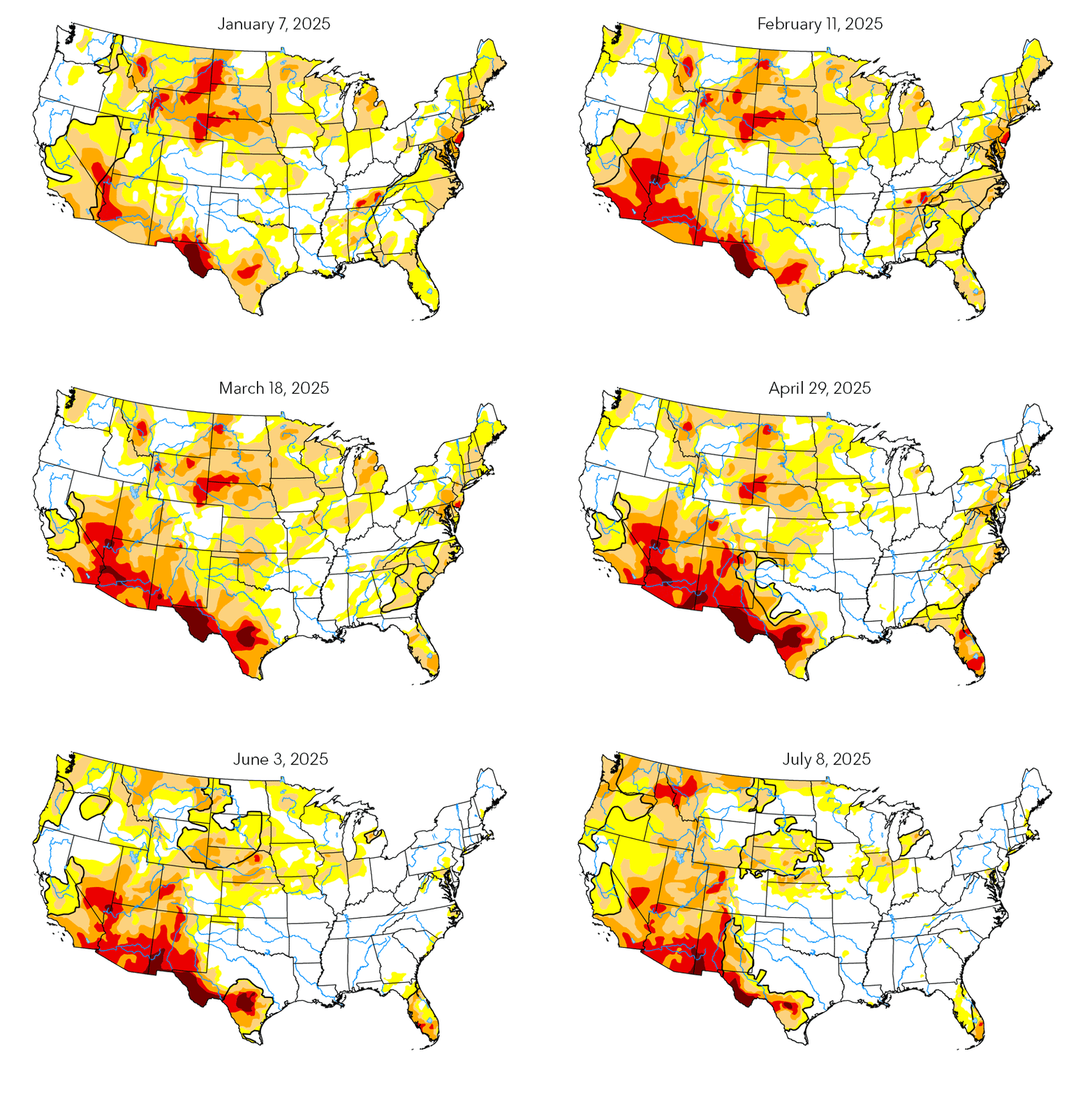
The Eastern Cornbelt experienced slightly cooler temperatures and a drop in humidity during the first full week of September, with an increased chance of precipitation expected by the coming weekend. Parts of Ohio were hit with heavy rain over the Labor Day weekend.
Highs in the low- to mid-80s were reported in central Illinois and Indiana at midweek, but temperatures were expected to drop to the mid-70s by Sept. 11, with showers likely over the weekend in both states. The week began with light showers over much of northern Ohio, but temperatures climbed to the high-70s and low-80s as the week progressed.
The corn crop was 9-11% mature in Illinois and Indiana as of Sept. 4, compared with 5% in Ohio. Corn maturation was trailing the average pace in all three states, and soybeans were also slightly behind the average, with 4-10% of the regional crop dropping leaves by that date.
Some 67-71% of the corn and soybeans in Illinois were rated as good or excellent on Sept. 4, compared with 57-58% in Ohio and 54-56% in Indiana.
“Our crops for the most part are looking really good, we just need some more heat units and sunshine now after 3-5 inches of rain fell over this past weekend and even more rain forecasted again this weekend,” said one Ohio source. “But overall, I think we are looking at some good yields down the road for our crops in my area.”
Western Cornbelt:

Highs in the upper-80s were reported in central Iowa during the week, with forecasts warning of a smoky haze across parts of the state coming from wildfires in the Western US.
Highs across Nebraska soared into the low- to mid-90s as the week progressed, with all of the state experiencing drought conditions ranging from moderate to exceptional. Missouri continued to register temperatures in the upper-80s for most of the week, but rain was in the weekend forecast as a cold front moved into the region.
Good or excellent ratings were assigned to 66% of Iowa’s corn and soybeans on Sept. 4, with 10% of the corn crop described as mature. Nebraska’s corn was 19% mature, with good or excellent ratings assigned to 39-41% of the state’s corn and soybeans. Nebraska’s sorghum remained at 20% good or excellent on Sept. 4, with 62% of the crop rated as poor or very poor.
Missouri’s corn and soybeans were 50% good or excellent, with 31% of the corn described as mature. The state’s cotton crop was 52% good or excellent, while the Missouri rice crop was rated at 55% good or excellent.
California:
Record-setting heat continued to bake much of California during the week, contributing to the spread of nine active wildfires that had consumed 41,600 acres as of Sept. 7. Daily temperature records during the week included 103 in Anaheim, 109 in San Jose, 115 in Stockton, 116 in Sacramento, 117 in Ukiah, and 127 in Death Valley.
Excessive heat warnings were in effect for much of Southern California, along with a high-wind watch for parts of San Bernardino and Riverside counties. A Flex Alert was issued on Sept. 8, marking another request for Californians to conserve power during the extended heat wave. So far, the state’s power grid operator has not resorted to rotating power outages.
Some relief from heat and drought was in the forecast for parts of Southern California late in the week, with rain expected from Tropical Storm Kay as it moves up the coast of Baja California. A flood watch was issued for parts of Riverside and San Bernardino counties, and continues on Sept. 9, with up to 2 inches of rain possible for some mountain communities.
California’s cotton crop was 90% good or excellent as of Sept. 4, with bolls opening on 10% of the acreage. The rice crop was 75% good or excellent on that date.
Pacific Northwest:
Hot, dry weather was reported across the Pacific Northwest in early September, with gusty winds fueling a number of wildfires in the region. Fire weather watches and red flag warnings were posted for much of western Oregon and southwestern Washington on Sept. 9.
The scorching temperatures produced numerous daily heat records during the week, including 90 degrees in Everett, Wash.; 100 in Great Falls, Mont., Idaho Falls, Idaho, and Casper, Wyo.; 108 in Hardin, Mont.; and 112 in St. George, Utah.
Growers were wrapping up the small grains harvest and gearing up for potatoes in the region. As of Sept. 4, the harvest of spring wheat and barley was estimated at 74-78% complete in Idaho, 76-77% in Washington, and 80-87% in Montana.
Western Canada:
Hot weather continued to blanket much of Western Canada, with multiple daily heat records set in Saskatchewan during the first days of the month.
A cold front was in the forecast for parts of Alberta and British Columbia as the week progressed, with temperatures expected to drop into the single digits for the Rockies and foothills late on Sept. 9. Another blast of heat was in store for the coming weekend for southern areas of both provinces, however.
Saskatchewan’s latest crop report pegged the harvest at 42% complete overall, slightly ahead of the 40% five-year average, with average yields estimated at 43 bushels/acre for hard red spring wheat, 30 bushels/acre for durum, 34 bushels/acre for canola and field peas, and 1,174 pounds/acre for lentils.
“Harvest is pretty much wrapped up here, and most yields are mid-level, better than last year but not as good as normal,” commented one source in southern Saskatchewan.
Harvest progress in Manitoba was lagging, however, with just 15% completed overall, well behind the 51% five-year average. The slow progress was attributed to delayed spring seeding, high humidity, and frequent rains, with the precipitation contributing to favorable crop conditions across most of the province.
US Gulf:
Ongoing Colorado Lock delays were expected to block navigation from 7:00 a.m. to 5:00 p.m., Monday through Friday, until Sept. 9. Corps data put delays up to seven hours on Sept. 6.
Guidewall construction at Bayou Sorrel Lock, which restarted on Aug. 1, was anticipated to limit Monday-through-Friday movements between 6:30 a.m. and 5:00 p.m. through February 2023. Minimal delays were recorded through the week.
Efforts to correct an “extensive” shoaling issue in the Atchafalaya River’s Morgan City, La., area at Miles 113-117 resumed on Sept. 1, according to a Coast Guard safety bulletin. Dredging at the site is scheduled through Sept. 15, prompting 10-foot draft limits, 55-foot width limits, 600-foot maximum lengths, and a requirement to check in with the VTS Berwick Bay at Mile 110 prior to arrival in the area. In addition, all tows running longer than 400 feet were required to travel with an assist vessel.
Due to the presence of exposed underwater pipelines revealed by a recent hydrograph of the Atchafalaya River, commercial travel was completely unavailable through Little Island Pass, Middle Island Pass, and Riverside Pass.
Tows locking without assistance through Algiers Lock remained subject to length and width restrictions, sources said, essentially capping tows to four standard barges or two 30,000 mt tankers per turn. Longer hauls could lock when accompanied by an assist tug. Most lockages were reported concluding in less than five hours through Sept. 6.
Intermittent travel restrictions continued to be reported through the Belle Chasse Bridge due to a construction operation scheduled through the end of the year. Interruptions to navigation were described up to 12 hours. The bridge is located at Mile 3 in the West Canal.
Port Allen Lock delays were posted up to 16 hours through the week, while tows passing Industrial Lock saw wait times up to 32 hours on Sept. 5-6. Intermittent Brazos Lock waits ran as high as 10 hours.
Mississippi River:
Low river levels continued to impact travel on the lower Mississippi River. Draft limits of 11.5 were imposed from Cairo, Ill., to Rosedale, Miss., lifting to a full 18 feet below that point. Additionally, tow lengths were reduced by 10-15% from typical capacity, while northbound drafts were reportedly capped at 10.5 feet.
The river gauge at St. Louis returned a 2.06-foot depth reading on Sept. 7, above the 1.21 feet posted one week earlier. Forecasts continued to predict levels dropping below the 0.00-foot mark on Sept. 12.
Channel maintenance in progress at Mile 336 was tentatively expected to wrap up on Sept. 8. The work was noted blocking southbound travel daily between 7:00 a.m. and 5:00 p.m., although daytime travel was considered on a tow-by-tow basis.
A safety advisory has been in place since Aug. 1 at Miles 228-230 on the lower river due to repair work underway at the I-10 Bridge. The project is scheduled to run through the first half of 2023. Intermittent transit delays were reported.
Old River Lock is reportedly shut to navigation through Nov. 13 due to planned miter gate replacement. Tows looking to access the Red River were advised to make passage through the Atchafalaya River instead.
Due to the upper Mississippi River’s impending shutdown for the winter navigation season, barges loading from NOLA with destinations at or above Dubuque, Iowa, were expected to see final releases in the second week of October. Barges scheduled for unloading below Dubuque were slated for final release in the third week of October.
Illinois River:
Brandon Road Lock repairs in progress since May 9 reportedly wrapped up ahead of the planned Sept. 9 reopening, returning the lock to normal operation on Sept. 2. To complete the project, daytime shutdowns were reported at the site on Sept. 7 and Sept. 8. Sporadic 5-10 hour delays were noted during the week.
Peoria Lock will be shut on Monday, Tuesday, Thursday, and Friday weekly, Aug. 29 through Oct. 7, between 7:00 a.m. and 3:00 p.m., for tests of the lock’s carp deterrent system.
Wickets remained up at Peoria Lock and LaGrange Lock due to reduced river levels. As a result, tows were required to lock through both locations.
Ohio River:
A miter gate replacement effort underway at the Cannelton Lock main chamber was reported forcing tows to pass via the secondary chamber through an estimated Nov. 11. Corps data showed most passages delayed in the 24-36 hour range during the week.
Miter gate and quoin repair in progress at the Hannibal Lock primary chamber will run through Oct. 8, limiting lockages to use of the secondary chamber. Minimal delays were noted through the week.
Meldahl Lock returned to normal locking hours on Sept. 2 following a round of equipment repair that closed both the site’s main and auxiliary chambers. Transit through the location was unavailable daily from 7:00 a.m. to 5:00 p.m. while work was underway, pushing delays up to 10 hours.
Belleville Lock delays were observed up to 11 hours on Sept. 7. Corps data showed intermittent six-hour waits at Newburgh Lock.
At the Tennessee River’s Kentucky Lock, wait times were reported up to 24 hours. Kentucky Lock was scheduled to shut to daylight-hour navigation for equipment repair on Sept. 6-26. Wilson Lock delays were reported at 4-14 hours through the week.
Planned work on the U.S. Highway 60 bridge will necessitate a shutdown of the Cumberland River on Sept. 12-14, from 5:30 a.m. to 10:00 p.m. daily, near the Ohio River interchange.
Daytime travel shutdowns are scheduled from Oct. 13 through Nov. 4 at Barkley Lock for dive inspections, blocking navigation daily between 6:00 a.m. and 6:00 p.m. Intermittent Barkley Lock waits were noted up to 12 hours during the week.
Arkansas River:
A revised Norrell Lock repair schedule saw the lock closed to daytime navigation from Aug. 22 through Nov. 30, blocking movements daily between 7:00 a.m. and 7:00 p.m. Navigation remained available during overnight hours, subject to a 70-foot maximum width. Norrell Lock will shut to travel completely on Jan. 30-31, 2023.
Planned daylight travel interruptions at Joe Hardin Lock were extended from the previously scheduled Sept. 12-19, to Sept. 12-29. During this time, travel will be unavailable daily from 7:00 a.m. to 7:00 p.m. The lock will shut completely to vessel traffic from Sept. 30 through Oct. 9.
Planned electrical work at Emmet Sanders Lock will shut that site to navigation entirely on Oct. 2-6.
Clean technology developer AmmPower, Toronto, announced on Aug. that it has competed a prefeasibility study for the green ammonia port facility at Porto Central, Brazil. As previously reported, AmmPower has a Memorandum of Understanding (MOU) (GM July 30, 2021) with Porto Central, a port location under development in Brazil with the objective to be a major green energy hub, to design, build, finance, maintain, and operate a 4,000 m/d green ammonia facility.
The company worked with an EPC (engineering, procurement, and construction) company to complete the pre-feasibility study for both a 4,000 mt/d and 2,000 mt/d green ammonia port facility design.
AmmPower anticipates that offshore wind will be the prime source of power for the green ammonia port facilities, as access to offshore wind connections via strategic coastal locations is prioritized among each project. The company believes that simultaneously developing the offshore wind farms and solar farms will help the facility be able to better maintain stable resource costs, creating a more effective business model and optimal market price.
The facility is designed to distribute domestic fertilizer for agricultural offtakers, transport hydrogen in the form of ammonia to major international offtakers via an Atlantic Ocean conduit, and support shipping companies by providing bunkering and jetty accessibility for fueling ships and loading fuel for transport.
The facility is expected to consist of fully integrated systems, including offshore wind energy and solar farm resources and partnerships with other industry experts, as well as a combination of proprietary technology specializing in ammonia synthesis, ammonia decomposition, and manufacturing efficiency. AmmPower believes integration of the full value-chain from early development will allow the company’s projects to successfully develop product with reduced costs for the facilities as well as clients and off-takers.
In addition to Porto Central, AmmPower earlier this year signed a Letter of Intent (LOI) to develop a green hydrogen/ammonia facility at the Port of South Louisiana (GM Feb. 4, p. 28). The facility, based on future feasibility studies, could produce up to 4,000 mt/d of green ammonia.
In the meantime, AmmPower expects to begin production of its IAMM™ units (Independent Ammonia Making Machine) in October at its plant in Novi, Mich. The small units only require water and electricity to operate and produce 4 mt/d of green ammonia. Their target markets are independent distributors and retailers of ammonia used as fertilizer. The company eyes first-quarter 2023 for first deliveries (GM May 20, p. 28). AmmPower earlier suggested a price tag of $3-$3.5 million.
Three unions representing 15,000 rail workers on Aug. 29 reached a tentative agreement with Class 1 railroads on a new contract that includes a 24% compounded increase to wages over a five-year term, which is retroactive to 2020. It also includes $5,000 total in bonuses to be paid out across the life of the contract, Bloomberg reported.
The workers represented by the three unions – the Transportation Communications Union/IAM (TCU/IAM), Brotherhood of Railway Carmen, and International Association of Machinists and Aerospace Workers (IAM) – account for just 13% of the total number of employees negotiating new collective bargaining agreements with the nation’s major railroads, however.
Nine other unions representing approximately 100,000 rail workers have yet to reach a new contract agreement, and are warning that a strike is possible if a deal is not reached by Sept. 16, the end of the latest 30-day “cooling off” period. The unions and the railroads have been trying to reach a contract for more than two years.
“It is critical for all stakeholders, including customers, employers, and the public, that all parties promptly resolve the negotiations and prevent service disruptions,” the National Carriers’ Conference Committee (NCCC), which is negotiating on behalf of the railroads, said. “Accordingly, we look forward to additional discussions with the unions that have not yet reached tentative agreements and will continue seeking voluntary agreements based on the [Presidential Emergency Board’s (PEB)] recommendations.”
The PEB was appointed by President Biden in July to avert a strike after earlier efforts by the National Mediation Board (NMB), an independent federal agency that mediates railroad and other labor agreements, failed to bring the two sides together on disagreements over wages, health care benefits, and scheduling (GM July 15, p. 1).
In an Aug. 16 report (GM Aug. 19, p. 28), the PEB recommended a 22% wage increase, along with $5,000 in service recognition bonus payments, over the five-year life of the contract, retroactive to Jan. 1, 2020. The recommended wage hike, which is the largest general wage increase for rail workers in nearly 40 years, is below the 28% increase that the unions sought, but above the railroads’ 16% proposed wage hike.
Railroad Workers United (RWU), an organization that represents rail workers across unions, released a survey this week of 3,162 workers that found nearly 95% support a strike after the cooling off period ends on Sept. 16, according to the trade publication Sourcing Journal
RWU said 93% of rail workers surveyed do not support the PEB package of recommendations, and declared “unequivocal opposition to any tentative agreement” that does not include “substantial add-ons” from what the PEB recommended.
The Fertilizer Institute (TFI) on Aug. 18 issued a statement thanking the PEB for “providing measured recommendations” on a pending contract agreement, and urged all parties to “swiftly reach a compromise and contract agreement.”
“Uncertainty of this nature is yet another disruption in an already complex environment for farmers, so speedy resolution is paramount,” said TFI President and CEO Corey Rosenbusch. “Over half of all fertilizer moves by rail year-round throughout the US, and the timeliness and reliability of fertilizer shipments is absolutely critical. If farmers do not receive fertilizer, it results in lower crop yields, higher food prices, and more inflation for consumers.”
The Suez Canal Economic Zone (SCZONE) on Aug. 25 announced the signing of seven Memoranda of Understanding (MOU) with respect to green hydrogen and ammonia production. The agreements were between SCZONE, The Sovereign Fund of Egypt (TSFE), The Egyptian Electricity Transmission Co. (EETC), The New and Renewable Energy Authority (NREA), and seven global companies and consortiums working in the field of new and renewable energy production.
“Signing MOUs with various international entities aimed to establish many facilities for the green fuel production to serve exporting purposes and ship bunkering service,” said SCZONE Chairman Waleid Gamal El-Dein. “The integration between the industrial zones and the affiliated ports gave SCZONE the competitive advantage that made it one of the most important global destinations and a regional hub for the green fuel industries.”
In providing information on the seven projects, SCZONE did not in all cases specify if production capacities were specifically for ammonia or hydrogen.
The MOU with the UK’s Globeleq is to establish a green fuel production plant in SCZONE on an area of 10 million square meters, with investments estimated at $11 billion and a production capacity of 2 million mt/y. Globeleq said on Aug. 29 that it will initially focus on green ammonia fertilizer production while considering other end uses for green hydrogen in the medium- and long-term.
Globeleq said Egypt’s unique geographical location as the crossroads of Africa, Europe, and Asia, with about 13% of the global trade flowing through the Suez Canal, puts the country in a position to become a global green energy hub.
Saudi Arabia’s Alfanar will establish a facility for green fuel production on an area of 4 million square meters, with investments estimated at $4 billion. Total ammonia capacity is expected to be 500,000 mt/y, with hydrogen at 100,000 mt/y, according to a report in Arab Finance.
UAE’s Alcazar will establish an industrial complex for green fuel production in Sokhna on an area of 37,000 square meters, with investments amounting to $2 billion and a total production capacity of 230,000 mt/y.
UAE’s K&K Global Co.’s MOU is to establish a plant to produce 230,000 mt/y of green hydrogen in Sokhna.
Under the Mediterranean Energy Partners (MEP) MOU, the company will invest $250 million to establish a plant for the production of green fuel, with a production capacity of 120,000 mt/y of green ammonia on an area of 100,000 square meters in the industrial zone in Sokhna.
India’s The Acme Group will establish a plant for green fuel production on an area of 4.5 million square meters in Sokhna, with investments of $13 billion, and total production capacity of 2.2 million mt/y.
An MOU with UK’s Actis is to establish an industrial complex for green fuel production from hydrogen and green ammonia, with $1.5 billion investments and a production capacity of 200,000 mt/y. The project will be located on an area of 2 million square meters in the industrial zone of Sokhna.