

Eastern Cornbelt:
Potassium thiosulfate pricing was unchanged at $780/st FOB Terre Haute for the last confirmed offers.
Eastern Cornbelt:
Potassium thiosulfate pricing was unchanged at $780/st FOB Terre Haute for the last confirmed offers.
Eastern Cornbelt:
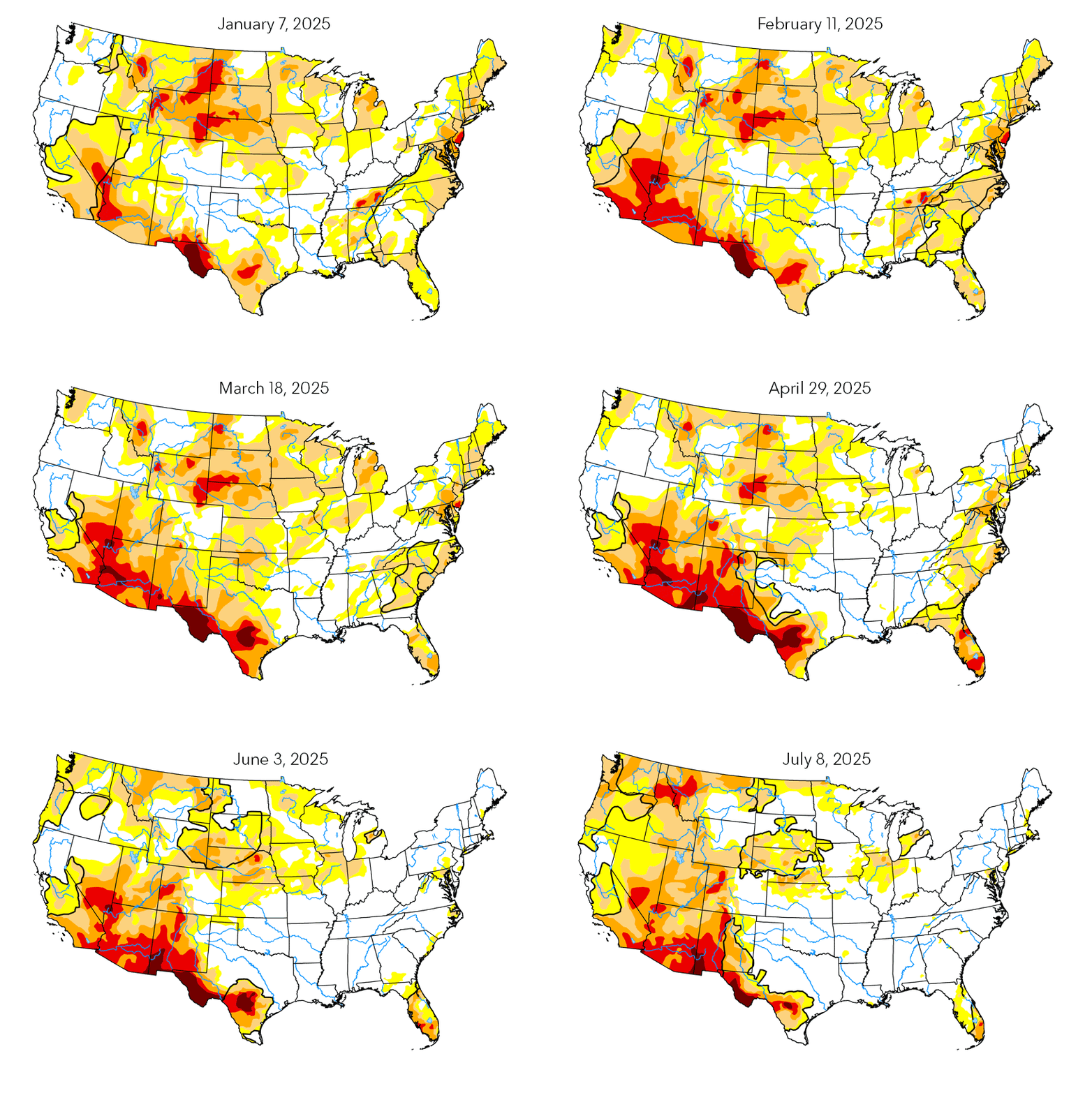
Temperatures in the mid-80s were common across Illinois and Indiana during the week, with highs climbing to the mid- to upper-80s in parts of Ohio. Although spotty showers were reported during the week, most areas remained dry in late August.
With 20-37% of the regional corn crop at the dented stage by Aug. 21, USDA assigned good or excellent ratings to 70% of the acreage in Illinois, 60% in Ohio, and 54% in Indiana. Some 80-88% of the regional soybean crop was setting pods by that date, with good or excellent ratings assigned to 68% of the acreage in Illinois, 59% in Ohio, and 55% in Indiana.
Western Cornbelt:
Thunderstorms were rolling through parts of Iowa at midweek, with reports of brief but heavy rain and strong winds in central and southern areas of the state.
Spotty thunderstorms were also reported across Nebraska as the week advanced, with afternoon highs reaching the mid-80s to low-90s. Similar conditions were reported in Missouri, although with higher humidity as the week progressed.
Good or excellent ratings were assigned to 62-66% of Iowa’s corn and soybeans on Aug. 21, with 30% of the corn crop at the dented stage and 88% of the soybeans setting pods. Nebraska’s corn and soybeans were 42-46% good or excellent, with 39% of the corn dented and 93% of the soybeans setting pods.
Missouri’s corn and soybeans were 49-51% good or excellent, with 55% of the corn dented and 73% of the soybeans setting pods. The state’s cotton crop was 52% good or excellent, while the Missouri rice crop was rated at 53% good or excellent. Nebraska’s sorghum crop slipped to 20% good or excellent on Aug. 21, with 52% of the crop rated as poor or very poor.
Northern Plains:

Temperatures in the upper-70s and low-80s were common across central and southern Minnesota during the week, with spotty afternoon showers reported.
Parts of North Dakota were hit with strong thunderstorms at midweek, with reports of some areas collecting 2-3 inches of rain. A marginal risk of severe weather was in the Black Hills forecast for the end of the week, with forecasts warning of 1-3 inches of rain possible in some areas of South Dakota.
USDA rated 67-68% of the corn crop in Minnesota and North Dakota as good or excellent on Aug. 21, compared with 48% in South Dakota. Minnesota’s soybeans were 67% good or excellent, compared with 55-57% of the crop in the Dakotas. The South Dakota sorghum crop was 40% good or excellent on that date.
The spring wheat harvest was just 18% complete in North Dakota, 30% in Minnesota, and 84% in South Dakota, with good or excellent ratings assigned to 88% of the crop in Minnesota, 74% in North Dakota, and 47% in South Dakota. The barley harvest was also lagging at 28-30% complete in Minnesota and North Dakota, with 68-73% of the crop rated as good or excellent.
Northeast:
Southern New England received more than three inches of rain in some spots early in the week, while southern Maine was under a flash flood warning on Aug. 22 due to rainfall ranging from 1.5 to 3 inches. Portland, Maine, notched a daily record rainfall total on Aug. 22.
Storms also rolled through Pennsylvania on Aug. 22, bringing heavy rain and thunderstorms across the state. Conditions remained hot and humid in Maryland, with temperatures climbing into the 90s as the week progressed.
Crop conditions were varied across the Northeast, depending on summer rainfall, with severe-to-extreme drought conditions present in areas of New England in late August. Pennsylvania’s corn crop was 11% dented by Aug. 21, with 52% of the acreage rated as good or excellent.
Eastern Canada:
Strong thunderstorms tracked through southern Ontario late in the week, while earlier storms hammered Quebec and parts of the Maritimes.
A severe thunderstorm watch was in effect for portions of southern Ontario on Aug. 25, with a tornado watch posted near Milton, Ont. Four days earlier, strong thunderstorms brought heavy rain and hail to southern Quebec, leaving large areas of the province without power late on Aug. 21.
The previous week brought heavy rain to parts of the Maritimes, causing flooding in some locations. Four inches or more of rain fell in parts of Eastern Cape Breton, Nova Scotia, and Keswick Ridge, New Brunswick, on Aug. 17-18.
Sources reported mixed crop conditions in the region in late August, depending on the amount and timing of summer rainfall. “Crops over here look okay, but some are still lacking a bit of moisture,” said one Ontario source. “All in all, I think we will be okay.”
U.S. Gulf:
Colorado Lock repairs are underway from July 26 through Sept. 9, closing the site to navigation daily between 7:00 a.m. and 5:00 p.m. Corps data showed waits up to seven hours during the week.
Bayou Sorrel Lock guidewall construction in progress through February 2023 was noted triggering intermittent transit stoppages between the hours of 6:30 a.m. and 5:00 p.m., Monday through Friday. Normal 24-hour operation was scheduled to resume on Saturday and Sunday. Waits were quoted up to nine hours on Aug. 22.
Repairs underway at the Port Allen Route’s Bayou Sorrel Bridge were reported blocking Monday-through-Thursday traffic from 7:00 a.m. to 11:00 a.m., and again from 1:00 p.m. to 5:00 p.m., through late August.
Draft limits noted at a maximum 10 feet remained in place through the Morgan City, La., area of the Atchafalaya River due to extensive shoaling. In addition to the draft limits at Miles 113-117, tow lengths were capped at 600 feet, with widths limited to 70 feet. Tows running longer than 400 feet were encouraged to travel with an assist tug.
Potentially hazardous underwater pipes observed during a recent hydrograph of the Atchafalaya River were noted stopping movements through Little Island Pass, Middle Island Pass, and Riverside Pass. Tows could avoid the restrictions by running through the Port Allen Route, Coast Guard documents indicated.
Algiers Lock length and width limits continued to restrict unassisted tows to four standard barges or two 30,000 mt tankers per pass, while tows traveling with an assist boat were allowed to lock with longer strings. Intermittent delays were reported in a wide 11-25 hour range during the week.
Construction efforts underway at the Belle Chasse Bridge, located at Mile 3 of the West Canal, triggered intermittent navigation shutdowns lasting up to 12 hours at a time. The project was scheduled to run through the end of the year.
Most Port Allen Lock delays were reported at 5-10 hours, although a small number of vessels required 18-16 hours to pass. Industrial Lock wait times were observed in a wide 6-26 hour range.
Mississippi River:
Falling water levels impacted lower river travel, with the primary effect described as a reduction in maximum tow sizes, depending on vessel horsepower. Tows were reportedly reduced by 10-15% from normal capacity, with northbound drafts capped at 10.5 feet. Draft limits on southbound tows were noted at 11.6 feet between Cairo, Ill., and Rosedale, Miss., but were heard returning to 18 feet from Rosedale to the Gulf.
A flood warning was in place on Aug. 24 for lower Mississippi River tributaries in the Vicksburg, Miss., area. The warnings were due to remain in effect until further notice.
Bank grading work underway since July 7 at Mile 344 was scheduled to conclude on Aug. 24, ending a period of daylight-hour shutdowns for tows running in the downriver direction. The project was expected to move to Mile 336 from Aug. 25 to Sept. 28, triggering intermittent travel shutdowns for the remainder of the operation.
A safety advisory was in place at Miles 228-230 of the lower river due to repairs to the I-10 bridge. The project was expected to trigger intermittent navigation outages through the first half of 2023.
Daytime shutdowns at Old River Lock, which began on July 28, were noted limiting transits daily from 6:00 a.m. to 7:30 p.m. through Aug. 29. Following the end of daytime closures, the lock is scheduled to shut completely for miter gate installation from Aug. 30 through Nov. 13, blocking all travel. Tows seeking access to the Red River during the shutdown can detour through the Atchafalaya River.
Due to the upper Mississippi River’s impending closure for the winter navigation season, barges departing from NOLA and destined for unloading at Dubuque, Iowa, or above were expected to see most final releases during the second week of October, sources indicated. Cargoes headed below Dubuque will continue to depart through the third week of October.
Intermittent Lock 22 wait times were posted in a 4-6 hour range during the week.
Illinois River:
Transit was completely unavailable at Brandon Road Lock through the week due to a repair and maintenance operation in progress at the site since May 9. Access to the lock was scheduled to remain unavailable through Sept. 4, after which overnight-only navigation is slated for Sept. 5-8. Normal locking hours will resume on Sept. 9. Towing widths are limited to 70 feet on all lockages while the project is underway.
Wickets remained up at both Peoria Lock and LaGrange Lock during the week due to low water levels, necessitating continued locking through both locations. Peoria Lock waits were quoted at 17 hours on Aug. 24.
Ohio River:
The Cannelton Lock primary chamber is reportedly shut for miter gate replacement from July 5 through Nov. 11, necessitating passage through the site’s secondary chamber. Most tows were expected to require at least two lockages to pass the location, triggering wait times in the 7-18 hour range.
The Hannibal Lock main chamber is shut to navigation through Oct. 8 due to ongoing miter gate and quoin repairs. Tows were noted passing through the secondary chamber. Work at the site kicked off on July 5.
Waits were observed up to seven hours at Montgomery Lock. Meldahl Lock delays were reported at 14-24 hours on Aug. 23-24.
A salvage operation was planned to block navigation at the Tennessee River’s Miles 169-179 on Aug. 29, triggering expected delays in the 12-24 hour range. The shutdown could repeat on Aug. 31 if unsuccessful on the first go-around.
Kentucky Lock wait times were posted up to 28.5 hours during the week. Boats transiting Wilson Lock faced delays up to nine hours.
Arkansas River:
Norrell Lock shut daytime navigation on Aug. 21 for planned repairs, blocking navigation daily between 7:00 a.m. and 7:00 p.m. through Sept. 21. The closures are scheduled to be repeated on Oct. 20-Nov. 18; Nov. 29-Dec. 23; and Jan. 3-31, 2023. The site is scheduled to undergo a complete shutdown from Sept. 30 through Oct. 9.
Joe Hardin Lock navigation will be subject to daytime closures on Sept. 12-19, and again on Sept. 28-29. A total navigational outage is scheduled for Sept. 30 through Oct. 9.
The Indian government announced this week that all bags of subsidized fertilizer must bear a label identifying the product under the name Pradhanmantri Bhartiya Januvarak Pariyojna. The name change comes as the government rolls out a campaign called “One Nation, One Fertilizer.”
According to a statement released by the government on August 24, all subsidized fertilizer will now be marked by a single brand – for example, Bharat Urea or Bharat DAP. This new design will take up two-thirds of the 45-kg bags. The remaining one-third of the bags will allow space for the manufacturer’s name and logo.
The new bag designs will be put in use beginning October 1. By the beginning of 2023, only the new design will be allowed, giving companies until the end of the year to use up any old bags.
Because all fertilizers are subsidized to some degree – urea being the most dramatic – all bags of fertilizers delivered to farmers will be in the Bharat bags.
Companies have already complained to the local media. The new design, one producer told a local newspaper, gives very little space to the manufacturer. One analyst also said the companies, whether state-owned or private, will now be relegated to the role of contractor for the Indian government. The uniform look of the bags could also weaken loyalty to a particular manufacturer that has worked to build trust with local distributors and farmers.
Political opposition leaders said the move is designed to promote the ruling party. Supporters of the government responded that when the government spends up to US$25 billion in subsidies and controls where the fertilizers can be shipped, it should get some of the credit with the farmers.
The government could possibly get some blame as well. One analyst told a local newspaper that currently if there is a quality problem with a fertilizer, the individual company gets the blame. Under the new plan, the weight of the problem could fall on the government.
First Uranium Resources, Vancouver, B.C., on Aug. 18 reported that it has taken a 17% equity stake in the Diamond Creek organic phosphate rock mine southeast of Salt Lake City, Utah.
The mine is expected to produce 48,000 mt/y in year five, according to majority owner London-based Keras Resources PLC, which is currently reporting monthly sales of about 500 mt, with firm orders for the rest of the quarter. The product is processed at its facility near Spanish Fork.
The project has received organic certification by all three key certification agencies, and as a direct shipping ore (DSO) requires no chemical upgrade process. Keras said the product has in-situ grade of ~28% P2O5, low heavy metal impurities, and significantly higher available phosphate than any other organic rock phosphate in North America. Keras said the project’s premium product can be priced at a competitive level to gain market share, and that it has a modest target of 14% of the North American market in five years.
In the meantime, First Uranium’s wholly-owned subsidiary, Southwind Corp., is conducting a coring campaign in northern Arkansas where it holds agreements on over 1,300 acres, which it said is mostly underlain by a phosphate deposit with strong rare earth element enrichment. It said NI-43-101 Technical Report, undertaken in 2020, based on the current sample assays, local geology, and historical research, has indicated potential in the Southwind holdings of up to 28 million mt of phosphate ore.
Southwind has also been working with a specialist chemical company on the extraction of the rare earth elements from the raw ore using proprietary chelating polymers, and the initial laboratory results are “highly encouraging” for the development of a beneficiation process to extract almost all of the rare earth content early in the phosphate processing, the company noted.
The company also said that it recently decided to conserve cash and reduce the total planned Southwind exploration expenditures due to market conditions. It added that these market conditions have brought multiple new attractive opportunities, which are under consideration.
“We are excited to get drilling at Southwind to test zones of interest,” said First Uranium CEO Robert Debeau. “In parallel, we are delighted at the opportunities that are being presented to us, and we’re examining these opportunities carefully.”
Verde AgriTech, Belo Horizonte, Brazil, announced on Aug. 16 that it has formed a strategic partnership with Latin American agricultural input distributor Grupo Lavoro, under which Lavoro will distribute Verde’s products in Brazil. Verde’s multi-nutrient potassium products, BAKS® and K Forte®, are sold internationally as Super Greensand®. Verde has launched its Bio Revolution technology, which also allows it to incorporate microorganisms to its products.
Verde’s 2022 guidance provides for sales of 1 million mt, with revenue of C$109.09 million, EBITDA of C$49.06 million, and net earnings per share of C$0.87. The 2023 guidance provides for sales of 2 million mt/y.
Verde said it currently operates Plant 1 with a capacity of 600,000 mt/y, with Plant 2 on track for commissioning in third-quarter 2022 with an additional capacity of 2.4 million mt/y. With the addition of Plant 2, Verde said capacity will be over 3 million mt/y and it will be Brazil’s largest potash producer by capacity.
Plant 3’s construction is planned for 2023 and is expected to add 10 million mt/y, which Verde said will allow it to produce up to 16.4% of the current national demand for potash.
SQM Inc.’s second-quarter net income soared to $859.3 million ($3.01 per share), or 857%, compared to the year-ago $89.8 million ($0.31 per share), however, it still missed the analyst average estimate (Bloomberg Consensus), which was $876.8 million. Revenues were $2.6 billion, up 342% over the year-ago $588 million and also topping the analyst estimate of $2.3 billion. Gross profit was $1.3 billion, up from $185.9 million. Adjusted EBITDA was $1.32 billion versus the year-ago $210 million.
“We are very pleased with our results for the first half of the year,” said Ricardo Ramos, SQM CEO. “These results were related to favorable market conditions related to fertilizers, iodine, and lithium, and decades of investment, hard work, R&D, and know-how. In fact, this year we are celebrating 25 years in the lithium industry. During this time, we have become a great partner to the government in this ‘public-private’ alliance with CORFO. As a result of our operations during the first half of the year, over US$2.2 billion are going to public coffers due to the lithium operations.
“We are close to reaching 180,000 mt of lithium carbonate capacity, and as mentioned previously, we are not stopping there,” he added. “Today, we are working to complete a lithium carbonate capacity of 210,000 mt of sought after, top quality, value-added product, which will be produced right here in Chile. We remain committed to reducing our usage of brine and water through technology and continuous innovation. This new capacity will let us produce high value-added lithium products to power more than 5 million electric vehicles.”
Lithium represented 73% of SQM’s six-month gross profit and 40% of revenues. The company said the average lithium price surpassed $54,000 mt, and that sales of electric vehicles in China in June more than doubled the year-ago month. SQM expects lithium demand to grow at least 35% this year, adding that new lithium supply outside of SQM has been delayed and slow to come online.
Second-quarter Specialty Plant Nutrition (SPN) revenues were up 52%, to $330.3 million from the year-ago $217.2 million on higher prices for all products, particularly potassium nitrate, though total SPN volumes were off 22%, to 230,100 mt from 296,200 mt. Potassium nitrate-based volumes were off 21%, to 138,300 mt from 174,300 mt.
SQM said prices increased almost 10% compared to the first quarter, and that as a result of historically high prices, demand in the agricultural potassium nitrate market could decrease about 10% this year compared to global demand last year. As a result, SQM believes 2022 potassium nitrate sales volumes will be lower than 2021.
Six-month SPN revenues were up 47%, to $605.6 million from the year-ago $411.2 million. Volumes were off 24%, at 440,800 mt compared to the year-ago 576,700 mt. Potassium nitrate-based volumes were down 22%, to 262,600 mt from 337,500 mt.
Second-quarter Potassium Chloride and Potassium Sulfate (MOP/SOP) revenues were up 209%, to $182.4 million from the year-ago $59 million. Volumes were off 4%, to 177,600 mt from 184,500 mt.
SQM reported record-level prices in the MOP market with average prices of over $1,000 mt during the quarter, up 28% from the first quarter. However, in recent weeks, it said it had seen higher stock levels in the market that are pressuring prices, especially in Brazil, a market important to the company.
SQM believes average prices could decrease during the remainder of the year compared to those in the second quarter. However, the company still believes 2022 total MOP/SOP sales will reach approximately 750,000 mt.
Six-month MOP/SOP revenues were up 148.6%, to $296.5 million from the year-ago $119.3 million, while volumes were off 17.4%, to 319,300 mt from 386,800 mt.
Company-wide SQM six-month net income was $1.66 billion ($5.80 per share) on revenue of $4.62 billion, up from the year-ago $157.8 million ($0.55 per share) and $1.12 billion, respectively. Gross profit was $2.46 billion, up from $322.5 million, while adjusted EBITDA was $2.51 billion versus $375.1 million.
ADM has expanded its fertilizer terminal in St. Paul, Minn., with the addition of a new 40,000 st fertilizer warehouse and blender to better serve farm-direct and wholesale customers in the Northern Plains and Western Canada.
The new warehouse and blender more than doubles the 30,000 st terminal capacity that ADM has been operating at the St. Paul Port Authority’s Southport terminal since 2006 at a facility leased from Alter Logistics Co. The expansion was completed on July 1, and a ribbon-cutting ceremony was held on Aug. 5.
“The St. Paul facility is the newest leg of our strategy to be a world-class supplier of fertilizer,” said Scott Nagel, President of ADM-Benson Quinn in St. Paul. “It strengthens our global supply chain logistics infrastructure to help ensure we continue to reliably procure and deliver high-quality fertilizer. It is ADM’s robust logistics network that enables us to rapidly respond to changing market conditions like what we have been experiencing over the last year.”
The 40,000 st expansion reportedly includes seven large storage bins for bulk products, three micro bins, and a high-capacity blending and loadout system. ADM received $1.8 million from a Minnesota Department of Transportation port development assistance grant for the project, and just under $1 million from private sources, the Twin Cities Pioneer Press reported.
The new facility is one of 28 river and inland fertilizer terminals operated by ADM across the US and Canada. The company has another Minnesota fertilizer terminal location at Winona.
Ascension Parish, the home of CF Industries Holdings Inc.’s giant Donaldsonville nitrogen complex, is under evaluation as the site for the $2 billion blue ammonia plant planned by CF and Mitsui & Co. Ltd. The initial announcement about the project only stated that the plant would be in the US Gulf Coast region (GM May 6, p. 1).
The export-oriented plant would produce 1.7 million tons per year of blue ammonia. Earlier this month, CF announced a $198.5 million plan to add carbon capture and sequestration capability to its existing ammonia production facility in Donaldsonville (GM Aug. 12, p. 29).
Louisiana Economic Development (LED) announced on Aug. 17 that Ascension Parish was under evaluation. LED estimates the project would result in 311 indirect jobs, for a total of 414 new jobs in the Capital Region. It would create 103 new local jobs, with over $10 million in permanent payroll and significant local economic activity during construction.
LED said to secure the project, the State of Louisiana is offering CF a competitive incentive package that includes the services of LED FastStart, which was recently ranked the No. 1 statewide workforce development program in the nation.
Additionally, CF would be eligible for a performance-based award of up to $6 million to be paid out over four years to reimburse verified project development and infrastructure expenditures. The company is also expected to utilize the state’s Quality Jobs and Industrial Tax Exemption programs.
“This massive proposed investment from CF Industries would create good-paying jobs and strengthen Louisiana’s position as a leader in the clean energy transition,” said Gov. John Bel Edwards. “This would be another big step toward our goal of making Louisiana carbon-neutral by 2050. We thank CF Industries for its continued commitment to Louisiana, and look forward to working with company, parish, and regional economic development leaders to move the project forward.”
“CF Industries has long appreciated the partnership we have had with the State of Louisiana and Ascension Parish, both as we have expanded our operations over the years and now as we decarbonize our production processes and consider new capacity growth. We look forward to working with them further as we continue to evaluate our proposed blue ammonia production facility,” said Tony Will, CF President and CEO.
CF and Mitsui expect to begin a front-end engineering design (FEED) study once the site and technology provider for the new plant are finalized. A FEED study typically takes 9-12 months from the start date to complete.
A final investment decision by the companies is expected to occur in 2023. Construction and commissioning of a new world-scale capacity ammonia plant typically takes approximately four years from that point.
A Presidential Emergency Board (PEB) on Aug. 16 published a report outlining several recommendations to resolve longstanding contract differences between the US Class 1 railroads and 12 unions representing 115,000 rail workers.
The PEB was appointed by President Biden in July to avert a strike after earlier efforts by the National Mediation Board (NMB), an independent federal agency that mediates railroad and other labor agreements, failed to bring the two sides together on disagreements over wages, health care benefits, and scheduling (GM July 15, p. 1).
The PEB recommended a 22% wage increase, along with $5,000 in service recognition bonus payments, over the five-year life of the contract retroactive to Jan. 1, 2020, according to the Trains magazine News Wire.
The board also recommended what it called “modest improvements” in the existing health and welfare benefits package, including the expansion of hearing and speech therapy benefits, while also removing caps on employees’ monthly contributions to their health coverage, Bloomberg Law reported. It also would increase coverage for travel costs when rail workers are assigned to work away from home, among other changes.
The recommended 22% wage hike, which is the largest general wage increase for rail workers in nearly 40 years, is below the 28% increase that the unions sought, but above the railroads’ 16% proposed wage hike. The unions and the railroads have been trying to reach a contract for more than two years and were $9 billion apart in their wage proposals, the PEB report noted.
The PEB asked the railroads and unions to continue negotiations over issues regarding engineer and conductor scheduling. If no agreement can be reached, the report recommends the matter be referred to binding arbitration.
“The Board hopes that this may prove to be a ‘win-win’ in which the Carriers obtain a more efficient and reliable system for manning the locomotives, with both operational benefits and cost savings, and employees will obtain preferred schedules with more control over their personal lives when not otherwise scheduled,” the report said.
After its appointment on July 18, the PEB was given 30 days to come up with recommendations. The publication of the report now triggers a second 30-day cooling off period between the railroads – including BNSF Railway, CSX Transportation, Kansas City Southern, Norfolk Southern, and Union Pacific – and the unions. During this period, no work stoppage or lockout can be ordered.
The PEB’s recommendations are not binding for either party. If the plan is rejected, the workers will be free to strike at the conclusion of the 30-day period, Bloomberg Law reported, but Congress can intervene by passing legislation to require the parties to extend talks, or to even force a resolution.
The Association of American Railroads (AAR), which represents major freight carriers, applauded the PEB report as a “useful basis to reach a resolution,” and said the industry was prepared to propose agreements based on the recommendations. “In the interests of all rail stakeholders, now is the time for railroads and their unions to reach a contract,” AAR President and CEO Ian Jefferies said in a statement.
The Transport Workers Union of America declined to comment on the recommendations. In a statement to Bloomberg Law, freight railroad Union Pacific, however, said “it is in the best interest of all stakeholders for the parties to reach agreements that provide our employees with well-deserved pay increases and prevent rail service disruptions.”