

Cornbelt:
The NPSZ market remained at $875-$905/st FOB in the Cornbelt, depending on location.
Pacific Northwest:
40-Rock was steady at $900/st FOB or DEL in the Pacific Northwest.
Cornbelt:
The NPSZ market remained at $875-$905/st FOB in the Cornbelt, depending on location.
Pacific Northwest:
40-Rock was steady at $900/st FOB or DEL in the Pacific Northwest.
California:
The granular SOP market was reported at $950-$1,000/st FOB Stockton, depending on supplier. An earlier 3Q fill program at the $900-$920/st FOB level has reportedly ended.
Pacific Northwest:
Granular SOP pricing was unchanged at $990/st FOB in Washington.
California:
The granular SOP Magnesia market was steady at $645/st FOB in California for the last confirmed offers.
Pacific Northwest:
The granular SOP Magnesia market remained at the $660/st FOB level in the Pacific Northwest in mid-August.
California:
Potassium nitrate prices in California were unchanged at $1,430/st FOB Stockton for bulk tons, $1,535/st FOB for bulk bags, and $1,555/st FOB for 50-pound bags.
Eastern Cornbelt:
Potassium thiosulfate pricing was unchanged at $780/st FOB Terre Haute for the last confirmed offers.
California:
The potassium thiosulfate market remained at $780/st FOB Sacramento for the last offers.
Eastern Cornbelt:
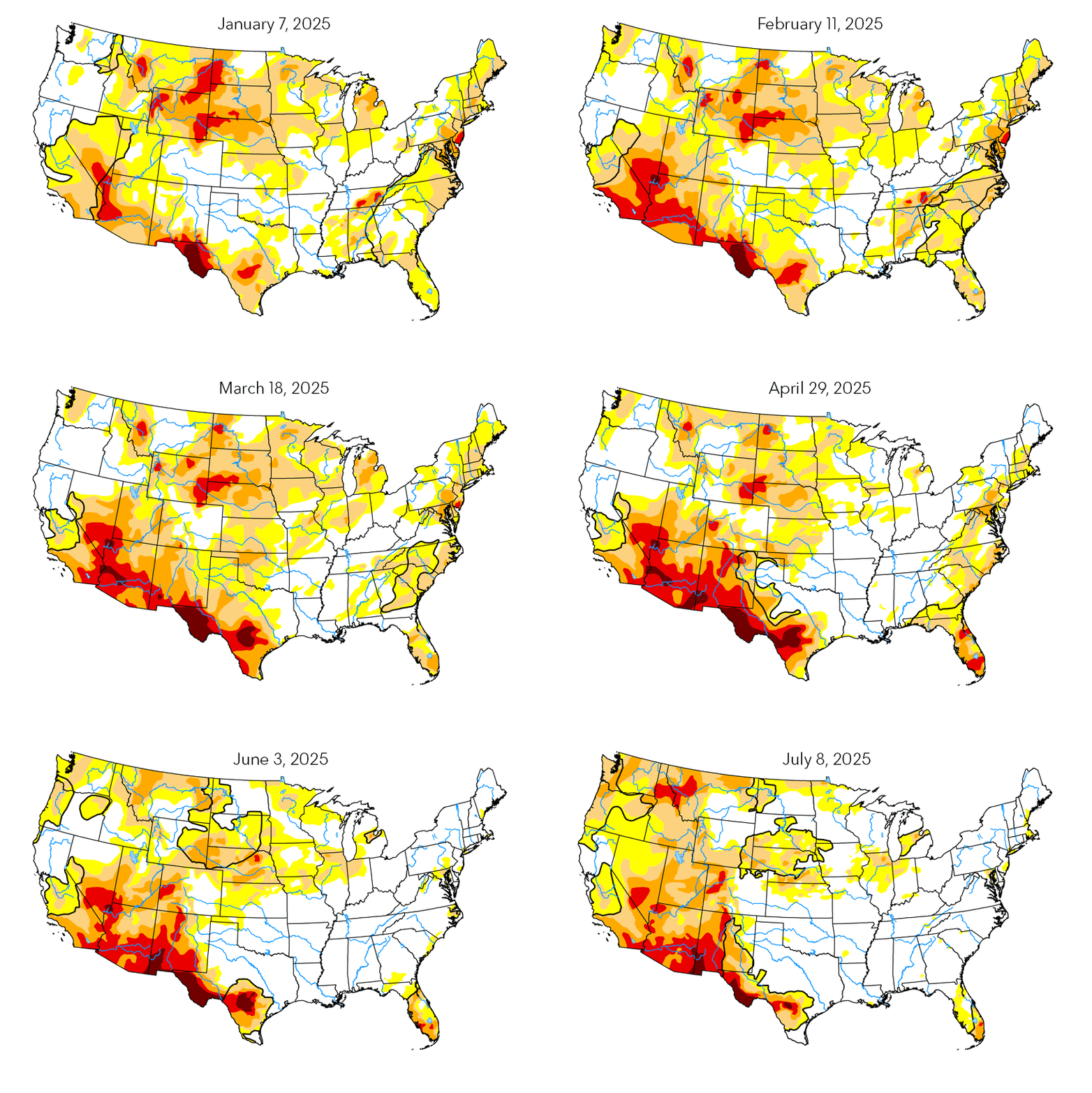
Dry, hot weather continued across central Illinois during the week, but cooler weather settled over Indiana and Ohio, with midweek highs reported in the upper-70s and low-80s. Spotty showers were reported across northern Ohio early in the week.
With 8-12% of the regional corn crop at the dented stage by Aug. 14, USDA assigned good or excellent ratings to 73% of the acreage in Illinois, 58% in Ohio, and 54% in Indiana. Some 71-74% of the regional soybean crop was setting pods by that date, with good or excellent ratings assigned to 69% of the acreage in Illinois, 59% in Ohio, and 54% in Indiana.
Western Cornbelt:
Heat and humidity sparked an increased chance of thunderstorms across parts of Iowa and Nebraska as the week progressed.
Forecasts warned of possible severe thunderstorms in southeastern Nebraska late on Aug. 18. The threat was expected to move into Iowa on Aug. 19, carrying a risk of strong winds, large hail, and tornadoes.

Corn and soybean conditions were down from the previous week, with good or excellent ratings assigned on Aug. 14 to 63-66% of Iowa’s crop and 46-48% of the acreage in Missouri and Nebraska. Nebraska’s sorghum crop slipped to 21% good or excellent, with 46% of the crop rated as poor or very poor.
Missouri’s cotton and rice were reported at 48% and 53% good or excellent, respectively, with 71% of the rice crop headed.
California:
Temperatures soared to the upper-90s and triple digits across much of California during the week, prompting a statewide Flex Alert on Aug. 17 asking residents to conserve electricity. Highs in the low-triple digits were reported across the Central Valley, with temperatures in the San Joaquin Valley reaching 104-108 degrees.
The entire state remained under drought conditions ranging from severe to exceptional, with a wide band of extreme-to-exceptional drought extending from Central California up to the Oregon border.
Good or excellent ratings were assigned to fully 95% of California’s cotton crop on Aug. 14, along with 80% of the acreage in Arizona. California’s rice crop was 80% headed by that date, with 75% of the acreage rated as good or excellent.
Pacific Northwest:
High heat was reported across much of the Pacific Northwest in mid-August, along with smoky conditions in some areas from a number of wildfires burning in the region.
A heat advisory was in effect at midweek for Portland, Ore., and the Willamette Valley, with highs in the mid- to upper-90s. Heat advisories were also posted for southern Idaho, with highs pushing into the triple-digits in some locations.
A Red Flag fire warning was also in effect for southern Oregon and much of western Washington, with drought conditions ranging from moderate to exceptional reported across central and southern Oregon and portions of southern Idaho. A patch of extreme-to-exceptional drought was also present in north-central Montana in mid-August.
The regional winter wheat harvest had progressed to 71-82% complete in Montana and Oregon by Aug. 14, compared with 28% in Idaho and 45% in Washington. The spring wheat harvest was rated at 26% complete in Montana and 14% in Idaho and Washington, while the barley harvest had progressed to 40% in Montana and 24-29% in Idaho and Washington.
Good or excellent ratings were assigned to fully 97% of Washington’s spring wheat and barley on Aug. 14, compared with 68-75% in Idaho and 37-38% in Montana.
Western Canada:
High temperatures and spotty thunderstorms were reported across Western Canada during the week. Southern Manitoba was hit with severe thunderstorms on Aug. 15 that produced strong winds and heavy rain, with some areas collecting nearly four inches of rain.
A heatwave in British Columbia pushed temperatures to record-level highs in multiple locations during the week. While many areas saw temperatures hit the low-30s C, both Pemberton and Lillooet notched highs in the 37-38 C range on Aug. 17. Heat warnings were also in effect for nearly all of Alberta at midweek.
Harvest activities were kicking off in some parts of the Prairies at mid-month. Harvest progress was estimated at 5% complete in Saskatchewan on Aug. 18, just behind the five-year average of 8%, with southwestern areas of the province leading at 17% complete at mid-month.
U.S. Gulf:
Work in progress at Colorado Lock was expected to shutter navigation from 7:00 a.m. to 5:00 p.m., Monday through Friday, until Sept. 9. Intermittent delays were noted in a wide 5-20 hour range through the week.
A dredging operation running on a 24-hour schedule since July 13 was expected to wrap up on Aug. 15. The effort was noted impacting travel through Algiers Lock, Industrial Lock, and Harvey Lock.
Guidewall replacement work that restarted on Aug. 1 at Bayou Sorrel Lock was projected to limit Monday-through-Friday lockages between 6:30 a.m. and 5:00 p.m. The operation was loosely scheduled to run into February 2023. Waits were posted up to 11.5 hours early in the week.
Bayou Sorrel Bridge repairs that resumed in early July were expected to block Monday-through-Thursday transit between 7:00 a.m. and 11:00 a.m., as well as 1:00 p.m. to 5:00 p.m., through the second half of August.
Draft limits persisted at Miles 113-117 of the Atchafalaya River due to “extensive” shoaling in the Morgan City, La., area, particularly at Miles 115.5-117, a Coast Guard safety bulletin indicated. Drafts were restricted to a maximum 10 feet through the area, while tow lengths and widths were limited to 600 feet and 70 feet, respectively. Tows measuring longer than 400 feet were advised to travel with an assist vessel.
Following a recent hydrograph of the Atchafalaya River, navigation was made completely unavailable through Little Island Pass, Middle Island Pass, and Riverside Pass due to the discovery of potentially hazardous underwater pipes. Tows can bypass the river’s restrictions via a detour through the Port Allen Route.
Length and width restrictions continued on unassisted passes through Algiers Lock, capping lockages to four standard barges or two 30,000 mt tankers per turn. Larger passes were possible when utilizing an assist boat. Delays were noted topping out at around 6.5 hours early in the week.
An ongoing construction project at the Belle Chasse Bridge, scheduled to continue through the end of the year, prompted expectations of intermittent wait times lasting up to 12 hours. The bridge is located at the West Canal’s Mile 3.
Port Allen Lock waits were observed up to nine hours during the week. While most Industrial Lock wait times were noted at 4-10 hours, intermittent delays were seen spiking up to 24-28 hours. Waits topped out around five hours through Brazos Lock.
Mississippi River:
Hot weather returned to the lower Mississippi River during the week, slowing some outdoor commercial navigation-related activities such as barge loading and maintenance. A heat advisory on Aug. 17 warned of a 110-degree heat index for parts of northeastern Louisiana and central Mississippi.
Bank-grading activities in progress since early July at Miles 336-344 were heard blocking most southbound travel through the area daily from 7:00 a.m. to 5:00 p.m. Vessels were assessed for possible daytime travel on a case-by-case basis.
Repairs to the I-10 bridge underway at Miles 228-230 triggered a blanket safety advisory for all boats passing the area. Intermittent navigation stoppages were also possible. The project was expected to run seven days per week through June 2023.
Old River Lock, located at Mile 305 on the lower river, was reported shut to daytime navigation through Aug. 29, blocking travel daily between 6:00 a.m. and 7:30 p.m. The shutdowns were described as a precursor to planned miter gate installation scheduled for Aug. 30 through Nov. 13. That shutdown will block all navigation through the site, forcing tows looking to access the Red River to detour through the Atchafalaya River while the project is underway.
Final loading windows for barges departing from NOLA for upper-river destinations were generally slated for October, sources indicated. Final tows destined for Dubuque, Iowa, and above were expected to release in the second week of October, while loads heading south of Dubuque were expected to see final departures in the third week of October.
Illinois River:
Repairs begun on May 9 and scheduled through Sept. 8 at Brandon Road Lock significantly impacted movements through the site. Lockages were limited to overnight hours only through Aug. 14.
Starting on the morning of Aug. 15, the site was closed to all traffic until Sept. 4. Overnight-only travel is scheduled to resume on Sept. 5-8, after which standard operating hours will return on Sept. 9. A 70-foot width limit is in effect for the entirety of the operation. Prior to the Aug. 15 shutdown, delays were reported up to 48 hours.
Wickets were reported in the raised position at both Peoria Lock and LaGrange Lock during the week, necessitating lockages through the site. Delays were noted up to 15.5 hours at Peoria, while minimal waits were reported at LaGrange. Marseilles Lock waits ranged from 2-5 hours through the week.
Ohio River:
The Cannelton Lock main chamber is reportedly shut for repairs and maintenance from July 5 until Nov. 11, triggering passages through the site’s auxiliary chamber. Most tows require at least two passes to clear the lock, resulting in wait times of 12-15 hours on Aug. 17, Corps data indicated. Sporadic delays were shown as high as 23.5 hours.
Repairs to the Hannibal Lock primary chamber miter gate and quoin, in progress since July 5, necessitated a complete main chamber shutdown, prompting detours through the secondary chamber until Oct. 8. The operation resulted in minimal delays during the week.
Intermittent six-hour delays were reported at R.C. Byrd Lock during the week.
Wait times at the Tennessee River’s Kentucky Lock peaked at 40 hours on Aug. 13-15. Daylight-only restrictions reported on southbound travel through Wilson Lock prompted delays up to 11 hours, according to Corps data.
The Pickwick Lock main chamber is reportedly shut to navigation due to a potential structural issue discovered in May, forcing tows to pass through the secondary chamber. Nominal delays were reported through the week.
Arkansas River:
Daylight-hour travel shutdowns at Norrell Lock were scheduled to resume on Aug. 21 and run through Sept. 21, leaving travel unavailable daily from 7:00 a.m. to 7:00 p.m. during that time. The travel outages are due to repeat on Oct. 20-Nov. 18; Nov. 29-Dec. 23; and Jan. 3-31, 2023. Navigation will be completely unavailable between Sept. 30 and Oct. 9.
Joe Hardin Lock will close to transit from 7:00 a.m. to 7:00 p.m. on Sept. 12-19, and again on Sept. 28-29. Navigation through the site is scheduled to be completely unavailable Sept. 20 through Oct. 9.
Kalium Lakes Ltd., Balcatta, Western Australia, on Aug. 18 announced that it has received firm commitments from investors for a two-tranche placement of fully paid ordinary shares to raise A$22 million (before costs). The placement will comprise the issue of approximately 550 million new shares at a price of A$0.04 per share. The price represents a 56.5% discount to the last traded price of A$0.092 per share on Aug. 9.
Kalium will also offer all of its existing eligible shareholders the opportunity to subscribe for up to a maximum of A$30,000 worth of shares at an offer price of A$0.04 per share under a share purchase plan (SPP) to raise up to an additional A$8 million. The SPP is subject to the company obtaining shareholder approval for the issue of shares under the SPP.
Kalium’s largest shareholder, Greenstone Resources, has committed to take up to A$8 million under the placement. Greenstone’s participation in tranche two of the placement is subject to the company obtaining shareholder approval. Co-founder and Director Brent Smoothy has also committed to subscribe for A$2 million under the placement, pending shareholder approval.
Kalium said the capital raising is being undertaken to fund additional working capital during ramp-up of Kalium’s Beyondie Sulfate of Potash Mine (BSOPM), which targets an initial production target run-rate of 80,000 mt/y by first-quarter 2023, and to assist in the expansion of the BSOPM to 120,000 mt/y production run-rate, which is targeted to be achieved by third-quarter 2024. It said additional working capital is primarily required due to the delayed production profile for BSOPM.
Kalium also said it has successfully negotiated the terms of a debt restructure with its two senior lenders, KfW IPEX-Bank and the Northern Australia Infrastructure Facility, to facilitate the expansion to 120,000 mt/y. As part of the debt restructure, the existing royalty holders of the company have also agreed to subordinate and defer the payment of their royalties.
“We are pleased to have successfully undertaken the debt restructure and received firm commitments for the necessary additional equity injection,” said Kalium CEO Len Jubber. “This places the business in a position to now deliver on the targeted ramp-up profile at Beyondie, commencing with the full restart of the SOP process plant in September. I would like to thank our financiers and major shareholders for their support in this process, as well as welcome all new shareholders to the Kalium register.”
The trading of Kalium shares were temporarily suspended Aug. 9 on the Australian Securities Exchange pending the announcements and resumed on Aug. 18.
Ostara, Vancouver, announced on Aug. 8 that Kerry Cebul has been named CEO. The company said he has 15 years of experience building and investing in organizations to scale sustainable solutions in agriculture and energy markets.
He joins Ostara from Grosvenor Food & AgTech, where he supported the firm’s expansion into the US. Prior to Grosvenor, he was a founding member of a sustainable farmland investment and management firm, SLM Partners’ North American grains fund.
Prior to SLM, he helped build and run the investment advisory arm of The Cleantech Group. There he supported Fortune 500 companies in making venture capital investments in sustainable energy and agriculture startups.
“Kerry’s skills are highly complementary to the existing executive team and will enable the company to realize its vision of global expansion as we continue to increase production of Crystal Green phosphate fertilizer and its portfolio of products,” said Monty Bayer, Executive Chairman of Ostara’s Board of Directors, who had been serving as Interim CEO. “With Kerry’s extensive experience in bringing new businesses into the marketplace and connection to US agriculture, his leadership will be crucial as we become a key global fertilizer producer.”
“Farmers are looking for options to help them increase yield, embrace sustainability, and decrease costs. Ostara’s highly efficient phosphate fertilizers improve farm economics while producing healthier, more sustainable crops,” said Cebul. “I am excited to join the team as we significantly expand production of our Crystal Green product to meet farmer demand with the addition of a new production facility in St. Louis, Mo.”
Itafos Inc., Houston, announced that Matthew O’Neill has been named CFO, succeeding George Burdette, who is stepping down to pursue other interests. O’Neill has more than 25 years of experience in financial management, corporate development, planning, treasury, insurance, risk management, and financial reporting.