

Cornbelt:
The NPSZ market was quoted at $875-$905/st FOB in the Cornbelt, depending on location.
Pacific Northwest:
40-Rock was posted at $900/st FOB or DEL in the Pacific Northwest.
Cornbelt:
The NPSZ market was quoted at $875-$905/st FOB in the Cornbelt, depending on location.
Pacific Northwest:
40-Rock was posted at $900/st FOB or DEL in the Pacific Northwest.
California:
The granular SOP market was generally reported at $950-$1,000/st FOB Stockton, depending on supplier, although sources said a 3Q fill program was out from one supplier at the $920/st FOB level for contracts.
Pacific Northwest:
Granular SOP pricing was unchanged at $990/st FOB in Washington.
California:
The granular SOP Magnesia market was steady at $645/st FOB for the last confirmed offers in California.
Pacific Northwest:
The granular SOP Magnesia market remained at the $660/st FOB level in the Pacific Northwest in late July.
California:
Potassium nitrate prices in California were unchanged at $1,430/st FOB Stockton for bulk tons, $1,535/st FOB for bulk bags, and $1,555/st FOB for 50-pound bags.
Eastern Cornbelt:
Potassium thiosulfate pricing was unchanged at $780/st FOB Terre Haute, Ind., for July offers.
California:
The potassium thiosulfate market remained at $780/st FOB Sacramento for the last offers.
Eastern Cornbelt:
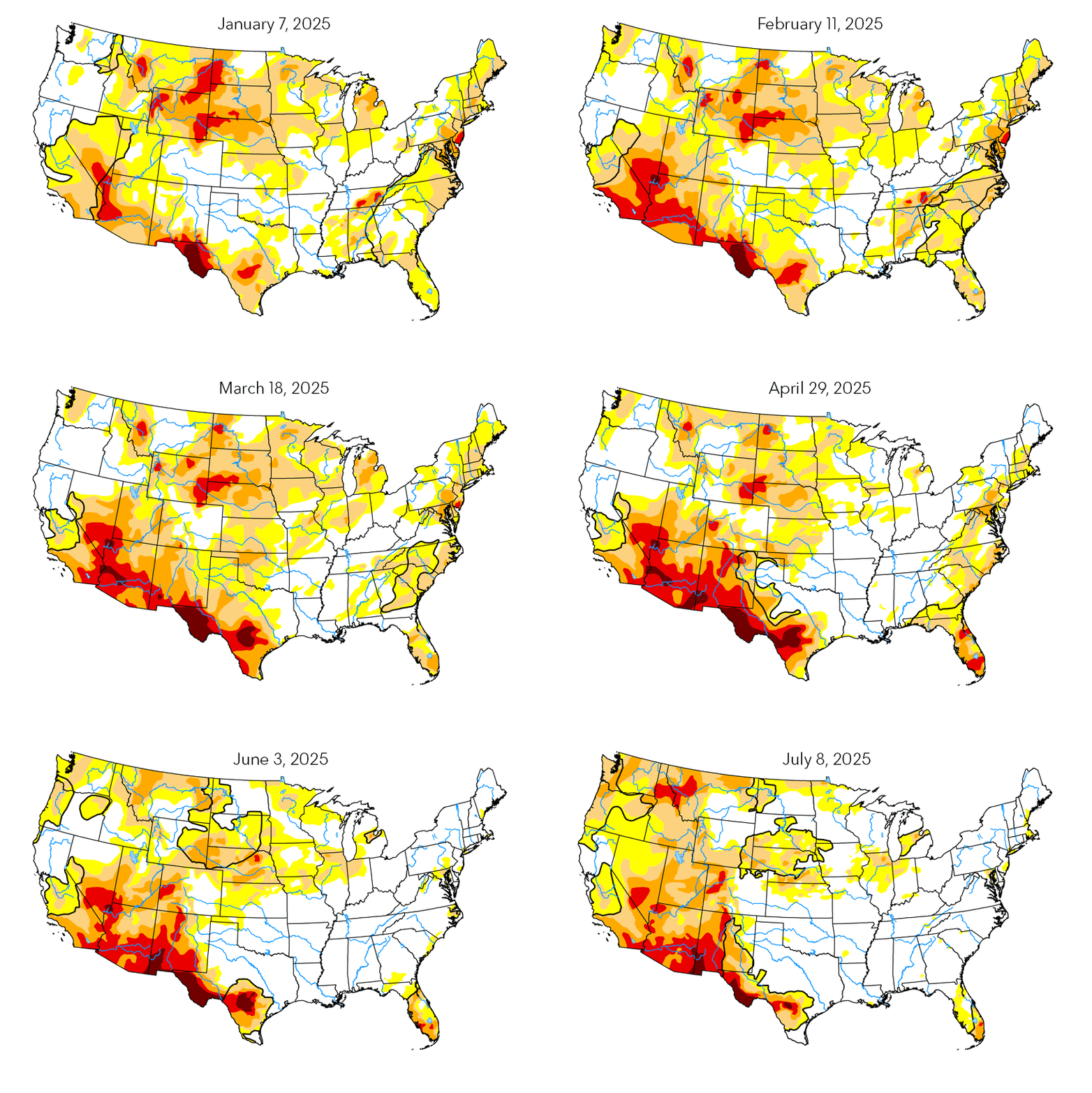
Highs in the low- to mid-80s were common across the Eastern Cornbelt during the week, providing welcome relief from the previous week’s scorching heat and humidity.
Although most areas enjoyed mostly dry conditions, scattered thunderstorms were reported in all three states as the week progressed, with temperatures dropping to the upper-70s in northern Ohio by the end of the week.
Good or excellent ratings were assigned to 71% of the Illinois corn crop on July 24, along with 61% of the state’s soybeans. Ohio’s crop conditions improved from the previous week, with 54-55% of the corn and soybeans reported as good or excellent. Indiana’s corn and soybeans were rated at 46-48% good or excellent in late July.
Western Cornbelt:
Temperatures across Iowa were in the mid-80s during much of the week, with spotty thunderstorms reported as the week progressed.
Similar conditions were observed in Nebraska, although some strong thunderstorms were reported in the panhandle and central Nebraska at midweek, with reports of hail and damaging winds in some locations.

In Missouri, a record amount of rain on July 25-26 sparked widespread flooding in the St. Louis area, causing the death of at least one person and the rescue of more than 100 residents. More than 9 inches fell in St. Louis, the greatest single day total for the city in more than 100 years, with 7 inches falling in just six hours.
Fully 75-80% of Iowa’s corn and soybeans were rated as good or excellent on July 24, compared with 57-60% in Nebraska and 46-53% in Missouri. All three states experienced crop quality declines from the previous week, which carried over into Nebraska’s sorghum crop, which sunk to 39% good or excellent from the prior week’s 50%. Missouri’s cotton and rice were reported at 53% and 56% good or excellent, respectively.
California:
Drought conditions ranging from severe to exceptional continued to cover nearly all of California, with the driest areas reported in Central California.
Parts of the state were also experiencing unusually hot temperatures in late July. Highs in Northern California were expected to reach 100-113 degrees in the northern Sacramento Valley on July 28-29, and possibly as high as 115 degrees in Trinity County. Local reports said overnight lows in those areas were only falling to the low-80s and high-70s.
Good or excellent ratings were assigned to fully 95% of California’s cotton and rice crops on July 24, along with 80% of the cotton acreage in Arizona.
Pacific Northwest:
Heat advisories and excessive heat warnings were in effect for much of Oregon, Washington, and the Idaho panhandle during the week.
Highs climbed to 102 degrees in Portland and 94 degrees in Seattle on July 26, and Portland was bracing for another triple-digit high on July 29. The heat spell was expected to last into the weekend, and extended to western Washington as well.
Southern Idaho and much of Montana also experienced blistering heat during the week, including multiple days of triple-digit highs across southwestern Idaho.
The regional winter wheat harvest had progressed to 18% complete in Montana and Oregon by July 24, compared with 2-5% in Idaho and Washington. Good or excellent ratings were assigned to fully 96% of Washington’s spring wheat and barley, along with 63-68% of the acreage in Idaho and 35-43% in Montana.
Western Canada:
Strong thunderstorms were reported in parts of Manitoba and Saskatchewan in late July, prompting warnings of high winds. Temperatures were building across the region as the week progressed, with highs climbing from the mid-20s C into the 30s. Excessive heat warnings were posted for nearly all of Alberta at midweek.
Overall crop conditions as of mid-July were rated at 75% good or excellent in Alberta, above the provincial five-year average of 65%, although some areas reported significant hail damage from July thunderstorms. Hail damage is also prevalent across Saskatchewan and Manitoba, with crop conditions described as variable.
U.S. Gulf:
Port Allen Lock experienced intermittent daytime shutdowns on July 25-26 due to lock equipment installation. A small number of additional shutdowns were expected to be announced at a later date. Wait times were quoted up to nine hours ahead of the project’s start.
Colorado Lock repairs scheduled for July 26 through Sept. 9 were projected to limit daylight access to the site daily between 7:00 a.m. and 5:00 p.m.
Brazos Locks navigation was blocked on weekdays between 7:00 a.m. and 5:00 p.m. due to repairs and maintenance. The project was expected to run through at least July 29, although an extension was possible. Normal access hours resumed on Saturday and Sunday. Weekday delays were noted up to 16 hours.
Intermittent daylight shutdowns were expected at Port Allen Lock on July 20-30, potentially blocking travel for up to 12 hours or more. Wait times were observed up to seven hours on July 25.
Wide-ranging dredging work in progress since the third week of July was expected to cause sporadic travel shutdowns at Algiers Lock, Industrial Lock, and Harvey Lock through mid-August.
Travel through the bridge at Mile 231 in the West Canal was reportedly unavailable daily between 5:00 a.m. and 9:00 a.m., and again from 3:00 p.m. to 7:00 p.m.
Calcasieu Lock maintenance on July 18-29 blocked Monday-through-Thursday travel between 7:00 a.m. to 12:00 p.m., and again from 1:00 p.m. to 5:30 p.m. Calcasieu Lock is located at Mile 238.5 in the West Canal.
Bayou Sorrel Lock guidewall construction scheduled through February 2023 remained paused for the week, but was generally expected to resume on Aug. 1. Once begun, weekday lock access is anticipated to be unavailable between the hours of 6:30 a.m. and 5:00 p.m., with 24-hour operation scheduled to resume on Saturday and Sunday.
Repairs underway at the Bayou Sorrel Bridge, located at Mile 37 of the Port Allen Route, were set to block Monday-through-Thursday traffic from 7:00 a.m. to 11:00 a.m. and from 1:00 p.m. to 5:00 p.m. The project was expected to run into second-half August.
Ten-foot draft limits remained in place through the Atchafalaya River’s Morgan City area due to extensive shoaling. In addition to the draft limits, tow lengths were capped at 600 feet, while widths were permitted up to 70 feet. Tows longer than 400 feet were advised to travel with an assist tug.
The discovery of potentially hazardous underwater pipes forced a complete travel shutdown through Little Island Pass, Middle Island Pass, and Riverside Pass. Vessels could bypass the restrictions entirely via a detour through the Port Allen Route, Coast Guard documents indicated.
Algiers Lock length and width limits effectively restricted unassisted tows to four standard barges or two 30,000 mt tankers per turn, although tows traveling with an assist vessel were able to lock with larger barge counts. Intermittent delays were noted up to 14 hours during the week.
Construction underway at the West Canal’s Belle Chasse Bridge, located at Mile 3, was expected to trigger intermittent navigation outages up to 12 hours at a time. The project will be in progress through the end of the year.
Industrial Lock delays were reported up to 26 hours during the week.
Mississippi River:
Dangerous heat levels once again impacted river operations in some areas of the Mississippi River Valley, prompting slowdowns in barge travel, loading activities, and other outdoor commercial and navigation-related efforts. A heat advisory on July 27 warned of a 105-110 degree heat index in northeast Louisiana, southwest Arkansas, and parts of western Mississippi.
Low water levels continued to hamper travel on the lower river, limiting drafts and cutting towing capacity. Drafts continued to be heard at a maximum 10.5 feet on northbound travel, while boats moving downriver were permitted up to 12.5 feet of draft. Maximum tow lengths were reduced by 10-15%.
Channel maintenance in progress through Aug. 7 was noted limiting southbound, daytime travel at Miles 336-337. Navigation was projected to be unavailable daily between 7:00 a.m. and 5:00 p.m.
Power line work at Mile 107 was scheduled to conclude on July 27, beyond the project’s original July 20 end date. Daytime travel was operating on a one-way pattern daily between 4:00 a.m. and 7:00 a.m., and again from 1:00 p.m. to 4:00 p.m., while transit was completely unavailable from 7:00 a.m. to 1:00 p.m.
The Corps launched revetment activities at the lower river’s Mile 932. Tows traveling downriver were expected to be limited to 15 barges during daylight hours, with larger tows waiting until nightfall to pass. Delays were expected up to 12 hours.
Old River Lock was scheduled to begin daytime shutdowns on July 28, limiting locking availability daily from 6:00 a.m. to 7:30 p.m. through Aug. 29. The lock is then expected to shut entirely for miter gate installation from Aug. 30 through Nov. 13, blocking all movement through the site. Tows seeking access to the Red River during this time should detour through the Atchafalaya River.
Wait times were noted up to 5.5 hours at Lock 12. Lock 14 delays peaked at 7-14 hours on July 26, and Corps data showed 4-6 hour delays at Lock 17 during the week. Wait times were noted up to six hours at Mel Price Lock.
Illinois River:
Repair and maintenance work since May 9 at Brandon Road Lock continued to slow movements through the site during the week. Navigation was limited to overnight hours through Aug. 14, while a complete shutdown of the site will make transit unavailable from Aug. 15 through Sept. 4.
Overnight-only navigation at Brandon Road Lock will resume on Sept. 5-8, after which normal locking hours are projected to return on Sept. 9. Widths were limited to 70 feet on all lockages while the project is underway. Wait times were seen up to 14 hours through the week.
Wickets were reported up at both Peoria Lock and LaGrange Lock during the week, requiring lockages through both locations.
Ohio River:
McAlpine Lock, located in the Louisville, Ky., area at Mile 607, was reportedly shut to daylight travel on July 18-23 due to lock inspections, pushing delays to 12 hours or more.
Olmsted Lock maintenance prompted alternating closures between the primary and auxiliary lock chambers, starting on July 18. The project was slated to continue through Aug. 6, with minimal delays expected.
The Cannelton Lock main chamber is shut for miter gate replacement through Nov. 11, triggering travel through the secondary chamber. Most tows were expected to require multiple lockages to clear the site, triggering delays in the 8-28 hour range.
The main chamber at Hannibal Lock is closed to navigation through Oct. 8. Tows were heard passing through the auxiliary chamber, with minimal delays reported.
On the Tennessee River, Kentucky Lock wait times were observed in the 8-31 hour range during the week. Kentucky Lock is working through a long-term construction project anticipated to last until the end of 2024. Sporadic Pickwick Landing Lock wait times were noted at 4-8 hours, while delays at Wilson Lock were recorded up to 2.5 days over the weekend.
The Cumberland River’s Cheatham Lock is engaged in repairs through Aug. 5, with substantial delays expected. Navigation through the site was reported to follow an 11-days closed, three-days open pattern, set to repeat through the end of the operation.
Arkansas River:
Norrell Lock is set to close to daytime navigation on Aug. 1-10 for planned repairs and maintenance, blocking travel daily between 7:00 a.m. and 7:00 p.m. The closures are projected to repeat on Aug. 21-Sept. 21; Oct. 20-Nov. 18; Nov. 29-Dec. 23; and Jan. 3-31, 2023. A complete shutdown of the site is scheduled for Sept. 30 through Oct. 9.
Joe Hardin Lock will undergo a daytime navigation shutdown on Sept. 12-19, and once more on Sept. 28-29. A total closure of the site is scheduled for Sept. 20 through Oct. 9.
The U.S. International Trade Commission (ITC) on July 18 determined that the U.S. UAN industry is not materially injured or threatened with material injury by reason of imports of UAN from Russia and Trinidad and Tobago that the U.S. Department of Commerce (DOC) has determined are subsidized and sold in the U.S. at less than fair value (GM June 24, p. 1).
The vote was unanimous. Chairman David S. Johanson and Commissioners Rhonda K. Schmidtlein, Jason E. Kearns, Randolph J. Stayin, and Amy A. Karpel voted in the negative.
ITC said that as a result of the negative determinations, DOC will not issue countervailing duty orders and antidumping duty orders on imports of this product from Russia and Trinidad and Tobago.
“This comes as a welcome relief,” said National Corn Growers Association (NGCA) President Chris Edgington. “We have been sounding the alarms and telling the ITC Commissioners that tariffs will drive up input prices to even more unaffordable levels for farmers and cripple our supply. I am so glad they listened.”
In addition to NGCA, other ag trade groups, including the Agricultural Retailers Association, Russian and Trinidad producers, U.S. importers and marketers, and several Members of Congress, sought a negative vote, citing record high fertilizer prices, UAN producer profits, and industry consolidation.
“We are disappointed that the International Trade Commission has determined the U.S. UAN industry has not been harmed by the unfair trade practices from state-subsidized entities underpinning UAN imports from Russia and Trinidad that were clearly established through thorough and impartial investigations by the U.S. government,” said Tony Will, CF President and CEO.
“Unfortunately, this outcome will perpetuate an unlevel playing field for a domestic industry that has invested billions of dollars in the U.S. to ensure American farmers have a reliable source of UAN fertilizer,” he added.
CF reiterated that DOC’s June decision found that imports from Russia are dumped (i.e., sold at less than fair value) at rates ranging from 8.16%-122.93%, and unfairly subsidized at rates ranging from 6.27%-9.66%. In addition, it noted that DOC found that imports from Trinidad are dumped at a rate of 111.71% and unfairly subsidized at a rate of 1.83%.
The ruling sent CF shares tumbling as much as 4.9% in New York on July 18. However, the downward momentum was only temporary, and shares were back up for the July 19 close. CF filed the petition for the U.S. to impose duties in June 2021 (GM July 2, 2021).
The Commission’s public report Urea Ammonium Nitrate Solutions from Russia and Trinidad and Tobago [Inv. Nos. 701-TA-668-669 and 731-TA-1565-1566 (Final), USITC Publication 5338, August 2022] will contain the views of the Commission and information developed during the investigations. The report will be available by Aug. 22, 2022; when available, it may be accessed on the USITC website at http://pubapps.usitc.gov/applications/publogs/qry_publication_loglist.asp.
In the meantime, ITC’s 2021 decision (GM April 23, 2021; March 12, 2021) to allow duties on phosphate imports from Russia and Morocco is currently on appeal with the Court of International Trade (GM July 1, p. 1).
Compass Minerals, Overland Park, Kan., on July 21 announced the signing of a nonbinding Memorandum of Understanding (MOU) to explore supplying Ford Motor Co. with a battery-grade lithium product from its lithium brine development project at its Ogden, Utah, solar evaporation facility.
Under the terms, Compass and Ford will work together to create a two-phase arrangement that secures a significant quantity of Compass’ production for Ford starting in 2025. Both companies will continue good-faith negotiations, aiming toward a definitive offtake and supply agreement.
The agreement with Ford quickly follows a similar MOU that Compass signed with LG Energy Solution (GM July 1, p. 27).
Compass previously announced an expected annual commercial production capacity of 30,000-40,000 mt lithium carbonate equivalent (LCE) for the project, with an initial phase-one capacity of approximately 10,000 mt LCE coming online by 2025.
Compass is pursuing the sustainable development of an approximate 2.4 million mt LCE resource on the Great Salt Lake, available for extraction through existing permits, water rights, and operational infrastructure at the company’s Ogden facility.
Martin Midstream Partners LP (MMLP), Kilgore, Texas, reported second-quarter net income of $6.6 million ($0.17 per diluted unit) on revenues of $267 million, up from a year-ago loss of $6.6 million ($0.17 per unit) and $184.3 million, respectively. Adjusted EBITDA was $38.3 million, up from the year-ago $22.5 million.
The company boosted annual adjusted EBITDA guidance to $126-$135 million from the previous guidance of $110-$120 million. It also declared a quarterly distribution of $0.005, or $0.02 per unit annually.
“The partnership experienced another outstanding quarter, with elevated demand for our land transportation assets and robust margins in our lubricants and fertilizer businesses,” said Bob Bondurant, President and CEO of Martin Midstream GP LLC, the general partner of MMLP.
“Overall, each of our four business segments performed above expectations, beating the high range of guidance for the quarter by $13 million,” he added. “We now expect the current refinery utilization levels to remain strong through year end, which will bring continued solid demand for our diversified products and services.”
MMLP’s Sulfur Services segment, which also includes fertilizer, reported second-quarter operating income of $9.1 million on revenues of $57 million, up from the year-ago $6.3 million and $38.3 million, respectively. Adjusted EBITDA was $13.9 million, up from $8.9 million.
Despite robust margins, second-quarter fertilizer volumes were off 26%, to 62,000 lt from the year-ago 84,000 lt. Sulfur volumes were 118,000 lt, down 19% from the year-ago 146,000 lt.
Six-month Sulfur Services operating income was $21.8 million on revenues of $116.1 million, up from $12.8 million and $73.1 million, respectively. Adjusted EBITDA was $29.2 million, up from $18.1 million.
While six-month sulfur volumes were up 6% at 232,000 lt from the year-ago 219,000 lt, fertilizer volumes were off 18%, to 146,000 lt from 179,000 lt.
Company-wide, MMLP reported six-month net income of $18.1 million ($0.46 per unit) on revenues of $546.2 million, compared to a year-ago loss of $4.1 million ($0.10 per unit) and $385.3 million, respectively. Adjusted EBITDA was $78.3 million, up from $53.4 million.