All posts by mickeybarb@charter.net

Sulfuric Acid

US Gulf:

Sources estimated the spot market at $55-$65/mt CFR, depending on specification, falling from last week’s $65-$80/mt CFR range, a roughly 17% drop. Multiple players reported an absence of demand from domestic consumers.

US Imports:

April sulfuric acid imports softened 25.2% from April 2022, registering 296,692 st compared to 396,788 st. Imports fell 6.2% in July-April, to 2.85 million st from the year-ago 3.04 million st.

US Exports:

April sulfuric acid exports were reported at 11,164 st, a 72.2% decrease from the year-ago 40,144 st. Exports firmed to 823,534 st for July-April, however, up 199.6% from 274,870 st in the prior July-April.

Brazil:

Sources reported no updates at Brazil, leaving last-done in the $70-$80/mt CFR range. Glencore has been linked to recent sales into Brazil from Northeast Europe, with netbacks estimated at $0-$10/mt FOB. Players reported similar pricing on recent transactions into Argentina.

Ammonium Thiosulfate

Eastern Cornbelt:

Ammonium thiosulfate was quoted at $385-$400/st FOB in the Eastern Cornbelt, with the Terre Haute, Ind., market pegged at the $390/st FOB level. The latest offers in Michigan were reported as high as $430/st FOB with limited availability.

Western Cornbelt:

The ammonium thiosulfate market remained at $340-$370/st FOB in the Western Cornbelt, with the low reported at Waterloo, Iowa.

Southern Plains:

The latest ammonium thiosulfate prices in the Southern Plains were confirmed at $250/st FOB Houston and Lubbock, Texas, down from the previous $300/st FOB level.

South Central:

The ammonium thiosulfate market was quoted at $340-$345/st FOB Memphis during the week.

Sulfate of Potash

US Imports:

SOP imports fell 38.7% in July-April, to 94,229 st from 153,794 st in the prior-year period. Imports moved 49.2% lower in April, to 14,769 st from the year-ago 29,060 st.

US Exports:

SOP exports for April stood at 1,034 st, falling 74.2% from the year-ago 4,015 st. July-April exports totaled 42,444 st, down 17.1% from 51,224 st logged in April 2022.

Southeast:

New SOP offers in Florida were reportedly down $20/st, to $750/st FOB Tampa for ag grade and $800/st FOB for turf grade.

Crops/Weather

US Drought Monitor

Eastern Cornbelt:

High heat and humidity continued to blanket much of Illinois and Indiana at the start of the week, with highs in the low- to mid-90s. Temperatures moderated to the upper-70s and 80s as the week progressed, however, with air quality alerts posted in both states due to a smoky haze from wildfires in Canada.

Dry and hazy weather was reported in Ohio as well, with highs staying in the upper-60s and 70s during the week. A chance of rain was in the weekend forecast for parts of Ohio and Michigan.

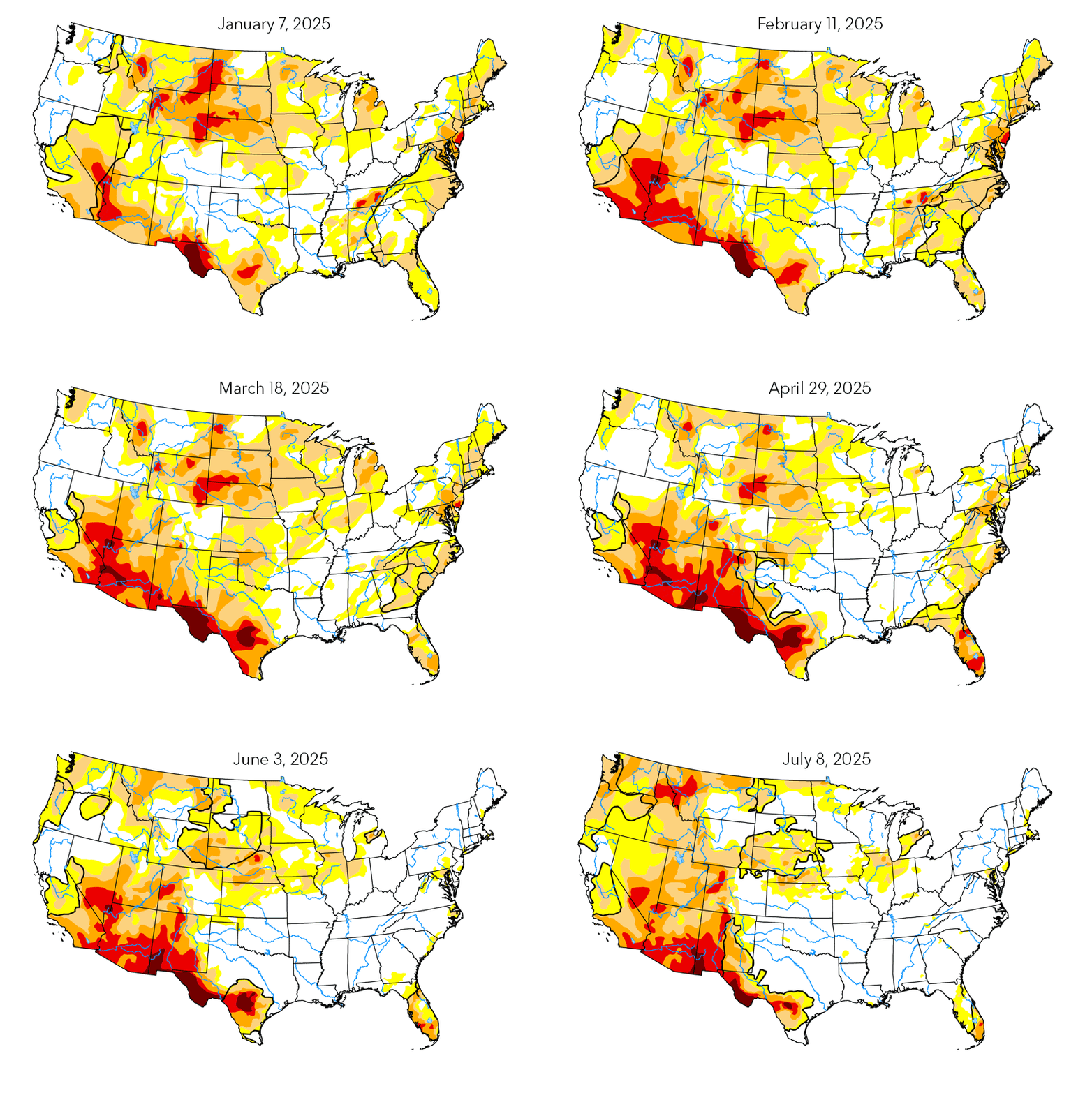
Nearly all of the Eastern Cornbelt is now experiencing some form of drought, with conditions ranging from abnormally dry to moderate as of June 8. “We have had no measurable rain since May 20,” said one Ohio contact. “We are going to need rain real soon or we are looking at yield damage starting.”

Planting of corn and soybeans continued to track ahead of the average pace in the Eastern Cornbelt and Great Lakes region. Corn planting as of June 4 was 97% complete in Indiana, 96% in Illinois, 95% in Ohio, and 91% in Michigan, while soybean planting had progressed to 96% complete in Illinois, 95% in Indiana, 94% in Ohio, and 92% in Michigan.

Western Cornbelt:

Corn Wheat Soybean Index

Scattered showers and cooler temperatures were reported across Iowa during the week, with highs topping out at around 80 degrees. A cold front also brought showers and thunderstorms to Nebraska as the week progressed, with highs ranging from the mid-70s to low-80s across the state.

Drought remained entrenched throughout Nebraska in early June, with conditions worsening in Missouri as well. Most of central and eastern Nebraska was experiencing drought conditions ranging from severe to exceptional, with the northern half of Missouri labeled as a moderate-to-extreme drought area.

Planting continued to track ahead of the average pace for corn, soybeans, and cotton in the Western Cornbelt. Corn planting as of June 4 was 97-100% in the region, with soybeans rated at 91% in Missouri, 96% in Nebraska, and 98% in Iowa. Missouri had 96% of the cotton crop planted by that date, while sorghum planting in Nebraska lagged at 51% complete.

Southern Plains:

Despite sporadic afternoon showers and an increased chance of precipitation over the coming weekend, a broad swath of southeastern, central, and northwestern Kansas remained in extreme-to-exceptional drought in early June.

The western half of Oklahoma was also locked in drought ranging from moderate to extreme, with similar conditions reported across much of western Texas and eastern New Mexico. Most of eastern Texas, by contrast, continued to experience frequent showers and remained drought-free during the week.

Corn planting as of June 4 was 91-94% complete in Colorado, Kansas, and Texas, with soybeans estimated at 80% planted in Kansas. The cotton crop was 69% planted in Kansas by that date, compared with 60% in Texas and 46% in Oklahoma, while sorghum planting had progressed to 85% complete in Texas, 32% in Oklahoma, 38% in Colorado, and 21% in Kansas.

Winter wheat conditions across the region continued to show the effects of drought, with poor or very poor ratings assigned to 65% of the acreage in Kansas, 37% in Texas, 30% in Colorado, and 26% in Oklahoma. Wheat rated as good or excellent totaled 43% of Colorado’s crop, 37% in Oklahoma, 29% in Texas, and just 12% in Kansas.

South Central:

Dry weather and temperatures in the 80s were common across Arkansas and Tennessee during the week, but forecasts warned of potentially severe thunderstorms across northern Arkansas by the weekend. Scattered showers at midweek pushed highs down to the 60s and 70s in southern Kentucky.

Heavy rain on June 6 prompted a flash flood warning across parts of southeastern Louisiana, with some areas reporting more than two inches of precipitation per hour.

Corn planting as of June 4 was 97-98% complete in Tennessee and Kentucky, with soybean planting estimated at 96% complete in Louisiana, 94% in Arkansas, 93% in Mississippi, 80% in Kentucky, and 76% in Tennessee. Arkansas growers had all of the cotton planted by June 4, compared with 98% in Louisiana, 96% in Tennessee, and 89% in Mississippi.

Southeast:

A smoky haze from wildfires in eastern Canada affected air quality as far south as Virginia and North Carolina during the week. The smoke also drifted into Alabama, though isolated showers at midweek helped clear the air in some locations.

Spotty showers and temperatures in the 80s were common across Georgia. Central Florida saw wild storms at midweek, with an EF-1 tornado confirmed late on June 7 in Brevard County. Some 40-50 homes were damaged by the tornado, with power outages reported as well.

Cotton planting as of June 4 was 94% complete in Virginia, 90% in Alabama, 83% in Georgia, and 81% in the Carolinas. North Carolina growers also had 73% of the soybeans and 100% of the corn seeded by that date, while peanut planting had progressed to 91-92% complete in Florida and Virginia, 89-90% in the Carolinas, 88% in Georgia, and 85% in Alabama.

Transportation

US Gulf:

Colorado Lock repairs ended on June 2, sources said, concluding a period of travel interruptions reported from 7:00 a.m. to 7:00 p.m. daily. Delays ran up to 21 hours on June 5-6.

Periodic closures were expected at the BNSF railroad bridge, located at Mile 1 of the Port Allen Route, from March 20 to July 6, and again from July 17 to Aug. 14. Transit stoppages at the site were possible between 7:00 a.m. and 7:00 p.m. daily.

The planned removal of a submerged dredge pipeline was anticipated to block traffic at Mile 9 of the Lower Mississippi River between 6:00 a.m. and 6:00 p.m. on June 13. Guidewall repairs at Bayou Sorrel Lock were projected to begin on June 6, leaving navigation unavailable daily from 7:00 a.m. to 6:00 p.m. Minimal delays were reported on June 7.

Sources expected Leland Bowman Lock chamber repairs to limit daytime navigation through the site for around 15 days, tentatively slated for June 30 through July 14.

Intermittent 5-14 hour waits were noted at Port Allen Lock during the week, and Industrial Lock delays tracked at a wide 15-44 hours, stretching from 18 hours at last check. Sporadic Algiers Lock wait times ran as high as 14 hours, sources said. Tows faced delays in a wide 4-25 hour range at Brazos Lock.

Mississippi River:

Falling water levels on the lower Mississippi prompted width limitations on some southbound movements, reducing downriver towing capacity by 10-20% and adding 12-24 hours to delivery windows.

The Captain of the Port of New Orleans issued a safety advisory for Miles 225-228.3 of the lower river due to low water levels at Baton Rouge. The advisory is expected to remain in place as long as the Baton Rouge gauge holds below the 16-foot mark. The gauge was posted at 14.47 feet and falling on June 7.

A flash flood watch for several areas of Mississippi and Tennessee, previously scheduled to expire on June 10, was canceled on June 6. The watch was established in May due to the possible failure of the Arkabutla Dam, located in Mississippi.

Revetment work at the lower river’s Miles 931-933 will block navigation in the southbound direction from 7:00 a.m. to 6:00 p.m. through mid-July. Sources noted delays in a 12-18 hour range.

Lock 12 wait times were posted in a 3-6 hours range, while Lock 20 delays topped out above six hours. Boats waited up to 12 hours to pass Lock 25.

Illinois River:

A long-anticipated repair and maintenance project was noted kicking off on June 1, effectively closing the Illinois River to commercial navigation through Oct. 1.

The project triggered complete 120-day navigation shutdowns at Brandon Road Lock, Dresden Island Lock, and Marseilles Lock, blocking access to the upper river. With Starved Rock Lock excluded from the operation, access to Ottawa will remain available, sources noted.

Low water levels necessitated raised wickets at both Peoria Lock and LaGrange Lock, forcing tows to lock through both locations. Lockport Lock, located above Brandon Road Lock, recorded no lockages through midweek.

Ohio River:

Floating mooring system repairs underway at John T. Meyers Lock are slated to continue through Aug. 20, prompting main chamber shutdowns. The secondary chamber will close Aug. 21 through Sept. 10 for miter gate repairs, after which the main chamber will shut once more from Sept. 11 to Nov. 17.

The New Cumberland Lock auxiliary chamber, closed for maintenance on May 29, is due to return to service on Aug. 18. The main chamber will remain available during the outage.

The secondary chamber at Melville Lock is closed through Aug. 4 for maintenance and repairs. The McAlpine Lock northern chamber is shut through June 15 for miter gate machinery repairs, necessitating detours through the site’s southern chamber. The auxiliary chamber at Meldahl Lock remains offline through June 30 for repairs, sources said.

Tows passing Smithland Lock were required to make use of an assist boat on southbound lockages due to strong outflows. The site’s land chamber is scheduled to close Sept. 22 through Oct. 22 for machinery repairs.

The primary chamber at Greenup Lock is slated to shut for maintenance July 5 through Aug. 14, leaving the auxiliary chamber open for navigation. Repairs scheduled July 10 through Sept. 15 at Winfield Lock are unlikely to trigger meaningful delays, sources said.

Wickets remained in the raised position at Olmsted Lock due to falling river conditions, reinstating lockages and closing the navigational pass. Waits were quoted up to 11 hours on June 7.

Early-week delays noted up to 29 hours at the Tennessee River’s Kentucky Lock softened to 13 hours on June 7, Corps data indicated. Intermittent Wilson Lock waits were clocked at a wide 4-14 hours.

EPC Awarded for KIMA Nitric Acid/AN Plant

Italian engineering and technology group Maire Tecnimont SpA and Cairo-based Orascom Construction SAE have been awarded a $300 million lump sum, turn-key Engineering, Procurement, and Construction (EPC) contract for a nitric acid and ammonium nitrate plant planned by Egyptian Chemical Industries Co. (KIMA), according to a June 9 announcement.

The plant, which is expected to be completed in the first half of 2026, will produce 600 mt/d of nitric acid that will be used to produce 800 mt/d of fertilizer-grade granular ammonium nitrate. The AN will be sold to local farmers, as well as exported to international markets. The new project is located at the same industrial complex as KIMA’s ammonia and urea plants in Egypt’s Aswan Governorship.

“We are really honored to keep on supporting a prominent player such as KIMA in the development of the Egypt’s fertilizer value chain,” said Maire CEO Alessandro Bernini. “With this award we further consolidate a long-lasting, fruitful relation and strengthen our industrial footprint in North Africa, thanks to our strong capability in executing EPC projects.”

The finalization of the contract is subject to successful execution of the financing package. The scope of work includes Tecnimont providing engineering and the supply of all materials and equipment, with construction activities carried out by Orascom Construction. Tecnimont said its portion of the EPC totals $220 million.

Kazakhstan Needs 236,000 Mt of Fertilizer Imports

Agricultural producers in Kazakhstan need about 236,000 mt of fertilizers that the country does not produce in sufficient quantities, Interfax reported, citing a Kazakhstan agriculture ministry press release.

According to the report, Agriculture Minister Yerbol Karashukeyev, speaking at a meeting in Moscow with fertilizer company executives, said the fertilizers in question include ammonium sulfate, urea, UAN, and compound fertilizers.

The Kazakhstan government in mid-May approved a list of fertilizers, comprising ammonium nitrate and ammonium phosphate fertilizers, which can only be exported by the producers (GM June 2, p. 28). The introduction of restrictions on the export of these products was intended to support domestic farmers.