

California:
The CAN-17 market in California remained at $490-$515/st FOB in early July, with the low at Stockton and the high at Woodland and Helm.
Pacific Northwest:
The CAN-17 market fell to $450/st FOB Kennewick, down $100/st from last report.
California:
The CAN-17 market in California remained at $490-$515/st FOB in early July, with the low at Stockton and the high at Woodland and Helm.
Pacific Northwest:
The CAN-17 market fell to $450/st FOB Kennewick, down $100/st from last report.
California:
AN-20 pricing was unchanged at $478/st DEL in California.
Pacific Northwest:
AN-20 pricing was reported at the $450/st level FOB Kennewick in early July, reflecting a $100/st drop from mid-June.
Cornbelt:
The NPSZ market was steady at $880-$940/st FOB in the Cornbelt, depending on location.
Pacific Northwest:
40-Rock pricing was up $30/st from mid-June, to $900/st FOB or DEL in the Pacific Northwest.
California:
The granular SOP market was unchanged at $930-1,000/st FOB Stockton, depending on supplier.
Pacific Northwest:
Granular SOP pricing was unchanged at $990/st FOB in Washington.
California:
The granular SOP Magnesia market was steady at $645/st FOB for the last confirmed offers in California.
Pacific Northwest:
The granular SOP Magnesia market remaining at the $660/st FOB level in the Pacific Northwest in early July.
California:
Potassium nitrate prices in California were unchanged at $1,430/st FOB Stockton for bulk tons, $1,535/st FOB for bulk bags, and $1,555/st FOB for 50-pound bags.
Eastern Cornbelt:
Potassium thiosulfate pricing firmed to $780/st FOB Terre Haute for July offers, up $30/st from last report.
California:
The potassium thiosulfate market firmed to $780/st FOB Sacramento in July, up from the previous $725/st level.
Eastern Cornbelt:
Soaring temperatures prompted a number of heat advisories, thunderstorm warnings and watches, and some flood watches in the Eastern Cornbelt during the week.
Temperatures surged into the 90s in Illinois during the week, with frequent thunderstorms observed across central and northern Illinois. Indianapolis, Ind., reached 99 degrees on July 5, the highest temperature posted since July 25, 2012. Forecasts warned of thunderstorms and showers across central and northern Indiana as the week progressed.
Several counties in central Ohio were under a flood watch at midweek after severe thunderstorms and torrential rains moved through the region. A severe thunderstorm watch was also in effect in southern Ohio at midweek.
Some 62-65% of the corn and soybeans in Illinois were rated as good or excellent on July 3, compared with 48-50% in Indiana and Ohio. The winter wheat harvest had progressed to 87% complete in Illinois, 62% in Indiana, and 47% in Ohio by that date, with good or excellent ratings assigned to 57-70% of the regional acreage.
Western Cornbelt:
A derecho swept through northern Iowa on July 5, producing 68 mph winds in Mason City and leaving thousands of Iowans without power until the morning of July 6. The same weather system also brought severe thunderstorms to southern South Dakota and parts of eastern Nebraska, where temperatures reached the upper 90s and low triple digits on July 5.

Highs in the 80s and 90s across much of Missouri sparked a round of thunderstorms on July 7, with reports of 1-2 inches of rain, 60-mph winds, and one-inch hail in some locations.
Good or excellent ratings were assigned to fully 77% of Iowa’s corn and soybeans on July 3, compared with 61-62% of the acreage in Nebraska and 56-65% in Missouri. Nebraska’s sorghum crop was 63% good or excellent on that date, while Missouri’s cotton and rice were reported at 63% and 71% good or excellent, respectively.
California:
Southern Californians were bracing for hot weather over the coming weekend. Forecasts warned of temperatures spiking to the mid-80s in Los Angeles, with the Inland Empire, San Fernando, Antelope, and Santa Clarity valleys expected to hit triple digits on July 10-11.
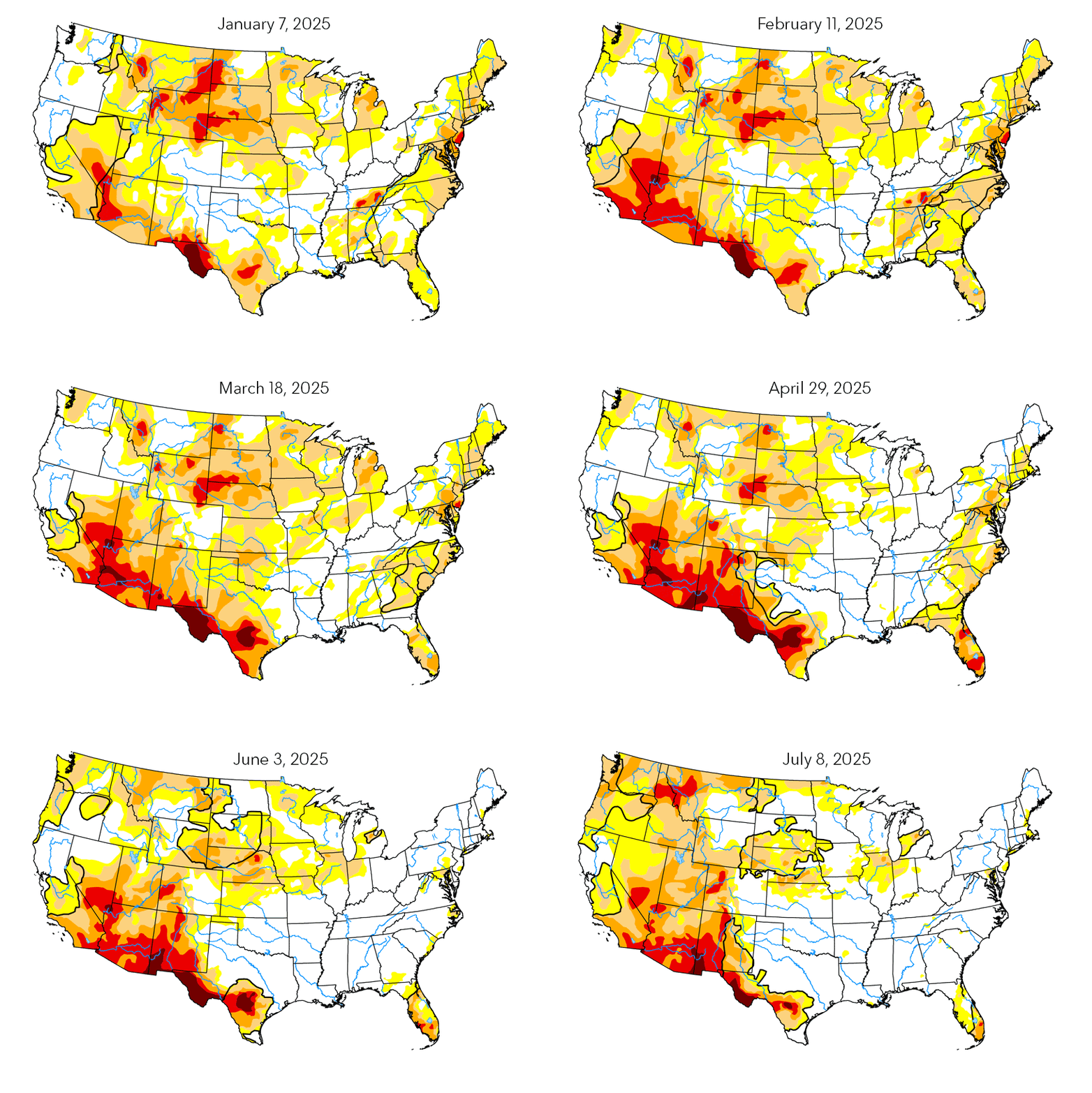
The entire state remained under drought conditions ranging from moderate to exceptional in early July, with a wide, uninterrupted swath of extreme-to-exceptional drought stretching from the southern border to the northern. Water use restrictions implemented in June remained in effect for most of the state.
California’s rice crop was 10% headed as of July 3, with 90% of the acreage rated as good or excellent. Roughly 10% of the California cotton crop was setting bolls by that date, compared with 36% in Arizona. USDA assigned good or excellent ratings to fully 95% of California cotton in early July, compared with 86% in Arizona.
Pacific Northwest:
Cool, cloudy weather persisted across Oregon and western Washington for most of the week, with highs in the 70s. Highs climbed into the 80s in the lower Columbia Basin as the week progressed.
Isolated thunderstorms were tracking through western Washington and northern Idaho on July 7, with the weekend forecast calling for widespread thunderstorm activity across eastern Idaho. Scattered thunderstorms were also reported in Montana, with highs reaching the 70s and 80s across much of the state during the week.
A wet June across much of the region benefited spring grains. Good or excellent ratings were assigned on July 3 to fully 95-97% of Washington’s spring wheat and barley, compared with 65-73% in Idaho and 35-36% in Montana. Winter wheat in the good or excellent categories totaled 80% of the acreage in Oregon, 70% in Washington, 64% in Idaho, and 32% in Montana.
Western Canada:
Strong storms continued to hammer parts of Western Canada in late June and early July. The week began with a severe thunderstorm watch for southern British Columbia, with reports of strong winds, large hail, and heavy rain in some locations.
At least three tornadoes touched down in Saskatchewan on June 29 as a powerful system churned through central and southern areas of the province. On July 4, weather warnings were issued for multiple Manitoba communities, with reports of up to an inch-and-a-half of rain in some locations.
By July 7, another system was expected to trigger severe thunderstorms across Alberta, with forecasts warning of tornado risks and “tennis ball-sized” hail. The risk areas included the cities of Calgary, Edmonton, and Red Deer.
Crops across the region benefitted from a wetter-than-normal June. Fully 75% of Alberta’s crops were rated as good or excellent, while soil moisture levels in Saskatchewan were improving significantly. In Manitoba, crop development in northwestern areas of the province was lagging, but spring wheat and canola crops were beginning to flower across the province.
U.S. Gulf:
Daytime navigation was restricted through the West Canal’s Calcasieu Lock from 7:00 a.m. to 6:00 p.m., Monday through Thursday, through late August. Calcasieu Lock is located at Mile 238.5.
Guidewall construction efforts underway at Bayou Sorrel Lock were estimated to run through February 2023, stopping travel Monday through Friday between 6:30 a.m. and 5:00 p.m. daily. Delays were expected up to 12 hours, although normal operations were projected to resume weekly on Saturday and Sunday. The work was reportedly paused for the week, with a restart expected on July 11.
Paused Bayou Sorrel Lock bridge repairs were expected to resume on July 5 and run for an estimated six weeks. During that time, navigation is scheduled to be unavailable Monday through Thursday between 7:00 a.m. and 11:00 a.m., and again from 1:00 p.m. to 5:00 p.m.
Maintenance operations at Brazos Lock wrapped up in late June after triggering weekday travel shutdowns from 6:30 a.m. to 5:00 p.m. Delays up to 25 hours in recent weeks were generally seen falling below the five-hour mark in early July.
Ten-foot draft limits remained in effect at Miles 113-117 of the Atchafalaya River following a failed effort to correct shoaling in the area. In addition to draft limits, the conditions prompted maximum 600-foot tow lengths, while widths were capped at 70 feet. Tows measuring longer than 400 feet were encouraged to travel with an assist vessel.
Vessels were advised to bypass the restrictions by detouring through the Port Allen Route. Underwater pipelines revealed during a recent hydrograph prompted added transit shutdowns through Little Island Pass, Middle Island Pass, and Riverside Pass.
Unassisted passages through Algiers Lock continued to be subject to length and width restrictions, sources indicated, effectively reducing lockages to four standard barges or two 30,000 mt tankers per pass. Larger tows could transit the site when locking with an assist vessel. Delays were reported in a wide 8-25 hour range during the week.
Construction efforts scheduled through late 2022 at the Belle Chasse Bridge caused intermittent travel delays up to 12 hours during the week, sources said. The structure is located at Mile 3 in the West Canal.
Industrial Lock wait times were noted up to 26 hours during the week.
Mississippi River:
Falling water levels on the lower Mississippi River were noted prompting draft restrictions, with reports indicating maximum drafts at 10.5-11.5 feet, dependent on location and direction of travel. Towing widths and maximum barge counts were also reduced, slowing average per-barge transit times by 10-15%.
Rock removal work at Mile 807 of the lower river was occurring primarily outside of the navigational channel, sources said, with minimal commercial impacts reported.
Power line work underway at Mile 107 on July 7-20 will limit daytime travel availability through the area. One-way traffic is scheduled daily between 4:00 a.m. and 7:00 p.m., and again from 1:00 p.m. to 4:00 p.m., with the site completely closed to navigation between 7:00 a.m. and 1:00 p.m.
Miter gate installation scheduled for Aug. 30 to Nov. 13 at Old River Lock will block direct access to the Red River from the lower Mississippi, requiring detours through the Atchafalaya River. Lock 14 wait times were observed up to seven hours on July 6.
Illinois River:
Repairs and maintenance at Brandon Road Lock, underway since May 9, are anticipated to run through Sept. 8. Movements are limited to overnight hours through Aug. 14, with tow widths capped at 70 feet. Transit will shut entirely between Aug. 15 and Sept. 4, followed by a return to overnight-only travel on Sept. 5-8. Normal operations are expected to resume on Sept. 9.
Wickets were reported in the raised position at both Peoria Lock and LaGrange Lock due to falling water levels on the lower river. Locking was required through both locations due to the raised wickets. As a result, wait times at Peoria Lock were reported up to 10 hours during the week.
Intermittent 5-7 hour delays were reported at Starved Rock Lock during the week, while Corps data showed intermittent six-hour delays through LaGrange Lock.
Ohio River:
Shoaling conditions at Mile 926 of the Ohio River continued to limit transit availability at Miles 920-926, with passage through the area considered on a case-by-case basis. Draft limits were set at a maximum 10 feet for the entire length of the river. No timetable for a return to normal operation was available on July 6.
Work at the Greenup Lock main chamber was scheduled to conclude on June 29, returning travel to the primary chamber and normalizing waits that spiked to 17 hours in the prior week. The project kicked off on May 1, in tandem with a Belleville Lock project that wrapped up on June 24.
Primary chamber miter gate replacements efforts were set to begin on July 5 at Cannelton Lock, blocking use of the chamber through at least Nov. 11. With all travel projected to route through the secondary chamber while the project is underway, that chamber was reportedly closed for maintenance preparations from May 5 through July 1.
Sources confirmed the Hannibal Lock primary chamber going down for miter gate and quoin repairs on July 5. Vessels were expected to lock through the secondary chamber through approximately Oct. 8. Minimal delays were reported for the week through July 6.
The Tennessee River’s Kentucky Lock, which is undergoing a long-term construction project slated to run through 2024, saw intermittent wait times up to 27 hours during the week. Corps data put Wilson Lock waits in the 7-15 hour range.
Repairs to miter gate machinery underway at the Cumberland River’s Cheatham Lock were on the books through Aug. 5. Closures were expected to follow a repeating two-week pattern, with an 11-day total travel closure followed by a three-day period of unrestricted navigation. Significant delays are expected.
Arkansas River:
Ongoing Norrell Lock maintenance operations has the lock shut to navigation daily from 7:00 a.m. to 7:00 p.m., through July 21. Additional daytime closures are schedule for Aug. 1-10; Aug. 21-Sept. 21; Oct. 20-Nov. 18; Nov. 29-Dec. 23; and Jan. 3-31, 2023. Travel through the site will be completely unavailable Sept. 30 through Oct. 9.
Joe Hardin Lock is set to shut for repairs from 7:00 a.m. through 7:00 p.m. daily on Sept. 12-19, and again on Sept. 28-29, a Corps posting indicated. Navigation will be completely unavailable between Sept. 30 and Oct. 9, sources said.
An explosion occurred in a bin at the Gold Eagle fertilizer plant in Hardy, Iowa, on July 5, according to a report in the Humboldt Independent, citing the company. Sulfur reportedly caught fire while being moved to the bin.
The fire was contained to an area between the blending and holding bins. No injuries were reported. While no other product was damaged, the bin did sustain some damage, according to the report.