All posts by mickeybarb@charter.net

Muriate of Potash

U.S. Gulf:

The NOLA potash barge market remained in the $750-$770/st FOB range.

Eastern Cornbelt:

The potash market was quoted at $770-$790/st FOB in the Eastern Cornbelt, depending on location, with the Cincinnati market pegged at $780-$790/st FOB during the week.

Western Cornbelt:

Potash pricing was reported at $770-$790/st FOB in the Western Cornbelt, depending in location, with the low at St. Louis.

Southern Plains:

Potash pricing was quoted at $760-$780/st FOB Catoosa/Inola and $765/st FOB Houston. Potash postings from Intrepid FOB Carlsbad, N.M., remained at $855/st for 60% white granular and $875/st FOB for 62% white standard.

South Central:

The potash market was reported at $770-$800/st FOB in the South Central region, with the low confirmed in Kentucky and the high at Shreveport. Pricing out of most Arkansas River terminals was reported at the $790-$795/st FOB level, while the Memphis market was pegged at $780-$785/st FOB.

Southeast:

The latest potash offers in the Southeast were confirmed at $790-$800/st FOB port terminals, with rail-DEL Canadian tons pegged in the $830-$840/st range in the region.

Bangladesh:

The Ministry of Agriculture is reported to have closed another tender for standard potash on June 9. The Ministry has not specified the volume it is looking to buy.

In early May, the Ministry awarded part of a tender for 257,000 mt of standard potash that closed in April (GM April 22, p. 15). The award prices were reported at $1,045-$1,250/mt CFR, but further details have been sketchy (GM May 13, p. 18).

Brazil:

A lower MOP price of $1,035-$1,150/mt CFR seems to have developed because of reduced demand rather than excess supply. Even the uncertainty of future MOP supplies from Russia and Belarus because of U.S. and E.U. sanctions has not forced prices up.

Sources said holders of MOP at portside warehouses and inland all seem anxious to move out their product. At the same time, buyers, sensing their desperation, are holding off on purchases until the last minute, and then only taking what they immediately need.

The Rondonópolis price reflected a similar softer uncertainty. Sources pegged the price range at $1,160-$1,250/mt FOB ex-warehouse.

Sulfur

Tampa:

Genscape reported the June 4 restart of a 190,000 barrel/d DU-2 crude distillation unit (CDU) at the Phillips 66 Wood River, Ill., refinery. The unit had been reported offline since March 7 for maintenance.

The second-quarter Tampa molten sulfur price was contracted at $481/lt CFR, a $199/lt increase from the first-quarter’s $282/lt level.

U.S. refinery capacity lifted to 94.2% for the week ending June 3, above the prior week’s 92.6% rate, according to data released by the Energy Information Administration (EIA). The current rate continued to top both the year-ago 91.3% and the 89.4% five-year average.

Crude inputs were also higher for the week, climbing to an average 16.387 million barrels/d, a 354,000 barrels/d increase from the previous week’s 16.033 million barrels/d rate.

U.S. Gulf:

ExxonMobil Corp. shut down the 225,000 barrel/d Pipestill 10 crude section on June 7, Genscape reported. It was not immediately clear if the shutdown was planned.

A 55,000 barrel/d hydrocracker was restarted on June 5 at the Valero Meraux, La., refinery, Genscape reported. The unit was originally shut on Feb. 20, while all other monitored units were taken offline for maintenance on March 30. A 50,000 barrel/d vacuum distillation unit (VDU) continued to show signs of a ramp-up on June 4. A fire with multiple injuries was reported at the facility on April 23.

Increased activity levels were reported from multiple units at the Calcasieu Lake Charles, La., refinery on June 7. The facility suffered a widespread, multiunit shutdown on May 25.

Despite a furnace stack shutdown reported on the morning of June 4 at the TotalEnergies refinery in Port Arthur, Texas, no accompanying unit outages were reported. A temporary compressor shutdown triggered by inclement weather was blamed for the furnace stack going offline.

The planned permanent shutdown of the LyondellBasell Ind. refinery at Houston, Texas, currently scheduled for Dec. 31, 2023, could be accelerated should the 263,000 barrel/d plant experience a major unit malfunction, such as damage from a hurricane, Reuters reported. The plant’s high elevation relative to other Houston-area refineries allowed the facility to operate through Hurricane Harvey in 2017.

Sources reported the sale of a 13,000 mt sulfur cargo from the U.S. Gulf during the week. The material was priced at $475/mt FOB. Market players continued to quote the Gulf sulfur market in the $470-$480/mt FOB range, unmoved from the prior report.

Brazil:

Last-done import tons sold into Brazil were unchanged at $520-$525/mt CFR, steady from week-ago levels. Second-quarter contract values were noted in the $480-$485/mt CFR range.

Vancouver:

Recent Vancouver export levels held steady in the $475-$480/mt FOB range, players said.

Alberta:

Genscape noted restarted operations of the 48,000 barrel/d RHC 3 hydrocracker and an integrated 65,000 barrel/d hydrotreater at the Shell Scotford Upgrader in Alberta on the morning of June 7, following signs of increasing activity observed since May 30. The units were noted offline since March 15 as part of a planned turnaround.

Alberta sulfur netbacks were reportedly holding at $366-$411/mt FOB through the week. The range included both molten tons contracted into the U.S. and prilled material selling offshore through the Vancouver export market.

West Coast:

Genscape noted a 23,000 barrel/d hydrocracker shutting down on the morning of June 4 at the Phillips 66 Rodeo, Calif., refinery.

West Coast solid sulfur values continued to be heard in line with Vancouver at $475-$480/mt FOB, steady from the prior report. Contracts for molten sulfur loading from West Coast locations were quoted in the $375-$390/lt FOB range for the second-quarter. Agreements were reported at $230-$245/lt FOB in Q1.

China:

China spot import cargoes continued to be heard at $520-$525/mt CFR, steady from the previous week.

ADNOC:

June ADNOC prill offers reportedly firmed to $480/mt FOB Ruwais, a $10/mt increase from $470/mt FOB in May.

Qatar:

Muntajat prills were called $490/mt FOB Ras Laffan for June loading, rising $30/mt from $460/mt FOB posted for the prior month.

Sulfuric Acid

U.S. Gulf:

Gulf import sulfuric acid prices were last reported in the $270-$280/mt CFR range.

Gulf Coast:

Annual Gulf Coast sulfuric acid contracts were noted in the $195-$280/st DEL range for 2022.

Midwest:

Midwest agreements for 2022 were quoted at $195-$280/st DEL, even with the Gulf Coast.

West Coast:

West Coast contracts for contract-year 2022 continued to be called $185-$270/st DEL.

Brazil:

With no new pricing reported, Brazil import values held steady at $280-$285/mt CFR for the week.

Ammonium Thiosulfate

Eastern Cornbelt:

The ammonium thiosulfate market slipped to $625-$685/st FOB in the Eastern Cornbelt, with the low confirmed at Seneca and the high at Cincinnati.

Western Cornbelt:

Ammonium thiosulfate pricing remained at $650-$675/st FOB in the region, depending on location.

Southern Plains:

The last offers for ammonium thiosulfate were reported at $525/st FOB Houston and $550/st FOB Lubbock, Texas.

Crops/Weather

Eastern Cornbelt:

U.S. Drought Monitor

Wet weather continued to limit sidedress applications in the Eastern Cornbelt. Highs across central and southern Illinois topped out in the upper-70s and low-80s as the week progressed, but another round of showers was in the forecast for June 10. Drier weather was on tap for the coming weekend, however.

Strong storms pushed through parts of Indiana at midweek, with reports of golf ball-sized hail, damaging winds, and at least one possible tornado in central Indiana on June 8. The same system then churned through western, southern, and central Ohio late on June 8, leaving thousands without power from high winds and at least one confirmed tornado.

“We have been very busy putting the finishing touches on planting and getting a strong start on the sidedress season as we speak,” said one Ohio source. “We got some rain last night that will keep us out until tomorrow on sidedressing, and they are calling again for more rain later in the week in my area.”

Corn planting as of June 5 had progressed to 95% complete in Illinois, 92% in Indiana, and 85% in Ohio, with all three states tracking ahead of their five-year averages. Soybean planting was also advancing quickly, with 84-88% of the crop planted in Indiana and Illinois and 71% in Ohio.

Western Cornbelt:

Corn, Wheat, Soybean Index

A band of strong thunderstorms moved through western and central Iowa on June 7, while rain was reported across eastern Iowa at midweek. Much warmer temperatures were on tap for the weekend, with highs in Iowa expected to climb into the 80s before surging into the 90s during the following week.

Parts of eastern Nebraska were hit with heavy rain early in the week, and a second band of thunderstorms hammered the state with hail and torrential rain at midweek. Strong thunderstorms also moved through parts of Missouri at midweek, spawning at least four tornadoes in the Kansas City area on June 8.

Corn planting in the region progressed to 95-98% complete by June 5, with soybean planting estimated at 94-95% complete in Iowa and Nebraska and 61% in Missouri. Missouri growers also had 96% of the cotton planted by that date, ahead of the average pace, with sorghum planting in Nebraska also tracking ahead of normal at 77% complete.

Southern Plains:

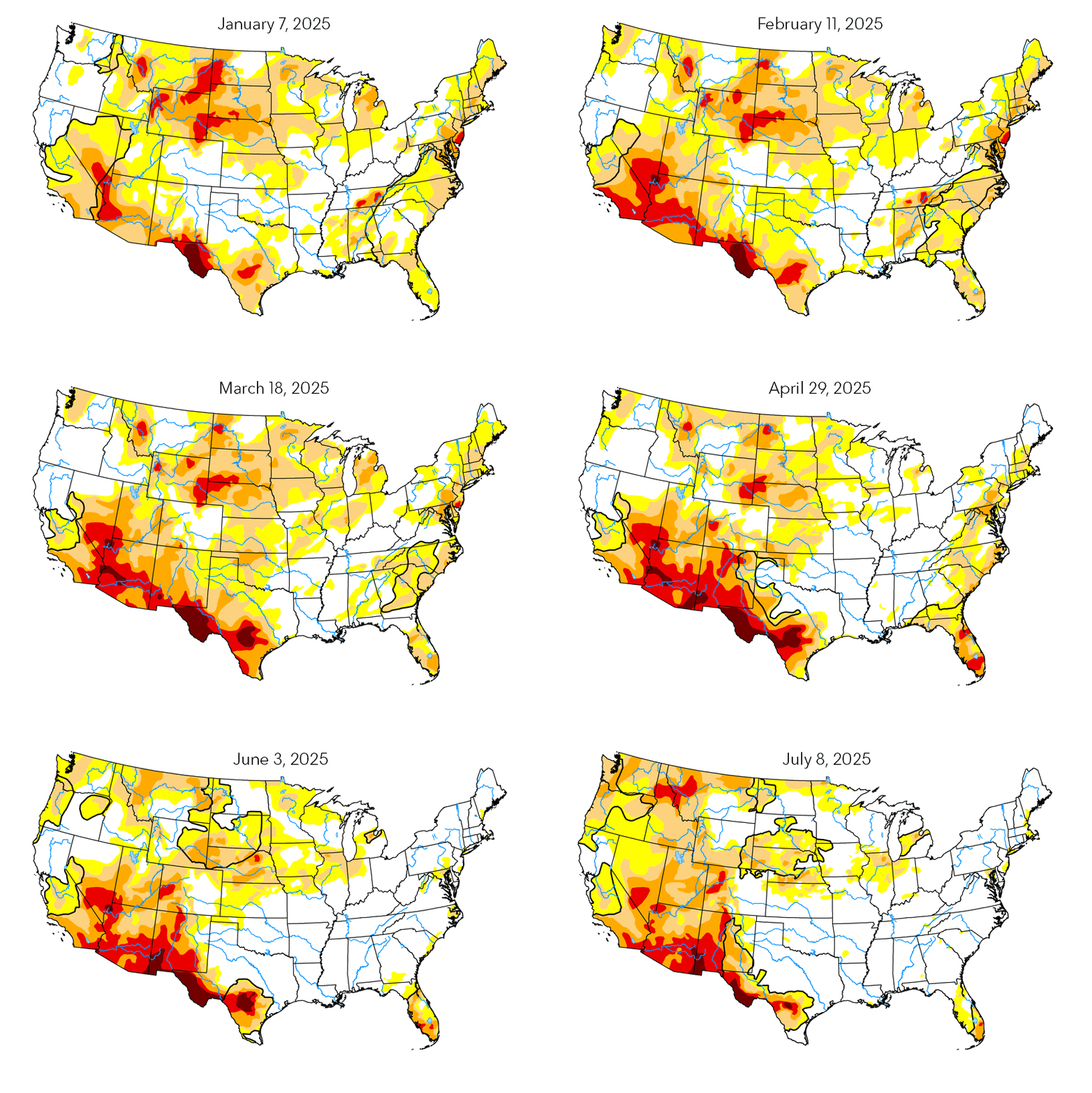
High heat sparked strong thunderstorms in parts of the Southern Plains during the week, and also worsened drought conditions across a vast swath of Texas, New Mexico, and western Oklahoma.

Strong storms spawned at least four tornadoes on June 8 in eastern Kansas, while an earlier system produced 60-80 mph winds and golf ball-sized hail in parts of northern Oklahoma. Highs in the mid-90s were expected in much of Oklahoma as the week progressed, with triple-digit highs common across central and western Texas during the week.

Corn growers had 93-97% of the regional crop planted by June 5, while cotton planting had progressed to 53% complete in Oklahoma, 82% in Texas, and 92% in Kansas. Kansas growers also had 64% of the soybeans planted by June 5, with sorghum planting estimated at 31% in Colorado, 33% in Oklahoma, 42% in Kansas, and 86% in Texas.

The regional winter wheat harvest was underway, but the drought has taken a toll on yields and quality. Poor or very poor ratings were assigned to fully 82% of the acreage in Texas, 55% in Colorado, 49% in Oklahoma, and 41% in Kansas. “Crops are burning up, especially in the Panhandle,” commented one Texas source at midweek.

“Our forecast looks to have a few days of open weather now to let fields, at least in the eastern two-thirds of Kansas, dry down for fieldwork,” said another regional source. “Wheat harvest will begin next week. I have not talked to any farmers that were optimistic about their yields.”

South Central:

Middle Tennessee was hit with severe storms on June 6-8, which included hail, high winds, minor flooding, and a few tornado warnings. Tornado watches were also in effect for several Kentucky counties at midweek.

After multiple days of rain, Arkansas residents enjoyed some sunshine and temperatures in the mid-80s on June 9. Temperatures in the upper-80s and 90s were reported across Louisiana and Mississippi during the week.

Planting was nearly complete in the South Central region. USDA reported that 95-98% of the corn was seeded in Kentucky and Tennessee by June 5, while soybean planting was tracking ahead of average at 73% complete in Kentucky and Tennessee, 86% in Arkansas, and 95-100% in Mississippi and Louisiana.

Cotton planting was also equal to or ahead of the average pace, with 94-100% of the regional crop seeded by June 5. Topdress applications on rice were underway in some locations, with good or excellent ratings assigned to 76-78% of the acreage in Louisiana and Arkansas, 68% in Mississippi, and 44% in Texas.

Southeast:

Strong thunderstorms moved through central North Carolina on June 8, with reports of hail and damaging winds. Scattered storms also brought torrential downpours and gusty winds to the D.C. region on that date, including parts of northern Virginia, where 1-3 inches of rain was reported.

Another band of thunderstorms moved through northern Georgia at midweek, while steady rainfall was reported across central Alabama during the early part of the week. High heat and humidity sparked a number of strong thunderstorms in Florida as well, just days after Tropical Storm Alex inundated parts of Southern Florida with torrential rain on June 3-5.

Cotton planting as of June 5 had progressed to 86-92% complete in the Southeast, with most states tracking close to their five-year averages. Peanut planting was estimated at 98% complete in Virginia, 92-95% in Georgia and Florida, 89-92% in the Carolinas, and 83% in Alabama by that date. North Carolina grower also had 78% of the soybeans planted.

Transportation

U.S. Gulf:

Daytime navigation restrictions at the West Canal’s Calcasieu Lock, located at Mile 238.5, were projected to block movements from 7:00 a.m. to 6:00 p.m., Monday through Thursday, until late August.

A repair operation reported to kick off on May 31 at Port Allen Lock was scheduled to conclude on the evening of June 7. The work reportedly stopped navigation on Monday through Friday between 6:00 a.m. and 6:30 p.m., producing delays up to 24 hours.

A guidewall construction project is underway at Bayou Sorrel Lock through an estimated February 2023, halting Monday-through-Friday travel between 6:30 a.m. and 5:00 p.m. daily. Delays were predicted in the 12-24 hour range.

Maintenance underway at the Brazos Locks system caused weekday travel shutdowns from 7:00 a.m. to 5:00 p.m., although normal 24-hour access was available on Saturday and Sunday. Work at the site was tentatively anticipated to wrap up by the end of June. Delays were reported in the 9-14 hour range.

Shoaling reported at Miles 113-116 of the Atchafalaya River continued to necessitate maximum 10-foot draft restrictions through the Morgan City, La., area, a Coast Guard posting indicated. Additionally, tows were capped at 600 feet, while strings measuring longer than 400 feet were advised to utilize an assist tug. Tow widths were limited to 70 feet. The restrictions could be bypassed via a detour through the Port Allen Route.

Unassisted lockages at Algiers Lock remained subject to length and width maximums, sources said, effectively capping tow sizes at four standard barges or two 30,000 mt tankers per turn. Larger passes were possible when locking with an assist vessel. Delays were reported in the 25-44 hour range through the week.

Construction underway through late 2022 at the Belle Chasse Bridge reportedly caused intermittent travel delays up to 12 hours in length during the week. The bridge is located at Mile 3 in the West Canal.

Port Allen Lock passages required up to 55 hours during the week, Corps data indicated, with 28 tows observed in line to lock on June 8. Bayou Sorrel Lock travel was counted up to nine hours, while most Industrial Lock waits fell in a wide 15-35 hour range.

Mississippi River:

Towing restrictions continued on the lower river during the week, following a return to action-stage river levels at Vicksburg, Miss. The gauge was posted at 35.08 feet on June 8, while forecasts predicted a move below the 35-foot action stage on June 8-9. With levels at Vicksburg, Cairo, Ill., and Baton Rouge, La., anticipated to chart downward heading deeper into June, the restrictions were expected to be lifted soon.

Rock-laying efforts underway since May 10 at the lower river’s Mile 807 blocked southbound movements daily between 6:00 a.m. and 6:00 p.m. The effort was tentatively set to conclude on June 10.

Movements were halted at the lower river’s Miles 232-233 on June 3-4 due to a broken power line.

Efforts to salvage a sunken barge at Mile 49 on the upper river necessitated towing restrictions. Previously expected to conclude by the end of May, the effort was extended through June, limiting barge counts to 20-30 units, depending on horsepower and direction of travel.

Lock 14 wait times were reported in the 4-7 hour range during the week. Intermittent 5-8 hour delays were seen at Lock 27 on June 7-8.

Illinois River:

Repairs and maintenance at Brandon Road Lock are scheduled to run through Sept. 8. Movements are limited to overnight hours through Aug. 14, with tow widths capped at 70 feet. Navigation will be completely unavailable from Aug. 15 to Sept. 4, while overnight-only travel on Sept. 5-8 will precede a Sept. 9 scheduled return to normal transit hours.

Elevated river conditions kept wickets down at LaGrange Lock through the week, sources said, allowing tows to pass the site without locking. Sources reported raised wickets at Peoria Lock, however, marking a return to locking at that location.

Intermittent 5-13 hour delays were noted at Brandon Road Lock for the week.

Ohio River:

The main chamber at Belleville Lock is reportedly closed to navigation through June 29 for planned maintenance and repairs. Transits remained available via the auxiliary chamber, however, resulting in 12-36 hour wait times during the week.

The Greenup Lock main chamber was noted shut for repairs in tandem with Belleville Lock’s May 1-June 29 schedule, during which movements are being routed through the auxiliary chamber. Wait times were generally quoted in the 5-16 hour range for the week.

Repairs and maintenance proposed for Hannibal Lock on July 5-Oct. 8 would limit access to the site’s primary chamber. Vessels would be free to pass through the auxiliary chamber, with delays expected.

Cannelton Lock main chamber navigation is projected to be unavailable from July 5 through Nov. 11 to allow for replacement of the primary chamber miter gate. In advance of the main chamber operation, the secondary chamber was reported shut from May 5 through July 1.

The Tennessee River’s Kentucky Lock posted wait times up to 31 hours during the week. Extended delays remained in effect at Wilson Lock, with passages posted up to 59 hours.

Miter gate machinery repairs underway at the Cumberland River’s Cheatham Lock were projected to continue through Aug. 5. Work was operating on a repeating two-week pattern, with an 11-day total travel closure followed by a three-day period of unrestricted navigation. Significant delays were expected.

Arkansas River:

Norrell Lock maintenance efforts saw the lock shut from 7:00 a.m. to 7:00 p.m. daily through June 11. Additional daytime shutdowns are schedule for June 22-July 21; Aug. 1-10; Aug. 21-Sept. 21; Oct. 20-Nov. 18; Nov. 29-Dec. 23; and Jan. 3-31, 2023. The lock will see a complete travel blackout from Sept. 30-Oct. 9.

Joe Hardin Lock will close for repairs from 7:00 a.m. to 7:00 p.m. on Sept. 12-19, a Corps posting indicated. Travel will be completely unavailable between Sept. 20 and Oct. 9.