

California:
The SOP Magnesia market was steady at $645/st FOB in California for the last confirmed offers.
Pacific Northwest:
The SOP Magnesia market was unchanged at $660/st FOB in the Pacific Northwest in late May.
California:
The SOP Magnesia market was steady at $645/st FOB in California for the last confirmed offers.
Pacific Northwest:
The SOP Magnesia market was unchanged at $660/st FOB in the Pacific Northwest in late May.
Eastern Cornbelt:
Potassium thiosulfate pricing remained at $750/st FOB Terre Haute for the last offers.
California:
The potassium thiosulfate market remained firmly at the $725/st FOB level in California in late May. Sources said a significant increase is expected this summer.
California:
Potassium nitrate prices in California were unchanged at $1,430/st FOB Stockton for bulk tons, $1,535/st FOB for bulk bags, and $1,555/st FOB for 50-pound bags.
Eastern Cornbelt:
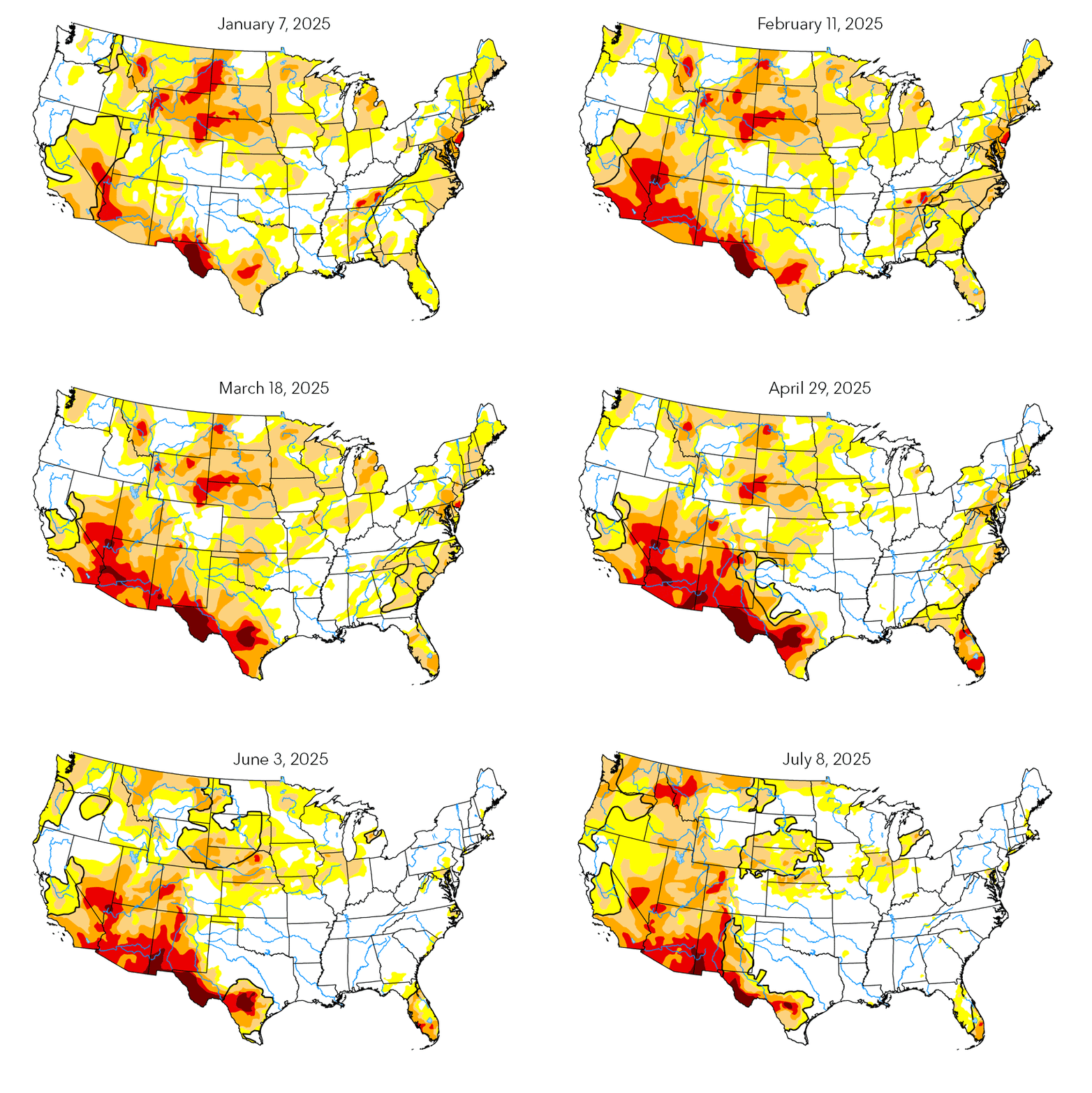
Heat and humidity sparked a number of strong thunderstorms across the Eastern Cornbelt as the week progressed. With temperatures pushing into the 80s, forecasts warned of severe thunderstorms on May 25-26 in all three states. Highs were expected to climb to the 80s and even 90s again over the Memorial Day weekend.
Sources reported a heavy planting pace during the week, as weather conditions allowed. Corn planting as of May 22 had progressed to 78% complete in Illinois, 64% in Indiana, and 52% in Ohio. Both Indiana and Ohio trailed their five-year averages slightly, but progress in Illinois is now equal to the average pace.
Soybean planting was reported at 62% complete in Illinois, 50% in Indiana, and 36% in Ohio. As with corn, Indiana and Ohio were only slightly behind their average pace, while Illinois was actually tracking ahead of the five-year average.
Western Cornbelt:

Highs across Iowa dropped to the mid- to upper-50s during the week. Conditions were mostly dry in the state, allowing rapid planting activity, although a line of showers moved through eastern Iowa on May 26. Much warmer weather was on tap for the Memorial Day weekend, with highs expected to reach the 80s and low-90s in Iowa.
Cool, rainy weather was also reported in Nebraska during the week, with a warm-up in the weekend forecast. Rainfall totals across central Missouri ranged from a half-inch to 1.5 inches during the first half of the week, while much drier weather moved in ahead of the holiday weekend.
Corn planting jumped to 84-85% complete in the region by May 22, just slightly behind the average pace, while soybean planting was also tracking on schedule at 69-72% complete in Iowa and Nebraska and 38% in Missouri. Missouri’s cotton crop was 85% planted by that date, well ahead of the 63% five-year average, with rice planting rated at 80% complete in the state.
One Iowa source said growers are “looking for a big sidedress” run after Memorial Day. “Crops look good, but spring tonnage was cut short this spring,” he added.
California:
Temperatures soared into the triple digits in California during the week, from Redding to Palm Springs, with multiple locations notching record daily highs.
The high heat exacerbated worsening drought conditions across the state. As of May 26, a wide band of extreme-to-exceptional drought intersected the state from north to south, with smaller patches of severe drought at the edges. Long Beach has registered just 1.14 inches of rain so far this year, 14% of the average 8.33 inches, while statewide snowpack has shrunk to just 12% of normal.
State officials imposed sweeping new water use restrictions on May 24, requiring local water agencies to reduce water use by up to 20%. “Drought has had a significant impact for California, with huge reductions in rice acres,” said one contact. “I have not seen any official data, but expect acres of row and field crops impacted as well due to major surface water cuts. Growers need access to good well water or they can see big reduction in acres.”
Other sources said the drought has impacted fertilizer demand and pressured prices. “There is a decent amount of reduced applications and demand destruction that we are contending with,” reported one contact. “The mild spring has also caused growers to back off on applications, because their trees have not had the normal stresses that show up deficiencies.”
“Surface water cuts, frost damage, and expected low grower nets are having their effect,” added another source. “Where the first-quarter fertilizer movement was down less than 10%, as of yesterday we are down more than 20%.”
Pacific Northwest:
Rain and cooler weather were reported in western Oregon and Washington as the week progressed. Parts of Idaho were also bracing for wet weekend conditions after posting highs in the 80s on May 26. The cooler Memorial Day weekend was also expected to bring several inches of snow to higher elevations in Idaho and Montana.
Most of the Pacific Northwest was experiencing some form of drought in late May, with the most significant extreme-to-exceptional drought conditions reported across most of Oregon and in north-central Montana.
Planting was wrapping up quickly in the region in late May. USDA reported that 85-90% of the spring wheat and barley was seeded in Montana as of May 22, compared with 88-90% in Idaho and 94-96% in Washington. Idaho’s sugar beet crop was fully 99% planted by that date.
Western Canada:
Warm air over the Prairies was expected to spark strong thunderstorms as the week progressed. Forecasts warned of 30-50 mm of rain across portions of northern Alberta and northeastern British Columbia in late May, and 10-20 mm across a wide swath of Saskatchewan and Manitoba.
Spring planting was 52% complete across Saskatchewan, according to provincial reports, well behind the 78% five-year average. Sources said planting in southwestern Saskatchewan and southern Alberta was nearly finished, and progress was well advanced in central and northern Alberta and central Saskatchewan.
Planting progress in Manitoba, however, remained critically delayed due to wet weather. “The Peace Country, eastern Saskatchewan, and all of Manitoba have just begun seeding. Many are switching out of soybeans and corn to canola,” commented one source at midweek. “Additional rain in Manitoba is not needed. They will seed canola in Manitoba until June 20, but after that its barley and oats and a lot less fertilizer being used.”
U.S. Gulf:
Water levels were back above the 12-foot mark at the river gauge in New Orleans during the week, sparking renewed towing restrictions, travel slowdowns, and horsepower minimums through the NOLA area.
The gauge was recorded at 12.17 feet and rising on May 23, while forecasts predicted a 12.4-foot crest on May 23-25. Levels in the area could fall below 12 feet as early as May 27, National Weather Service (NWS) data indicated. Travel above NOLA was similarly restricted due to persistent high water at Baton Rouge.
Daylight navigation remained restricted through Calcasieu Lock. Previously set to conclude in mid-May, the limitations will reportedly extend into late August, holding travel to between the hours of 7:00 a.m. and 6:00 p.m., Monday through Thursday. The closures have been underway since March 22.
Planned maintenance to the Bayou Sorrel Bridge was noted halting navigation from 7:00 a.m. to 11:00 a.m., and again between 1:00 p.m. and 5:00 p.m., Monday through Friday. Full 24-hour lock access resumed on Saturday and Sunday. The project was tentatively slated to continue through the end of May.
A seven-day repair project anticipated to kick off on May 31 at Port Allen Lock will block Monday-through-Friday movements from 6:00 a.m. to 6:30 p.m. Delays are projected up to 24 hours.
Guidewall replacement in progress at Bayou Sorrel Lock was expected to block Monday-Friday movements from 6:30 a.m. to 5:00 p.m. The shutdowns were likely to run into early 2023. Wait times were noted in the 3-11 hour range through the week.
Daylight Brazos Lock travel was reportedly unavailable on Monday through Friday. Set to run through approximately June 30, shutdown hours at the site were slotted to run from 7:00 a.m. to 5:00 p.m.
Bayou Chene was noted resuming overnight travel, a Coast Guard posting indicated, ending a lengthy period of overnight shutdowns due to floodgate construction operation. During the project, navigation had been limited to daylight hours, with tow lengths capped at 600 feet. Tows measuring wider than 54 feet had been required to travel with an assist vessel.
Draft limits remained in place through Miles 113-116 of the Atchafalaya River, according to a Coast Guard posting, due to an ongoing shoaling event in the Morgan City, La., area. Maximum drafts were capped at 10 feet, while towing lengths and widths were restricted to a maximum 600 feet and 70 feet, respectively. Tows measuring longer than 400 feet were encouraged to travel with an assist vessel. Vessels were advised to bypass the restrictions via the Port Allen Route.
Length and width restrictions in effect at Algiers Lock effectively capped unassisted lockages to four standard barges or two 30,000 mt tankers per pass. Corps data estimated most delays in a wide 24-48 range through the week, expanding from 24-36 hours noted previously. Larger lockages were reportedly available when accompanied by an assist vessel.
A Belle Chasse Bridge construction operation tentatively scheduled through the end of 2022 was noted prompting delays up to 12 hours during the week. The bridge is located in the West Canal.
Port Allen Lock wait times were reported in the 16-30 hour range during the week. Vessels transiting Industrial Lock saw waits up to 50 hours, while Calcasieu Lock delays were observed up to 10.5 hours. Colorado Lock passages required up to six hours, and wait times at Brazos Lock were heard up to five hours.
Mississippi River:
High water river levels continued to be observed on the lower Mississippi River. The conditions were noted impacting travel speeds, necessitating restrictions on towing sizes and prompting horsepower minimums on towing vessels. Additionally, transit through a number of bridges was restricted to daytime hours only.
The river gauge at Baton Rouge was noted at an action-stage 32.67 feet and falling on May 25, following a May 22 crest at 32.9 feet. Despite the decline, area levels were expected to bounce in and out of action stage through at least June 6. A flood watch announced on May 24 was slated to remain in place through May 27.
The Vicksburg, Miss., gauge returned an action-stage 38.08-foot reading on May 25, and was projected to remain above the 35-foot action stage through at least June 8. The Cairo, Ill., gauge moved out of action stage on May 19, and was not expected to return in the next two weeks.
Rock-placement work underway since May 10 at Mile 807 on the lower river was heard to close the area to southbound travel daily, between 6:00 a.m. and 6:00 p.m., with significant delays expected.
Ongoing salvage operations to retrieve a sunken barge at Mile 49 on the upper river were expected to continue through the end of the month. Due to the operation, maximum barge counts at the site were slashed, while the largest tows were reportedly limited to passing during daylight hours only.
Illinois River:
A planned maintenance and repair project scheduled at Brandon Road Lock will heavily impact navigation between May 9 and Sept. 8, a Corps posting indicated.
Transit through the lock will be limited to overnight hours only between May 9 and Aug. 14, with tow widths capped at 70 feet. The lock will undergo a total shutdown from Aug. 15 through Sept. 4, blocking all movements. Overnight navigation will return on Sept. 5-8, while normal travel hours are projected to resume on Sept. 9.
Wickets remained down at both Peoria Lock and LaGrange Lock during the week, sources said, allowing tows to pass both locations without locking.
Ohio River:
Improving travel conditions were noted on the Ohio River, allowing for increased transit speeds, reduced daylight-only restrictions, and tighter pickup and delivery windows.
Belleville Lock entered into a planned main chamber shutdown on May 1, requiring detours through the auxiliary chamber through June 29. Early-week delays were reported in a wide 36-62 hour range.
A Greenup Lock primary chamber closure was noted running concurrently with Bellville Lock, shutting that unit to navigation from May 1 to June 29. Passage remained available through the secondary chamber, with wait times reported at 30-45 hours through May 23.
Cannelton was noted facing one last week of Wednesday-Thursday daytime shutdowns. The final closure was scheduled for May 26, with delays projected up to 12 hours. An additional project was expected to impact travel between July 5 and Nov. 11.
A possible Hannibal Lock main chamber shutdown for repairs and maintenance remained at the proposal stage, sources said. If given the green light, the project is expected to trigger detours through the secondary chamber between July 5 and Oct. 8.
On the Tennessee River, Kentucky Lock delays were observed in the 31-48 hour range through the early part of the week. Wait times were previously noted at 19 hours. Wilson Lock passages required 29-45 hours, Corps data indicated, shifting from 8-30 hours in the prior report.
Cheatham Lock miter gate machinery repairs were noted underway since May 16. The project is slated to continue through Aug. 5, during which the site will experience a repeating pattern of 11-day shutdowns, followed by three days of unrestricted navigation. Extensive delays are predicted.
Arkansas River:
High water levels were reported to impact Arkansas River travel during the week, slowing or stopping movements throughout most of the river. Forecasts predicted the high waters to persist into late May.
Planned repairs and maintenance at Norrell Lock are projected to block daytime transportation starting in June. Navigation will be unavailable from 7:00 a.m. to 7:00 p.m. daily on June 1-11; June 22-July 21; Aug. 1-10; Aug. 21-Sept. 21; Oct. 20-Nov. 18; Nov. 29-Dec. 23; and Jan. 3-31, 2023. Transit will be completely unavailable through the site between Sept. 30 and Oct. 9.
The Corps announced a smaller-scale shutdown for Joe Hardin lock in September and October. Travel through the site will be unavailable between 7:00 a.m. and 7:00 p.m. daily on Sept. 12-19 and Sept. 28-29, while the lock will see a full shutdown on Sept. 30-Oct. 9.
Australia’s Association of Mining and Exploration Companies (AMEC) on May 12 called the Western Australian (WA) government’s A$10 million Potash Industry Rebate Scheme, which is a 50% royalty rebate over two years, only a modest step forward to support the establishment of a new potash industry in the state. The rebate was a part of WA’s 2022-23 State Budget.
AMEC, however, praised several other areas of the budget, including a further $20.2 million for the Department of Mining, Industry Regulation, and Safety’s Resources Advice and Regulation Services capacity, including $14.6 million for the Aboriginal Empowerment Initiative; $2.9 million for post grant mining titles compliance; $1 million for a new Registrar’s office in Geraldton; and $1.8 million to support a Mining Warden. AMEC said all of these will facilitate greater mining and mineral exploration.
AMEC also praised the commitment of $12 million for a state-wide passive seismic survey, the WA Array, which will increase the knowledge of WA geology at depth and generate precompetitive data. It said an additional $8 million for Minerals Research Institute of Western Australia (MRIWA) will support greater scientific research to extend the state’s leadership in the sector.
AMEC also said the $350 million expansion of Geraldton Port and $78 million for growth at Lumsden Point will facilitate projects in each port’s hinterland that will benefit from the increased capacity.
The budget also had a $100 million commitment to an Investment Attraction Fund to facilitate investment in a range of industries.
On May 16, AMEC welcomed the WA government’s Reduced Reporting Burden Pilot project.
The pilot program will stop or halve environmental reporting requirements for lower-risk industry licenses. A risk-based assessment was conducted to identify licenses eligible for reduced reporting requirements. These include: licenses with no monitoring requirements will no longer require annual environmental reports; and licenses with limited monitoring requirements will move to environmental reports every two years.
Other licenses, such as those that require comprehensive monitoring and have several environmental issues, multiple monitoring points, complex monitoring suites, and/or high frequency monitoring, will continue to require annual environmental reporting.
AMEC said the changes affect more than 60% of eligible licenses granted under Part V Division 3 of the Environmental Protection Act 1986.
“These sensible changes will reduce the government’s administrative burden while ensuring strong environmental protections remain in place,” said AMEC CEO Warren Pearce. “AMEC has been a strong advocate for significant regulatory reform and for better efficiency around environmental reporting. With less red tape for lower risk license holders, this program is a positive outcome for the mining and exploration industry.”
Energy infrastructure company Inter Pipeline, Calgary, said on May 11 that it is partnering with Itochu Corp. and Petronas Energy Canada Ltd. (GM Aug. 6, 2021) to evaluate the development of world-scale integrated blue ammonia and blue methanol production facilities.
“This project would be among the first of its kind in North America,” said Inter Pipeline President and CEO Brian Baker. “Once operational, these facilities would be at the forefront of diversifying Canada’s abundant supply of raw resources by converting them to value-added, energy transition products to supply growing global markets with low- or no-carbon fuel and energy products.”
The partners are expected to reach a final investment decision in early 2024. If sanctioned, construction would commence in late 2024, with a 2027 in-service date.
The proposed project would consist of two facilities based in Alberta, with early expectations – pending the results of the technical evaluation – of producing world-scale volumes of blue ammonia with blue methanol volumes. CO2 emitted during processing of both products would be sequestered underground permanently, and the resulting blue products would then be loaded onto rail cars for transport to an export facility before being shipped to global markets.
Last year, Itochu and Petronas said they were partnering with an unnamed Calgary-based midstream company to explore the feasibility of a US$1.3 billion, 1 million mt/y blue ammonia plant in Alberta. The plant was to export hydrogen from Alberta’s Industrial Heartland to Asian markets. The year-ago report did not include methanol.
Having recently completed the Heartland Petrochemical Complex, North America’s first integrated propane dehydrogenation and polypropylene plant, Inter Pipeline said it has proven it can successfully develop a petrochemical mega project.
In March, Inter Pipeline and Rockpoint Gas Storage, Calgary, announced that they have submitted a joint application as part of Alberta’s Energy’s Request for Full Project Proposals (RFPP) to develop a new carbon sequestration hub in Alberta’s Industrial Heartland. If approved and developed, the project would provide carbon storage capacity of more than 6 million mt/y, on an open access basis, to emitters in Alberta’s Industrial Heartland.
Nutrien Ltd., Saskatoon, said on May 18 that it is evaluating Geismar, La., as the site to build the world’s largest clean ammonia facility. It would produce 1.2 million mt/y.
The project will proceed to the front-end engineering design (FEED) phase, with a final investment decision expected to follow in 2023. If approved, construction of the approximately US$2 billion facility would begin in 2024, with full production expected by 2027.
Nutrien said the plant would leverage low-cost natural gas, tidewater access to world markets, and high-quality carbon capture and sequestration infrastructure at its existing Geismar facility to serve growing demand in agriculture, industrial, and emerging energy markets.
The blue ammonia plant is expected to capture at least 90% of CO2emissions, permanently sequestering more than 1.8 million mt/y of CO2 in dedicated geological storage. Nutrien said the plant will use auto thermal reforming technology to achieve the lowest carbon footprint of any plant at this scale, and has the potential to transition to net-zero emissions with future modifications.
Nutrien noted that it has actively been pursuing the development of low-carbon ammonia for more than a decade, and has approximately 1 million mt/y of production capability through its Redwater and Joffre, Alta., operations, as well as Geismar, all of which employ carbon capture and sequestration technology (GM July 30, 2021).
“Our commitment to the development and use of both low-carbon and clean ammonia is prominent in our strategy to provide solutions that will help meet the world’s decarbonization goals, while sustainably addressing global food insecurity,” said Ken Seitz, Nutrien’s Interim President and CEO. “Leadership in clean ammonia production will play a key role in achieving our 2030 Scope 1 and 2 emissions reduction goals, as part of our Feeding the Future Plan.”
Nutrien has signed a term sheet with Denbury Inc., a partner for nearly a decade, that would allow for expansion of the existing volume of carbon sequestration capability in the immediate vicinity of its Geismar facility, if selected as the final site of construction.
“Nutrien is optimally positioned to supply global emerging clean ammonia markets and grow a pathway for a decarbonized supply chain,” said Raef Sully, Nutrien’s Executive Vice President and CEO of Nitrogen and Phosphate. “We are pleased to partner with Denbury on this initiative given our established track record of cooperation. It is another example of how we are building on our expertise in low-carbon ammonia to decarbonize the agriculture industry while helping to sustainably feed and fuel the future.”
Nutrien has also signed a Letter of Intent to collaborate with Mitsubishi Corp., Tokyo, for offtake of up to 40% of expected production from the plant to deliver to the Asian fuel market, including Japan, once construction is complete.
Nutrien said it is committed to leading the development of low carbon and clean ammonia to rapidly accelerate the decarbonization of hard-to-abate sectors such as agriculture, industrial use of ammonia, power generation, and maritime fuel. As one of the world’s largest ammonia traders by marine transportation, Nutrien announced in 2021 a collaboration agreement with Exmar, Antwerp, Belgium, to jointly develop and build one of the first low-carbon, ammonia-fueled maritime vessels to help decarbonize shipping.
Nutrien is also involved with the U.S. Department of Energy and other partners to explore flexible clean ammonia production using air, water, and variable renewable electricity.
Fertilizantes Heringer, Viana, Brazil, reported higher earnings and revenue for first-quarter 2022, though fertilizer volumes were off 20%. The company said it maintained gross and operational profitability despite the global rise in input costs and lower market demand.
First-quarter net earnings were R$128.4 million on net revenue of R$1.23 billion, up from the year-ago loss of R$7.45 million on R$741.3 million, respectively. EBITDA was R$85.1 million, down from R$103.8 million
Volumes were 301,239 mt, down from the year-ago 376,550 mt. Specialty fertilizer volumes made up 51% of sales, up from the year-ago 48%. Specialty volumes were 153,000 mt, down from 181,000 mt, while conventional tons dropped to 148,000 mt from 196,000 mt.
Heringer said 30% of its sales went to the other crop category, 27% to coffee, 25% to corn, 14% to sugar cane, and 4% to soybeans.
SQM Inc., Santiago, reported first-quarter net income of $796.1 million ($2.79 per share), up from the year-ago $68 million ($0.26 per share). Gross profit reached $1.16 billion, up from $136.6 million.
Adjusted EBITDA rose to $1.19 billion from $165.1 million, while revenues totaled $2.02 billion, up from $528.5 million.
“Our first-quarter results reflect several positive circumstances: first, the impact of higher prices in all our business lines, where significant increases in lithium prices stand out, and second, the successful long-term, operational, and commercial strategy,” said SQM CEO Ricardo Ramos.
SQM noted that its first-quarter results included Corfo and tax provisions of $800 million. Ramos said that some 60% of operating margin from lithium is dedicated to payments to Corfo and taxes, and said the company’s lithium business is a very good example of a successful public-private partnership.
“Today we can proudly report that we are a leader in the lithium industry,” said Ramos. “We have almost tripled our production levels in three years, while we have significantly decreased the extraction of brines.”
SQM saw a surge in first-quarter lithium results, with volumes up 59%, to 38,100 mt from the year-ago 23,900 mt, and revenues up 970%, to $1.45 billion from $135.2 million. The company said prices reached a record $38,000/mt, and the company had the highest sales volumes it has ever reported.
SQM believes the lithium market will grow at least 30% this year, with one important indicator being a 125% increase in electric vehicle sales in China during the first quarter. SQM said its plans to increase capacity remain on target. It believes its 2022 sales volumes will surpass 140,000 mt.
SQM said its Specialty Plant Nutrition (SPN) business remains an important segment within SQM’s diverse portfolio, with average prices 39% higher in first-quarter 2022 than fourth-quarter 2021. However, the company fears demand growth in the agricultural potassium nitrate market could be impacted by these higher prices and continuous supply restrictions, and ultimately SQM sales volumes in 2022 could be lower than reported in 2021.
First-quarter SPN volumes were off 25% from year-ago levels, to 210,400 mt from 280,500 mt. Potassium nitrate-based volumes were off 24%, to 124,300 mt from 163,100 mt, and specialty blends 25%, to 50,000 mt from 66,600 mt.
SPN revenues, however, were up 42%, to $275.3 million from $194.1 million.
SQM reported that sales prices in its Potassium Chloride and Potassium Sulfate (MOP/SOP) segment were up 170% during the quarter compared to the year-ago period. As a result, revenues were up 89.2%, to $114.1 million from $60.3 million. Volumes were off 29.9%, to 141,700 mt from 202,200 mt. Despite the lower first-quarter volumes, SQM believes that while there is still uncertainty surrounding this market, total volumes for potassium chloride will reach about 750,000 mt during 2022.