

California:
Potassium nitrate prices in California were unchanged at $1,430/st FOB Stockton for bulk tons, $1,535/st FOB for bulk bags, and $1,555/st FOB for 50-pound bags.
California:
Potassium nitrate prices in California were unchanged at $1,430/st FOB Stockton for bulk tons, $1,535/st FOB for bulk bags, and $1,555/st FOB for 50-pound bags.
Eastern Cornbelt:
Potassium thiosulfate pricing was unchanged at $750/st FOB Terre Haute for the last offers.
California:
The potassium thiosulfate market remained firmly at the $725/st FOB level in California at mid-month. Sources said an increase is expected this summer.
Eastern Cornbelt:
Wet weather continued to delay fieldwork and spring planting across much of the Eastern Cornbelt, but much warmer and drier conditions were in the forecast for the second week of May.
Rainfall blanketed most of central and southern Illinois as the week progressed, with reports of damaging winds and hail in some southern parts of the state on May 5. Similar conditions were reported in central Indiana and northern Ohio, where highs topped out in the mid-60s on May 5-6.
During the second week of May, however, forecasts called for clear, warm weather through much of the region, with highs reaching the 70s in northern Ohio and the low-80s in central Indiana. Forecasts even talked of highs reaching the upper-80s and low-90s in parts of Indiana and Illinois on May 9-11.
With planting progress lagging considerably, growers are looking forward to the weather improvement. Corn planting in Illinois was just 7 percent complete by May 1, well behind the 43 percent five-year average. Progress in Indiana and Ohio was rated at 3-6 percent complete, also trailing the 16-25 percent average pace.

The regional soybean crop was 2-5 percent planted by May 1, compared with five-year averages of 19 percent in Illinois, 13 percent in Indiana, and 8 percent in Ohio. Oat planting in Ohio was also lagging at 46 percent complete by May 1, compared with 61 percent on average.
Western Cornbelt:
Cool temperatures and scattered showers moved through Iowa as the week progressed, limiting spring fieldwork in many areas. The wet weather was expected to continue through the Mother’s Day weekend, but highs in the 80s were on tap for the second week of May.
Cold, wet weather was also reported in Nebraska during the week, with western areas of the state collecting most of the moisture on May 4 followed by eastern locations on May 5. Much of Missouri also experienced a wet week, with 1-3 inches of rain reported across the state.
The wet spring has delayed planting significantly. Just 27 percent of Missouri’s corn was planted by May 1, well behind the 52 percent five-year average. Progress in Iowa lagged even more at 9 percent complete, compared with an average of 42 percent, while Nebraska corn growers had 28 percent of the crop seeded by May 1, behind the 34 percent average pace.
Soybean planting was reported at 4-5 percent complete in Iowa and Missouri, compared with five-year averages of 17 percent and 6 percent, respectively. Soybean planting in Nebraska was actually ahead of schedule, however, with progress reported at 19 percent complete compared with the five-year average of 14 percent.
Missouri growers had 8 percent of the cotton planted by May 1, equal to the average pace. Rice planting in the state was way behind, however, with progress estimated at just 5 percent complete by May 1, compared with a 51 percent five-year average.
California:
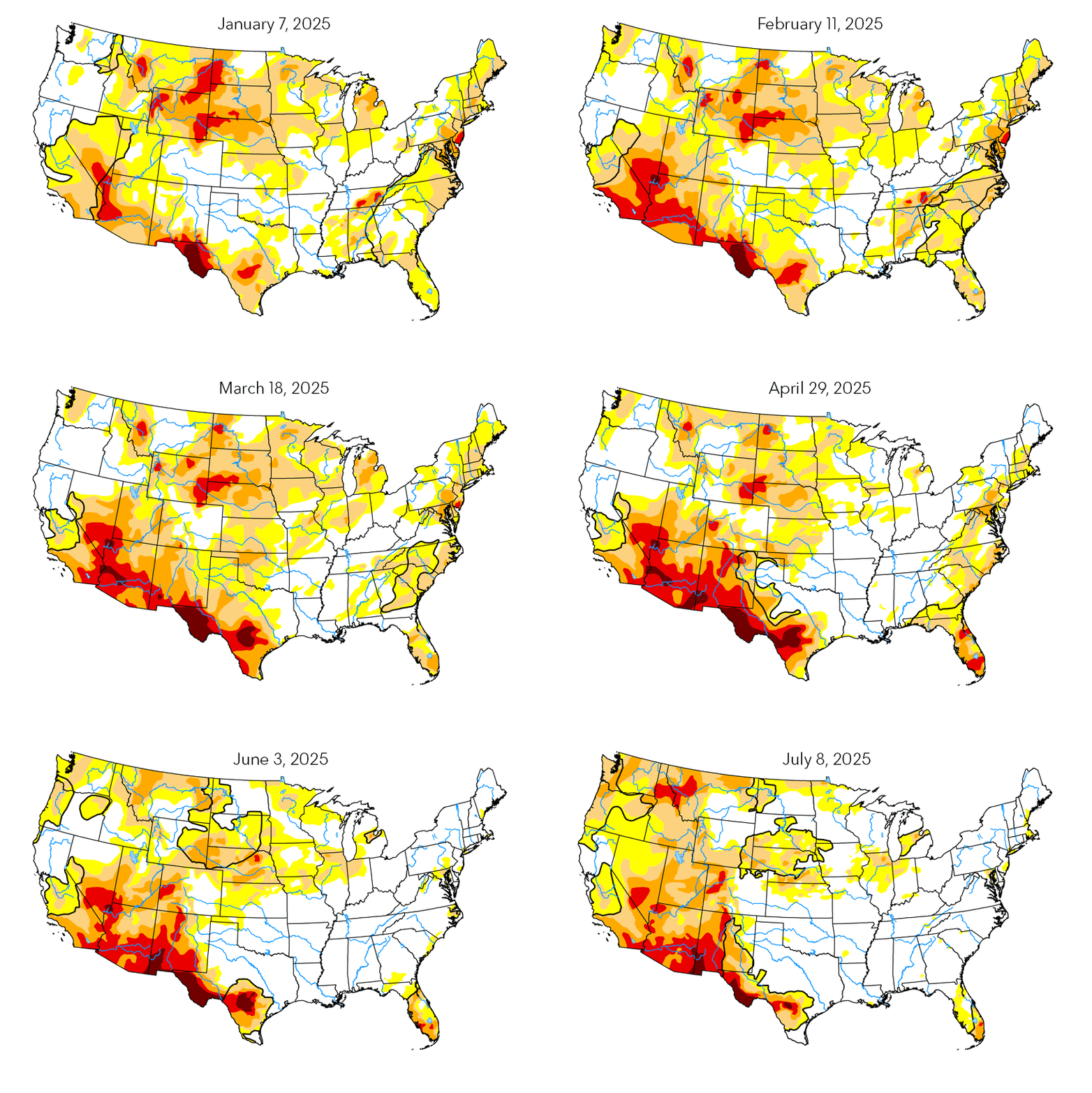
Unseasonably hot weather moved into Central and Northern California as the week progressed, pushing temperatures from the mid- to upper-70s up into the mid-80s and low-90s in some locations. The high temperatures were accompanies by 25-35 mph winds, raising wildfire and drought concerns.
Nearly all of the state was experiencing severe-to-extreme drought
in early May, although Northern California was expecting light rain by
the weekend, along with a rain/snow mix in the Sierra.
Cotton planting in California had progressed to 95 percent complete by May 1, well ahead of the five-year average. Rice planting was also ahead of average at 20 percent complete by that date.
Pacific Northwest:
Cold, wet weather was reported across Oregon and parts of Washington as the week progressed. Heavy rain was in the forecast for western Oregon on May 5-8, with up to four inches possible on the coast and 1-2 inches in the Willamette Valley. Forecasts warned of 3-6 inches of snow at higher elevations in western Oregon and western Washington.
Rainfall was also reported across southern Idaho and western and central Montana early in the week, but temperatures climbed to the 70s as the week progressed. Cooler weather and more precipitation was on tap for the coming weekend in both states, with highs in southern Idaho topping out in the mid- to upper-40s.
The planting of potatoes, sugar beets, corn, and spring grains continued in the Pacific Northwest in early May. “Potatoes are popping and corn is being planted in the Columbia Basin,” reported one contact. “Dryland areas have had a real slow start this spring.”
Idaho growers had 88 percent of the sugar beets planted by May 1, while spring wheat and barley planting had progressed to 31-44 percent complete in Montana, 57 percent in Idaho, and 65-75 percent in Washington.
Good or excellent ratings were assigned to 52-57 percent of the winter wheat acreage in Idaho, Oregon, and Washington in early May, while only 12 percent of Montana’s crop fell into those two categories.
Western Canada:
Parts of Manitoba were hit with 10-20 cm of snow on May 3. The snowfall followed heavy rain in the province over the prior weekend, including an average of 40-50 mm in the Red River Basin. As of May 2, 18 municipalities in the province had issued local states of emergency in response to flooding and infrastructure failure, according to the provincial government.
Conditions were also wet in southeastern Saskatchewan, but a contrasting weather pattern was in place across Alberta and western Saskatchewan, where sources reported extremely dry conditions. Saskatchewan’s first crop report on May 5 said just one percent of the spring crop had been seeded, trailing the 5 percent five-year average, with the greatest progress reported in southwestern Saskatchewan.
“Cooler-than-normal weather has delayed spring applications in Western Canada,” commented one regional source at midweek. “Southern Alberta is ready to go, but Saskatchewan and Manitoba are fairly quiet. It may take a couple more weeks before things start picking up.”
Another source speculated that fieldwork and fertilizer application in wet areas of Manitoba and Saskatchewan will be delayed at least through the second week of May, which he noted was three weeks later than last year and two weeks behind the average start.
U.S. Gulf:
With the river gauge at New Orleans continuing to track above the 12-foot mark, towing restrictions remained in effect between NOLA and Baton Rouge, La., for another week. The New Orleans gauge was observed at 12.25 feet and holding on May 2. Forecasts showed an expected dip below the 12-foot level as early as May 5, potentially marking an end to regional restrictions.
Longer-than-normal wait times continued to be reported at Leland Bowman Lock during the week, after an equipment malfunction was reported blocking lock operation in the prior report. Delays fell in the 4-11 hour range for the week, Corps data indicated.
Calcasieu Lock, located at Mile 238.5 in the West Canal, was reportedly shut for repairs Monday through Thursday, 7:00 a.m. to 6:00 p.m. The lock was scheduled to return to normal operating hours on May 20.
Regular travel was scheduled to return to the Brazos Locks system on May 2 following a run of restricted navigation during daylight hours. Access to the site had been limited between 7:00 a.m. and 5:00 p.m., Monday through Friday.
Bayou Sorrel Bridge repairs triggered daily travel shutdowns between 7:00 a.m. and 11:00 a.m., and again from 1:00 p.m. to 5:00 p.m., Monday through Friday. The project is scheduled to run into late May.
A planned guidewall construction project at Bayou Sorrel Lock, running currently and scheduled into early 2023, hindered lockages at the site between 6:30 a.m. and 5:00 p.m. on weekdays, with normal operation returning on Saturday and Sunday. Wait times were reported up to 25 hours, rising from five hours in the prior week.
Bayou Chene accessibility was limited to between the hours of 7:00 a.m. and 7:00 p.m. daily due to in-progress floodgate construction, a Coast Guard posting indicated. Tows were reportedly limited to 600 feet of length, while the use of an assist tug was required on tows with widths greater than 54 feet. Intermittent daylight-hour delays were expected due to dive operations, lasting approximately 6-12 hours at a stretch.
Shoaling reported at Miles 113-116 of the Atchafalaya River triggered ongoing draft restrictions in the Morgan City, La., area, according to a Coast Guard bulletin. Drafts were permitted at a maximum 10 feet, with tow lengths allowed up to 600 feet. Widths were capped at 70 feet, while configurations measuring longer than 400 feet were strongly advised to use an assist vessel. Vessels could avoid the restrictions via a detour through the Port Allen Route.
Algiers Lock length and width restrictions were reportedly in effect for the week, limiting unassisted lockages to four standard barges or two 30,000 mt tankers per pass. Tows traveling with an assist vessel were allowed to lock with higher barge counts, however. Waiting was reported in a wide 8-28 hour range.
Belle Chasse Bridge construction scheduled into late 2022 was anticipated to result in intermittent navigation stoppages. Delays were expected up to 12 hours at a time.
Wait times at Port Allen Lock were reported in the 8-20 hour range. Industrial Lock waits were observed in a 10-25 hour spread, while boats traveling through Calcasieu lock were typically delayed 6-13 hours during the week.
Mississippi River:
Fast-rising water levels on the middle Mississippi River led to fresh restrictions. Tows were reportedly limited to 20 barges on southbound travel between St. Louis and Cairo, Ill., with the constraints likely to continue through the week ahead.
The river gauge at St. Louis was expected to peak at 25.5 feet on May 5, shy of the 28-foot action stage. The Cairo gauge was projected to crest at an action-stage 32.3 feet on May 9-10. Persistent high water levels continued to snag traffic further downriver, reducing barge counts and limiting overnight bridge passage through a number of urban areas.
The river gauge at Baton Rouge returned an action-stage 32.85-foot reading on May 4. Levels are expected to hold above the 30.0-foot action-stage threshold through at least May 18. A Flood Warning dated May 3, in effect for the Mississippi River at Red River Landing, Baton Rouge, Donaldsonville, Reserve, and New Orleans, was scheduled to expire on May 7.
The Vicksburg, Miss., gauge registered an action-stage 36.7 feet and falling on May 4. Levels are expected to hover around the 35.0-foot action-stage threshold through May 17.
Lengthy travel delays were noted at Mel Price Lock through the early week after a collision closed the site’s main chamber on May 1-2. Waits were posted in a wide 6-17 hour range following the reopening, although travel times had largely normalized by May 4.
Channel reinforcement is scheduled to kick off on May 10 at the lower river’s Mile 807. Tentatively scheduled to continue for 30 days, the operation is expected to block southbound movements daily between 6:00 a.m. and 6:00 p.m.
Lock 22 waits were posted up to 5.5 hours for the week, while tows required up to 10.5 hours to pass Lock 25.
Illinois River:
Heavy precipitation triggered swollen river levels and high flows on the Illinois Waterway. The conditions forced some vessels to pause travel, while others were unable to transit mid-river bridges due to clearance issues.
While river gauges at Peoria and LaGrange remained below restricted levels for the week, the gauge at Starved Rock Lock spiked to a minor-flood 450.56 feet and rising on May 4. Levels there were expected to crest at 451.8 feet on May 3-4 before falling out of action stage on May 7.
The Ottawa gauge, posted at an action-stage 46.55 feet and rising on May 4, was anticipated to fall out of action stage on May 5-6 following an expected May 4-5 crest at 461.8 feet. A Flood Warning dated May 4 for the Illinois River at LaSalle, Bureau, and Putnam Counties was scheduled to expire on May 5.
A repair and maintenance operation, scheduled to run from May 9 through Sept. 8 at Brandon Road Lock, is expected to impact navigation. Overnight-only movements will be in effect between May 9 and Aug. 14, followed by a total shutdown of the lock from Aug. 15 to Sept. 4. Overnight travel will return on Sept. 5-8, after which the lock is scheduled to resume normal availability on Sept. 9. A width limit of 70 feet will be in place on all tows traveling through the site while the operation is underway.
Wickets were reported down at both Peoria Lock and LaGrange Lock for the period, allowing boats to pass both sites without locking. Marseilles Lock delays were reported up to nine hours for the week. Starved Rock delays peaked at 17 hours on May 3-4.
Ohio River:
Belleville Lock is scheduled to observe a main chamber repair and maintenance shutdown from May 1 through June 29. Vessels were noted passing through the secondary chamber while work is underway.
Similar to Belleville Lock, Greenup Lock reportedly kicked off a main chamber repair project on a May 1 through June 29 schedule. Main chamber movements were likely to be limited, with delays expected. Wait times were reported up to 11 hours at both Belleville and Greenup Locks during the week.
Due to ongoing main chamber repairs, Cannelton Lock navigation was reportedly available during overnight hours only on Wednesdays and Thursdays, through May 26. An additional shutdown proposed to run from July 5 through Nov. 11 was expected to necessitate detours through the secondary chamber.
Hannibal Lock is tentatively scheduled to undergo a round of main chamber maintenance from July 5 through Oct. 8, a Corps notice indicated. If adopted, vessels will likely be relegated to the use of the site’s auxiliary chamber.
Despite the scheduled April 28 end to main chamber repairs at the Tennessee River’s Wilson Lock, delays at the lock continued to be reported up to 46 hours over the May 2-4 period, falling from 2-5 days in the prior report. Tows were reportedly limited to locking a single barge per turn while work was underway.
Wait times at Kentucky Lock fell in the 3-11 hour range through the week.
On the Cumberland River, Cheatham Lock miter gate machinery repairs scheduled for May 16 through Aug. 5 were projected to trigger significant waits. Shutdowns during the project were announced to follow an 11-days-on, three-days-off pattern, effectively allowing for a single three-day period of unrestricted travel every two weeks.
Arkansas River:
Norrell Lock repairs and maintenance will disallow daytime navigation through the lock on June 1-11; June 22-July 21; Aug. 1-10; Aug. 21-Sept. 21; Sept. 3-Oct. 9; Oct. 20-Nov. 18; Nov. 29-Dec. 23; and Jan. 3-31, 2023. Locking will be unavailable daily between 7:00 a.m. and 7:00 p.m. while work is underway.
CF Industries Holdings Inc.’s first-quarter net income is expected to surge to $892 million compared to the year-ago $151 million, according to the Bloomberg Consensus, which averages the projections from major analytical firms. The actual range given by analysts was $759 million-$1.02 billion.
Adjusted EBITDA is forecast at $1.4 billion, up from the year-ago $398 million. The analyst range was $1.21-$1.68 billion.
Sales are expected to see a boost to $2.56 billion ($2.33-$2.89 billion) from the year-ago $1.05 billion.
CF’s first-quarter results are expected to be released after markets close on May 3.
Carbon dioxide capture company AirCapture, Berkeley, Calif., and carbon dioxide conversion company OCOchem, Richland, Wash., along with other partners, have won a $2.93 million grant from the U.S. Department of Energy to design and engineer an integrated carbon dioxide capture and conversion plant co-located at Nutrien Ltd.’s Kennewick Fertilizer Operations plant in Kennewick, Wash.
AirCapture develops on-site, modular technology that captures CO2 from the air using waste heat from manufacturing plants, enabling customer operations to go carbon neutral and even negative. OCOchem transforms recycled CO2, water, and zero-carbon electricity to produce formic acid, a globally traded commodity chemical and emerging electro-fuel.
The goal is to use both companies’ technologies to design an integrated carbon capture and conversion plant that uses waste steam from Nutrien’s fertilizer facility to extract CO2 from the air and then convert it, with water and electricity, to make formic acid.
The formic acid can then be stored, transported, and used directly in many industrial, consumer, transportation, and agricultural industries. Additionally, it can be used to transport green hydrogen safely and cost-effectively in an energy-dense liquid carrier form to a customer site where the hydrogen can be released for industrial use or as a transportation fuel, replacing fossil fuels.
Nutrien has committed to achieve at least a 30 percent reduction in greenhouse gas emissions per ton of Nutrien’s products by 2030. It has committed to being carbon-neutral by 2050.
Additional partners participating in the project include the Benton Public Utility District, the University of Alabama, Sacre-Davey Engineering, and TRI-DEC (Tri-Cities Development Council).
Enaex SA, Santiago, has presented to Chilean regulators an environmental impact statement for its “HyEx – Ammonia Synthesis” project, according to Bloomberg.
It would be the first green ammonia plant in Chile that uses green hydrogen and renewable energy. It will have the capacity to produce 18,000 mt/y. The ammonia will be used for the production of ammonium nitrate, which will be used as an explosive in the mining industry.
The plant will be some 24 kilometers from the city of Tocopilla, in the Antofagasta Region. Engie Energia Chile will provide green hydrogen.
Japanese companies JGC Holdings Corp., Yokohama, and Toyo Engineering Corp., Narashino, signed an alliance agreement on April 26 related to the receipt of orders and execution of engineering, procurement, and construction (EPC) projects for fuel ammonia manufacturing plants and ammonia receiving terminals, starting from feasibility studies (FS) and front-end engineering design (FEED).
The parties said the alliance will combine JGC Group’s record of constructing process plants in regions such as Australia and the Middle East with Toyo’s track record and technical expertise in ammonia manufacturing plants.
Brazil’s state-owned Petróleo Brasileiro SA (Petrobras), Rio de Janeiro, said the process of selling the nitrogen fertilizer plant Unidade de Fertilizantes Nitrogenados III (UFN-III) in Três Lagoas in Mato Grosso do Sul state to Russia’s Acron Group, Moscow (GM Feb. 4, p. 30), was not concluded. The company said the business plan proposed made it impossible for government approvals needed for the transaction, according to a Bloomberg reportciting a filing.
Petrobras said it is carrying out internal procedures to close the current sale process and plans to launch a new sale in June, according to Bloomberg. Terms of the sale were never reported.
Petrobras has been trying to sell the project for some time – at least since 2017 (GM Sept. 15, 2017). In 2019, it terminated talks to sell the project, as well as the nitrogen fertilizer plant Araucária Nitrogenados SA (ANSA) in Paraná state (GM Nov. 27, 2019), to Acron.
UFN-III has been under construction since 2011, and at last report was 81 percent complete. It is reported to be near main consumer markets and the Gasbol gas pipeline. The plant’s production capacity was targeted to be 3,600 mt/d of urea, 2,200 mt/d of ammonia, and 290 mt/d of carbon dioxide. The ammonia technology is KBR, while urea technology is Stamicarbon.
Petrobras leased two other idled nitrogen plants, Bahia (Fafen-BA) and Sergipe (Fafen-SE), to Brazil’s Proquigel Química SA, a unit of Unigel Group, a major petrochemical and fertilizer producer, in 2019 (GM Nov. 22, 2019).
In other Petrobras news, on April 28 the company announced that it would receive U.S. $2.2 billion from the sale of its 90 percent stake in the Albacora oil and gas field off the Brazil Coast to Brazilian oil producer PetroRio. Some $292.7 million was to be paid on April 28, with $1.66 billion to be paid at closing, and the rest of the contingent payments linked to Brent oil prices. However, the deal is contingent on Repsol Sinopec Brasil, a partner in the project, not exercising right of first refusal, as well as regulatory approvals.
CF Industries Holdings Inc., Deerfield, Ill., said on April 27 that its Board of Directors has declared a $0.40 per share dividend on its common stock, a 33 percent increase compared to its prior quarterly dividend. The dividend will be payable on May 31, 2022, to stockholders of record as of May 16, 2022.
“The dividend increase reflects our confidence in the company’s long-term free cash flow outlook and our commitment to return capital to shareholders,” said Tony Will, CF President and CEO.