

Eastern Canada:
SOP Magnesia pricing dropped to C$750-$760/mt FOB in Eastern Canada, some C$8/mt lower at the bottom end of the range.
Eastern Canada:
SOP Magnesia pricing dropped to C$750-$760/mt FOB in Eastern Canada, some C$8/mt lower at the bottom end of the range.
Eastern Cornbelt:
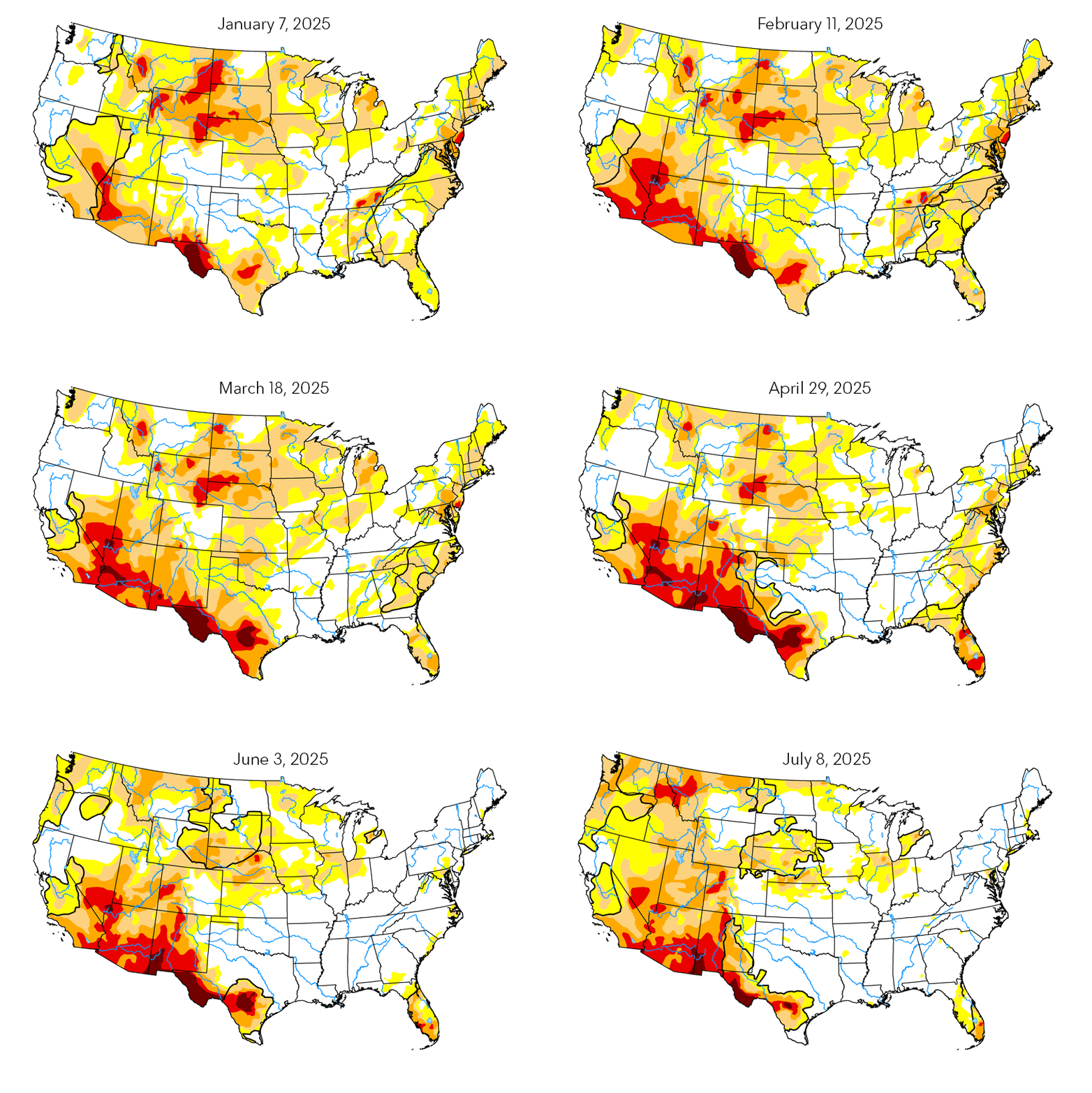
Spotty rains moved through western Illinois at midweek, but central areas of the state remained mostly dry, with temperatures climbing to the low-90s.
High heat and humidity also blanketed central Indiana during the week, while highs in the 80s were common across northern Ohio. Drought conditions were starting to spread in Michigan in late May after one of the driest Mays on record, prompting concerns that some corn may have to be replanted.
“Michigan is terribly dry,” commented one source. “Some of the corn and bean stands are very inconsistent and guys are debating disking them up and replanting, but we need some moisture first. I don’t ever remember pivots running in this area in May.”
The hot, dry weather continued to fuel a rapid planting pace, with all crops tracking ahead of their five-year averages in late May. Illinois growers had 92-95% of the corn and soybeans seeded by May 28, compared with 88-92% in Indiana and 87-89% in Ohio. Michigan’s corn and soybeans were 80% planted by May 28.

Western Cornbelt:
Spotty thunderstorms in central Iowa on May 30 dropped as much as 3.5 inches of rain in the Fort Dodge area, prompting flash flood warnings across the region.
Showers and thunderstorm activity were also reported in Nebraska, Missouri, and western Iowa at midweek, with reports of damaging winds, hail, and flooding in some locations.
Planting continued to track ahead of the average pace for all crops in the region. Corn planting as of May 28 was 96-98% planted in the Western Cornbelt, with soybeans rated at 86% in Missouri, 90% in Nebraska, and 94% in Iowa. Missouri growers also had 99% of the rice and 95% of the cotton crop planted by that date, while sorghum planting in Nebraska lagged at 36% complete.
Northern Plains:
High heat and humidity sparked several strong thunderstorms across the Northern Plains during the last days of May. Parts of southeastern North Dakota collected as much as three inches of rain on Memorial Day, including spotty reports of strong winds and hail.
Fertilizer movement was winding down as planting starts to wrap up across the region, but sources said applications have been running “wide open” since mid-May. Corn planting as of May 28 was 72% complete in North Dakota and 92-93% in South Dakota and Minnesota, while soybean planting had progressed to 53% in North Dakota and 81-86% in South Dakota and Minnesota.
Growers still had some work to do on sorghum and sunflowers, with the former estimated at 55% planted in South Dakota and the latter at 28-30% in the Dakotas. The planting of oats, spring wheat, and barley was well advanced however, with progress pegged at 93-99% in South Dakota and Minnesota, and 75-79% in North Dakota.
“The west is looking great on crops, the last rains are really helping,” commented one North Dakota source. “Central and eastern areas of the state are till planting a lot of soybeans. There will be some preventive planting, but just not sure how much yet as there are a lot of water holes the farmers are seeding around. Some are still just too wet, but for the most part we are plugging along and will keep going until June 20.”
Northeast:
Much of New England was bracing for a blast of heat late in the week, with highs climbing to the upper-80s and 90s. High heat also blanketed New York, Pennsylvania, and the Mid-Atlantic region, and abnormally dry conditions across the eastern half of Pennsylvania were sparking drought concerns in the state.
Pennsylvania growers had 77% of the corn crop planted by May 28, slightly ahead of the 68% five-year average. “I would say most of the spring planting demand is over,” reported one Pennsylvania contact at midweek. “We currently are very dry. Corn sidedressing has not started yet.”
Eastern Canada:
Ontario residents were bracing for high heat and humidity at the end of the week. Environment Canada at midweek warned that a two-day heat wave would start on June 1, with daytime temperatures expected to be near 30 C on June 1-2.
Summer weather also surged into southern Quebec in late May, with highs expected to hit 21 C on June 2. The province was also abnormally dry, prompting warnings of fire danger. Temperatures for June 1-2 were expected to reach the high 20s C and low 30s C for much of the Maritimes as well, with record highs expected to be set on both days for some locations.
Planting was winding down in Eastern Canada, with nearly all of the corn and most of the soybeans seeded. Corn sidedressing was just starting in the region. “With the heat this week and predicted going forward, we should see good demand next week and for the balance of June,” reported one regional contact.
US Gulf:
Colorado Lock repairs scheduled through June 2 were noted halting travel between 7:00 a.m. and 7:00 p.m. daily. Lock delays were reported up to 11 hours through the week. Intermittent navigation closures were expected at the Morgan City Railroad Bridge, located at the West Canal’s Mile 121, through the end of June.
Maintenance at Algiers Lock concluded on May 26, wrapping up a period of Monday-through-Saturday daytime shutdowns.
Bayou Sorrel Lock guidewall repairs were scheduled to begin June 6, leaving navigation unavailable daily from 7:00 a.m. to 6:00 p.m. Waits peaked at 4-14 hours on May 28-29, according to Corps data.
The Corps announced a forthcoming Leland Bowman Lock shutdown for chamber wall repairs, tentatively slated for the last 15 days of June. No firm start date was available on May 31.
Port Allen Lock waits topped out at five hours during the week, a sharp decline from 45 hours reported previously. Industrial Lock delays were noted as high as 18 hours.
Mississippi River:
Sources reported normal operating conditions on the full length of the Mississippi River. The St. Paul gauge receded below the area’s 10.0-foot action stage on May 26, tracking at 6.03 feet and falling on May 31. A flood warning reported in effect on May 24 was not renewed for the current week.
On the lower river, an NWS flash flood watch remained in place for parts of Mississippi and Tennessee due to the possible failure of the Arkabutla Dam, located in Mississippi. The watch was scheduled to expire on June 10.
Revetment work set to run May 13 through approximately mid-July at Miles 931-933, in the Wolfe Island area, blocked travel in the southbound direction from 7:00 a.m. to 6:00 p.m. daily. Sources described delays in a 12-18 hour range. The project was previously paused on May 19-27 due to a contractor request.
Illinois River:
A series of large-scale repair and maintenance projects were set to begin at Brandon Road Lock, Dresden Island Lock, and Marseilles Lock on June 1, effectively closing the Illinois River to commercial navigation until an estimated Oct. 1.
Starved Rock Lock was initially included in the maintenance slate but was subsequently removed, returning Ottawa to the waterway’s list of ports remaining available through the next four months. Shipping operators were noted paring back operations on the river ahead of the June 1 deadline.
Lock operators raised wickets at LaGrange Lock due to falling water levels, ending a period of lock-free navigation at the site. Wait times were posted up to six hours for the week. Raised wickets were also reported at Peoria Lock.
Ohio River:
Repairs to the floating mooring system at John T. Meyers Lock were scheduled to persist through Aug. 20, prompting intermittent main chamber shutdowns. The site’s auxiliary chamber is due to go offline Aug. 21 through Sept. 10 for miter gate repairs, followed by an additional primary chamber shutdown running Sept. 11 through Nov. 17.
The auxiliary chamber at Melville Lock was reported closed through Aug. 4 for maintenance. The northern chamber at McAlpine Lock is offline May 15 through June 15 for planned miter gate machinery repairs, prompting vessels to lock through the site’s southern chamber. The Meldahl secondary chamber is shut through June 30 for repairs, sources said.
At Smithland Lock, the use of an assist boat was required on southbound lockages due to strong outflows. The site’s land chamber is slated to shut Sept. 22 through Oct. 22 for machinery repairs.
The Greenup Lock main chamber will be unavailable for navigation July 5 through Aug. 14, forcing vessels to transit solely through the secondary chamber. Winfield Lock repairs, scheduled July 10 through Sept. 15, are unlikely to trigger delays.
Lock operators raised wickets at Olmsted Lock during the week due to falling river levels. Sources had previously expected to wickets to go up by May 29. Navigation at Robert C. Byrd Lock returned to normal on May 27 following a series of 18-hour shutdowns over the May 22-26 period.
Wait times were quoted up to 15 hours during the week at the Tennessee River’s Kentucky Lock. Intermittent 14-hour delays were seen at Pickwick Landing Lock, while Corps data put Wilson Lock passages at 5-7 hours.
France’s TotalEnergies, the global multi-energy company, and Finland-based biotechnology company Ductor Corp. on May 24 announced a new commercial and financial partnership with joint development of organic fertilizer and biogas production facilities and TotalEnergies equity ownership in Ductor.
The two have agreed to form a joint venture to co-develop and jointly invest in 15-20 anaerobic digestion facilities targeting nitrogen rich feedstocks and organic waste from the agricultural sector and turning it into sustainable organic fertilizers and renewable natural gas.
The facilities will utilize Ductor’s proprietary circular biotechnology already in use at Ductor’s operational plants in Germany and Mexico, capable of processing highly untapped waste streams from the poultry and aquaculture industries. The priority geographies for these new projects are in the US and Europe.
“Ductor has identified a significant opportunity pipeline for future biogas and sustainable organic fertilizer plants ready for development and commercialization, and the partnership with TotalEnergies will allow us to move forward with executing that pipeline and towards the construction of the first integrated fertilizer and biogas project,” said Ductor CEO Bernard C. Fenner. He added that the global market for organic fertilizer and biogas is expected to grow strongly in the years to come, and that the market potential is virtually endless.
Ductor will be responsible for screening opportunities, securing land, providing feedstock, engineering, obtaining permits, and conducting feasibility studies. TotalEnergies will actively participate in the development, construction, and operational phase, as well as being the offtaker of all produced renewable natural gas and its associated environmental attributes.
Ductor will offtake and market the specialty fertilizers such as liquid nitrogen fertilizers produced at the facilities. The product was registered for use in organic farming by the California Department of Food and Agriculture (CDFA) in October 2021.
“We are pleased to partner with Ductor, a young company with an innovative pre-treatment technology that will enable us to develop new biomethane production projects, using organic waste that is currently not, or only slightly, reused. By accelerating the biogas chain, this technology contributes directly to the energy transition and to TotalEnergies’ ambition of producing 20 TWh of biogas worldwide by 2030,” said Olivier Guerrini, Vice President, Biogas at TotalEnergies.
In addition, TotalEnergies has acquired a 20% stake in Ductor. Guerrini will join the Ductor Board of Directors.
Yara North America on May 24 announced the appointment of Molly Biedenfeld as Vice President, US Eastern Region Sales and Marketing, effective June 5, 2023. She replaces Federico De Vries, who will take a position in Yara Clean Ammonia as Vice President, Commercial and Business Development Projects. Biedenfeld will report to Geraldo Mattioli, Senior Vice President North America.
Yara said Biedenfeld brings a wealth of experience, with more than 20 years working in various roles at Cargill, Mosaic, Ostara Nutrient, and most recently ICL. Her expertise includes specialty and commodity fertilizers, nutrient recycling, freight, grain, and feed ingredients. She has an MBA and a Bachelor’s degree in Agricultural Business.
UK-based ATOME Energy Plc has decided to use its planned green hydrogen/ammonia complex in Paraguay (GM May 12, p. 1) to produce 250,000 mt/y of green calcium ammonium nitrate (CAN), the company announced on May 22. ATOME hopes to make a final investment decision and begin construction by the end of the year at its 75-acre site in Villeta, with the project scheduled to start production in second-half 2025.
“Our Villeta project is increasingly recognized as one of the most advanced and cost-effective green hydrogen and ammonia projects in the world,” said Olivier Mussat, ATOME CEO. “As such, discussions are underway with numerous leading international offtakers who have expressed interest in purchasing the entire planned green fertilizer production from Villeta.
“Our new commercial division has seen significant incoming market demand, which has underpinned our shift in strategic direction to incorporate a downstream proposition,” he added. “There is a clear and compelling commercial rationale to harness our Villeta plant so that it produces green fertilizer. With the EU being the largest consumer of CAN in the world and the Mercosur region being the largest importer of CAN – all of which are currently derived from hydrocarbons – the market potential for 100% green CAN is vast.”
ATOME said the global market for CAN is forecast to grow to US$43 billion by 2030.
While the company expects to expend more funds to build the plant and is seeking to add an additional 300MW of immediately available renewable power to its Paraguay business, it is holding to the 2025 start-up date.
The Villeta project extension to fertilizer will be accomplished with the same industry professional teams already appointed and currently working on the front-end engineering design (FEED) study, including ATOME’s owner’s engineer, multi-national Fortune 500 consulting firm AECOM, international Spanish contractor Urbas, and Swiss ammonia and fertilizer contractor Casale.
ATOME said other green projects are currently in discussions in Costa Rica and Iceland.
In addition to the CAN news, ATOME announced that Houston and London-based Baker Hughes, the global energy technology company, has subscribed £2.4 million in cash for a total of 2,526,316 new ordinary shares of ATOME at a price of £0.95 per share, representing 6.6% of the enlarged issue share capital of the company. ATOME has granted Baker Hughes the right of first offer to supply ATOME with compressors. The proceeds of the subscription will be used for general working capital.
LSB Industries Inc. and Amogy Inc. on May 25 jointly announced they have entered into a Memorandum of Understanding (MOU) aimed at promoting the adoption of low-carbon ammonia as a marine fuel, initially for the US inland waterways transportation sector. The two will collaborate on the evaluation and development of a pilot program that integrates LSB’s low carbon ammonia and Amogy’s ammonia-to-power technology.
Upon successful completion of the evaluation and pilot program, the companies expect to further collaborate on a larger-scale development, including exploration of opportunities for development of an end-to-end supply chain of low carbon ammonia and deployment of Amogy technology across multiple applications, including maritime vessels. The evaluation and pilot program includes potential engagement with other parties across the ammonia value chain. The two parties will also collaborate on various advocacy, education, and outreach efforts regarding the use of ammonia as a fuel.
“Our vision at LSB is to be a leader in the energy transition through the production of low and no carbon products,” said LSB President and CEO Mark Behrman. “This collaboration agreement is an exciting step in our journey toward achieving our goals and we’re thrilled to be working with such an outstanding partner in Amogy.”
“We’re delighted by this opportunity to work with LSB to advance the development of a low-carbon ammonia supply chain primarily in the US,” said Seonghoon Woo, Amogy CEO. “The success of this collaboration will be a key step toward solidifying ammonia’s position as a comprehensive solution for decarbonizing the commercial transportation sector across the entire value chain, from the upstream production to the downstream usage.”
Brooklyn-based Amogy, founded in 2020 by four MIT PhD alumni, seeks to enable the decarbonization of the heavy-duty transportation sector. Amogy plans to present its ammonia-powered, zero-emission tugboat in late 2023 (GM March 24, p. 28). Upon the successful sail of the tugboat, it plans its first commercial offering in 2024.
To date, Amogy’s scalable ammonia-powered, zero-emissions energy system has been demonstrated with success in a drone, heavy-duty tractor, and a semi-truck (GM Jan. 20, p. 31; June 3, 2022).
Amogy has other commercial deployments with partners, including an inland barge retrofit project with Southern Devall (GM Nov. 4, 2022) and Yara Clean Ammonia (YCA), a decarbonization-focused subsidiary of Yara International ASA (GM Nov. 11, 2022), under which YCA will consider Amogy’s ammonia-to-power system for use within future shipping projects. The companies will also pursue opportunities with external partners, including shipowners, for Amogy to deliver its technology and YCA to deliver clean ammonia.
The Mosaic Co. has closed on a new $700 million 10-year term loan facility through the Farm Credit System. The facility terms include a delayed draw option and prepayment with no penalty. The initial interest rate under the agreement is 175 basis points over the Secured Overnight Financing Rate.
NEOM Green Hydrogen Company (NGHC) on May 22 announced that it has now achieved financial close on the world’s largest green hydrogen production facility at a total investment value of US$8.4 billion.
The project is being financed with $6.1 billion in non-recourse financing from 23 local, regional, and international banks, and investment firms. The plant is currently being built at Oxagon, in Saudi Arabia’s region of NEOM.
NGHC has also concluded the engineering, procurement, and construction (EPC) agreement at a value of $6.7 billion, with Air Products as the nominated contractor and system integrator for the entire facility. Air Products has already awarded major contracts to various technology and construction partners. NGHC has also secured an exclusive 30-year offtake agreement with Air Products for all the green ammonia produced at the facility.
NGHC is an equal joint venture between ACWA Power, Air Products, and NEOM (GM July 10, 2020). The mega-plant will integrate up to 4GW of solar and wind energy to produce up to 600 mt/d of carbon-free hydrogen by the end of 2026, in the form of green ammonia.