

Eastern Cornbelt:
Potassium thiosulfate pricing remained at $700/st FOB Terre Haute, Ind., for the last reported offers.
Eastern Cornbelt:
Potassium thiosulfate pricing remained at $700/st FOB Terre Haute, Ind., for the last reported offers.
Eastern Cornbelt:
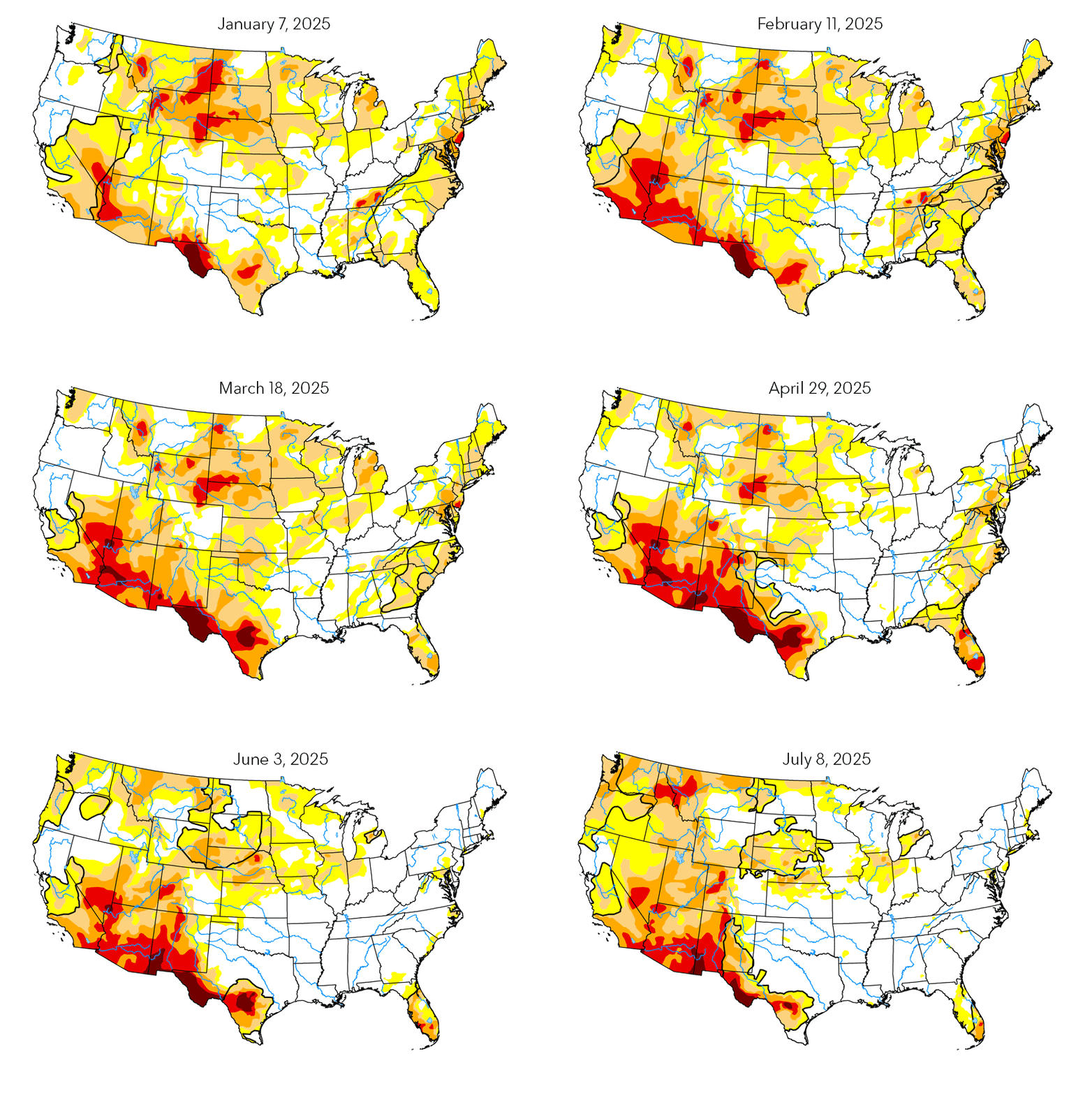
Parts of northern Illinois were hit with 2-3 inches of wet snow as the week progressed. Temperatures in the mid-30s were reported across central Indiana at midweek, but highs in the 40s were expected late in the week, along with widespread rain. By the weekend, highs were expected to top out in the mid- to upper-20s, with scattered snow showers likely.
Northern Ohio was also bracing for a wet and windy end to the work week, with a wintry mix of precipitation expected late in the week. Much colder weather was on tap for the coming weekend, with highs in the 20s and overnight lows in the single digits.
Western Cornbelt:
Temperatures in the 30s and low-40s were reported across Iowa as the week progressed, with wind chills in the teens and 20s. Isolated snow flurries were expected in parts of northern Iowa late in the week.
Temperatures in the 40s were also reported across central Missouri at midweek, with some areas posting highs in the 50s by the end of the week. A red flag fire danger warning was issued for most of eastern Nebraska on Feb. 8 due to warm, dry, and windy conditions. Winds were reported in the 20-40 mph range across the state.
Sources reported some fertilizer application taking place in the field, but the pace remained slow overall. “Dry weather persists and we need more rain,” said one California contact. “If we don’t get any moisture, we expect to see an early start to irrigation in some cases, and fertilizer will be injected in those irrigations.”
California:
Much of the state experienced unseasonably warm weather in early February, even prompting a heat advisory as several Southern California counties reported midweek temperatures in the mid- to upper-80s. Even in northern areas of the state, temperatures soared to 80 degrees or higher.
The warm weather, coupled with Santa Ana winds, sparked wildfires in the Laguna Beach area during the week, and also contributed to declining snowpack in the Sierra Nevada. The statewide snowpack fell from 160 percent of normal on Jan. 1 to 92 percent of normal on Feb. 1, with nearly all of the state reporting moderate-to-severe drought conditions.
“We are falling behind average precipitation by the day,” said one California contact at midweek.
Sources reported some fertilizer application taking place in the field, but the pace remained slow overall. “Dry weather persists and we need more rain,” said one California contact. “If we don’t get any moisture, we expect to see an early start to irrigation in some cases, and fertilizer will be injected in those irrigations.”
Pacific Northwest:
Mild, sunny weather was reported across inland Washington State during the week, with highs reported in the 40s.
Temperatures in the 40s and 50s were also common across Oregon and southern Idaho during the week, along with mostly dry conditions. Much of Montana experienced seasonal temperatures and dry conditions during the week, but some northwestern areas of the state were expecting 1-2 inches of snow in the valleys and 3-6 inches in the mountains by the weekend.
Western Canada:
Warm weather at the start of the week resulted in a number of record highs across British Columbia, including 12.9 C in Salmon Arm on Feb. 7. Temperatures climbed to 10 C in Edmonton, Alta., during the week, while lows in Winnipeg, Man., dropped to a negative 5 degrees C.
Mild temperatures across Saskatchewan produced freezing rain in some parts of the province at midweek, while strong Chinook winds battered southern Alberta earlier in the week. Heavy snow hit parts of Manitoba on Feb. 10, prompting weather warnings from Environment Canada and the closure of Highway 12 from Steinbach to the U.S. border. Some areas reportedly collected up to 10-15 cm of snow from the storm.
U.S. Gulf:
Emergency repairs closed Port Allen Lock to all navigation on Feb. 3. At least 26 tows were queued to pass on Feb. 8, with wait times counted up to 5.5 days. The delays were expected to slowly taper after lockages were restored.
Brazos Lock was closed to vessel traffic during daylight hours, Monday through Friday, through at least the end of February. Corps data showed Brazos Lock delays up to 31.5 hours on Feb. 8.
Guidewall repairs at Industrial Lock were scheduled to conclude on Feb. 11 after kicking off on Feb. 7. During the project, intermittent transit interruptions were noted daily between 6:00 a.m. and 6:00 p.m., with delays reported in a wide 10-25 hour range.
COVID-related labor shortages impacted the eastern river system during the week, with shorthanded operation reported throughout every phase of Gulf and river transport. The issue was expected to add “days” to average transit times through the short term.
Demolition of the Bayou Sorrel Lock southwest guidewall, scheduled to run from Feb. 8 through March 3, will trigger intermittent lock closures, sources said.
Monday-through-Friday navigation at Bayou Boeuf Lock continued to be limited to 7:00 p.m. through 7:00 a.m. due to ongoing maintenance operations. Lockages were available on a 24-hour schedule on Saturdays and Sundays.
Bayou Chene travel was restricted to 7:00 a.m. through 7:00 p.m. daily due to ongoing floodgate construction. Tows were capped at 600 feet of length, while an assist boat was necessary for configurations wider than 54 feet. Additionally, the waterway was subject to sporadic total closures for dive operations, with waits expected in the 6-12 hour range.
Towing restrictions were ongoing at the Atchafalaya River’s Mile 113-116, centered in the Morgan City area, due to shoaling. Maximum drafts were reduced to 10 feet, according to a Coast Guard posting, with tow sizes capped at 600 feet of length and 70 feet of width. Tows running longer than 400 feet were strongly advised to use an assist vessel. Captains were advised to bypass the restrictions by detouring through the Port Allen Route.
Restrictions on towing lengths and widths remained in effect on travel through Algiers Lock during the week, essentially limiting unassisted lockages to four standard barges or two 30,000 mt tankers per pass. Larger movements were permitted when accompanied by an assist vessel, however.
Construction efforts at the Belle Chasse Bridge were scheduled to run through late 2022, resulting in intermittent shutdowns lasting up to 12 hours at a time. Belle Chasse Bridge is located at Mile 3 in the West Canal.
Mississippi River:
Low-water conditions continued to be reported in the St. Louis area, necessitating ongoing towing restrictions. Draft limits were noted in the 9.5-10 foot range throughout the lower river, dependent on vessel location and direction.
The gauge at St. Louis returned a (-)1.01-foot reading on Feb. 9. Depths were projected to hold below the 0.00-foot mark for two weeks, sinking to an expected (-)1.9 feet on Feb. 22. Ice formation in the area during the week was expected to further impact navigation.
A rock-laying project in progress at the lower Mississippi River’s Mile 642 was scheduled to continue through late February. The effort was primarily affecting tows moving in the southbound direction, with delays reported up to 12 hours.
On the upper Mississippi River, Locks 1-20 were closed to vessel traffic for the winter navigation season. Most upper river locks were scheduled to begin opening for spring navigation on March 22, a delay from the previously scheduled March 3-21 window.
Illinois River:
Navigational slowdowns on the Illinois River were reported due to cold and ice conditions stemming from Winter Storm Landon, which swept through the region in the prior week. Navigation was projected to slowly normalize over the week ahead.
Frigid temperatures necessitated ongoing ice coupling use through all locks on the river, and barge counts were reduced by approximately 25 percent. O’Brien Lock was closed to navigation for the week.
Marseilles Lock wait times were posted above 12 hours on Feb. 8-9, while vessels transiting Starved Rock Lock were delayed up to 21 hours. Corps data showed nine-hour waits at Peoria Lock on Feb. 7. Boats passing LaGrange Lock were subject to 13-hour delays.
Repairs and maintenance are projected to impact Brandon Road Lock movements between May 9 and Sept. 8. Daytime travel is scheduled to be unavailable from May 9 through Aug. 14, followed by a total navigational shutdown running from Aug. 15 through Sept. 4.
Overnight-only operation will resume on Sept. 5-8, followed by an expected 24-hour opening starting on Sept. 9. A 70-foot width limit will be enforced on all lockages while the project is underway.
Ohio River:
Newburgh Lock reportedly suffered an emergency shutdown on Feb. 7 due to loose barges in the area. Work underway to collect the barges and reopen the lock was expected to conclude sometime over the Feb. 9-12 period. Delays through the lock were posted up to 26 hours on Feb. 9.
A repair project initiated on Jan. 26 at Cannelton Lock was impacting daylight-hour travel weekly on Wednesdays and Thursdays. The project is currently slated to run through May 26.
Main chamber repairs are set to begin at Emsworth Lock on Feb. 22, a Corps posting indicated. Tows will be limited to passage through the secondary chamber, with lockages capped at a single barge per pass. Significant delays are expected through the project’s end on April 16.
The Dashields Lock secondary chamber remained closed to navigation during the week due to an underwater obstruction blocking operation of the chamber’s lower miter gate. Locking was available through the primary chamber. The site’s primary chamber is scheduled to shut on March 7-31, followed by a round of secondary-chamber repairs slated for the April 1-22 period.
The main chamber at Belleville Lock is scheduled to close to navigation from May 2 through June 22 for repairs and maintenance, prompting traffic to pass through the secondary chamber.
A proposal to shut the Hannibal Lock main chamber for repairs would impact travel between July 5 and Oct. 8, Corps data indicated. A possible Cannelton Lock shutdown would run from July 5 through Nov. 11, forcing boats to pass through the auxiliary chamber.
On the Tennessee River, Kentucky Lock remains fully shut to navigation through Feb. 24 due to ongoing repairs. Detours were routing vessels through Barkley Lock, adding 1-2 days of transit time in each direction.
Primary chamber repairs are scheduled to run from Feb. 23 through April 28 at Wilson Lock, forcing detours through the site’s auxiliary chamber. The Corps has currently scheduled a single six-day main chamber opening during the project, set for March 18-23. Delays were expected to swell to seven days or more while work is underway. Wilson Lock delays were noted up to 31 hours for the week, rising from 18 hours reported previously.
A Coast Guard notice described repairs underway at the RJ Corman Railroad Bridge, located at Mile 126.6 on the Cumberland River. The project, scheduled to run through approximately March 1, was not expected to result in significant delays.
Cheatham Lock repairs proposed for May 16 through Aug. 4 would likely trigger delayed navigation through the area, if the project proceeds.
Yara International ASA, Oslo, reported a negative net income of $26 million for the fourth-quarter versus a positive $246 million net income for a year earlier, as the company recognized impairment losses of $250 million. Of these, $232 million is related to the Dallol potash mining project in Ethiopia.
Excluding currency effects and special items, fourth-quarter basic earnings per share were $1.19, compared with the year-ago $0.76 per share.
However, fourth-quarter EBITDA excluding special items increased by 50 percent to $765 million, up from $511 million, boosted by increased prices which more than offset lower deliveries and the impact of higher energy cost.
The quarter’s revenue grew by 72 percent to $5.03 billion, up from the year earlier $2.93 billion.
The fourth-quarter earnings missed estimates, and Yara shares tumbled by as much as 7 percent following the results publication, the most since March 2020. But analysts saw the miss as due to the time lag of high nitrogen prices filtering through to results, and not reflective of the company’s fundamentals, according to a Bloomberg report.
Ammonia production in the quarter was 6 percent down on a year ago at 1.76 million mt, while ammonia trade volumes were 9 percent lower on the year at 489,000 mt.
Output of total finished products (fertilizer and industrial, but excluding bulk blends) dipped by close to 2 percent, to 5.17 million mt.
Fertilizer (Crop Nutrition) deliveries in the fourth quarter were 4 percent lower year-over-year, dropping to 6.79 million mt from 7.12 million mt a year ago.
For Europe, fourth-quarter EBITDA excluding special items was 54 percent higher than a year earlier, as higher prices more than offset lower deliveries and increased feedstock costs. Deliveries decreased 7 percent to 2.17 million mt, mainly reflecting a strong period last year and customers reluctant to take positions in a volatile price environment, Yara reported.
In the Americas, EBITDA excluding special items in the quarter was 160 percent higher than the prior year, as increased nitrogen prices more than offset higher energy costs, inventory writedowns, and increased logistical costs. Yara highlighted the strong production margins in particular for ammonia and urea.
Total deliveries increased 6 percent year-over-year to 3.62 million mt, with the company reporting strong growth in premium products.
In Asia and Africa, fourth-quarter EBITDA excluding special items was 78 percent higher than a year earlier, mainly reflecting improved production margins on ammonia. Total deliveries were 27 percent lower on the year, at 999,000 mt, as higher prices impacted demand.
Yara reported a 60 percent EBITDA excluding special items increase in its Global Plants and Operational Excellence (GPOE) division for the fourth-quarter compared with the same prior-year period, reflecting higher nitrogen and phosphate prices which more than offset increased energy costs.
But the company’s Clean Ammonia business saw EBITDA excluding special items drop 43 percent on the year in the quarter, which it attributed to increased ammonia sourcing at higher prices. Yara said the price increases are passed on to the company’s production plants, but with a time lag of approximately one month.
Yara’s Industrial Solutions division posted a 56 percent drop in fourth-quarter EBITDA excluding special items, with the company citing higher production costs and lower reliability only partially offset by higher deliveries (up 8 percent on a year ago), higher selling prices and temporary surcharges.
The company recognized impairment losses in the fourth quarter totalling $291 million. Of the $232 million impairment loss related to the Dallol potash mining project in Ethiopia recognized in the fourth quarter, Yara said the recoverable value of the project is considered lower than its carrying value, and with significant capital expenditures remaining, the project is exposed to “significant uncertainties.”
The project is currently on hold while working on “a structural solution for the next stage of development,” Yara said. The updated assessment has determined that the fair value less cost of disposal of the project is close to zero in the current environment.
In response to the surprise of some analysts at a company earnings call on Feb. 8 about the impairment on the Dallol potash project, given the global potash commodity price trajectory, Yara International President and CEO Svein Tore Holsether said it was not about the global potash market, but more specifically about that the project and the location, with the situation in Ethiopia “highly uncertain.” In addition to war, other issues include geology and a railway to the port that never got built.
But Holsether said the Dallol project remains “an attractive project,” and that Yara still intends for this project to go ahead, but reiterated Yara is looking for structural solutions to limit the capex it puts in going forward
Yara was last reported to have a 51.8 percent stake in the Dallol project and had been looking at a potential production capacity of approximately 600,000 mt/y of sulfate of potash (SOP) utilizing solution mining (GM Feb. 14, 2020; Nov. 10, 2017).
Other impairment losses recognized in the fourth quarter included $32 million related to the fertilizer assets at the Paulínia site in São Paulo, Brazil.
However, some $41 million of impairment losses were reversed in the quarter, including the reversal of $23 million related to production assets in Italy and $18 million of the third-quarter 2021 impairment of the phosphates mining project in Salitre, in Ceará, Brazil, which is being acquired by EuroChem Group AG (GM Sept. 10, 2021;Aug. 6, 2021). This latter impairment reversal is mainly due to currency development (USD/BRL).
For full-year 2021, Yara reported a 44 percent drop in net income, to $384 million, down from the previous year $690 million. Excluding currency effects and special items, FY2021 basic earnings per share were $4.73 compared with the year-ago $3.08 per share.
Full-year EBITDA excluding special items increased by 34 percent, to $2.89 billion, up from $2.16 billion the previous year. Revenue increased by 42 percent, to $16.61 billion from the year-ago $11.73 billion.
Responding to an analyst’s question at a company earnings call whether Yara had been able to fill its potash requirements for NPK production in both Europe and Brazil following its decision to wind down sourcing of the nutrient from Belarus, announced last month, and targeted to be completed by April 1 (GM Jan. 14, p. 1). Holsether reminded that the company has a number of suppliers and that it had prepared a contingency plan given that the risk factor with regard to Belarus had been evidenced for some time.
“So, yes, we are able to source from other suppliers to be able to operate our NPK plants and that is working well,” he told analysts.
Looking ahead, Yara sees its market environment as supportive, with higher nitrogen prices globally reflecting strong demand and a tight supply situation.
But it warned high and volatile natural gas prices continue to pose a challenge for the nitrogen industry in Europe, “adding to global food security concerns in a situation with already tight supply across the main nutrients.”
As a result of the high gas prices, Yara curtailed production at several of its European ammonia production facilities in September and the fourth quarter. At the time, the company estimated that some 40 percent of its ammonia production capacity was coming offline (GM Sept. 17, 2021). In mid-December, it said that including planned maintenance and unscheduled outages, its European ammonia production was approximately 30 percent (around 370,000 mt) below capacity from September to November (GM Dec. 17, 2021).
Holsether put the cost of ammonia sourcing in the fourth quarter at “in the region of $50 million to $60 million.” He said most of Yara’s ammonia production is running normally now, although the company is always importing ammonia [into Europe] because the company is “structurally short” in Europe and “long” outside of Europe.
Yara reiterated that it is committed to supplying its customers “provided sufficient margins are available.”
It said the situation going forward will depend on market developments, especially for ammonia globally and natural gas in Europe.
Yara said its gas cost for the first and second quarters of 2022 would be respectively $900 million and $700 million higher than a year earlier.
The Yara Board will propose a NOK30 per share dividend to the AGM, bringing the company’s total cash dividend to shareholders for 2021 to NOK 58 per share.
Yara Production and Deliveries
| ‘000 mt | 4Q-2021 | 4Q-2020 | FY2021 | FY2020 |
| Production1 | ||||
| Ammonia | 1,759 | 1,866 | 7,261 | 7,606 |
| Finished fertilizer products (excluding bulk blends)1 | 5,170 | 5,270 | 20,856 | 21,047 |
| Yara Deliveries | ||||
| Ammonia trade | 489 | 539 | 2,007 | 1,966 |
| Fertilizer | 6,788 | 7,107 | 28,376 | 29,291 |
| Industrial product | 1,903 | 1,773 | 7,430 | 6,920 |
| Total deliveries | 9,180 | 9,419 | 37,814 | 38,177 |
1 Including Yara share of production in equity-accounted investees, excluding Yara-produced blends
Yara Deliveries
| ‘000 mt | 4Q-2021 | 4Q-2020 | FY2021 | FY2020 |
| Crop Nutrition Deliveries | ||||
| Urea | 1,281 | 1,567 | 5,745 | 6,051 |
| Nitrate | 1,390 | 1,427 | 5,477 | 5,826 |
| NPK | 2,735 | 2,672 | 10,400 | 10,444 |
| CN | 390 | 370 | 1,745 | 1,594 |
| UAN | 237 | 253 | 1,295 | 1,405 |
| DAP/MAP/SSP | 142 | 189 | 904 | 991 |
| MOP/SOP | 335 | 320 | 1,534 | 1,462 |
| Other products | 277 | 309 | 1,275 | 1,519 |
| Total Crop Nutrition Deliveries | 6,788 | 7,107 | 28,376 | 29,291 |
| Europe Deliveries | ||||
| Urea | 180 | 253 | 940 | 1,009 |
| Nitrate | 955 | 981 | 3,770 | 4,333 |
| NPK | 631 | 705 | 2,582 | 2,769 |
| CN | 75 | 89 | 440 | 446 |
| Other products | 329 | 299 | 1,500 | 1,559 |
| Total Deliveries Europe | 2,170 | 2,327 | 9,232 | 10,116 |
| Americas Deliveries | ||||
| Urea | 643 | 667 | 2,683 | 2,700 |
| Nitrate | 371 | 321 | 1,336 | 1,170 |
| NPK | 1,749 | 1,504 | 6,104 | 5,939 |
| CN | 247 | 219 | 1,096 | 962 |
| DAP/MAP/SSP | 133 | 173 | 820 | 869 |
| MOP/SOP | 312 | 296 | 1,432 | 1,374 |
| Other products | 164 | 232 | 991 | 1,240 |
| Total Deliveries Americas | 3,620 | 3,411 | 14,463 | 14,275 |
| Of which: | ||||
| North America | 800 | 832 | 3,465 | 3,481 |
| Brazil | 2,245 | 2,099 | 8,801 | 8,814 |
| Latin America excluding Brazil | 575 | 480 | 2,198 | 1,979 |
| Africa & Asia Deliveries1 | ||||
| Urea | 458 | 647 | 2,121 | 2,342 |
| Nitrate | 64 | 125 | 371 | 322 |
| NPK | 355 | 463 | 1,714 | 1,735 |
| CN | 68 | 62 | 209 | 186 |
| Other products | 53 | 71 | 265 | 314 |
| Total Deliveries Africa & Asia | 999 | 1,368 | 4,681 | 4,900 |
| Asia | 730 | 1,066 | 3,499 | 3,730 |
| Africa | 269 | 302 | 1,182 | 1,169 |
| Industrial Solutions Deliveries | ||||
| Ammonia2 | 155 | 142 | 563 | 543 |
| Urea2 | 418 | 407 | 1,645 | 1,577 |
| Nitrate3 | 318 | 240 | 1,234 | 1,069 |
| CN | 56 | 49 | 201 | 182 |
| Other products4 | 355 | 408 | 1,636 | 1,605 |
| Water content in industrial ammonia and urea | 601 | 528 | 2,152 | 1,944 |
| Total Industrial Solutions Deliveries | 1,903 | 1,773 | 7,430 | 6,920 |
1 The Africa and Asia business also includes Oceania
2 Pure product equivalents
3 Including AN Solution
4 Including sulfuric acid, ammonia, and other minor products
ICL Group, Tel Aviv, posted a big jump in adjusted net income attributable to shareholders of the group for fourth-quarter 2021, to $339 million, up from the year-ago $68 million. Adjusted earnings per diluted share were $0.26, up from $0.05 a year earlier.
Adjusted EBITDA for the quarter was $575 million, up from the prior-year $268 million, while fourth-quarter sales increased by 55 percent, to $2.04 billion, from $1.32 billion.
“We continued to benefit from our strategic focus on growing our long-term specialty solutions businesses, as performance in the fourth quarter was also supported by increased demand and higher prices in most markets and continued commodity upside momentum, said ICL President and CEO Raviv Zoller.
“All four of our businesses contributed, with double-digit growth in sales and EBITDA and, as a result, we were able to deliver yet another quarter of margin expansion and bottom-line improvement,” he said.
For full-year 2021, ICL reported a net income attributable to shareholders of $783 million, up substantially on the prior-year’s $11 million, while adjusted net income increased 219 percent on the year, to $824 million, up from $258 million.
Adjusted EBITDA came in 66 percent up on FY2020, at $1.64 billion versus $990 million, while full-year sales increased 38 percent to $6.96 billion, from $5.04 billion.
ICL said it expects full-year 2022 adjusted EBITDA of $1.85-$2.05 billion, with EBITDA of $875-$925 million coming from its specialties focused business.
ICL selected business segments
| 4Q-2021 | 4Q-2020 | FY2021 | FY2020 | |
| Potash | ||||
| Segment sales (including internal sales) $m | 698 | 379 | 1,931 | 1,346 |
| Segment operating income $m | 244 | 40 | 399 | 120 |
| Segment EBITDA $m | 288 | 83 | 564 | 286 |
| Production ‘000 mt | 1,188 | 1,208 | 4,514 | 4,527 |
| Sales (including internal sales) ‘000 mt | 1,147 | 1,333 | 4,434 | 4,666 |
| Phosphate Solutions | ||||
| Segment sales (including internal sales) $m | 609 | 501 | 2,432 | 1,948 |
| Segment operating income $m | 97 | 21 | 307 | 66 |
| Segment EBITDA $m | 146 | 75 | 522 | 276 |
| Innovative Ag Solutions | ||||
| Segment sales (including internal sales) $m | 380 | 163 | 1,245 | 731 |
| Segment operating income $m | 33 | 5 | 121 | 40 |
| Segment EBITDA $m | 48 | 11 | 159 | 65 |
The Potash business segment posted an 84 percent increase in sales (including internal sales) in the fourth-quarter, to $698 million, while EBITDA grew 247 percent on the same year-ago quarter, to $288 million.
The segment’s operating income in the quarter jumped to $244 million, from the year-ago $40 million. ICL cited the positive impact of a $259 per mt or 114 percent increase in the average realized price of potash from fourth-quarter 2020 to $487/mt, as well as an increase in the selling prices of FertilizerpluS products as mainly driving the significant rise in operating income. This more than offset the impact of lower potash sales volumes at both ICL Dead Sea and ICL Iberia.
The group said it expects recent price increases will have a continued positive impact into first-half 2022.
Potash production in the quarter dipped 2 percent, to 1.19 million mt, from the prior-year 1.21 million mt. ICL attributed the dip to a decrease in total production at the Dead Sea site in parallel with an increase in granular potash production. This impact was partially offset by higher production at ICL Iberia in Spain, following the connection of the ramp to the Cabanassess mine in the first quarter of 2021.
Fourth-quarter potash sales volumes (including internal sales) fell 14 percent lower year-on-year, to 1.15 million mt, down from 1.33 million mt. The group cited lower sales volumes to China, India, the U.S., and Spain, partially offset by higher sales to Brazil, Taiwan, and Morocco.
Full-year 2021 potash production was 4.51 million mt, versus the year-ago 4.53 million mt, while full-year sales (including internal sales) were down 5 percent, to 4.43 million mt, from the prior-year 4.67 million mt.
ICL highlighted the completion of the assembly of all P-9 pumping units at the Dead Sea site in the fourth quarter, and the start of their operations in early 2022. In both the Dead Sea and Spain, the group said it maximized its granular potash production “through debottlenecking efforts,” which resulted in higher realized prices.
“The shift not only meant granular comprised approximately 50 percent of our production but it also added roughly $35 million to operating income in 2021,” Zoller told analysts at a group earnings call on Feb. 9.
Zoller told analysts the current plan is for potash sales volumes of around 1.3 million mt for 2022 to India and China. He noted this is a little bit more than 25 percent of ICL’s 4 million mt annual potash production capability. He said ICL typically sells between 1.2-1.5 million mt/y combined to the two countries
The CEO did not speculate when he thought new supply contracts to India and China would get concluded, but cited rumors suggesting the new price for China could be “somewhere between $500 and $600/mt [CFR],” that is, more than doubling on the last contract price of $247/mt CFR.
At ICL Boulby in northeast England, ICL saw an increase in both polysulfate production and sales volume in the fourth quarter, with production up 36 percent from a year ago to around 214,000 mt, while sales volumes increased 42 percent to around 230,000 mt.
As previously announced, in December the company secured approval for Boulby’s application to continue mining and production through 2048 (GM Dec. 3, 2021).
Beginning from Jan. 1, 2022, ICL said the Boulby operation will move from the Potash business segment to the company’s Innovative Ag Solutions (IOA) segment, which will “better align” Boulby’s speciality products, as the company continues to focus on targeting long-term growth through specialty solutions.
Zoller conceded that the Boulby polysulfate business, while it has developed some speciality products based on polysulfate that can command a premium, “Boulby is still not a profitable business.”
ICL’s Phosphate Solutions business segment reported a 22 percent increase in fourth-quarter sales (including internal sales), to $609 million, while EBITDA almost doubled, to $146 million.
The segment’s fourth-quarter operating income jumped to $97 million, from the prior-year $21 million.
Phosphate specialities sales in the quarter were up 28 percent on the year, at $373 million, while operating income jumped 92 percent to $46 million.
Fourth-quarter sales of phosphate commodities increased 12 percent from a year-ago, to $236 million and operating income more than doubled to $51 million, up from the year-earlier $54 million.
Higher prices and increased demand for phosphate products drove the higher results, despite continued supply chain, raw material and production cost pressures, said ICL. The group also highlighted strong results from its YPH joint venture in China.
As previously announced as 2021 drew to a close, ICL secured an extension to its phosphate mining concession in Rotem, which has provided for an additional three years mining through the end of 2024 (GM Jan. 7, p.29).
ICL’s Innovation Ag Solutions (IAS) business segment posted a 133 percent increase in fourth-quarter sales (including internal sales), to $380 million and a 336 percent increase in EBITDA to $48 million. Segment operating income in the quarter rose to $33 million, up from just $5 million a year earlier.
The group said strong organic growth, in addition to the acquisitions last year of two Brazilian specialty plant nutrition businesses – Fertiláqua, completed in January 2021 (GM Jan. 8, 2021) and ADS (formerly Compass Minerals América do Sul SA) completed in July 2021 (GM July 2, 2021) – contributed to the significant year-over-year improvement in the segment’s results in the fourth quarter. It pointed to strong demand and increased volumes across most regions and product lines, along with higher prices, which partially offset higher raw material costs.
ICL said its Board of Directors has declared a quarterly dividend of 13.18 U.S. cents per share (approximately $169 million), payable on March 8 to shareholders of record on Feb. 23, 2022.
Belarusian potash mines may soon cease production, BMO Capital said this week, after the firm spoke with various potash suppliers, according to a report in real-time financial news publisher The Fly. BMO Capital analyst Joel Jackson said he understands that the last shipment from the potash mines in Belarus to Lithuania was over a week ago and that he would “not be surprised to see the Belarusian potash mines” owned by Belaruskali OAO stopping production “any day,” leading to likely heightened potash supply anxiety and higher imminent prices.
Belaruskali’s key export shipment route for its potash has been blocked since midnight on Jan. 31, when the termination of Lithuanian state-owned railway Lietuvos Geležinkeliai’s (LTG) contract to transport of Belarusian potash to Lithuania’s Klaipėda port came into effect, blocking the export shipment of around 90 percent of Belarus’ potash (GM Jan. 14, p. 1).
The termination of LTG’s contract with the Belarus potash producer followed the Lithuanian government’s decision on Jan. 12 to end the railway contract between LTG and Belaruskali. The decision was taken due to “national security concerns.”
Belarus could begin transshipping potash this year through the Russian port of St. Petersburg and ports in Russia’s Leningrad region, according to an Interfax report on Feb. 9, citing the Russian Ambassador to Belarus, Boris Gryzlov. The ambassador was speaking on the Russia-24 television channel.
Gryzlov said that this direction for transshipping Belarusian goods “will be implemented already this year in the near future,” and “that it could assist Belarus in transshipping its products that are [usually] exported through the Lithuanian port of Klaipėda.”
Leningrad region ports include the Baltic Sea ports of Ust-Luga and Primorsk.
Market participants and analysts, however, have questioned whether sufficient spare transshipment capacity is, and can be, made available at Russian ports to handle an additional 10-12 million mt/y of Belarusian potash. Many believe not.
Belarus state-run news agency BelTA, citing President Alexander Lukashenko, reported this week that Belarus was implementing “a project to increase port capacities for the transshipment of potash in Russia,” and intending to “complete it as soon as possible.”
According to the report, citing Lukashenko, Russia has provided a platform for the project to create additional infrastructure in order to increase the capacity for transshipment of Belarusian potash through Russian ports.
The project is supposedly being financed by private investment from Belarus, and is targeted to enable Belarus to start using the new infrastructure “at least in a year.” However, no hard details were provided.
Last week, Belarus claimed it had started to redirect its potash shipments to Russian ports for onward export, according to a Bloomberg report, citing Interfax, which in turn cited Belarus Prime Minister Roman Golovchenko (GM Feb. 4, p. 33).
The Belarus claim was refuted by Kremlin spokesperson Dmitry Pesov, as cited by a subsequent Interfax report. Pesov said the possible rerouting of Belarusian potash to Russian ports is “on the agenda” and is being discussed, but the re-routing of shipments has not begun just yet, as cited by Interfax.
Belaruskali filed a complaint with the Vilnius Regional Administrative Court last month, seeking to get the Lithuanian government’s decision to terminate the contract between it and LTG annulled (GM Jan. 28, p. 28). The court, which accepted the appeal on Feb. 4, however, is not introducing any interim measures while the appeal is being considered, according to BNS, citing an official of the court.
Other than via Russia, Belarus appears to have few if any alternative transshipment options for its potash. Private carriers in neighbouring Latvia, which like Lithuania, is a European Union Member state, have said no, according to BBC International Reports (Europe) in December (GM Dec. 17, 2021). Ukraine has also refused to participate in the export of Belarusian potash, according to an Interfax report.
OCI NV, Amsterdam, announced Feb. 7 it has inked definitive legal agreements to create a strategic alliance (GM Nov. 24, 2021) with Abu Dhabi’s ADQ and Alpha Dhabi Holding, under which the Abu Dhabi firms will acquire a 15 percent stake in the OCI Methanol Group for $375 million.
OCI said the alliance is aimed at positioning the OCI Methanol Group to be able to pursue future growth opportunities in hydrogen-based applications, including fuel.
“Methanol is a fundamental enabler of the hydrogen economy and is one of the most efficient fuels that will be key to decarbonizing the marine industry in particular,” said OCI.
OCI Methanol has methanol production capacity of around 3 million mt/y, with plants in The Netherlands and in Texas, U.S.
Under the terms of the agreements, OCI Methanol Group will be incorporated as an Abu Dhabi Global Market (ADGM) company in Abu Dhabi.
The Northern Australia Infrastructure Facility (NAIF) will invest A$255 million (approximately US$182.8 million at current exchange rates) in infrastructure supporting Perdaman Chemicals and Fertilisers Pty Ltd.’s proposed A$4.3 billion urea project near Karratha on the Burrup Peninsula in Western Australia’s Pilbara region.
The investment will be used in upgrades to common-user infrastructure that will support the urea project that proposes to produce some 2.14 million mt/y of granular urea.
NAIF’s investment comprises two loans and are the first NAIF investments into Western Australia government entities, according to a Western Australian government statement, announcing the funding.
The loans include a A$160 million facility to the Pilbara Ports Authority for a new multi-user wharf and facilities at the Port of Dampier, and a A$95 million facility to the Water Corp. for the expansion of the Burrup seawater supply and brine disposal scheme that will connect the Perdaman urea plant once built.
The NAIF loans build on the Western Australia government support for the project, which has included A$47.6 million for road relocation costs, the detailed design of a new Dampier cargo wharf and upgrades to seawater supply infrastructure.
Western Australia’s Environmental Protection Authority (EPA) last September recommended for environmental approval Perdaman’s proposal to construct and operate a urea plant within the Burrup Strategic Industrial Area, subject to conditions including air quality (GM Sept. 10, 2021).
“Recent international supply chain issues have highlighted just how important urea is to industry sectors such as agriculture and transport,” said Western Australia Deputy Premier and State Development, Jobs and Trade Minister Roger Cook.
Country-wide shortages of technical-grade urea, which is used to make AdBlue solution, over the past several weeks have been threatening to bring Australia’s transport industry to a halt (GM Jan. 28, p. 30; Dec. 31, 17, &10, 2021).
Perdaman currently is targeting first production in fourth-quarter 2025. The company last May signed a 20-year offtake deal with Incitec Fertilizers Pty Ltd., a wholly-owned subsidiary of Incitec Pivot Ltd. (IPL), for up to 2.3 million mt/y of granular urea from the proposed plant 2025 (GM May 7, 2021).
Saudi Arabian Mining Co. (Ma’aden) announced on Feb. 10 the completion of construction and pre-commissioning activities at its “Ammonia 3” plant at Ras Al-Khair Industrial City on Saudi Arabia’s East Coast, and the start of the trial production at the new 1.1 million mt/y capacity plant.
However, according to the company’s filing to Tadawul, Saudi Arabia’s stock exchange, Ma’aden said the financial impact will appear “after the completion of the trial production and start the commercial production, which is expected in the third quarter of 2022.”
Ma’aden previously had been targeting operations to begin in the first quarter of 2022 (GM Aug. 13, 2021; June 18, 2021).
The “Ammonia-3” plant is the first unit under construction as part of Ma’aden’s ambitious plans for a third large-scale phosphate complex, “Phosphate 3,” which, upon completion, will add a further 3 million mt/y of phosphate fertilizer production capacity to Ma’aden’s portfolio.
However, ammonia from Ammonia-3 has been expected to be sold initially on the market. In February last year, local media, citing Ma’aden, reported output from the new plant would add 1.1 million mt to the Saudi producer’s sales (GM Feb. 12, 2021).
Belgian fertilizer producer Rosier SA plans to seek investor approval on March 14 for a debt-for-equity swap aimed at raising €55 million (approximately $62.8 million at current exchange rates) from its majority shareholder Vienna-based Borealis AG after its assets fell to less than a quarter of its statutory share capital, according to a Feb. 9 statement by the company.
The EGM proposal is for the issue of 2.75 million new shares at €20 each, boosting Borealis’ equity stake in the company to around 98 percent, from the current around 77.8 percent.
The valuation follows an assessment by KBC Securities that saw Rosier’s equity value as negative, and compares with a €62 market price when trading in shares was suspended on Jan. 18, according to a Bloomberg report. The proposed issue price represents about a 67.7 percent discount to the last closing price before the suspension of trading.
The Moustier, Belgium-based fertilizer producer is also to receive an up to €15 million unsecured financing facility from Borealis.
According to the statement, Rosier’s Board of Directors expects the new committed facility to cover Rosier’s needs up to March 14, 2023, while the proposal to increase Rosier’s capital will reinforce the solvency of the company and would allow Rosier to find alternative sources of financing.
However, the Board conceded given that the new committed facility is expected to cover the company’s needs only up to March 14, 2023, it believes “there is a material uncertainty which may cast doubt on the company’s ability to continue as a going concern” after that date. However, they said they have “reasonable expectations” that Rosier will have adequate resources to continue in operational existence for the foreseeable future and at least until March 14, 2023.
The company said it intends to assess “strategic options” for its 100 percent-owned Netherlands subsidiary, Rosier Nederland BV, with its operations in Sas van Gent, in the near future, according to the company statement. The options include a divestment of Rosier Nederland from the Rosier Group.
Rosier SA reported an unaudited FY2021 net loss of -€36.9 million (FY2020: -€25.6 million). FY2021 EBITDA was -€4.9 million (FY2020: €1.1 million) on sales of €233.8 million (FY2020:€202.6 million). Sales volumes decreased by 6 percent compared with 2020, and margins decreased with 29 percent
Among the key challenges faced by the company last year were steep hikes in most basic raw materials prices, especially the ones produced from natural gas – “some as much as 50 percent,” it said.
Rosier SA is not part of Borealis’ parent company, Austrian oil and gas company, OMV AG’s plans to sell Borealis’ fertilizer business, according to OMV’s FY 2021 annual report statement, published last week.
Borealis/OMV announced last week they had received a binding offer from EuroChem Group AG, Zug, Switzerland, for the acquisition of Borealis’ nitrogen business, including fertilizer, melamine and technical nitrogen products (GM Feb. 4, p.1). The parties have begun exclusive negotiations for the acquisition.
The EuroChem offer values the Borealis nitrogen business on an enterprise value basis at €455 million (approximately $514 million at current exchange rates).