

Cornbelt:
The NPSZ market was quoted at $805-$825/st FOB in the Cornbelt in late January, depending on location.
Cornbelt:
The NPSZ market was quoted at $805-$825/st FOB in the Cornbelt in late January, depending on location.
Eastern Canada:
The SOP market jumped to the C$1,330-$1,400/mt FOB range in Eastern Canada in late January, depending on location, up from a low of C$1,120/mt FOB at last report.
Eastern Canada:
SOP Magnesia prices were unchanged at C$870-$980/mt FOB in Eastern Canada, depending on grade and location.
Eastern Cornbelt:
Potassium thiosulfate pricing remained at $700/st FOB Terre Haute, Ind., for the last reported offers.
Eastern Cornbelt:
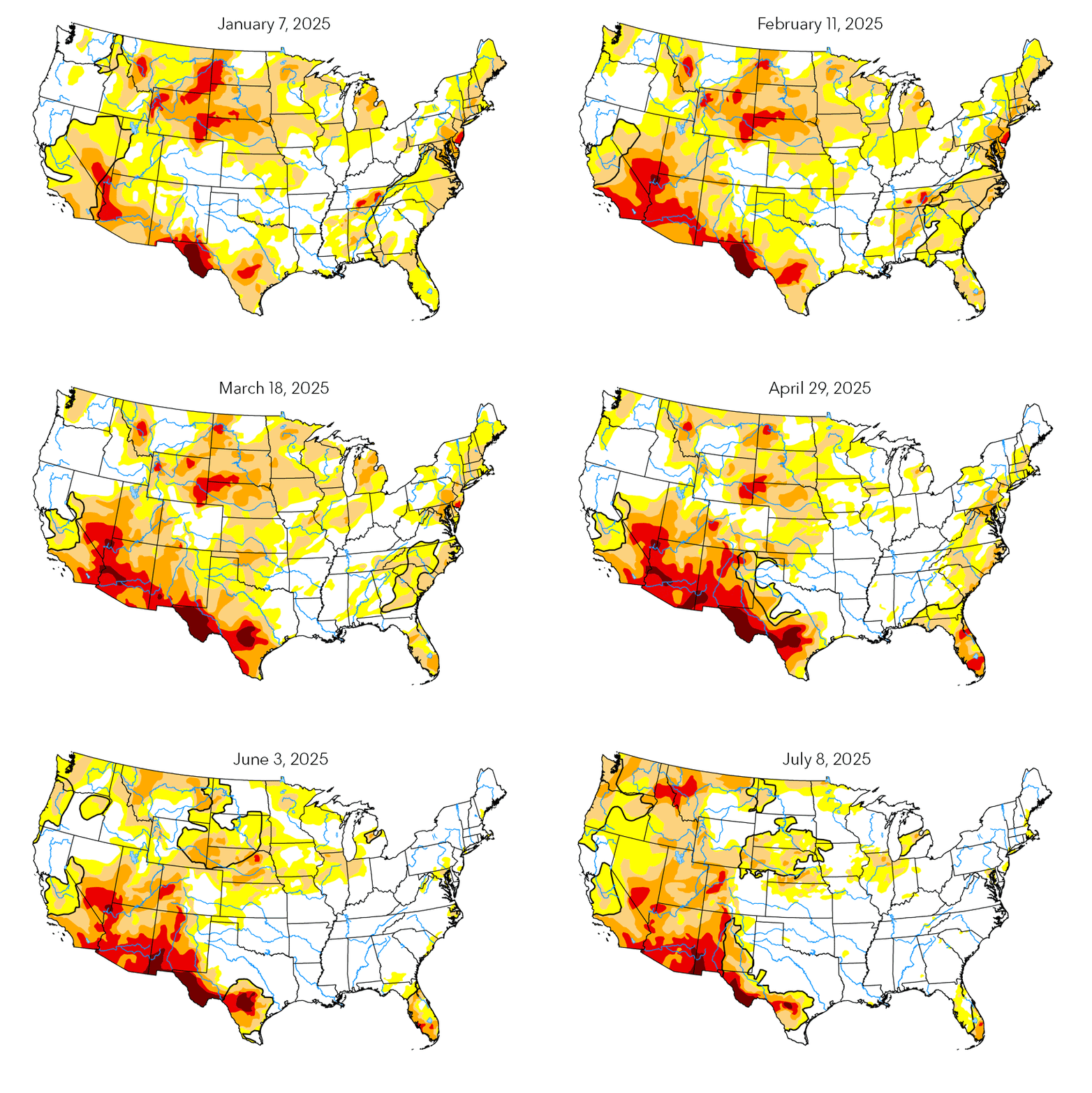
While most of the Eastern Cornbelt was expected to avoid the potent mix of snow and cold temperatures from Winter Storm Kenan, the region still experienced its share of both during the last full week of January.
Much of central and northern Illinois experienced subzero wind chills during the week, with light snow reported in central Illinois at midweek. Temperatures in central Indiana warmed to the low-20s at midweek, followed by snow flurries on Jan. 28.
Temperatures in northern Ohio struggled to break out of the teens during the week, with lake-effect snow reported in some locations.
Western Cornbelt:
Much of Iowa was under a wind chill advisory at midweek, with readings falling to minus 20-30 degrees across northern Iowa and the negative 10-20 range in eastern and central Iowa. Highs were expected to climb to the upper-20s and lower-30s in central Iowa by Jan. 28, however.
Milder temperatures were reported in Missouri at midweek, but wind chills still dropped to near zero in the Kansas City area, along with a dusting of snow in some locations.
Northern Plains:
Minnesota experienced see-sawing temperatures during the week, with highs climbing 46 degrees in the Twin Cities area over a 24-hour period at midweek before plummeting again as the week progressed. Forecasts warned that the entire state would experience temperatures in the double digits below zero by Jan. 27.
Subzero wind chills were also reported across North Dakota during the week, with highs struggling to reach the teens. Slightly warmer weather was on tap for the weekend, along with dry conditions, but another drop into frigid lows is expected for early February.
Northeast:
Wild temperature fluctuations and potentially heavy snow dominated Northeast weather patterns for the last full week of January.
In New England, temperatures rebounded from subzero lows at midweek to the teens and 20s by late Jan. 27, with highs in the 30s in the forecast for Jan. 28. Thursday morning wind chill readings included minus 4 degrees in Boston, 6 degrees in New York, and minus 10 degrees in Watertown, N.Y.
Heavy snowfall was in the weekend forecast for much of New England and the Mid-Atlantic region from Winter Storm Kenan, along with high winds and blizzard conditions. Baltimore was planning for 2-3 inches of snow from the weekend storm, with Philadelphia expecting six inches and parts of southern New England bracing for a possible 12-18 inches of accumulation.
Eastern Canada:
Winter weather advisories and special weather statements were in effect for nearly all of Eastern Canada as the week progressed. Heavy snow squalls produced whiteout conditions across southern Ontario at midweek, with frigid temperatures blanketing much of the province late in the week.
Extreme cold warnings were also in effect for western Quebec during the week, with wind chills plunging to the negative 30s and 40s C at many locations. By the weekend, a powerful nor’easter was expected to bring heavy snow to the three Maritime Provinces on Jan. 29, along with 50-80 km/h wind gusts.
The Russian government is looking at a possible temporary ban on exports of ammonium nitrate (AN) to avoid shortages in the local market, according to a Bloomberg report, citing Russia’s Kommersant newspaper.
Exports may be halted for the peak of the early sowing season, until April 1.
Russia already has set allocations for the export of AN, as well as various other nitrogen products, beginning from Dec. 1, 2021, though May 31, 2022. The AN export allocation was set at 744,000 mt (GM Nov. 5, 2021).
This latest development, if it comes to pass, will further exacerbate AN supply concerns, particularly among buyers in Brazil, who are the biggest offtakers of Russian AN. Over 50 percent of Russia’s AN exports went to Brazil in January-November 2021, some 1.92 million mt out of total AN exports of 3.84 million mt, according to Trade Data Monitor. Brazil takes almost all of its AN imports from Russia.
Interestingly, Russian AN shipments to Europe are near zero.
According to the paper, which cited unidentified sources, the potential halt was discussed at a Jan. 27 meeting in the Agriculture Ministry, but a final decision has not been taken.
U.S. Gulf:
Bayou Boeuf Lock movements were restricted to overnight hours only on weekdays, a Coast Guard posting indicated, leaving transit unavailable between 7:00 a.m. and 7:00 p.m. Monday through Friday. The lock returned to 24-hour accessibility on Saturdays and Sundays.
Bayou Chene was reportedly shut to overnight navigation for the week due to in-progress floodgate construction. The waterway was closed between 7:00 p.m. and 7:00 a.m. nightly, leaving vessels to pass during daytime hours with a maximum 600 feet of length. Tows measuring wider than 54 feet were required to travel with an assist vessel. Wait times were reported in the 6-12 hour range.
An ongoing shoaling event reported at Miles 113-116 in the Atchafalaya River necessitated 10-foot draft limits through the area, according to a Coast Guard posting. Maximum tow lengths were set at 600 feet, with tows measuring longer than 400 feet strongly encouraged to travel with industry assistance. Towing widths were permitted up to 70 feet. The Coast Guard advised vessels to bypass the restrictions via a detour through the Port Allen Route.
Unassisted Algiers Lock movements were restricted to four standard barges or two 30,000 mt tankers per turn. Larger tows were possible when traveling with an assist vessel. The size limits will remain in place until further notice.
Belle Chasse Bridge construction activities will continue through late 2022, producing intermittent travel delays of up to 12 hours at a stretch. The bridge is located at Mile 3 in the West Canal.
Boats transiting Bayou Sorrel Lock reported delays of up to eight hours for the week, while Industrial Lock waits peaked at 25 hours. Transits through the Colorado Floodgates were counted up to 27 hours. The Corps reported Brazos Lock wait times up to 7.5 hours.
Mississippi River:
Diminishing water levels on the lower Mississippi River precipitated tighter restrictions during the week. Vessel drafts returned to maximum 9.5-10 foot drafts on the waterway, depending on location and direction of travel, a change from 9.5-11.5 feet noted one week earlier.
The river gauge at St. Louis returned a (-)1.18-foot reading on Jan. 26. Depths were expected to recede below the (-)3.0-foot mark on Feb. 3. Levels at Vicksburg crested at an action-stage 35.29 feet on Jan. 20, but were reported at 31.17 feet and falling on Jan. 26.
Channel reinforcement efforts in progress since Jan. 5 at the lower river’s Mile 642 were projected to continue through February. Tows moving in the downriver direction were reportedly delayed up to 12 hours at a time.
Upper river locks 1-21 were closed to navigation for seasonal maintenance, Corps data indicated. Lock 15 was scheduled to reopen on March 3, followed by Locks 5 and 7 on March 11. Locks 5A, 8, and 10 were projected to resume locking on March 17, while Lock 4 is tentatively scheduled to return to service on March 21, conditions permitting.
Illinois River:
Ice floes were reported slowing navigation and impeding lockages on the Illinois Waterway during the week. Wickets were raised at both LaGrange Lock and Peoria Lock, while ice couplings remained a requirement for all locks. Peoria lockages were recorded up to 5.5 hours due to the conditions, while tows passing through LaGrange Lock required up to 47 hours, up from nine hours in the prior report.
Marseilles Lock was reportedly shut to navigation on Jan. 22. Wait times were noted in an 8-17 hour range for the week.
A repair and maintenance project at Brandon Road Lock is scheduled to run from May 9 through Sept. 8, prompting expectations of significant delays. Daylight-hour shutdowns and 70-foot width restrictions are scheduled for May 9 through Aug. 14, followed by a complete lock shutdown from Aug. 15 to Sept. 4. Overnight lockages will resume on Sept. 5-8. The lock is scheduled to resume 24-hour access on Sept. 9.
Boats passing Starved Rock Lock required up to nine hours to lock during the week.
Ohio River:
The Corps announced a round of planned Emsworth Lock main chamber repairs set to begin on Feb. 22 and run through April 16. Movements will be available solely through the secondary chamber, with lockages limited to a single barge per turn. Delays are expected.
Dashields Lock’s auxiliary chamber remained shut to navigation for the week due to an underwater obstruction inhibiting operation of the downstream miter gate.
Proposed 2022 shutdowns on the Ohio River were reported to include operations at Hannibal Lock, likely to close the site’s primary chamber from July 5 through Oct. 8. A proposed Cannelton Lock repair and maintenance effort would limit movements between July 5 and Nov. 11, forcing detours through the auxiliary chamber.
On the Tennessee River, Kentucky Lock is scheduled to fully close to vessel traffic from Jan. 31 through Feb. 24 for repairs to the upper miter gates. The Corps has designated Barkley Lock as an alternate route, adding an estimated 1-2 days of travel time in each direction.
The primary chamber at Wilson Lock, located at the Tennessee River’s Mile 259.4 in Florence, Ala., will shut for maintenance from Feb. 23 through April 29. Vessels will be able to pass via the secondary chamber on a 24-hour schedule, while the main chamber will open temporarily on March 18-24 to pass any assembled traffic. During this window, the auxiliary lock will continue to pass tows running six or fewer barges.
Delays at Kentucky Lock were posted in a wide 11-38 hour range for the week. Tows moving through Wilson Lock needed up to 18 hours to pass the site.
Barkley Lock, on the Cumberland River, is shut to daytime navigation through Jan. 30 for repairs to the bio-acoustic fish fence (BAFF) system. The work kicked off on Jan. 15. Cheatham lock is tentatively scheduled for maintenance from May 16 through Aug. 4.
Ameropa, Vienna, has acquired the majority stake in Promat Comimpex and Agroind Cauaceu, distributors of agri inputs and outputs in northern Romania, according to law firm Popovici Nitu Stoica & Asociatii (PNSA).
Ameropa now holds 70 percent of the two firms, recently adding a 30 percent share to the 40 percent stake it acquired in 2018. The purchase has received the approval of Romania’s Competition Council.
Other recent Ameropa acquisitions in Romania include fertilizer manufacturer Azomureş Târgu Mureş, Chimpex, one of the largest port operators in Constanta Harbor, and Ameropa Grains (former Comcereal Constanta and top three agri inputs and outputs trader in Romania), as well as various silos, storage and distribution facilities, and/or business lines from various players.
Stamicarbon, Sittard, The Netherlands, a unit of Maire Tecnimont, announced that it has been awarded a licensing and equipment supply contract for two Ultra-Low Energy grassroots urea plants in the People’s Republic of China. The plants will be built in Dongping, Shandong Province, for a local urea producer.
Stamicarbon will deliver the Process Design Package and the proprietary high-pressure equipment in Safurex®, and associated services for the urea melt plant and finishing by prilling. The two urea melt plants will each have a capacity of 2,334 mt/d and a pool reactor. The plants are expected to start up in mid-2023.
Stamicarbon said this contract represents its fifth and sixth application of its proprietary Ultra-Low Energy technology since its introduction. It builds on the success of the three earlier plants in China, of which Jinjiang Xinlianxin and Hubei Sanning are in operation, and Henan Xinlianxin is under construction.
Junior producer Chatham Rock Phosphate Ltd. (CRP), Wellington, N.Z., said on Jan. 14 it has started a prefeasibility study for the production of Dicalcium Phosphate (DCP), an animal feed ingredient, at the Korella and Korella South phosphate projects in Queensland, Australia.
CRP acquired the Korella phosphate and rare earth mine last October, and applied for an exploration permit over the 196 square kilometers of Korella South in December.
Samples of Korella phosphate are now on their way to phosphate technology specialists Prayon SA, Engis, Belgium, for testing to establish the parameters for production of DCP through their “GetMoreP” technology (GMP), with initial results expected in March. Under the GMP process, additional inputs are limestone and sulfuric acid, both of which CRP said are readily available locally.
CRP noted that DCP is a fully imported product in the country, and has recently become subject to supply-chain difficulties.
In addition to Korella, in 2021 CRP also acquired Australian-based Avenir Makatea Pty Ltd. (GM July 2, 2021), which is progressing the recovery of phosphate from the French Polynesian island of Makatea, while enabling the rehabilitation of the island. In other recent news, CRP said it was admitted to membership in Safer Phosphates, which is limited to producers of low cadmium phosphate.