All posts by mickeybarb@charter.net

Sulfur

Tampa:

Q4 Tampa molten contracts were reported at $183/lt CFR, a decline of $12/lt from $195/lt CFR in the previous quarter.

Refinery operating rates pushed higher for the week, the U.S. Energy Information Administration (EIA) reported. Utilization climbed to 89.8 percent of capacity for the period ending Dec. 3, a 1.0-point increase from 88.8 percent in the prior week. The current rate led the year-ago 79.9 percent while matching the 89.8 percent five-year average.

Crude inputs were also shifted higher, notching an average 15.785 million barrels/d through the period, a 154,000 barrel/d decrease from 15.631 million barrels/d recorded one week earlier.

U.S. Gulf:

Genscape reported the Dec. 4 shutdowns of a 275,000 barrel/d crude distillation unit (CDU) and an 83,000 barrel/d vacuum distillation unit (VDU) at the Flint Hills Corpus Christi West, Texas, refinery. Both units were noted entering a restart phase on Dec. 7.

A 40,000 barrel/d CDU at Valero’s Corpus Christi West plant was observed going offline for roughly eight hours on Dec. 4. Valero suffered a total facility shutdown at McKee, Texas, on Dec. 5, including a 130,000 barrel/d CDU, a 53,000 barrel/d VDU, a 54,000 barrel/d fluidic catalytic cracking unit (FCC), and numerous other units. The CDU and VDU were noted returning to operation on Dec. 6, while the FCC was restarted on Dec. 7.

A hydrocracker shut on Nov. 26 due to a malfunction at the Motiva plant in Port Arthur, Texas, showed increased activity on Dec. 5, although the unit remained shy of normal operating levels. Normal activity was fully restored on Dec. 7.

A 250,000 barrel/d CDU and a 66,000 barrel/d ULSD hydrotreater that were shut on Nov. 1 at the Shell Norco, La., refinery began ramping up on Dec. 7, but remained shy of operable levels. The refinery has continued to slowly restart operations following a late-August shutdown ahead of Hurricane Ida.

A 66,000 barrel/d ULSD hydrotreater at the TotalEnergies facility in Port Arthur, Texas, was restarted on Dec. 7. The unit was taken offline on Sept. 12 for maintenance.

Most players continued to note Gulf export price ideas in the $230-$240/mt FOB range, unmoved from the prior report. Recent price increases reported from key international markets such as Brazil could push Gulf pricing higher, sources said, should new business conclude today.

Brazil:

Last-done on the Brazil import market was noted firming to the $295-$299/mt CFR range, an increase from $284.50-$295/mt CFR reported previously. A $296/mt CFR cargo that reportedly transacted on Dec. 3 was understood to originate from the Arab Gulf.

Fourth-quarter import contracts were typically pegged at $234/mt CFR, rising from $221-$223/mt CFR in the prior quarter.

Vancouver:

Easing logistics hurdles at Vancouver led to firming values, players said. Price ideas were typically quoted in the $230-$235/mt FOB range, lifting from $205-$210/mt FOB at last report.

Alberta:

With Vancouver prices shifting higher, netbacks to Alberta supplies firmed to the $68-$165/mt FOB range, up from $68-$140/mt FOB in the prior report. The wide spread included both molten tons contracted into the U.S. market and prilled material exported out of Vancouver.

West Coast:

Observed activity increases from a 32,000 barrel/d CDU at the Phillips 66 plant in Rodeo, Calif., fizzled on Dec. 1, Genscape reported on Dec. 3. Increases at the unit, offline since Feb. 10, had been ongoing since Nov. 30.

Prilled sulfur loading from the West Coast was indicated at $230-$235/mt FOB, above the last reported range of $205-$210/mt FOB.

Sources quoted molten sulfur contracts at $160-$170/lt FOB for loading in the fourth quarter.

China:

China sulfur import pricing was reported moving up for the week, with players calling last-done values in the $290-$295/mt CFR range, firming from the prior $265-$275/mt CFR. “(It) appears China is waking up and being more active at higher prices,” said one source.

ADNOC:

Abu Dhabi National Oil Co. offers for December were noted firming to $265/mt FOB Ruwais, a $35/st increase from November’s posting of $230/mt FOB.

Qatar:

Qatar formed sulfur offerings for December stood at $265/mt FOB Ras Laffan, sources said, up $39/mt from the previous month.

Kuwait:

Sources quoted sulfur vessels loading from Kuwait at $267/mt FOB, up $41/mt from $226/mt FOB in November.
Sulfuric Acid

U.S. Gulf:

Sources quoted Gulf import sulfuric acid pricing in the $240-$245/mt CFR range, softening from $245-$250/mt CFR at last report.

Gulf Coast:

Contract values for delivery to the Gulf Coast were quoted at $85-$110/st DEL for 2021. Players generally expect 2022 agreements to conclude in the $200-$230/st DEL range.

Midwest:

Midwest sulfuric acid pricing was noted on par with the Gulf Coast in the $85-$110/st DEL range.

West Coast:

West Coast pricing for 2021 was quoted at $100-$130/st DEL.

Brazil:

Brazil spot sulfuric acid imports were heard softening to $260-$270/mt CFR.

Australia:

Verdant Minerals Pty Ltd. has tapped Montreal-based SNC-Lavalin Group to study the feasibility of building a 4,500 mt/d sulfuric acid plant at Verdant’s Ammaroo Phosphate Project, an integrated mine and phosphate production facility located in Australia’s Northern Territory, SNC-Lavalin reported.

Uralkali Enters Brazil’s Distribution Market

Russia’s Uralkali has acquired UPI Norte, a shareholder in Brazilian fertilizer distributor FertGrow, the company said in a statement, as reported by Bloomberg. Uralkali is focusing on developing its own distribution in key global markets.

“The acquisition of a stake in FertGrow will considerably help Uralkali to optimize its operations in Latin America,” according to Uralkali Trading CEO Alexander Terletskiy.

Ammonium Thiosulfate

Eastern Cornbelt:

Ammonium thiosulfate pricing jumped to $550-$600/st FOB, with the low confirmed at Seneca, Ill., for spring tons and the high reflecting a limited offer FOB Terre Haute, Ind.

Western Cornbelt:

Ammonium thiosulfate pricing was reported at $600/st FOB Waterloo, Iowa, for what sources described as a limited time and volume offer during the week. All tons offered were sold by the end of the week.

Southern Plains:

The last reported pricing for ammonium thiosulfate included $375/st FOB Houston and $435/st FOB Lubbock, Texas.

South Central:

The last ammonium thiosulfate offers remained at $435-$440/st FOB Memphis.

Crops/Weather

Eastern Cornbelt:

After unseasonably warm weather during the week, highs were expected to drop into the 50s in central and southern Illinois by the end of the week, ushering in potentially strong thunderstorms over the coming weekend.

Similar conditions were reported in central Indiana, where highs pushed into the 60s after starting the week in the high 30s and 40s. Forecasts warned of a wet weekend for much of the state, followed by cooler weather.

Parts of northern Ohio were blanketed with 1-3 inches of lake effect snow at midweek, followed by warmer weather that pushed highs into the 50s by Dec. 10. Strong winds and possible thunderstorms were in the weekend forecast for the region.

Western Cornbelt:

Following a stretch of mild temperatures in early December that included a high of 63 degrees on Dec. 5 in Sioux City, Iowa, residents in parts of Nebraska, Iowa, and South Dakota were bracing for the first big winter storm of the season on Dec. 10-11.

A winter storm warning was posted late in the week for northeastern Nebraska, southeastern South Dakota, and much of northern Iowa, with forecasts warning of 2-5 inches of snow in Norfolk, Neb., 3-7 inches in Sioux City, S.D., and up to 10 inches in Sheldon, Iowa.

A separate system was taking aim at Missouri, with potentially strong storms possible in the St. Louis area late on Dec. 10. The weather could put a lid on fall ammonia movement, which was still running strong in parts of Missouri during the week. Some sources speculated that the brisk fall ammonia pace has cut into the expected spring demand by as much as 50 percent.

Southern Plains:

Much of the Southern Plains was experiencing a seesaw in temperatures in early December. After unseasonably warm weather during the first days of the month, a cold front dropped highs into the 40s across Kansas and Oklahoma on Dec. 6, down dramatically from the 70s experienced over the prior weekend.

Temperatures gradually warmed again during the week, with highs once again reaching the 70s by Dec. 10 across Kansas and Oklahoma, and even pushing into the 80s in central Texas. Another cold front was on tap for the coming weekend, however, with lows dropping to the 50s and 60s in Texas and down to the 20s and 30s in Colorado.

Snow was also in the weekend forecast for higher elevations in Colorado and New Mexico.

South Central:

After a round of strong thunderstorms over the previous weekend, most of Tennessee experienced cool weather for the week, with lows in the 20s and high only reaching the low- to mid-40s. Relatively cool temperatures were also reported across Arkansas during the week, with an increased chance of potentially strong thunderstorms over the coming weekend.

By contrast, unseasonably warm temperatures in the mid-70s across Louisiana and Mississippi ushered in some strong thunderstorms, with reports of damaging winds in some areas. Western Kentucky was also bracing for some potentially strong storms heading into the weekend.

Southeast:

After a cool start to the week, temperatures warmed to the 70s across Alabama and Georgia by Dec. 9, with an increased chance of thunderstorms over the coming weekend. Temperatures in the 80s were common across southern Florida during the week.

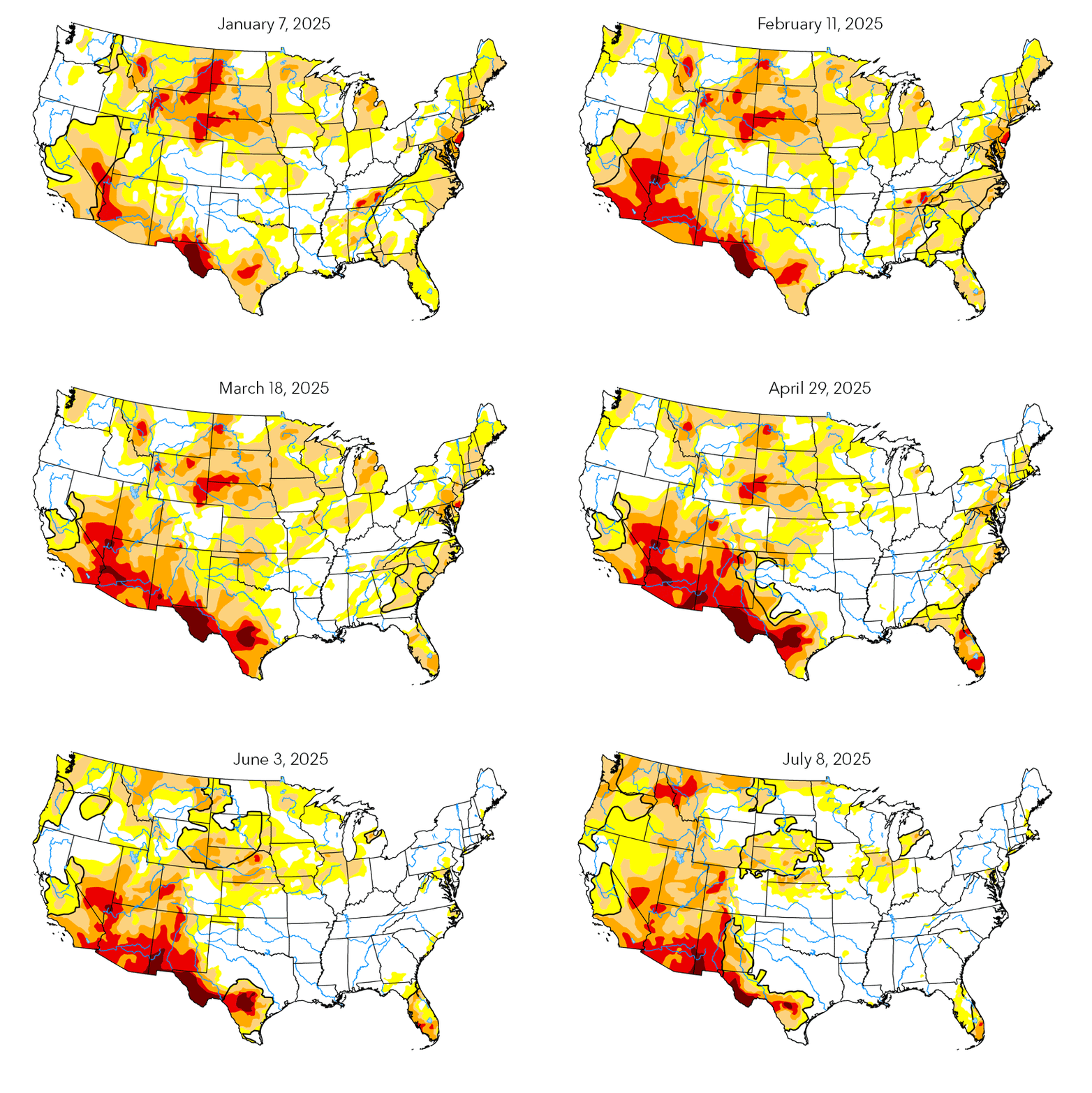
Although midweek rains were reported across parts of Virginia and North Carolina, more than half of North Carolina is now experiencing severe drought after an unusually dry autumn.

Most of the fall harvest was over in the Southeast, although sources said growers were still working on the last cotton acres in Georgia.

Transportation

U.S. Gulf:

Overnight fog conditions reportedly caused slowdowns and outright stoppages throughout the Gulf during the early week. Forecasts were said to show improved conditions heading into the weekend.

An emergency shutdown reported at Harvey Lock on Dec. 6 was noted prompting detours through Algiers Lock. Ongoing travel restrictions reported through Bayou Boeuf Lock limited weekday movements to the hours between 7:00 p.m. and 7:00 a.m. The Corps resumed 24-hour access on Saturdays and Sundays, however.

Floodgate construction restricted movements through Bayou Chene to daytime hours only, a Coast Guard posting indicated. The waterway was open to navigation daily between 7:00 a.m. and 7:00 p.m., while tow lengths were limited to 600 feet. Strings larger than 54 feet wide were required to travel with an assist vessel. Delays were reported in the 6-12 hour range.

Travel near Morgan City via the Atchafalaya River travel was restricted due to shoaling reported at Miles 113-116. Drafts were capped at 10 feet, while total vessel dimensions were limited to 600 feet of length and 70 feet of width. Tows running longer than 400 feet were strongly encouraged to use an assist tug. Vessels could bypass the restrictions via a detour through the Port Allen Route.

Vessels transiting Algiers Lock continued to see size constraints, essentially limiting unassisted tows to four standard barges or two 30,000 mt tankers. Tows with larger dimensions were able to transit when accompanied by an assist vessel.

Ongoing construction efforts at Belle Chasse Bridge were expected to trigger intermittent delays up to 12 hours. Located near Algiers Lock, at Mile 3 in the West Canal, the effort is slated to continue through late 2022.

Port Allen Lock waits were noted up to 55 hours for the week. Boats passing Bayou Sorrel Lock saw wait times up to 12 hours, while Industrial Lock navigation was intermittently delayed by 10 hours at a stretch. Sporadic Brazos Lock waits were reported in the 6-14 hour range.

Mississippi River:

The Corps had largely concluded channel reinforcement disruptions at Victoria Bend, located at Mile 595 in the lower Mississippi River, as of Dec. 7. Work was said to continue, although navigational impacts were projected to be minimal going forward.

Dredging underway at Mile 591 continued to limit movements, however. Southbound travel resumed on the morning of Dec. 7 following a multiday stoppage, with more than 70 vessels queued to pass the site on Dec. 7. Tows traveling in the upriver direction were expected to begin transits on Dec. 8-9, at the discretion of the Dredge Hurley, with loads reportedly limited to 40-42 barges.

An unspecified incident temporarily halted lower river travel at Mile 541 on Dec. 7.

Low water levels in the St. Louis area necessitated draft restrictions on lower river travel, with northbound drafts capped at 10-11 feet at various sections of the waterway. Southbound vessels were limited to 11-11.5 feet. The National Weather Service (NWS) river gauge at St. Louis returned a (-)0.05 foot reading on Dec. 8. Levels were projected to descend to (-)2.5 feet on Dec. 18-20.

Bridge maintenance at the upper river’s Mile 309.9 reportedly closed the area to navigation on Dec. 6-9, between 7:00 a.m.-10:00 a.m. and 12:00 p.m.-3:00 p.m.

Upper river locks 1-10 were shut for the winter navigation season. Lock 15 is scheduled to close for seasonal maintenance on Jan. 1. Lock 24 is also slated to shut for one month, starting on Jan. 1.

Lock 15 is due to return to service on March 3, followed by Lock 5 and Lock 7 on March 11. Locks 5A, 8, and 10 are tentatively set to resume lockages on March 17, while Lock 4 is expected to return for the spring on March 21.

Seven-hour delays were noted through Lock 27 during the week.

Illinois River:

With wickets raised at Peoria Lock and LaGrange Lock due to low water levels, delays through Peoria Lock reportedly climbed to as high as 10 hours for the week. The Corps counted wait times at nearly 16 hours through LaGrange Lock on Dec. 6-7.

Brandon Road Lock is scheduled to undergo a repair and maintenance project from May 9 through Sept. 8. Daytime navigation is anticipated to be unavailable May 9 through Aug. 14, while overnight movements will be limited to 70-foot widths. The Lock is scheduled to shut entirely from Aug. 15 to Sept. 4. Overnight-only navigation will return on Sept. 5-8.

Ohio River:

Emergency hydraulic repairs were noted shutting the Markland Lock main chamber on Dec. 4-8. Traffic was forced to lock solely through the smaller auxiliary chamber, resulting in delays of 5-22 hours through the period.

The primary lock chamber at Montgomery was reported offline through Dec. 22 for repairs and maintenance. Tows have been forced to lock one barge at a time through the site’s secondary chamber, with long waits of 5-7 days reported.

An ongoing Hannibal Lock main chamber repair project was scheduled to wrap up on Dec. 10, ending a spate of secondary chamber-only travel that began on Oct. 29. A second round of repairs proposed by the Corps would see the main chamber shut between July 5 and Oct. 8 next year.

Access to the auxiliary chamber at Dashields Lock remained unavailable for the week due to an obstructed miter gate. Despite the closure, minimal delays were reported.

A proposed Cannelton Lock repair would see the site’s primary chamber closed to navigation from July 5 through Nov. 11, 2022, forcing traffic through the site’s secondary lock chamber.

On the Tennessee River, the Corps has extended a Kentucky Lock miter gate repair project through Dec. 14, four days beyond the original Dec. 10 plan. Tows were projected to detour through Barkley Lock and the Barkley Canal while the project is underway. Limited to 12-barges per tow, the detour was expected to add 1-2 days of transit time in each direction.

The main chamber at Wilson Lock is tentatively set to shut for repairs from Feb. 23 through April 28, 2022, forcing boats to pass via the site’s secondary chamber. One main chamber opening is currently scheduled during the project, on April 1-3.

The Corps announced a round of maintenance at the Cumberland River’s Barkley Lock, expected to block main chamber access daily from 6:00 a.m. to 6:00 p.m., on Jan. 15-30, 2022. Maintenance proposed for Cheatham Lock would necessitate some level of navigational disruption between May 16 and Aug. 4, 2022.

Lock 6 on the Allegheny River is closed indefinitely due to a damaged miter gate anchorage.