All posts by mickeybarb@charter.net

Ammonium Thiosulfate

Eastern Cornbelt:

Ammonium thiosulfate pricing was quoted at $450-$500/st FOB in the Eastern Cornbelt for the last prompt or prepay offers.

Western Cornbelt:

Ammonium thiosulfate pricing was steady at the $450/st FOB level or higher in the Western Cornbelt.

California:

The last ammonium thiosulfate offers were quoted at the $380-$387/st FOB level in California for limited tons.

Pacific Northwest:

The ammonium thiosulfate market was up $50/st in the Pacific Northwest, to $415/st FOB and $420-$440/st DEL in late November.

Calcium Ammonium Nitrate

California:

The CAN-17 market in California was moving up, with new pricing reported at $420/st FOB Stockton and $435/st FOB Woodland and Helm, up from the last reported range of $400-$415/st FOB.

Pacific Northwest:

CAN-17 pricing in the Pacific Northwest was quoted at $430/st FOB Kennewick, up $30/st from early November.

Germany/Benelux:

Yara on Nov. 22 posted its prices for February 2022 deliveries of CAN-27 (YaraBelaNitromag) in Germany and Benelux. The new prices are set at €617/mt bulk CIF for Germany, and €622/mt bulk CIF for Benelux, marking a €7/mt increase on Yara’s last posting for January deliveries for both destinations announced at the start of November (GM Nov. 2, p. 18). The supplier once again warned that only limited volumes would be available.

Yara has also announced its list prices for February 2022 deliveries of YaraBelaSulfan product to Germany and Benelux, firming to €627.50/mt bulk CIF for Germany and €634/mt bulk CIF for Benelux. Those levels reflect €7/mt increase on the price for January deliveries to both countries.

Crops/Weather

Eastern Cornbelt:

The week began with reports of lake effect snow in northern Indiana and the Great Lakes region, while temperatures in southern Illinois warmed to the upper-50s. A second system was expected to bring rain and snow to parts of Indiana and northern Ohio later in the week, with highs in northern Ohio only reaching the mid-30s by Friday.

The corn harvest had progressed to 91-96 percent complete in Indiana and Ohio by Nov. 21, compared with 84 percent in Ohio. The regional soybean harvest was 90-95 percent complete by that date.

Western Cornbelt:

Mild, breezy weather helped growers move quickly on the remaining fall harvest in the region before Thanksgiving. The dry conditions prompted a red flag warning for the entire Nebraska Panhandle and central Nebraska at midweek, with winds gusting to 25-45 mph.

Much cooler weather was on tap for the end of the week, however, with highs expected to dip into the 30s in Iowa by Friday.

The regional corn harvest had progressed to 95-97 percent complete in the region by Nov. 21, with all three states tracking slightly ahead of their five-year averages. The soybean harvest was finished in Iowa and Nebraska and 90 percent complete in Missouri, with Missouri’s cotton harvest estimated at 94 percent complete by Nov. 21. Nebraska growers had 95 percent of the sorghum crop in the bin by that date.

California:

A brief storm earlier in November brought more rainfall to parts of Northern California and the Sacramento Valley, with 6-9 inches of additional snow reported in the Sierra Nevada. The system followed the “bomb cyclone” in late October that produced up to 10 inches of rain in Northern California and brought 3-5 feet of snow to the Cascades and Sierra Nevada.

Dry weather persisted for much of November across the state, however, with forecasts warning of Santa Ana winds in Southern California on Thanksgiving Day, along with potential power shutoffs and wildfires. A fire weather watch was in effect on Nov. 24-26 for large portions of Los Angeles, Orange, and Ventura counties, as well as the Inland Empire.

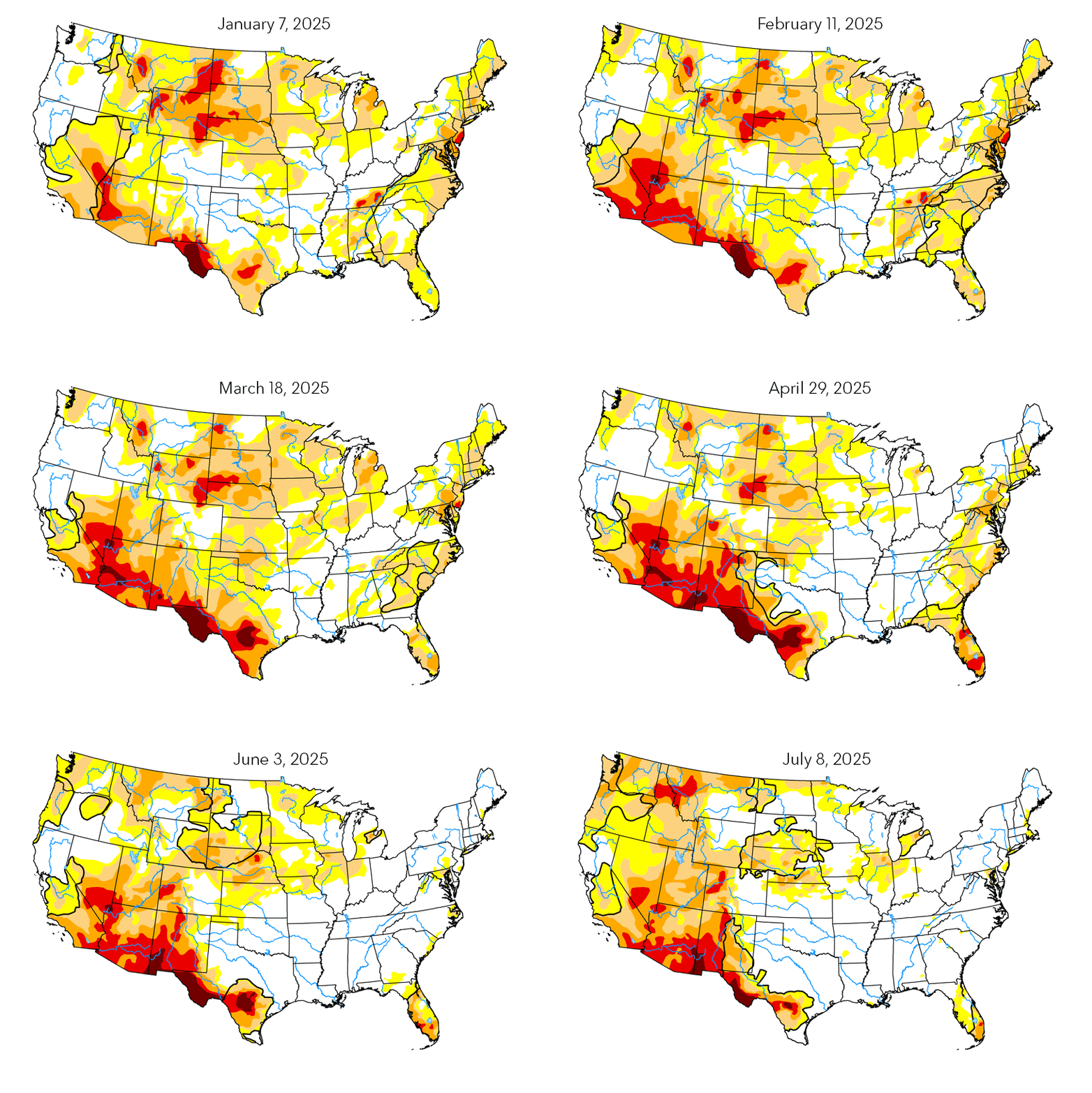
Despite the needed precipitation in late October and early November, a vast area of extreme-to-exceptional drought continued to cover the bulk of California, with small areas of moderate-to-severe drought reported on the southern and northern edges of the state.

Pacific Northwest:

Wet, winter weather conditions were reported in many areas of the Pacific Northwest during the week. After heavy rains and flooding across northwestern Washington during the previous week, another system was expected to bring additional moisture to the same location during the Thanksgiving week, with 3-6 inches of rain possible as November draws to a close.

Oregon was also bracing for a wet Thanksgiving, with 4-8 inches of snow expected in the Cascades and an additional 2-4 inches of accumulation over the Willamette Pass by the weekend. A quick shot of winter weather brought snow to southern Idaho and western Montana during the week as well, with 1-5 inches reported at higher elevations in Montana.

Most of the fall harvest and fieldwork was completed in the Pacific Northwest.

Western Canada:

A powerful storm was taking aim at parts of British Columbia during the week, with up to three inches of rainfall expected in Vancouver and as much as 10-20 inches of precipitation at higher elevations by the end of the month.

Weather conditions across the Prairies were much calmer after the prior week’s winter blast, however. The powerful mid-November storm hammered all three Prairie Provinces with heavy snow and strong winds on Nov. 16-17, prompting highway and rail line closures due to whiteout conditions and drifting snow.

Mid-month snowfall totals included as much as 26 cm in Fort Saskatchewan, Alta., and 20 cm in Edmonton, Alta., with 10 cm or more reported in Regina, Sask., along with 60-90 km/h winds. Manitoba’s Interlake Regional also collected up to 15 cm of snow during the storm.

The inclement weather put a stop to fall fertilizer application in many parts of the region. “Fall volumes have been strong lately, with tonnes likely pulled forward from Q1 due to demand and shortage concerns,” said one contact.

Others, however, said fall application volumes were lower than expected in their territories. “I think any fall application that was going to happen is done, but it seems acres are way down in our area for fall application,” reported one regional source.

Transportation

U.S. Gulf:

Emergency dredging reported blocking overnight Port Allen Lock navigation concluded on Nov. 20. Extensive delays persisted on Nov. 22, however, with Corps data showing wait times in the 2-4 day range. The delays were expected to slowly dissipate through the course of the week.

Travel through Bayou Boeuf Lock continued to be unavailable during daylight hours on weekdays, limiting movements to 7:00 p.m. through 7:00 a.m., Monday through Friday. Full 24-hour access resumes on Saturday and Sunday, a Coast Guard posting indicated.

Bayou Chene was shut to overnight movements due to an ongoing floodgate construction project. A Coast Guard posting described the channel as closed nightly between 7:00 p.m. and 7:00 a.m., while daytime tows were capped at 600 feet of length. Configurations wider than 54 feet were required to use an assist vessel. Waits were heard in the 6-12 hour range for the week.

Draft limitations due to shoaling remained at a maximum 10 feet through Miles 113-116 of the Atchafalaya River in the Morgan City area. Vessel lengths maxed out at 600 feet, while tows measuring above 400 feet were strongly encouraged to make use of an assist vessel. Tow widths were limited to 70 feet. The Coast Guard advised boats to detour through the Port Allen Route to avoid the restrictions.

Tows locking through Algiers Lock were limited to four standard barges or two 30,000 mt tankers when traveling without assistance. Larger configurations were possible with the use of an assist tug, however. The restrictions were in place until further notice.

Belle Chasse Bridge construction underway through late 2022 is expected to trigger intermittent navigational stoppage up to 12 hours at a time. Located at Mile 3 in the West Canal, slowdowns at the site could affect Algiers Lock movements as well.

Most Industrial Lock movements fell in the 6-13 hour range on Nov. 22, while intermittent delays were reported up to 27 hours. Vessels transiting Algiers Lock experienced waits up to 11 hours, and sporadic Calcasieu Lock wait times were noted in the 6-10 hour range. Corps data put Brazos Lock delays up to 11 hours for the week.

The 2021 Atlantic hurricane season will officially conclude on Nov. 30. The National Hurricane Center reported zero tropical disturbances in the Atlantic on Nov. 23.

Mississippi River:

Channel reinforcement efforts were underway at Miles 343-346 on the lower Mississippi River, restricting downriver travels to 20-25 barges per tow during daytime hours. Boats traveling upriver were not affected. Full navigation through the area was possible in both directions between 7:00 p.m. and 6:00 a.m. nightly. The project was scheduled to run through Dec. 1.

Rock-laying efforts scheduled for Dec. 1-15 are expected to disrupt navigation at Mile 595.

Locks located on the upper Mississippi River are anticipated to begin closing for the winter season on Nov. 28, beginning with Locks 5A, 8, and 10. Locks 4, 5, and 7 are due to halt navigation on Dec. 6, followed by Locks 15 and 24 on Jan. 1, 2022.

Lock 24 is projected to return to service on Jan. 31, followed by Lock 15 on March 3 and Lock 5 and Lock 7 on March 11. Lock 5A, Lock 8, and Lock 10 are on the calendar for a March 17 reopening, while Lock 4’s planned March 21 opening is expected to mark a full return to spring navigation on the upper river.

Five-hour delays were noted at Lock 24 during the week.

Illinois River:

Brandon Road Lock is scheduled to begin a repair and maintenance operation on May 9, 2022. The work will trigger daytime travel shutdowns at the site through Aug. 14, with tows limited to 70-foot widths during travel-permitted hours. A full shutdown is on the books for Aug. 15 through Sept. 4, followed by a return to overnight-only navigation on Sept. 5-8. The project is expected to conclude on Sept. 9.

Wickets were heard coming up at Peoria Lock on Nov. 22, marking a return to lockages through the site. LaGrange Lock was expected to follow suit in the near future. Vessels were previously noted passing both locations through the nonlocking navigational pass.

Ohio River:

Cannelton Lock primary chamber repairs initiated on June 21 concluded on Nov. 19, ending a bout of secondary-chamber navigation. The Corps has proposed an additional round of maintenance in 2022, tentatively set to run from July 5 through Nov. 11.

Repairs and maintenance in progress at the Montgomery Lock primary chamber are on the books through Dec. 22 after starting on Oct. 29, later than the original Oct. 18 plan. Boats were noted passing through the auxiliary chamber, with Corps data showing wait times in a wide 3-6 day range, rising from 3-5 days in the prior report.

A Hannibal Lock main chamber repair project previously scheduled to conclude on Oct. 29 was extended through Dec. 10, leaving tows to detour through the site’s 600-foot secondary chamber. Additional work has been proposed at the site, scheduled for July 5 through Oct. 8, 2022.

The DashieldsLock auxiliary chamber remained closed for navigation due to an underwater obstruction. Transit was possible through the site’s main chamber, with minimal delays reported.

Kentucky Lock is shut through Dec. 10 for planned miter gate repairs, prompting vessels to detour through the Barkley Canal via Barkley Lock. The bypass has reportedly added 1-2 days of travel time in each direction. The Corps will temporarily resume service through Kentucky Lock on Nov. 25-28 to pass waiting vessels.

Despite a reported conclusion of repair work at Wilson Lock on Nov. 11, delays continued to be reported at the site. Most waits were reported in the 4-11 hour range, while intermittent delays spiked above the 24-hour mark on Nov. 20-21.

Lock 6 on the Allegheny is expected to remain shut to navigation indefinitely due to a damaged miter gate.