All posts by mickeybarb@charter.net

Crops/Weather

Eastern Cornbelt:

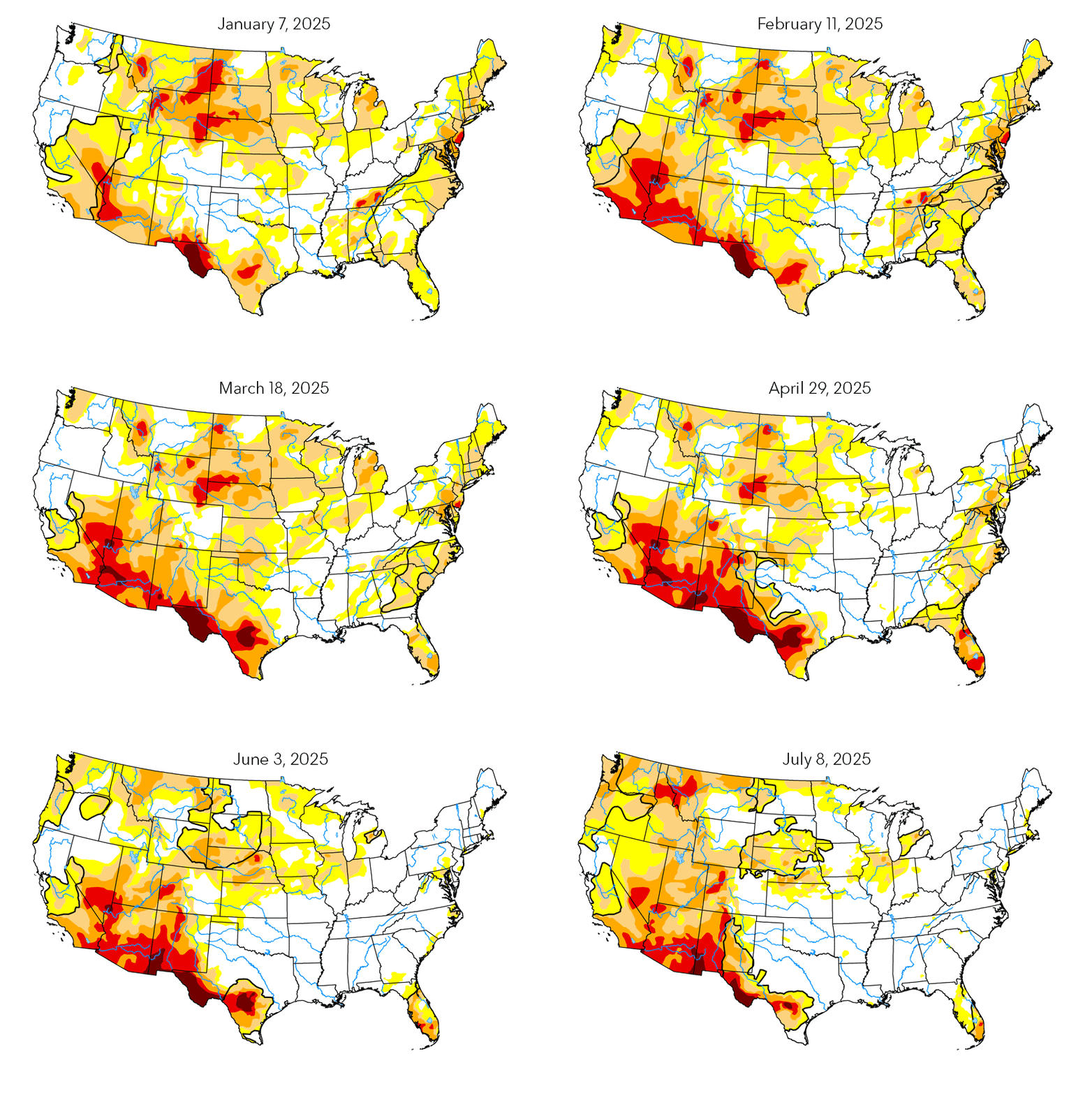
U.S. Drought Monitor

Much of the Eastern Cornbelt enjoyed cooler temperatures and lower humidity during the week, with highs reported in the 70s. Highs were expected to return to the mid- to upper-80s late in the week.

The week also brought scattered thunderstorms to parts of the Eastern Cornbelt. A series of strong storms blew through northern Illinois and northwestern Indiana on Sept. 7, producing 70-mph wind gusts and large hail in some locations.

Fully 30 percent of the Illinois corn crop was mature by Sept. 5, USDA reported, compared with 10-15 percent in Ohio and Indiana. Good or excellent ratings were assigned to 67-72 percent of the regional corn crop on that date, along with 64-67 percent of the soybeans.

“We have not started any harvest yet in our area,” commented one regional contact at midweek. “I would expect we are about two weeks out yet for soybeans, and just about ready to start chopping silage in our area.”

Western Cornbelt:

Mild temperatures and dry weather across much of the Western Cornbelt were gradually replaced by heat and humidity as the week progressed, with highs expected to climb back into the upper-80s by the weekend.

Those conditions benefited crop maturation in the region. Fully 31 percent of Missouri’s corn was mature by Sept. 5, along with 14-18 percent of the acreage in Iowa and Nebraska. USDA placed 64-67 percent of Nebraska’s corn and soybeans in the good or excellent categories on that date, compared with 60-64 percent in Iowa and Missouri.

Missouri’s rice crop was 6 percent harvested by Sept. 5, with 59 percent of the acreage rated as good or excellent. As for other crops, Missouri’s cotton was 69 percent good or excellent and Nebraska’s sorghum was 51 percent good or excellent by that date.

Northern Plains:

Drought conditions were easing somewhat in southern Minnesota, helped by a series of strong storms that prompted spotty flooding warnings in the state in late August.

Conditions remained critically dry in northern Minnesota and much of North Dakota, however, with wide areas of extreme-to-exceptional drought reported in both locations on Sept. 9. Much of South Dakota also remained in some form of drought in early September, with the worst conditions reported in the northwestern and north-central areas of the state.

The hot, dry summer has accelerated crop development in the Northern Plains, but crop quality continues to suffer. The small grains harvest was 93-100 percent complete in the region as of Sept. 5, with 18 percent of the corn described as mature in Minnesota and South Dakota by that date, compared with 12 percent in North Dakota.

USDA rated just 16-18 percent of North Dakota’s corn and soybeans as good or excellent on Sept. 5, compared with 22-23 percent in South Dakota and 34-37 percent in Minnesota. Corn and soybeans in the poor or very poor categories totaled 40-45 percent of the acreage in the Dakotas, compared with 26 percent in Minnesota.

“We’ll have an early harvest, so we should see decent fertilizer demand for fall,” said one regional contact. “It still depends on weather, but we got some good moisture in August that will allow for good fall tillage.”

Great Lakes:

A line of strong thunderstorms surged through Wisconsin and Michigan on Sept. 7, producing large hail and damaging winds and causing widespread power outages.

Baseball-sized hail was reported in several central and eastern Wisconsin counties on Tuesday, along with heavy rain and strong winds. The same line of storms battered Michigan later that evening, with reports of quarter-sized hail and damaging winds that caused power outages across a wide swath of the state. Flooding was also reported in some Michigan locations due to torrential rains from the storms.

Sources continued to report generally favorable crop conditions in the Great Lakes region in early September. Roughly 5-7 percent of the regional corn crop was mature by Sept. 5, according to USDA, with 70-75 percent of the acreage rated as good or excellent. Soybeans in the good or excellent categories totaled 74 percent of the acreage in Wisconsin and 64 percent in Michigan.

Northeast:

Parts of the Northeast continued to deal with the aftermath of severe weather spawned by the remnants of Hurricane Ida in early September. The storm caused widespread flooding across central and southern New England on Sept. 1-2, with some areas receiving more than seven inches of rain. Gusty winds and numerous tornadoes were also reported.

Some areas were expecting more severe weather during the week. Central Pennsylvania was bracing for strong thunderstorms late on Sept. 8, with forecasts warning of damaging winds and heavy rain. A coastal flood advisory was also in effect at midweek in parts of Maryland due to severe thunderstorms, with forecasts warning of up to six inches of rain in some locations.

Crop conditions continued to be described in favorable terms across much of the Northeast, thanks to plenty of heat and moisture. As of Sept. 5, fully 86 percent of Pennsylvania’s corn was rated as good or excellent, with just one percent of the crop described as mature.

Transportation

U.S. Gulf and Atlantic:

Marine navigation in the U.S. Gulf remained constricted on Sept. 7 following Hurricane Ida’s Aug. 29 landfall at Louisiana. Movement resumed in much of the region during the week, although a patchwork of restrictions and shutdowns complicated the return to normal operations. Sources predicted ongoing headaches persisting well into September.

Port Condition Zulu was lifted from the Port of New Orleans during the week, returning travel to much of the Central and Eastern Gulf, although restrictions remained. Shoaling blocked all West Canal movements at Miles 18-20, while a dredge dispatched to the site was reportedly unable to clear the area.

Gulf locks that were closed during the prior week reopened to vessel traffic, while daylight-only operating restrictions were noted at Bayou Chene and Port Fourchon, near Ida’s initial landfall. Coast Guard data also indicated a navigation shutdown in the Houma Canal on Sept. 2.

Algiers Lock travel restrictions remained in place during the week, effectively capping unassisted lockages at four standard barges or two 30,000 mt tankers. Larger crossings continued to be possible with the use of an assist vessel.

Intermittent 12-hour transit stoppages were expected at Belle Chasse Bridge, located near Algiers Lock at Mile 3 in the West Canal, due to a long-term construction project. Work at the site is projected to run into late 2022.

Port Allen Lock delays were reported up to 60 hours for the week, with 45 vessels queued to lock on Sept. 7. Bayou Sorrel Lock waits topped out at five hours, while Colorado Lock passages were heard at six hours on Sept. 7.

Hurricane Larry was tracked near Bermuda as a Category 2 storm on Sept. 9, according to the National Hurricane Center. Larry was expected to dogleg north in the days ahead, potentially causing strong ocean swells along the U.S. coastline.

Tropical Storm Mindy made landfall in the Florida Panhandle on Sept. 8 just hours after forming, dropping 2-6 inches of rain in the process. Mindy moved eastward into the Atlantic on Sept. 4, following an expected path toward Bermuda.

Mississippi River:

The lifting of Port Condition Zulu during the week returned much of the lower Mississippi River to navigation, although shutdowns remained. No traffic was permitted at Miles 105-108 due to the institution of a Safety Zone, while navigation was described as largely unavailable on Sept. 7 between Mile 108 and Mile 167.

A number of vessels were noted adrift at Mile 37 on the lower Mississippi River, while submerged barges and storage tanks reported at Miles 53-54 called for extreme caution while operating in the area. Daylight-only restrictions were in place for the week on Deep Draft vessels running south of Mile 114 on the lower river. Downed power lines also hindered traffic at a handful of locations.

Low water levels and fast river flows continued to result in northbound tow-size reductions of 5-10 barges. The Dredge Hurley was on site at Mile 585, with no navigation shutdowns predicted.

Lock 18 was scheduled to close to navigation from 8:00 a.m. to 6:00 p.m. on Sept. 15 for repairs.

On the upper river, the Merchants Memorial Rail Bridge was set to undergo two 24-hour navigation shutdowns in September, part of an extended $222 million replacement effort scheduled through 2022. Navigation was expected to be unavailable on Sept. 10 and Sept. 13.

Illinois River:

Wickets remained in the raised position for the week at both LaGrange Lock and Peoria Lock due to low water levels, forcing continued lockages through both locations.

Ohio River:

The Newburgh Lock secondary chamber was reportedly shut for emergency repairs during the week. The chamber was projected to return to service on Sept. 9.

Montgomery Lock is scheduled to undergo a main chamber shutdown running from Oct. 18 through Dec. 17 for repairs and maintenance, forcing traffic to pass through the site’s smaller secondary chamber. A recent main chamber closure that ended on Aug. 27 was noted producing 2-4 day delays.

Main chamber maintenance at Cannelton Lock was in progress through Nov. 19, forcing detours through the secondary chamber. Auxiliary chamber repairs are likely to trigger intermittent transit stoppages on Nov. 1-19. Work at the site has been underway since June 21.

Structural miter gate damage at the Markland Lock secondary chamber was anticipated to force all transportation through the site’s primary chamber through an estimated Oct. 29.

The main chamber at Braddock Lock is scheduled to close from Sept. 13 through Oct. 15 for maintenance, prompting traffic to pass solely through the secondary chamber, with delays expected.

A mechanical breakdown blocked main chamber access at Willow Island Lock on Sept. 8. Boats were noted passing through the auxiliary chamber during the closure, despite ongoing maintenance on that chamber scheduled through Sept. 30. Following the conclusion of secondary chamber work, the main chamber is set to shut on Oct. 1-31 for maintenance and repairs. Willow Island delays were quoted up to 11 hours on Sept. 8.

The Hannibal Lock primary chamber was slated to go offline from Sept. 13 through Oct. 29 for repairs and maintenance, prompting tows to lock through the 600-foot auxiliary chamber. McAlpine Lock delays were noted up to 14 hours for the week.

High flows limited navigation at the Tennessee River’s Wilson Lock, located at Mile 259, due to the institution of staggered one-way lockages running at 12-hour intervals. Vessels traveling southbound were expected to lock during daytime hours, while those traveling upriver were greenlit for overnight passage only.

Kentucky Lock is scheduled to shut from Nov. 1 through Dec. 10 for repairs. The Corps was reportedly planning a single opening period ton Nov. 25-28 to pass waiting vessels. Delays were reported up to 8.5 hours for the week, down from 36 hours in the prior report.

Maintenance to the Cumberland River’s bio-acoustic fish fence (BAFF) system was scheduled to block daytime movements through Barkley Lock starting on Sept. 16. Navigation will be unavailable daily from 6:00 a.m. to 6:00 p.m. through Oct. 5.

The Monongahela River’s Lock 2 will see limited main chamber access between Sept. 13 and Oct. 15 due to repairs and maintenance. Passage will remain available through the secondary chamber while the project is underway.

Arkansas River:

David D. Terry Lock was scheduled to return from a full dewatering and repair shutdown on Sept. 9. The project began on Aug. 27, and was preceded by a round of intermittent closures on Aug. 16-26.

Intermittent daily closures at Joe Hardin Lock are expected between 7:00 a.m. and 6:00 p.m. on Oct. 19-21. Similar delays are on the books at Emmett Sanders Lock on Oct. 26-28.

Simplot Teams with GreenKeeper

Simplot Turf & Horticulture, Boise, said on Sept. 8 it has engaged with the GreenKeeper web-based application in an exclusive licensing agreement to optimize turf management.

Simplot said the app from Lincoln, Neb.-based GreenKeeper includes the use of advanced data models to guide turfgrass management decisions. It uses over 650 different agronomic algorithms to aid in the scheduling of product applications, turfgrass cultural practices, and inventory operations.

“Simplot’s commitment to the turf industry and the science to move it forward has been a critical part of our collaboration,” said Dr. Bill Kreuser, GreenKeeper Founder. “Working with them to get this in the hands of so many turf professionals will be incredible.”

Simplot said data-driven decision making and precision turf management is the next frontier for the profession. “Simplot T&H is proud to team up with the GreenKeeper app and is excited to support this program in the professional turf markets,” said Barry Mac Ban, Simplot Turf & Horticulture General Manager. “Intelligent data analysis is essential to lead a successful turf management team, and it is our opinion that GreenKeeper is the best tool out there.”

USDA Hikes Corn Acreage, Yield Estimates

USDA’s National Agricultural Statistics Service (NASS) on Sept. 10 boosted yield and acreage estimates for corn. Analysts had expected the increases after USDA on Sept. 1 announced plans to revisit those figures in its September Crop Production and World Agricultural Supply and Demand Estimates (WASDE) reports (GM Sept. 3, p. 27).

Corn production for grain is now forecast at 15.0 billion bushels, up 2 percent from the previous forecast and up 6 percent from 2020. Based on conditions as of Sept. 1, corn yields are expected to average 176.3 bushels/acre, up 1.7 bushels from the previous forecast and up 4.3 bushels from last year.

Total area planted to corn, at 93.3 million acres, is up 1 percent from the previous estimate and up 3 percent from the previous year. Area harvested for grain is forecast at 85.1 million acres, also up 1 percent from the previous forecast and up 3 percent from the previous year. NASS said acreage updates were made in several states based on a thorough review of all available data.

USDA said this month’s 2021/22 U.S. corn outlook is for larger supplies, increased feed and residual use, greater exports, and higher ending stocks. Projected beginning stocks for 2021/22 were 70 million bushels higher based on a lower use forecast for 2020/21, with reductions in corn used for ethanol and exports. With supply rising more than use, USDA said ending stocks were increased by 166 million bushels, to 1.4 billion. The season-average corn price received by producers was lowered 30 cents, to $5.45/bushel.

Soybean production is now forecast at 4.37 billion bushels, up 1 percent from the previous forecast and up 6 percent from 2020. Based on conditions as of Sept. 1, yields are expected to average 50.6 bushels/acre, up 0.6 bushel from the previous forecast and up 0.4 bushel from 2020.

Total area planted to soybeans this year is estimated at 87.2 million acres, down less than 1 percent from the previous estimate but up 5 percent from the previous year. Area harvested for beans in the U.S. is now forecast at 86.4 million acres, also down less than 1 percent from the previous forecast but up 5 percent from 2020.

The soybean export forecast was raised 35 million bushels on increased supplies and lower prices. Ending stocks were projected at 185 million bushels, up 30 million from last month, with the U.S. season-average soybean price now forecast at $12.90/bushel, down 80 cents.

All cotton production is forecast at 18.5 million 480-pound bales, up 7 percent from the previous forecast and up 27 percent from 2020. Cotton yields are expected to average 895 pounds/acre based on conditions as of Sept. 1, up 95 pounds from the previous forecast and up 48 pounds from 2020.

All cotton planted area totaled 11.2 million acres, down 5 percent from the previous forecast and down 7 percent from 2020. All cotton area harvested is forecast at 9.92 million acres, down 4 percent from the previous forecast but up 20 percent from 2020.

The outlook for the 2021/22 U.S. wheat crop is for reduced supplies, slightly higher domestic use, unchanged exports, and decreased ending stocks, USDA said. Wheat imports were reduced by 10 million bushels, to 135 million, with exports unchanged at 875 million bushels. Projected 2021/22 ending wheat stocks were reduced 12 million bushels, to 615 million, some 27 percent below last year and the lowest in eight years.

The projected 2021/22 season-average farm price for wheat was lowered $0.10 per bushel, to $6.60 on reported NASS prices to date and price expectations for the remainder of 2021/22.

CF Donaldsonville Plant Begins Restart Process; Gulf Struggles to Recover from Hurricane Ida

CF Industries Holdings Inc., Deerfield, Ill., said late day Sept. 9 that it has begun restarting its ammonia plants at the Donaldsonville Complex in Louisiana. It said the startup of urea, nitric acid, and UAN would follow.

CF said shipping will proceed on an as-available basis and it will communicate directly with customers regarding impacts caused by Hurricane Ida. CF shut down all production units at the facility on Saturday, Aug. 28, 2021, as part of its contingency plans for the storm.

Market participants were hopeful that September would see a return to normalcy compared to what one termed, “the chaos that is now New Orleans.” Product availability, particularly for urea, was reported to be very thin for September, with prices having spiked as high as $552/st FOB for NOLA granular urea on Sept. 9. In addition to the plant outages, sources reported major logistics issues in both loading barges and unloading waiting vessels, as well as damaged barges and fears that some had sunk.

Based on the Sept. 9 announcement, the giant CF complex would have been totally offline for approximately 11 days. According to a letter dated Friday, Sept. 3, CF declared force majeure regarding the Donaldsonville product. “Due to these circumstances CF Industries Sales LLC has declared an event of force majeure affecting the production and shipment of product from the CF Donaldsonville, LA nitrogen complex,” it stated.

Industry sources had told Green Markets on Sept. 9 that CF had been loading some products, presumably from storage onto trucks. Citing vessel data, Bloomberg reported that the tugboat Abundance, which is normally connected to the giant (22,000 st) ocean-going ammonia barge Harvest, left Donaldsonville on Sept. 9, presumably on its way to The Mosaic Co.’s phosphate facilities in Florida.

Anhydrous ammonia was released from two CF storage tanks at Donaldsonville as a result of the storm, according to the Louisiana Department of Environmental Quality (LDEQ). However, a CF spokesman said the issue had been resolved and there had been no off-site impacts.

Koch Nitrogen also reported an ammonia release at a site near the Mississippi. However, the company did not respond to a request for comment.

Major refineries, petrochemical, and wastewater treatment plants also reported spills, with nearly 100 spills and other episodes reported to LDEQ as of Sept. 2, raising concerns among environmentalists and public health officials about toxic discharges.

On Sept. 9, Nutrien Ltd., Saskatoon, told Green Markets that its Geismar, La., fertilizer plant was still in the process of restarting and that it expected it to be back to normal operations within the next week.

As previously reported, Mosaic expects eight to nine weeks to make repairs at its two Louisiana plants (GM Sept. 3, p. 1). In all, it expects to lose some 300,000 mt of production due to the storm, as well as a phosphoric acid tank problem at New Wales, Fla.

No update was available from the Incitec Pivot Ltd./Dyno Nobel ammonia plant at Waggaman, La., however, as previously reported, Cornerstone Chemical Co. (GM Sept. 3, p. 1), also at the complex, lost power during the storm and had to declare force majeure.

Also declaring force majeure on Sept. 3 was Interoceanic Corp (IOC), White Plains, N.Y., which markets ammonium sulfate and ammonium thiosulfate from the PCI Nitrogen plant in Pasadena, Texas. While the Pasadena plant was not damaged, IOC was having trouble finding empty barges to load. The massive damage to NOLA grain terminals was causing loaded grain barges to back up as they were unable to unload, leaving a shortage of available barges for other dry products.

Only two major export grain elevators on the lower Mississippi have returned to action in the past week after Ida barreled through the region, according to a Sept. 10 Bloomberg report that analyzed vessel data. Those were the Louis Dreyfus Commodities LLC’s Port Allen elevator and Archer Daniels Midland’s Destrehan elevator.

No vessels had entered other major facilities owned by ADM, Bunge, Cargill, CHS, or Zen-Noh. There were 97 total bulk carriers on the Lower Mississippi early on Sept. 10 and just 16 were berthed in port, with the majority anchored and waiting to load. The Lower Mississippi sends approximately 59 percent of bulk corn, soybeans, and wheat abroad according to data from the USDA, which inspects the product before shipment.

Only about 20 percent of Gulf of Mexico oil and gas production is back online as of Sept. 8, according to Bloomberg, marking an even slower comeback than in the wake of Hurricane Katrina.

More than a week after the Category 4 storm made landfall, about 79 percent of the region’s offshore oil output and 78 percent of gas production remains shut-in, according to the Bureau of Safety and Environmental Enforcement. By comparison, less than 60 percent of oil production and just 40 percent of gas output was still offline this long after Katrina in 2005.

The offshore oil industry is having a tougher time restarting due to the extensive power outages and damaged infrastructure on land. Refineries and petrochemical plants along the Mississippi River are also facing slow restarts, meaning offshore production platforms would be backed up with oil if they resumed immediately.

Semios Acquires Agworld, Expands Ag-Tech Business

Vancouver-based Semios, a provider of real-time crop data and pest management tools for growers of tree fruit, nuts, and other permanent crops, announced on Aug. 24 that it is acquiring Agworld, a data-driven farm management platform headquartered in Perth, Australia. Terms of the deal were not disclosed.

Semios said the acquisition will form one of the largest independent ag-tech solutions providers in the world, with centralized crop management data from one dashboard serving growers, agronomists, and ag retailers in the U.S., Canada, Australia, New Zealand, Europe, and South Africa.

“Through the acquisition of Agworld, Semios is furthering its commitment to simplifying the grower’s experience through leveraging technology to deliver critical insights,” said Dr. Michael Gilbert, CEO of Semios. “The true impact of our combined forces in the global agricultural industry will soon be realized through the increased velocity of our R&D efforts and getting new products to market, benefiting growers who are being tested by Mother Nature like never before.”

Gilbert said the two companies are closely aligned in values and culture, and offer complementary solutions to help growers manage risk and optimize yields. Semios was founded in 2010 and utilizes a network of sensors that provide more than 500 million data points measuring climate, soil moisture, and daily insect and disease activity. Founded in 2009, Agworld allows growers to track and share relevant field and reportable data with other farmers, advisors, and third parties.

“Empowering growers with data for better analysis, insight, and action is at the core of what we do,” said Doug Fitch, Agworld CEO. “The agricultural industry has long demanded the benefits of managing their crops from start to finish with a single solution, which is why I’m so excited about this next step of the journey for both Agworld and Semios together. The availability of important data to growers and their stakeholders for real-time decision-making through one platform is key to improving the sustainable performance of farming operations.”

Semios has been in a recent expansion mode. The company in June announced the acquisitions of Altrac, an agriculture automation software developer, and Centricity, developers of a suite of field data collection applications. Semios has been named to the Global Cleantech 100, an annual list of the 100 most innovative cleantech companies globally, and the Thrive Top 50, list of the 50 leading global AgTech companies.

Simplot Expands Retail Business in Ohio

The J.R. Simplot Company, Boise, Idaho, announced on Sept. 2 that it is expanding its retail presence in Ohio. The company has agreed to acquire Precision Partners LLC, an agricultural retail and wholesale distribution facility serving growers in South Charleston, and also plans to develop a new greenfield Simplot Grower Solutions location in Tiffin.

“We’re thrilled to expand our products and services into Ohio and we welcome the new employees, customers, and partners to Simplot Grower Solutions,” said Troy Bolt, Vice President and General Manager of Retail Business for Simplot’s AgriBusiness division. “We look forward to bringing value to the growers and communities we serve and working together to contribute to feeding our world.”

Precision Partners offers dry and liquid fertilizers, crop protection products, and lime from its South Charleston location. The company started in 2011 as a soil sampling and crop consulting business before expanding into custom application in 2012. All 14 of the company’s employees will join Simplot Grower Solutions on the target acquisition close date of Sept. 17, 2021.

“Simplot brings a wide network of products and services, as well as a “deeper bench” of knowledge and expertise to support our existing employees and customers,” said Dalton Dodd, Managing Partner for the Precision Partners South Charleston location. “The biggest win for our customers is that they will have more access to the products they need when they need them.”

Simplot said plans for the new Tiffin location are still being finalized, but the company anticipates a team of 10 employees at the site. The new Ohio locations will join a network of more than 230 locations and 2,500 employees across the U.S. and Canada under the Simplot Grower Solutions name, which operates as a wholly-owned subsidiary of J.R. Simplot Co. The business was formed in 2020 when Simplot completed its acquisition of Pinnacle Agriculture (GM Jan. 24, 2020).

“We are committed to the growers and families in South Charleston and Tiffin and will provide the expertise and products to help drive growth and prosperity to the surrounding agriculture communities,” said Bolt.

Grupo Vittia IPO Successful

The third time was the charm for Brazil specialty fertilizer company Grupo Vittia, Sao Joaquim da Barra, Sao Paulo, which announced on Sept. 1 that its shares are now trading on Brazil’s B3 Exchange. The company had pulled initial public offerings (IPO) in April and a few weeks ago (GM Aug. 20, p. 35; April 30, p. 33), citing volatility and adverse conditions in capital markets.

Vittia’s Board of Directors approved a price per share of R$8.60 upon the primary issuance of 8.33 million and secondary of 36.1 million common shares, according to Bloomberg, citing a company filing. Brothers Wilson and Guilherme Romanini are expected to retain control and manage the 50-year old family-owned company.

The company plans to use the funds from the offering to carry out strategic acquisitions.

Co-op Mergers Take Effect in Washington, Iowa; Farmers Win/Five Star Proposed Merger Rejected

Two regional cooperative mergers took effect on Sept. 1, while a third was recently voted down by members. In the Pacific Northwest, Valley Wide Cooperative in Nampa, Idaho, and Ag Link Inc. in Reardan, Wash., officially merged on the first of the month. And in Iowa, Alceco in Albert City completed its merger with First Cooperative Association (FCA) in Cherokee.

Valley Wide and Ag Link announced in July that members of both organizations had voted in favor of unification, with Ag Link’s seven Washington locations joining Valley Wide’s growing footprint in the region (GM July 16, p. 1). Ag Link had operated under that name since 2006, offering fertilizer, crop protection products, and fuels and lubricants from northeastern Washington locations at Almira, Coulee City, Davenport, Dayton, Edwall, Reardan, and Wilbur.

With more than 1,200 members, Ag Link posted $95 million in sales in 2020, with approximately $20 million coming from agronomy and $75 million from energy products and services. Valley Wide offers agronomy, feed, fuel and propane, and farm supply products and services to more than 60 communities in Idaho, Wyoming, Utah, Oregon, and Washington. The company’s operations include 24 agronomy locations, 18 retail stores, 15 propane plants, and a feed center. Total Valley Wide sales in 2020 were $500 million.

Both organizations said locations, management, crop advisors, and energy reps will remain the same, but former Ag Link customers will now have access to more precision agriculture tools, proprietary custom-blended crop inputs, and expanded service and online buying options. The Valley Wide board has expanded to 12 with the completion of the merger, consisting of three members from the existing Ag Link board and nine from the existing Valley Wide board.

The merger between Alceco and FCA was first announced in December (GM Dec. 18, 2020), with Alceco members voting in July to approve the unification (GM July 23, p. 1). The combined organization is headquartered in Cherokee under the FCA name, with a home office remaining open in Albert City. The merged co-op now operates a total of 32 Iowa facilities offering agronomy, energy, grain, and feed products and services.

FCA is recognized as the oldest continuously active cooperative elevator in the nation, tracing its roots to 1887. FCA was formed under its present name in 1997 through the merger of four Iowa cooperatives – Farmers Cooperative Association in Marathon, Agland Coop in Alta, Farmers Cooperative in Aurelia, and Farmers Cooperative in Cleghorn.

Alceco, which stands for Albert City Elevator Cooperative, was formed in 1905, but grew over the decades through multiple expansions and acquisitions, including a merger in 2008 with Midwest Farmers Cooperative. Alceco partnered with Cargill in 1997 to form Ag Partners LLC, a joint venture that provides grain, agronomy, feed, and petroleum products and services from 17 retail and wholesale locations in Iowa. Alceco acquired full ownership of Ag Partners last year (GM July 31, 2020), and the company now operates as a solely-owned subsidiary.

Ag Partners CEO Troy Upah has been named as CEO of the combined cooperative, with Merle Lyons, FCA’s former General Manager, serving as Chief Operating Officer.

A third merger proposal in Iowa that was announced earlier this year between Farmers Win Co-op in Fredericksburg and Five Star Cooperative in New Hampton (GM Feb. 12, p. 1) failed to win the support of a sufficient majority of Farmers Win members, the companies announced on Aug. 23.

According to a statement from Farmers Win Board President Dwane Koch and Five Star Board President Tom Shatek, 70 percent of Five Star voting members returned ballots with a more than two-thirds majority supporting the merger, meeting Iowa’s legal threshold for the merger to succeed. Some 60 percent of Farmers Win voting members returned ballots, but only 60 percent supported the merger, falling below Iowa’s 66.67 percent legal threshold.

Koch and Shatek said the voting process was marred by mail delays that required new ballots to be sent to some members, but enough votes were received from both co-ops to satisfy Iowa requirements that at least 50 percent of voting members submit ballots. Farmers Win board members reportedly met in late August to discuss the next steps to be taken, if any. The topic will also be discussed at the upcoming annual meetings in September.

“It has been a two-year process of discussions with both boards and employees to get to this point, and your Directors went through an intense discovery and due diligence time to make sure that both co-ops would work together to increase the value and strength of our co-op,” Koch and Shatek said in the statement.

Mosaic Reports Negative Impacts from Ida

The Mosaic Co. announced on Sept. 2 that North American phosphate operations are expected to be negatively impacted by damage caused by Hurricane Ida. Wind damage to the Faustina and Uncle Sam facilities in Louisiana is expected to result in reduced production as repairs are completed over the next 8-9 weeks.

In addition, an Aug. 18 phosphoric acid tank failure at the company’s New Wales, Fla., facility is also expected to impact production. The contents from the tank were released into the immediate area, a company spokesperson told local news channel WFLA, but most were captured in another container. Mosaic was to assess its other tanks at the site. No injuries were reported, and no further details were provided.

As a result of the outages, Mosaic said third-quarter production is expected to be off 300,000 mt. Fourth-quarter operating rates are expected to improve sequentially, but production may still be down from historical averages.

Mosaic also reported that Ida caused navigational issues on the Mississippi River, which could cause congestion during the busy fall application season and create logistical risks for Mosaic’s production. Both of Mosaic’s Louisiana plants were shut down and secured ahead of Ida. As of Monday morning, Aug. 30, the company said roads were still impassable and it was too early to know the full extent of the impact.

Mosaic plans to provide an update, including estimated financial impacts of the hurricane, when it reports third-quarter results. As it completes repairs to operations, it said it is supporting its employees and communities through a $100,000 disaster relief grant to the Capital Area United Way and by providing affected employees with access to funds through the company’s employee-to-employee assistance plan.

By late Wednesday, Sept. 1, Nutrien Ltd. said its Geismar, La., facility was “currently in the process of restarting” after ceasing operations ahead of Ida. The plant did not lose power and saw no major damage or flooding.

As of Aug. 30, CF Industries Holdings Inc. said its production facility in Donaldsonville, La., did not appear to have sustained any significant damage after initial assessments of the plant. CF said it was working to resume production “as soon and safely as possible.” CF initiated a controlled shutdown of all production units at the facility on Aug. 28 ahead of the storm. No updates were available as of late Thursday, Sept. 2.

A spokesman for Australia-based Incitec Pivot Ltd., Southbank, Victoria, said its Dyno Nobel WALA unit, which has an ammonia plant at Waggaman, La., does not provide ongoing commentary on the status of its manufacturing plants.

Cornerstone Chemical Co., which operates at the Waggaman site, said that on Aug. 28, in advance of Ida’s landfall, it gave advance notice to its customers and suppliers that the weather event excused its performance as a force majeure event. The company produces acrylonitrile, melamine, and sulfuric acid at the location. It said the path of Ida crossed near the site at 7 pm and the entire complex lost external power supply due to a catastrophic failure of the Entergy power grid, which remained offline as of late Sept. 2.

Cornerstone said it had auxiliary power to operate and maintain key safety and environmental equipment. There were no environmental releases and no injuries to Cornerstone personnel, and initial assessments indicate no significant damage to Cornerstone assets. Minor repairs to wind-damaged structures were underway. It said assessment teams will fully evaluate the facility before restarting operations.

San Antonio-based NuStar Energy LP told Green Markets on Sept. 2 that the Louisiana segment of its anhydrous ammonia pipeline has been fully assessed and sustained no major damage. It said it was ready for service as soon as its customers are up and running.

Bayer Crop Science confirmed that its Luling, La., facility, which is the largest producer of glyphosate, was offline as of Aug. 28 following the company’s regular hurricane emergency preparedness protocol. Bayer did not provide an update on the extent of damages at the site, if any, nor on the duration of the pause in production.

Ida had a significant impact on a number of large grain storage facilities in Louisiana, according to wire reports. Global grains trader Cargill Inc. confirmed extensive damage at its grain export facility in Reserve, La., and also reported that its Westwego terminal sustained damages from the storm.

CHS Inc. is diverting export shipments through its Pacific Northwest terminal through next month, the company told Reuters, because of downed transmission lines that power its Gulf Coast facility in Myrtle Grove, Miss. The company said it may take 2-4 weeks for power to be restored to the facility. Other grain shippers, including Bunge Ltd. and Archer-Daniels-Midland Co., were reportedly without power and still assessing damages to their locations.

Cargill and CHS have a joint venture in three Pacific Northwest elevators, and have loaded a combined three bulk carriers over the past week, according to vessel data.

Uncertainties about the extent of elevator damage and the duration of power outages in the Port of South Louisiana, which handles more than 50 percent of all U.S. grain export annually, roiled the commodity markets during the week.

By Thursday morning, corn had fallen to a fresh seven-week low and soybeans continued a recent slump as efforts continued to get exports back on track, Bloomberg reported. Corn retreated 0.9 percent, to $5.18 a bushel in Chicago, and touched the lowest since July 12 for a most-active contract. Prices were down about 30 percent from a peak in May.

Soybeans lost 0.2 percent to head for a sixth straight decline, the longest run of losses since May. Wheat futures also declined, Bloomberg reported, reaching the lowest since early August.

Ida’s impact on barge and rail traffic was also significant. Prior to Ida’s arrival, the Coast Guard ordered a complete barge evacuation of the Mississippi River south of Mile 73, while an Aug. 28 Port Condition Zulu order halted navigation on the lower river below Mile 305. No firm estimates on a return to navigation were immediately available, although some speculated that barge movements in the area could require weeks to normalize.

On Aug. 28, local officials reported 22 barges on the loose in the lower Mississippi, with one hitting a bridge in Laffite, La. Mike Strain, commissioner of the Louisiana Department of Agriculture and Forestry, reported observing numerous barges sunk and at least five ships grounded during a flyover of the river. Strain told reporters on Sept. 1 that the Army Corps of Engineers and the Coast Guard anticipated opening the upper Mississippi later that day from Baton Rouge northward, in an effort to start moving vessels.

Kansas City Southern (KCS) shut its main line in Louisiana, halted exchanges between railroads in New Orleans, and also shut a line in Mississippi from Gulfport to Hattiesburg, Bloomberg reported. The railroad on Aug. 31 reported that its Gulfport Subdivision was back in service, with service resuming at its New Orleans Subdivision on Sept. 2.

Norfolk Southern Corp. reported that it planned to resume interchange operations in New Orleans and Mobile on Sept. 2, but said the Intermodal Terminal in New Orleans would remain closed through the remainder of the week. Norfolk Southern said it was working to identify opportunities to detour interline traffic through alternative gateways where possible,

The remnants of Ida also impacted the northeastern part of Norfolk Southern’s network, the railroad said, with widespread flooding, commercial power outages, and downed trees and powerlines blocking mainline routes to the greater New York and Philadelphia metropolitan areas.