All posts by mickeybarb@charter.net

Sulfuric Acid

U.S. Gulf:

Price ideas on sulfuric acid imported by vessel to the U.S. Gulf continued to be heard in the $220-$225/mt CFR range for the week, unmoved from the prior report.

Gulf Coast:

Gulf Coast sulfuric acid contracts stood at $120-$150/st DEL in the third-quarter, sources said. Annual contracts governing the full 2021 period were rated at $85-$110/st DEL. Third-quarter pricing to the southeastern U.S. was reported at $140-$180/st DEL.

Midwest:

Sources quoted Midwest market sulacid at $120-$150/st DEL for third-quarter agreements. For 2021 deals, prices were heard at $85-$110/st DEL.

West Coast:

Annual West Coast contracts were noted in the $100-$130/st range. Third-quarter contracts were pegged at $140-$170/st DEL, sources said.

Brazil:

Recent Brazil sulfuric acid imports were heard in the $245-$250/mt CFR range.

Ammonium Thiosulfate

Eastern Cornbelt:

The ammonium thiosulfate market was reported in a broad range $375-$455/st FOB in the Eastern Cornbelt, with the low confirmed for the latest prompt/fill pricing at Terre Haute, Ind., and the high out of inland tanks in Ohio.

Western Cornbelt:

The ammonium thiosulfate market was down slightly at $375-$400/st FOB in late August, with the low reported for prompt/fill offers at Waterloo, Iowa.

Southern Plains:

The ammonium thiosulfate market remained at $325/st FOB Houston and $385/st FOB Lubbock, Texas.

South Central:

The ammonium thiosulfate market was reported at $375-$400/st FOB in the South Central region, depending on location.

SOP Magnesia

Southern Plains:

Intrepid’s Aug. 9 Trio postings FOB Carlsbad included $370/st for standard, $405/st for granular, $420/st for premium, $445/st for OMRI standard and fine standard, and $480/st for OMRI granular. Those levels were up $50-$55/st from the previous postings.

Southeast:

SOP Magnesia pricing in Florida was up some $50/st from last report, firming to $465-$500/st FOB, depending on grade and location.

Crops/Weather

Eastern Cornbelt:

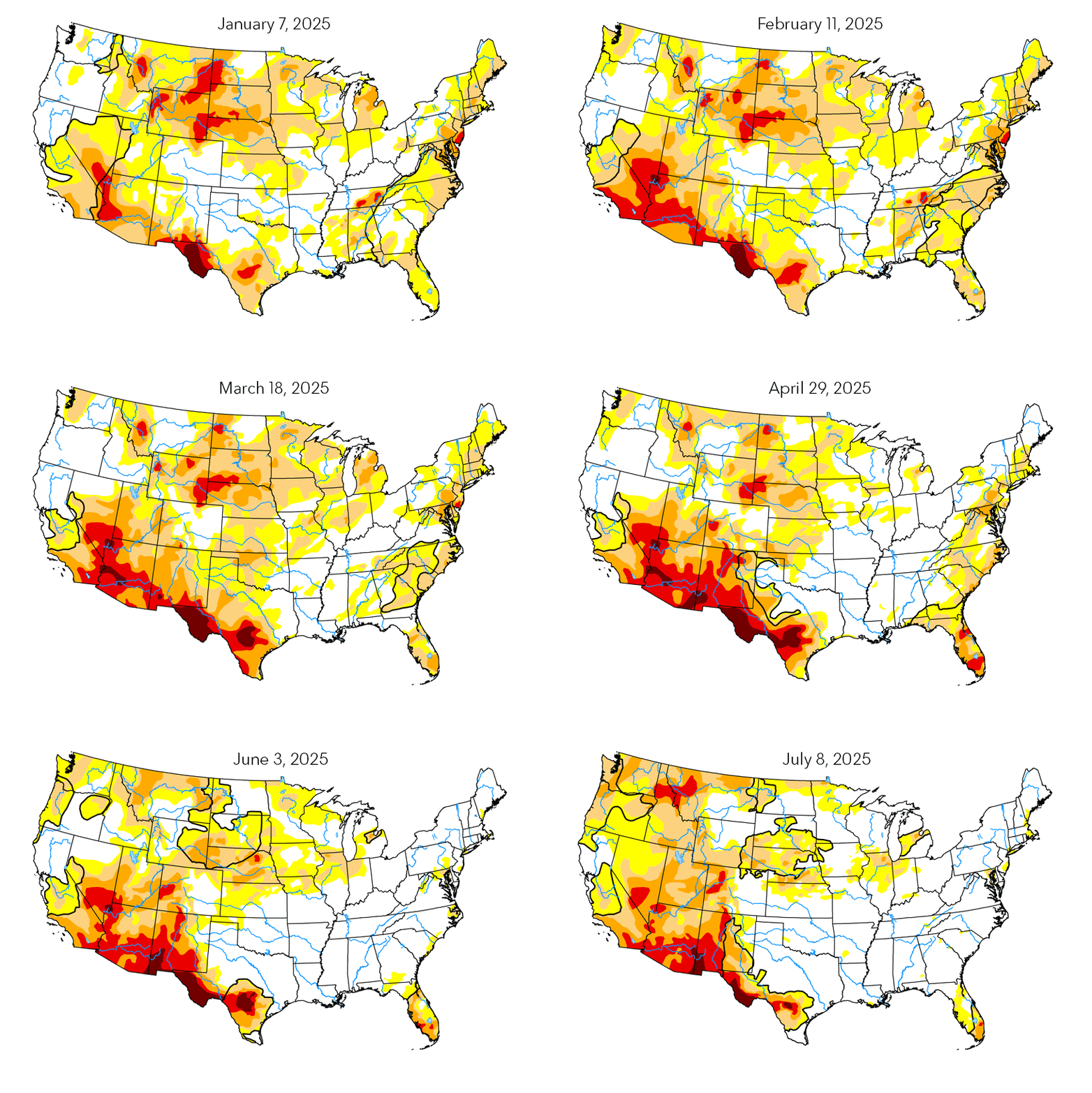
U.S. Drought Monitor

Multiple strong thunderstorms hammered parts of northern Illinois at midweek, sparked by high temperatures and humidity that pushed heat index values to as high as 108 degrees in some locations.

High heat and humidity also generated showers and thunderstorms across much of Indiana and Ohio at midweek. The National Weather Service issued a heat advisory on Aug. 25 for much of central Ohio, with heat index readings climbing to 95-100 degrees in the state.

Corn and soybean crops continued to benefit from the region’s favorable growing weather. USDA on Aug. 22 rated fully 73-79 percent of Ohio’s corn and soybeans as good or excellent, compared with 67-71 percent of the acreage in Indiana and Illinois.

Western Cornbelt:

Severe thunderstorm watches were in effect on Aug. 24 for much of central and southern Iowa. Another round of severe weather was expected on Aug. 26 for parts of eastern and northern Iowa, with forecasts warning of potentially damaging winds, large hail, and heavy rain.

Hot, muggy conditions were reported in southeastern Nebraska as the week progressed, with highs climbing to the upper-90s and heat index values reaching 105-107 degrees in some locations. The heat and humidity followed a band of strong thunderstorms on Aug. 20 that brought heavy rain, hail, and strong winds to eastern Nebraska.

Heat advisories were also in effect early in the week in parts of Missouri and Kansas, with thermometers topping out at 95 degrees and heat index readings climbing to 107 degrees in the Kansas City area on Aug. 23.

USDA rated 58-61 percent of the corn and soybeans in Iowa as good or excellent on Aug. 22, compared with 61-63 percent in Missouri and 67-69 percent in Nebraska. Missouri’s cotton was 70 percent good or excellent, while 61 percent of the state’s rice crop fell into those two categories. Nebraska’s sorghum crop had reportedly slipped to 56 percent good or excellent, down three points from the prior week.

Southern Plains:

Hot weather blanketed the Southern Plains in late August. With the exception of New Mexico and western Colorado, however, the region was largely drought-free, with favorable crops conditions reported.

Highs across Texas and Kansas reached the mid-90s during the week, while parts of central Oklahoma registered highs in the triple digits. “Corn harvest is going well, and looks a bit better than we had hoped,” remarked one Texas contact. “There was some concern that we had too much rain during pollination, but the ears are filled out and look good.”

USDA rated 52 percent of the Colorado corn crop as good or excellent on Aug. 22, compared with 60-64 percent in Kansas and Texas. The Kansas soybean crop was 58 percent good or excellent on that date, while cotton in those two categories totaled 48 percent of the acreage in Kansas, 66 percent in Oklahoma, and 70 percent in Texas. The regional sorghum crop was 62-74 percent good or excellent on Aug. 22.

South Central:

High heat and humidity blanketed Arkansas and Kentucky during the week, while parts of Middle Tennessee continued to assess damages from up to 15 inches of rain on Aug. 21.

Highs in the mid-90s were reported in northwestern Arkansas as the week progressed, with high humidity pushing heat index readings well into the triple digits. Similar weather was reported across Kentucky, where highs ranged from the upper-80s to low-90s during the week.

Torrential rains caused widespread flooding across western and central Tennessee on Aug. 21, causing at least 15 deaths from flash flooding. Another tropical depression was taking aim at coastal areas of Louisiana and Mississippi in late August, with the National Hurricane Center (NHC) warning of potentially dangerous winds and heavy rainfall over the coming weekend.

The ample heat and moisture continued to benefit crops across the South Central region. Fully 76-80 percent of the corn in Kentucky and Tennessee was rated as good or excellent on Aug. 22, while soybeans in those two categories totaled 69-70 percent of the acreage in Arkansas and Tennessee, 75-78 percent in Mississippi and Kentucky, and fully 84 percent in Louisiana.

Cotton was also described in favorable terms, with 67 percent of Tennessee’s crop rated as good or excellent, compared with 71-72 percent of the acreage in Louisiana and Mississippi, and 83 percent in Arkansas.

The rice harvest as of Aug. 22 had progressed to 62 percent complete in Louisiana, 51 percent in Texas, and 2 percent in Mississippi and Arkansas, with good or excellent rating assigned to 82-85 percent of the acreage in Mississippi and Louisiana, and 72-74 percent in Arkansas and Texas.

Southeast:

Parts of the Southeast were still recovering from Tropical Storm Fred, which made landfall in the Florida Panhandle on Aug. 16 and brought 2-6 inches of rain, flooding, and severe weather to Georgia, the Carolinas, and Virginia.

One of the hardest hit areas was western North Carolina, where intense flooding left several residents dead and prompted a state of emergency declaration from Gov. Roy Cooper. In Virginia, parts of Fairfax County received more than 4.5 inches of rain, while parts of northern Georgia also experienced localized flooding and downed trees.

Calmer weather settled over the region in late August, although several thunderstorms were reported across Alabama at midweek, along with high humidity and 90-95 degree temperatures. Although some crops benefited from the combination of heat and moisture, sources said citrus crops in Florida were struggling in late August.

Most of the crops were in good shape in the region in late August, however. USDA rated 70-80 percent of North Carolina’s corn and soybeans as good or excellent on Aug. 22, while cotton in those two categories totaled 70-73 percent of the acreage in Georgia, Alabama, and North Carolina, 82 percent in South Carolina, and 95 percent in Virginia.

Good or excellent ratings were also assigned to 62-69 percent of the peanut crop in Florida and Alabama, compared with 78 percent in Georgia, 81 percent in North Carolina, and 95-96 percent in South Carolina and Virginia.

Transportation

U.S. Gulf and Atlantic:

A long-term Belle Chasse Bridge construction project was expected to prompt intermittent navigation shutdowns at Mile 3 in the West Canal through late 2022. Delays up to 12 hours were expected.

Delays were posted up to nine hours through Port Allen Lock, while Corps data showed Industrial Lock wait times as high as 11 hours on Aug. 23. Bayou Boeuf Lock travel topped out at 5.5 hours on Aug. 23, and boats locking through the Colorado Floodgates saw intermittent waits up to 17 hours for the week. Sporadic delays at Brazos Lock fell in a wide 9-21 hour range.

Tropical Storm Henri made landfall near Westerly, R.I., on Aug. 22. Henri was downgraded from a Category 1 hurricane earlier on Aug. 22 prior to coming ashore.

The NHC was tracking three tropical disturbances in the Caribbean and Atlantic during the week. The most imminent threat was identified as Tropical Depression Nine, located to the southwest of Jamaica on Aug. 26. Forecasts predicted a northwesterly path into the Gulf of Mexico, while warnings indicated a potential strike along the Gulf Coast as a major hurricane.

Two additional disturbances in the region, one located due east of Bermuda and the other east of northern Venezuela, were each assigned a 40-60 percent chance of strengthening into a tropical cyclone prior to Aug. 28.

Mississippi River:

A dredging operation at Victoria Bend, located at Mile 595 on the lower Mississippi, reportedly concluded during the week, with subsequent dredging activities scheduled at Mile 607. Backups persisted on Aug 24 at Victoria despite the conclusion of work in the area, with some expecting travel to remain slow into September. Intermittent shutdowns were expected at Mile 607 while work is underway.

Low river levels, fast currents, and shoaling necessitated ongoing towing restrictions below St. Louis, with maximum lengths reduced by 5-10 barges, determined on a case-by-case basis. River forecasts suggested a potential continuation of the limitations into the first week of September.

A construction operation at the upper river’s Merchants Memorial Rail Bridge was scheduled to block river travel through the site on Sept. 10 and 13, with shutdowns projected to total 24 hours on both occasions. Merchants Bridge is in the midst of an ongoing replacement project scheduled through the end of 2022.

Intermittent 4-7 hour waits were posted through Lock 4, while boats passing Locks 18 and 20 were delayed up to five hours at each site.

Illinois River:

Wickets remained down at both Peoria Lock and LaGrange Lock for the week due to low water levels in the area.

Ohio River:

The J.T. Meyers Lock secondary chamber returned to normal operation on Aug. 18. Maintenance at the site has limited use of the chamber since Aug. 9.

The Pike Island Lock primary lock chamber was scheduled to close from 8:00 a.m. to 4:00 p.m. daily on Aug. 24-26 for repairs and maintenance. The shutdown was scheduled to repeat over the Aug. 31-Sept. 2 period. Traffic was expected to pass through the smaller auxiliary chamber, with delays anticipated.

Main chamber access was scheduled to resume at Montgomery Lock on Aug. 27 following the conclusion of repair activities that began on July 26. Navigation was routed through the secondary chamber while the operation was in progress. An additional main chamber closure is scheduled at Montgomery between Oct. 18 and Dec. 17. Delays of 4-6 days were reported for the week.

Repairs and maintenance underway at the Cannelton Lock main chamber since June 21 prompted detours through the auxiliary chamber. The project is anticipated to run through Nov. 19, while secondary chamber closures are also expected over the Nov. 1-19 period.

The auxiliary chamber at Markland Lock is reportedly offline through an estimated Oct. 29 due to structural miter gate damage discovered in first-half 2020. Movements have continued through the site’s main chamber for the duration of the closure, with minimal delays reported.

Braddock Lock is slated to undergo a main chamber outage from Sept. 13 through Oct. 15, forcing detours through the secondary lock chamber. Delays are expected.

The auxiliary chamber at Willow Island Lock is shut from Aug. 16 through Sept. 30 for repairs. The current round of work will precede a main chamber closure scheduled for Oct. 1-31, during which delays are anticipated. Sporadic wait times at Willow Island were noted up to five hours for the week.

A Hannibal Lock primary chamber shutdown is reportedly on the docket for Sept. 13-Oct. 29 for planned repairs. Tows are expected to pass through the 600-foot secondary unit while work is underway.

Belleville Lock delays were quoted up to 9.5 hours on Aug. 23. On the Tennessee River, Kentucky Lock wait times maxed out around 16 hours on Aug. 23, falling from 8-28 hours reported previously.

Bio-acoustic fish fence (BAFF) maintenance scheduled at the Cumberland River’s Barkley Lock will block movements daily from 6:00 a.m. to 6:00 p.m. for the Sept. 16-Oct. 5 period.

The Monongahela River’s Lock 2 is set to see a planned main chamber closure on Sept. 13-Oct. 15, during which navigation is expected to detour through the auxiliary chamber.

Emergency repairs were noted blocking movements through the Allegheny River’s Lock 6 during the week. No timetable for a return to navigation was available on Aug. 24.

Arkansas River:

David D. Terry Lock is scheduled to undergo a complete dewatering and repair shutdown from Aug. 27 to Sept. 9, blocking river access above that location. Intermittent shutdowns were noted ahead of the closure on Aug. 16-26.

Intermittent transit stoppages were scheduled at Joe Hardin Lock on Oct 19-21, a Corps posting indicated. Following the Hardin project, similar shutdowns were projected for Emmett Sanders Lock on Oct. 26-28.

Salt Lake Potash – Management Brief

Junior sulfate of potash (SOP) developer Salt Lake Potash (SO4), Perth, Western Australia, reported on Aug. 27 that CEO Tony Swiericzuk has resigned. This news comes one month after SO4 announced that it had revised its SOP production ramp up and would require more funding to continue operations (GM July 30, p. 1).

The Board of Directors said it is in advanced discussions with a replacement CEO and will be in a position to make an announcement in the next couple of weeks. It said it is committed to the success of the Lake Way Project and the larger vision of SO4 becoming a major global exporter of seaborne SOP.

Swiericzuk will continue on the Board and also as a consultant to ensure a smooth transition to the new CEO, as well as providing ongoing strategic and technical advice.

The Board thanked Swiericzuk for the energy and commitment he brought to the CEO role since joining the company in November 2018, noting that he guided the permitting, financing, development, and construction of the Lake Way Project, positioning it as a leader in Western Australia.

The Sulphur Institute – Management Brief

The Sulphur Institute (TSI), Washington, D.C., on Aug. 11 announced that Connor Dyck of Koch Sulfur has assumed responsibilities as Chairman of the Board. The appointment comes following TSI’s Annual General Meeting held in May.

“It is an honor to be named TSI’s Chair,” said Dyck. “I look forward to working with the Institute and its members to advocate on behalf of the sulfur and sulfuric acid industries.” 

“We are excited about Connor being named TSI’s Chair; his enthusiasm for the Institute will help execute our newly formed strategy and I am looking forward to working closely with him,” said TSI President John Bryant.