All posts by mickeybarb@charter.net

Ammonium Thiosulfate

Eastern Cornbelt:

Ammonium thiosulfate pricing was pegged at $400-$455/st FOB in the Eastern Cornbelt, with the high reported out of inland tanks in Ohio and the low reflecting fill offers out of Terre Haute, Ind., and the fill price announced by IOC out of Ohio River terminals on July 22.

Western Cornbelt:

The ammonium thiosulfate market was steady at the $400/st FOB level in Iowa for fill tons.

Southern Plains:

IOC on July 22 also announced new season/fill pricing for ammonium thiosulfate, with postings reported at $325/st FOB Houston, Texas, and $385/st FOB Lubbock, Texas.

South Central:

The ammonium thiosulfate market was pegged at the $400/st FOB level for limited fill offers in the region.

SOP Magnesia

Southern Plains:

The latest Trio postings from Intrepid FOB Carlsbad included $320/st for standard, $355/st for granular, $365/st for premium, $395/st for OMRI standard and fine standard, and $430/st for OMRI granular.

Southeast:

SOP Magnesia pricing in Florida was steady at $415/st FOB for standard and $450/st FOB for premium grade, with rail-DEL premium offers quoted at the $465/st level in the Carolinas.

Crops/Weather

Eastern Cornbelt:

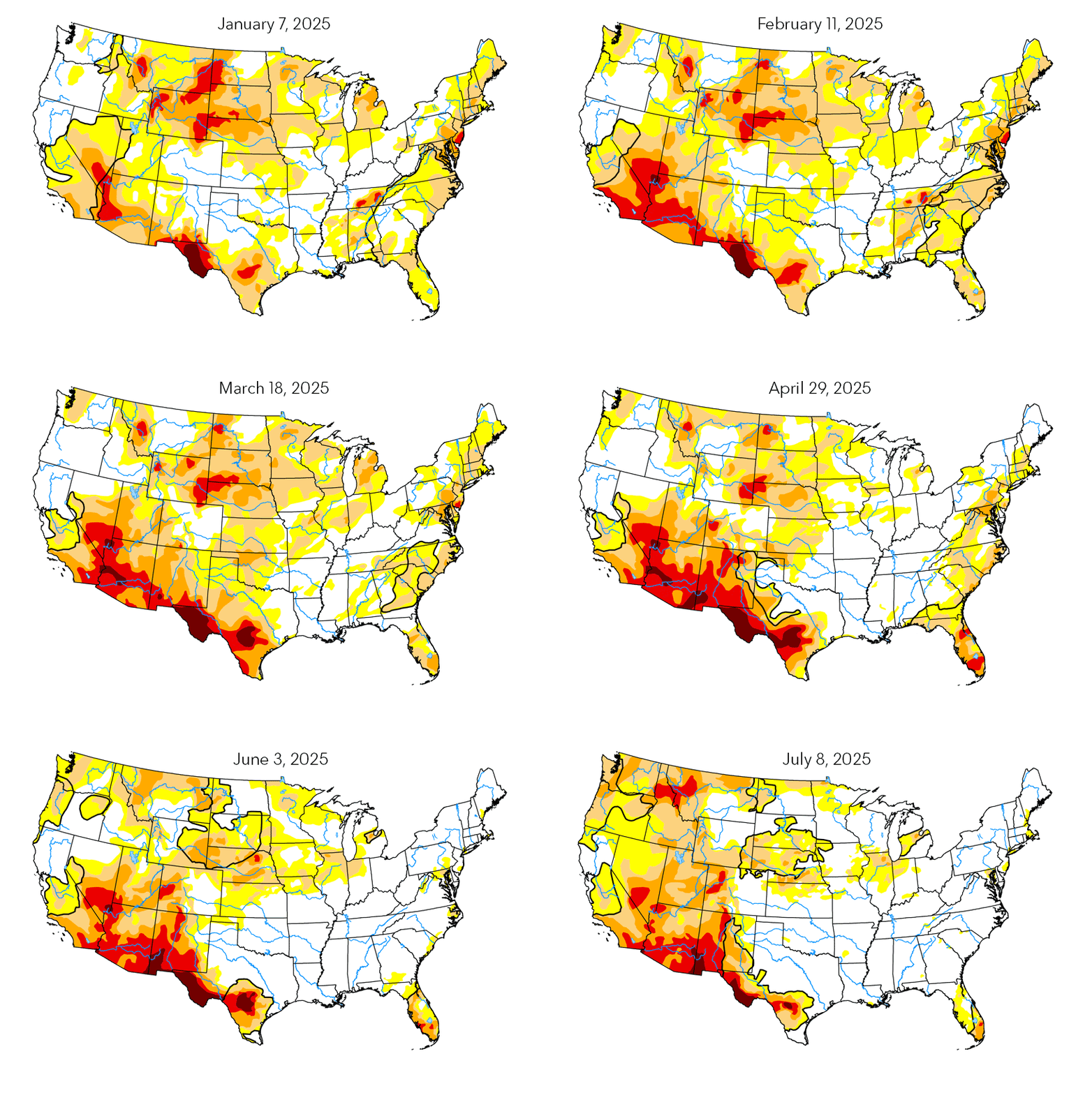
Seasonal temperatures and mostly dry weather was reported across the Eastern Cornbelt in early August after a series of thunderstorms during the last days of July. Highs in the mid- to upper-80s were common across Illinois, Indiana, and Ohio during the week, with higher temperatures and humidity expected by the coming weekend.

U.S. Drought Monitor

Crop conditions continued to be described in generally favorable terms, particularly in Ohio. “We’ve had timely rains,” said one Illinois contact at midweek. “It’ll be a good crop, but not a great crop.”

USDA on Aug. 1 rated 67-68 percent of the corn and soybeans in Illinois as good or excellent, compared with 72-76 percent in Indiana and 74-80 percent in Ohio.

Western Cornbelt:

After a week of slightly cooler temperatures, another wave of high heat and humidity was taking aim at the Western Cornbelt region. Temperatures in the low- to mid-90s were expected across Nebraska by the coming weekend.

Corn, Wheat, Soybean Index

USDA rated 59-64 percent of the corn and soybeans in Iowa and Missouri as good or excellent on Aug. 1, compared with 71-80 percent in Nebraska. Crop quality in all three states was slightly lower than the previous week. Missouri’s cotton and rice were 64-66 percent good or excellent, also down slightly, while Nebraska’s sorghum crop had slipped to 64 percent good or excellent, down from 75 percent in late July.

Southern Plains:

Temperatures in eastern and central Kansas warmed to the low-90s as the week advanced, with high humidity driving the heat index into the triple digits. Forecasts warned of potentially strong thunderstorms over the coming weekend.

Temperatures in the 90s were also reported across much of Oklahoma during the week. In Texas, the week began with lows dropping into the 60s in northern areas of the state, but the return of high heat and humidity was expected to usher in some strong thunderstorms in southern Texas as the week advanced.

While nearly all of New Mexico remained locked in drought in early August, powerful storms unleashed heavy rains and flash flooding on Aug. 3 in the northern mountains and some northeastern areas of the state. Heavy mountain rains in Colorado on Aug. 2 also prompted warnings of flash floods and mud slides.

USDA rated 63-65 percent of the regional corn as good or excellent on Aug. 1, along with 59 percent of the Kansas soybean crop. Good or excellent ratings were also assigned to 61 percent of the cotton in Kansas, compared with 54 percent in Texas and 41 percent in Oklahoma. Sorghum in the good or excellent categories totaled fully 81 percent of the acreage in Colorado, compared with 60-66 percent in the rest of the region.

South Central:

Strong thunderstorms hammered parts of Tennessee on the last day of July, dropped a record 3.13 inches of rain in Nashville and leaving thousands of residents without power. Kentucky sources reported high heat and humidity during the week, with highs pushing to the mid- to upper-80s.

Louisiana experienced cooler weather and widespread rainfall early in the week after ten consecutive days of heat warnings and advisories. Temperatures gradually warmed as the week progressed, however, with highs returning to the low-90s as the wet weather moved out. High heat and humidity was also reported across Mississippi during the week.

The combination of heat and moisture continued to benefit crops across the South Central region. Fully 82-84 percent of the corn in Kentucky and Tennessee was rated as good or excellent on Aug. 1, while soybeans in those two categories totaled 64 percent of the acreage in Arkansas, 79 percent in Tennessee, and 82-83 percent in Mississippi, Louisiana, and Kentucky.

Cotton and rice crops were also described in favorable terms. Fully 96 percent of Louisiana’s cotton was rated as good or excellent on Aug. 1, along with 81-82 percent of the acreage in Arkansas and Mississippi, and 68 percent in Tennessee. Rice in the good or excellent categories totaled 92 percent of the crop in Mississippi, 74 percent in Louisiana, 66 percent in Arkansas, and 64 percent in Texas.

Southeast:

High heat and humidity contributed to several strong thunderstorms in the Southeast in late July and early August. Tornado warnings were posted for parts of North Carolina and Virginia on July 31, with widespread power outages reported due to severe weather.

Strong thunderstorms also moved through South Florida on Aug. 3-4, coupled with a soaring heat index that climbed into the low triple digits. Parts of Georgia and Alabama also picked up scattered showers at midweek, with highs reported in the upper-80s to mid-90s.

Most of the crops were in good shape in the region in early August. USDA rated 68-74 percent of North Carolina’s corn and soybeans as good or excellent on Aug. 1, while cotton in those two categories totaled 64 percent of the acreage in North Carolina, 78 percent in Alabama, 80 percent in South Carolina, and 92 percent in Virginia.

The regional peanut crop was in exceptional condition, with good or excellent ratings assigned to fully 97 percent of the crop in South Carolina, 94 percent in Virginia, and 73-77 percent of the acreage in the rest of the region.

Transportation

U.S. Gulf:

A long-term Belle Chasse Bridge replacement project kicked off at the West Canal’s Mile 3 on Aug. 2. The effort is anticipated to run through late 2022, triggering intermittent 12-hour navigation stoppages in the process. Due to the structure’s proximity to Algiers Lock, delays were likely to spill over to that site as well, sources said. Transit through the bridge was unavailable from 6:00 a.m. to 7:00 p.m. on Aug. 4.

Handysize Shipping Index

Locking restrictions persisted through Algiers Lock, limiting tows to four standard barges or two 30,000 mt tankers. Larger tows remained passable with the use of an assist vessel. Algiers Lock wait times were reported spiking to 38 hours on Aug. 1.

Nighttime travel limitations continued to be described through Bayou Chene due to ongoing construction activities and associated dive operations. Bayou Chene reportedly closed to traffic nightly from 7:00 p.m. to 7:00 a.m., with delays heard in the 6-12 hour range. The use of an assist boat was required while work is underway.

Port Allen Lock saw intermittent delays in the 10-38 hour range for the week. Wait times were noted up to 48 hours at Bayou Sorrel Lock, while vessels passing Industrial Lock experienced delays ranging from 6-60 hours. Bayou Boeuf Lock delays were quoted up to 37 hours, and 16 tows queued to pass through Calcasieu Lock on Aug. 3 were noted waiting up to 38 hours for access.

The National Hurricane Center (NHC) reported tracking two tropical disturbances in the Eastern and Central Atlantic on Aug. 5.

Mississippi River:

Rock-laying operations near Wolf Island at Mile 933 on the lower Mississippi River triggered restrictions on southbound travel on Aug. 2-6. Tows moving downriver were capped at a reported nine barges per tow during daytime hours, while vessels moving upriver were able to pass on a 24-hour schedule. Delays were heard up to 12 hours in the southbound direction.

New navigational shutdowns were announced for the St. Louis-area Merchants Memorial Rail Bridge in September, marking the newest phase of a $222 million replacement project that began in 2019. Two 24-hour closures were expected, tentatively scheduled for Sept. 10 and Sept. 13, dependent on environmental conditions. The project is scheduled to run through 2022.

The planned shutdown of the Lock 27 main chamber has been temporarily canceled due to a lack of ideal river conditions. The project to repair the site’s upper bullnose was previously scheduled for Aug 2-19. The Lock 27 auxiliary chamber was shut through July 27 for lower bullnose work.

Daylight-hour shutdowns remained in force during miter gate installation at Lock 2, causing intermittent delays up to nine hours for the week. Sporadic stoppages in the 4-12 hour range are expected for the project’s duration.

Lock 21 delays were posted in the 4-10 hour range for the week, while extended wait times were noted at Locks 19, 22, 24, and 25 starting on Aug. 1.

Illinois River:

Falling levels on the Illinois Waterway sparked a return to locking at Peoria Lock and LaGrange Lock during the week. Peoria Lock delays were posted up to four hours.

Ohio River:

The primary chamber at Montgomery Lock is shut through Aug. 27 for repairs and maintenance, an extension from the project’s original Aug. 24 end date. Boats were noted detouring through the site’s secondary chamber, prompting delays up to 46 hours. One additional main chamber closure is scheduled to run from Oct. 18 through Dec. 17.

The primary chamber at Cannelton Lock is offline through Nov. 19 for repairs and maintenance. Boats were noted passing through the auxiliary chamber instead, with minimal delays reported. The secondary chamber at Cannelton is projected to go offline Nov. 1-19 for repairs.

Markland Lock’s secondary chamber is closed to navigation through an estimated Oct. 29 due to structural damage to the miter gate. Discovered in early 2020, the damage subsequently forced all traffic through the site’s main chamber.

The main chamber at Braddock Lock is scheduled to close from Sept. 13 through Oct. 15, forcing detours through the secondary chamber, with delays expected. Willow Lock will undergo a main chamber shutdown on Oct. 1-31, prompting vessels to pass through the auxiliary chamber.

Passage through Hannibal Lock will be unavailable from Sept. 13 through Oct. 29, forcing boats to lock via the site’s 600-foot auxiliary chamber.

On the Tennessee River, Kentucky Lock delays were noted in a wide 6-24 hour range at the start of the week, but then jumped to nearly 50 hours on Aug. 2-4.

Lock 2 on the Monongahela River will halt main chamber access from Sept. 13 through Oct. 15 for repairs and maintenance, prompting detours through the secondary chamber.

Arkansas River:

David D. Terry Lock will shut to navigation from Aug. 27 through Sept. 9 due to a planned dewatering and repair operation, closing the Arkansas River at the site. Ahead of the full shutdown, intermittent shutdowns are expected on Aug. 16-26.

Joe Hardin Lock is projected to undergo intermittent travel shutdowns on Oct 19-21. Intermittent closures were also on the books at Emmett Sanders Lock, from Oct. 26-28.

LSB Posts 2Q Net Income of $23.7 M

LSB Industries Inc., Oklahoma City, reported second-quarter net income of $23.7 million ($0.42 per diluted share) on net sales of $140.7 million, up from the year-ago loss of $365,000 ($0.34 per share) and sales of $105 million. Adjusted EBITDA was $46 million, up from the year-ago $29.2 million.

“We delivered significant year-over-year growth in both our top and bottom line in the second quarter,” said Mark Behrman, LSB President and CEO. “Our net sales increased 34 percent, while adjusted EBITDA, which reached an all-time record level for our chemical operations, was up almost 60 percent versus the same period last year.

“These outstanding results reflect robust demand and pricing trends for both our agricultural and industrial products, coupled with continued solid operating performance by our facilities and the operating leverage inherent in our business model,” Behrman added.

LSB said it benefited from an ag economy that saw the highest corn prices in eight years. The company also benefited from a 133% uptick in Tampa ammonia prices, as many of its industrial chemical contracts are indexed to that price.

LSB said the industrial business also continues to benefit from positive trends in its key end markets, including automotive, homebuilding, and power generation, which have recovered to above pre-pandemic levels, reflecting the beneficial impact of widespread COVID-19 vaccination throughout the U.S. The company said economic forecasts point to continued expansion, with The International Monetary Fund predicting 7 percent year-over-year GDP growth for the U.S. in 2021, the largest percentage increase since 1984.

LSB said positive market trends in both ag and industrial are expected to continue through 2021, and it anticipates significant growth in net sales and adjusted EBITDA for the full year relative to 2020.

Six-month net income was $10.4 million ($0.37 per share) on net sales of $238.8 million, up from the year-ago loss of $19.8 million ($1.35 per share) and sales of $188.4 million. Adjusted EBITDA was $63.3 million, up from $44.8 million.

Sector Net Sales $/M 2Q-21 2Q-20 Percentage Change
Agricultural 66.5 65 2
Industrial 60.6 29.6 105
Mining 13.6 10.5 30
Total 140.7 105 34
Ag Products Sold (000 st) 2Q-21 2Q-20 Percentage Change
UAN 122 111.9 9
HDAN 76.5 128 (40)
Ammonia        17 28.4 (40)
Other 6.6 9.3 (28)
Total 222.2 277.5 (20)
Avg Selling Price $/st 2Q-21 2Q-20 Percentage Change
UAN 231 149 55
HDAN 286 232 23
Ammonia        395 250 58
Industrial/Mining (000 st) 2Q-21 2Q-20 Percentage Change
Ammonia        67.5 62.1 9
AN, Nitric Acid, Other 118.3 73 62
Total 185.8 135.1 38
Other Factors 2Q-21 2Q-20 Percentage Change
Avg Nat Gas (mmBtu) 2.78 1.81 54
Tampa NH3 $/mt 545 234 133
       

Salt Lake Potash Ltd. – Management Brief

Salt Lake Potash Ltd., Perth, Western Australia, on July 21 announced the appointment of Stuart Fraser as CFO. The company said he is an experienced energy services finance executive, having spent the past 25 years in senior finance roles, including 19 years in Schlumberger, a provider of technology and services to the energy industry.

Most recently, Fraser was Chief Accounting Officer of Weatherford International, a wellbore and production energy solutions company. He also served as a Non-Executive Officer of Weatherford and was on the Board of the Weatherford Foundation.

Fraser will assume all responsibilities from Acting CFO Grant Coyle, who has accepted a role as Managing Director of a resources company.

CF Industries Holdings Inc. – Management Brief

CF Industries Holdings Inc., Deerfield, Ill., said on July 20 its Board of Directors has elected Jesus Madrazo, 51, Founder and Chairman of Kompali Farms, a large wine venture in Mexico, as an Independent Director for the company.

Prior to founding Kompali Farms, he served for more than two decades in global leadership roles at Monsanto Co., and more recently as Executive Vice President, Public Affairs and Sustainability, for the Crop Science Division of Bayer.

Madrazo holds a legal degree from the Instituto Tecnológico y de Estudios Superiores de Monterrey in Mexico and received post-legal degrees from Universidad Nacional Autónoma de México (UNAM) and University of Arizona. He also holds an MBA from Cardiff Business School in the United Kingdom.

The election brings membership of the CF’s Board to 12. Madrazo is expected to stand for re-election by stockholders at the company’s 2022 Annual Meeting.

Russia, Trinidad Still Seeking to Stuff Distribution Channels with UAN, Says CF

CF Industries Holdings Inc., Deerfield, Ill., which filed an antidumping and countervailing duty petitions on June 30 (GM July 2, p. 1) alleging that a surge in UAN imports from Russia and Trinidad from 2018 through 2020 severely harmed domestic producers, reports that an uptick in those imports also occurred this past June into the month of July.

“In the past few weeks, we heard from our customers that Russian and Trinidadian producers are still undercutting CF’s prices and planning to send even more tons of UAN to the United States,” said CF President and CEO Tony Will in his written testimony dated July 20, 2021.

“We’ve counted approximately 260,000 st of subject imports arriving in June 2021 alone,” he said. “You’d need to go back to November 2019 to find a month’s worth of subject imports that high – they are seeking to stuff U.S. distribution channels yet again.”

“This needs to stop,” said Will. “Absent relief, the domestic industry’s condition will worsen.”

Frank O’Connell, CF Vice President of Product Management, UAN/AN, reported a surge in Russian imports after CF publicly stated its intention to bring a trade case against UAN from Russia. “We have heard from our customers that Russian producers are undercutting our prices by as much as $70/st and trying to stuff the market because of this case, with significant volumes of Russian product heading to American shores,” he said.

“As these low-priced imports enter the U.S. market, they will adversely impact U.S. prices and our sales to downstream customers, compounding the injury we’ve already suffered,” O’Connell added. “And if these products go into inventory, they will create an overhang that impacts our profitability through the rest of this year and into 2022.”

“According to data tracked by CF, large quantities of subject imports entered in June and are continuing to enter in July, after a temporary dip in import levels that began in late 2020,” said Andrew Szamosszegi, Principal, Capital Trade Inc., who delivered an economic presentation on behalf of CF. “These subject volumes could overwhelm distribution channels in the coming months, a situation comparable to 2019.”

Szamosszegi noted that while subject imports ratcheted up to the U.S. 33 percent from 2018 to 2019, those imports into the European Union declined from nearly 1.2 million st in 2018 to 800,000 st in 2019, to just below 600,000 st in 2020.

According to the CF petition, UAN imports from Russia topped 1.7 million st for calendar year 2019, up from 2018’s 1.23 million st. However, they have been on the decline since then. Trinidad imports topped out at 996,136 st in 2020, up from 2019’s 942,578 st. They have also been on the decline.

Any increase in UAN imports for June and July would be a change in the near-term trend, as January-May 2021 UAN imports were down 7 percent at 1.1 million mt, according to Trade Data Monitor. Imports from Russia were down 26 percent at 430,024 mt, and Trinidad 12 percent at 351,438 mt.

“CF and other domestic producers were forced into a Hobson’s choice: either lose sales and forfeit market share, or lower prices to unsustainable levels,” said Jeffrey Kessler, an attorney with Wilmer Cutler Pickering Hale and Dorr LLP, on behalf of CF. “And after lowering prices, they faced the same choice again from persistent, aggressively priced subject imports. The result was a collapse in the domestic industry’s U.S. prices and profitability in 2020.

“This fact pattern easily satisfies the legal standard that the Commission must apply in the preliminary stage: whether there is a reasonable indication of material injury by reason of subject imports,” Kessler said.

CF argued that from 2018-2019 the subject imports surged by 33 percent, partly in response to E.U. antidumping investigations on UAN. “Moreover, a significant portion of the imports that surged into the U.S. market in 2019 accumulated in storage tanks and was not actually consumed by U.S. farmers until 2020,” said Kessler.

“This is because the imports arrived too late in the year to reach farmers in time for the 2019 spring application season. As imports continued to enter, they stuffed U.S. supply chains and glutted the market….,” he added.

In addition to earlier CF allegations that Russian producers guaranteed importers “risk free” profit on the UAN purchased from them, O’Connell said importers regularly offered prices at “CF less $5/st” or with an even greater discount, and that this caused a “race to the bottom” on pricing.

“U.S. prices for delivery in the Midwest fell to their lowest level in over 15 years,” added O’Connell. “At these prices, we believe it was unprofitable for Russian and Trinidadian producers to sell their UAN here.”

Importers, however, have countered that it is well-established that CF is the UAN price setter in the U.S. (GM July 23, p. 1).

David Bilby, CF Director, Market Research, Planning, and Analysis, noted that domestic producers have made significant investments in the past decade to grow capacity to serve U.S. customers and meet U.S. demand.

“From 2012 to 2017, U.S. producers, including CF, invested more than $4 billion to expand production capacity, including over $2 billion that CF invested beginning in 2012 in a production facility in Donaldsonville, La. The Donaldsonville investment expanded UAN production capacity by approximately 1.9 million st,” said Bilby.

CF said Donaldsonville is home to the world’s largest single-train UAN plant.

Bilby said CF has never been able to operate the new Donaldsonville UAN plant at maximum capacity, due largely to the unfair competition from dumped and subsidized imports from Russia and Trinidad.

However, importers have argued that CF built the Donaldsonville expansion to serve the export market, and when the E.U. imposed duties against U.S., Russian, and Trinidad product, that CF dumped product onto the U.S. market (GM July 23, p. 1).

Bilby put total U.S. capacity at over 16 million st, which he said exceeds U.S. demand. He said CF’s capacity is 8.4 million st, saying the company’s UAN business employs 500 production workers, with 200 at Donaldsonville.

Bilby also said the U.S. industry has the infrastructure and distribution network to serve every region in the country, and said CF owns a U.S.-flagged vessel that it uses to deliver UAN to ports on the East, West, and Gulf Coasts.

However, importers argued that due to logistics and transportation costs, U.S. producers were less likely to serve the outlying markets and those markets have been served by imports (GM July 23, p. 1).

Bilby said the U.S. accounts for over half of global UAN consumption, with the U.S. and E.U. market combined accounting for three quarters. Only a handful of other countries, such as Argentina, widely use UAN.

Bilby put Russian capacity at 3 million st, with Russia’s Acron launching a 500,000 st expansion. Acron has argued that while it was upgrading its facilities that it has been moving more toward urea and ammonium nitrate production and away from UAN. It also said that Russian exports of UAN to the U.S. declined over 3 percent between 2018 and 2020 and over 22 percent during the interim period.

CF put Methanol Holdings (Trinidad) Ltd. (MTHL) capacity at about 1.5 million st. MTHL said that its export levels to the U.S. have remained consistent except for 2018 when it was having production problems (GM July 23, p. 1).

CVR Reports Severe Impact;
Farm Bureau Fears More Fert Price Hikes

U.S. UAN producer CVR Partners LP, Sugar Land, Texas, added its voice to the trade complaint in a July 26 statement to the U.S. International Trade Commission.

“For too long, CVR has been forced to compete with Russian and Trinidadian imports that enjoy government product cost subsidies and sell in the U.S. market at artificially low prices to the detriment of our company,” said CVR President and CEO Mark Pytosh.

“The U.S. UAN market is a stable-growth, price-sensitive commodity market. In such a market, an influx of subsidized imports at the levels seen in 2019 and 2020 was virtually certain to depress prices, and that is exactly what happened. The impact on our business has been severe – the depressed U.S. prices have resulted in lower revenues and profits and constrained CVR’s ability to invest capital into the business,” he said.

Pytosh said it was critical that the U.S industry and its workers obtain relief as soon as possible.

The American Farm Bureau Federation (AFBF) said farmers are already burdened by higher fertilizer prices, noting that the USDA’s Economic Research Service is projecting that fertilizer prices will rise 5 percent in 2022 over 2021 – and that is before tariffs on UAN were even being considered.

“If realized, this will mean that between 2018 and 2022, fertilizer prices will have increased by double digits for every major field crop in the U.S,” said AFBF, who put the increase for cotton at 16.5 percent, barley 16.6 percent, oats 16.7 percent, wheat 17.1 percent, peanuts 17.6 percent, rice 18.1 percent, corn and sorghum 18.6 percent, and soybeans 18.9 percent.

AFBF said fertilizer costs are projected to account for approximately 36 percent of operating costs for major field crops in the U.S. in 2022. It said since UAN accounts for 43 percent of nitrogen fertilizer usage, and nitrogen accounts for 59 percent of total fertilizer use, that means about 25 percent of operating costs can be attributed to UAN.

“Certainly, a significant increase in UAN solution costs would be felt in farmers’ bottom line,” said AFBF.