All posts by mickeybarb@charter.net

Ammonium Thiosulfate

Eastern Cornbelt:

The ammonium thiosulfate market was steady at $400-$485/st FOB in the Eastern Cornbelt, with the low at Ottawa and the high out of inland warehouses in Ohio. The last offers out of Terre Haute were quoted at $430-$450/st FOB.

Western Cornbelt:

Sources reported limited ammonium thiosulfate tons priced at the $430-$450/st FOB level in Iowa.

Northern Plains:

The last ammonium thiosulfate offers were reported at the $405/st FOB level in central North Dakota.

Sulfate of Potash

U.S. Imports:

SOP imports for May dropped 70.9 percent, to 4,053 st from the prior-year 13,906 st. July-May imports totaled 93,731 st, up 8.4 percent from the year-ago 86,465 st.

U.S. Exports:

SOP exports totaled 3,266 st in May, a 16.4 percent increase from the year-ago 2,806 st. July-May exports stood at 48,074 st, however, down 48.6 percent from the prior-year 93,589 st.

Crops/Weather

Eastern Cornbelt:

U.S. Drought Monitor

High heat and humidity continued to blanket much of the Eastern Cornbelt, with highs reaching the upper-90s in parts of Illinois at midweek. Thunderstorms were also moving through the region as the week progressed, with reports of heavy rain and damaging winds in parts of northern Indiana on July 7-8.

Northern Ohio was also expecting an additional half-inch of rain as the week progressed, with 10-day rainfall totals reported up to 2-3 inches in some locations. Parts of the state were bracing for another round of strong thunderstorms late in the week.

Crop conditions remained favorable in the region in early July. Good or excellent ratings were assigned to fully 77-80 percent of Ohio’s corn and soybeans on July 4, compared with 70-73 percent in Indiana and 63-65 percent in Illinois. The winter wheat harvest had reportedly progressed to 87 percent complete in Illinois, 44 percent in Indiana, and 30 percent in Ohio, with 74-78 percent of crop rated as good or excellent.

Western Cornbelt:

Corn, Wheat, Soybean Index

Much of the Western Cornbelt experienced high heat and humidity during the week, with forecasts warning of severe thunderstorms over the coming weekend.

Parts of central Iowa were bracing for 1-3 inches of rain by the weekend, which would help ease drought concerns after a 2.5-inch deficit in June rainfall. High heat and humidity were expected to generate some strong thunderstorms in western Nebraska late in the week, with forecasts warning of large hail, damaging winds, and the possibility of tornados.

Highs in central and northern Missouri reached the low-90s late in the week, with nearly all of southern Missouri enduring heat indices of around 100 degrees. Weekend forecasts warned of “widespread” storms across the state, with rainfall expected to range from a half-inch to two inches.

In terms of crop conditions, Nebraska remained the region’s garden spot in early July, with good or excellent ratings assigned to 82 percent of the state’s corn and soybeans and 85 percent of the sorghum. Iowa’s corn and soybeans were 59-62 percent good or excellent as of July 4, while Missouri posted good or excellent ratings for 55-59 percent of the corn and soybeans, 70 percent of the rice, and 73 percent of the cotton.

The region’s winter wheat harvest was underway in early July. Progress was rated at 66 percent complete in Missouri and 7 percent in Nebraska, with good or excellent ratings assigned to 49 percent of the acreage in Missouri and 65 percent in Nebraska.

Northern Plains:

Long-overdue rains hit much of Minnesota on July 6, with temperatures falling nearly 20 degrees from the previous day’s high. Temperatures in Minneapolis, Minn., topped out in the upper-70s on July 6, down from 96 degrees on Monday, with rainfall totals ranging from a half to three-quarters of an inch.

The cooler temperatures were expected to linger for most of the week, but another round of hot weather was likely by the weekend. Scattered thunderstorms and showers were also reported in western and central North Dakota, with highs falling to the upper-70s and low-80s at midweek. Weekend temperatures were expected to climb to the upper-80s and 90s, however.

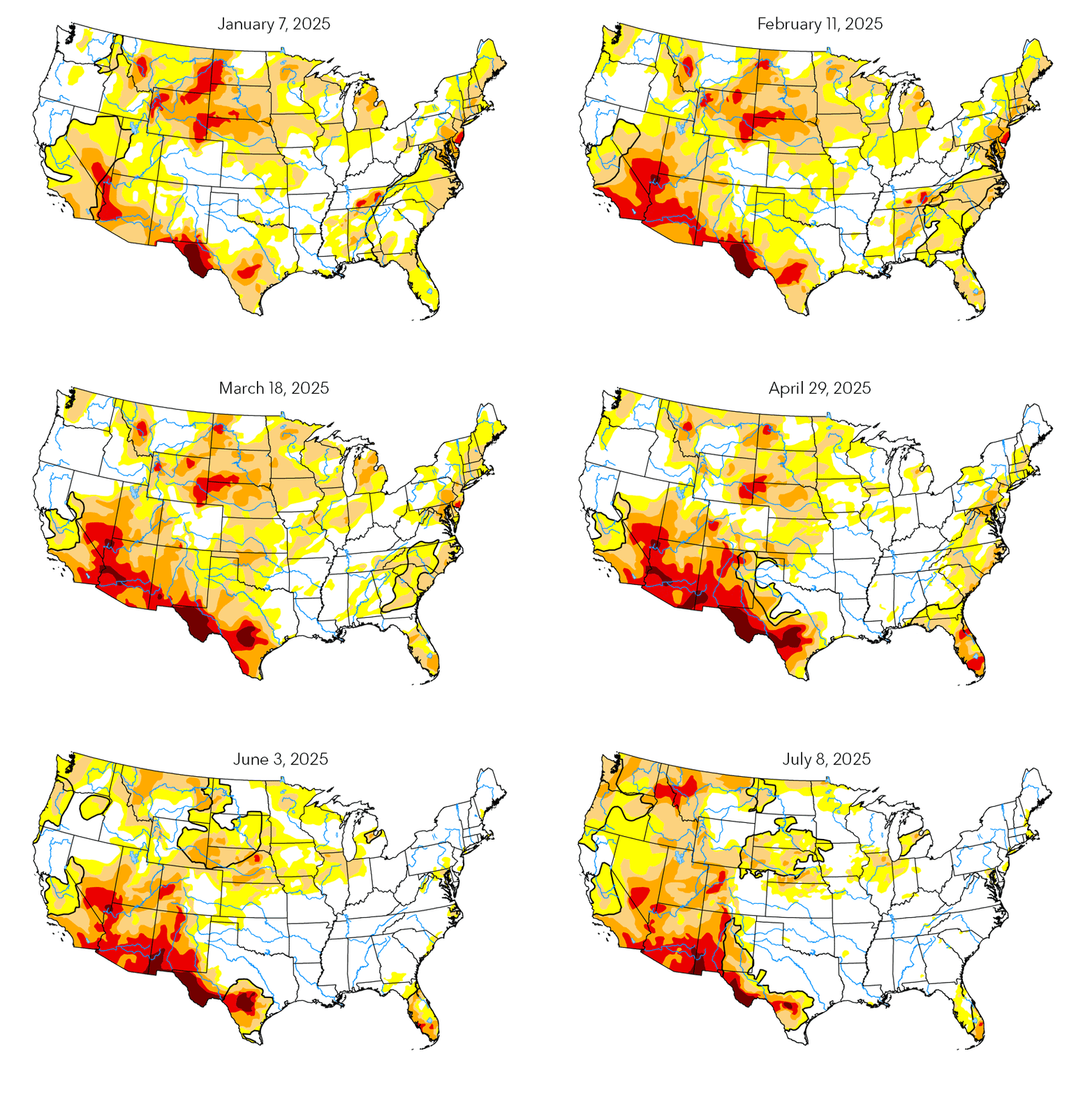
The July 8 U.S. Drought Monitor continued to show drought conditions covering the entire Northern Plains, with a vast section of central North Dakota registering extreme-to-exceptional drought. Most of South Dakota and Minnesota reported moderate-to-severe drought conditions in early July.

The drought has taken a toll on crop quality in the Northern Plains. Just 24 percent of South Dakota’s corn was rated as good or excellent on July 4, compared with 35 percent in North Dakota and 41 percent in Minnesota. North Dakota’s soybeans were only 19 percent good or excellent, compared with 24 percent in South Dakota and 44 percent in Minnesota.

Small grains were also suffering in early July. USDA assigned good or excellent ratings to 35-36 percent of Minnesota’s spring wheat and barley on July 4, compared with 14-18 percent in North Dakota and just 7 percent in South Dakota. Fully 50-56 percent of North Dakota’s spring wheat and barley fell in the poor or very poor categories in early July.

Northeast:

The Mid-Atlantic and Northeast regions were bracing for heavy rain from Tropical Storm Elsa as the week progressed. The storm was hovering over southern Georgia at midweek, but was expected to bring 1-2 inches of rain and gusty winds to Maryland on July 8-9. A flash flood watch was issued for multiple Maryland counties late in the week.

Baltimore, Md., was hit with strong thunderstorms at midweek that produced heavy rain, 60-mph wind gusts, and quarter-sized hail. Spotty thunderstorms were also reported in Pennsylvania, and a heat advisory was in effect for central areas of the state, with highs reaching the mid-90s.

High heat and humidity continued for southern New England as well, but a tropical storm watch was in effect later in the week as Elsa moved into the region. Forecasts warned of two or more inches of rain across interior portions of the region, with winds gusting to 50-55 mph across the Cape and Islands. Heavy rain was also expected in Vermont.

Although Maine was experiencing moderate-to-severe drought ahead of Elsa’s arrival, high heat and ample rainfall in much of the Northeast has produced excellent crops so far this summer. Fully 85 percent of Pennsylvania’s corn crop was rated as good or excellent on July 4.

Transportation

U.S. Gulf:

Tropical Storm Elsa made landfall in Taylor County, on Florida’s Gulf Coast, on the morning of July 7. Elsa strengthened into a Category 1 hurricane overnight on July 6, but saw sustained winds fall below the 75 mph threshold before coming ashore.

Forecasts warned of storm surges and flooding in Florida and Georgia, while tornado warnings were in effect in many parts of western Florida. After landfall, Elsa pressed northward into Georgia and the Carolinas, dropping significant rainfall along the way.

Rough weather, due in part to Elsa, was noted triggering intermittent rough-sea and high-wind delays in the Gulf for the week, particularly in the East and West Canals.

Guidewall damage continued to restrict Port Allen Lock travel, with unassisted westbound lockages reportedly limited to a single barge per turn. Vessels traveling to the west with two or more cargoes were required to use an assist vessel. Eastbound tows moving without assistance were capped at 650 feet of length. Delays up to nine hours were reported for the week.

Locking restrictions continued at Algiers Lock, where limitations on the length and width of tows passing the site without assistance limited movements to four standard barges or two 30,000 mt tankers. Larger tows were allowed to pass with an assist vessel. Most waits were noted in the 4-7 hour range for the week, although a handful of intermittent delays were reported up to 25 hours.

Overnight travel through Bayou Chene remained unavailable due to ongoing construction activities and diving operations. Bayou Chene was shut nightly between 7:00 p.m. and 7:00 a.m., with 6-12 hour delays expected. Assist boat usage was required while the project is underway.

Industrial Lock waits were clocked up to 33 hours for the week, while 5-10 hour delays were observed at Bayou Boeuf Lock on July 6-7.

Mississippi River:

River levels in the St. Louis area dropped quickly below the 28-foot action stage on July 3, falling to 18.3 feet on July 7. The rapid drainage contributed to dangerously fast river flows, however, prompting the continuation of a 20 percent barge-count reduction on southbound vessels running between St. Louis and Cairo, Ill. In addition, tows were limited to running during daylight hours between Cape Girardeau, Mo., and Cairo.

The secondary chamber at Lock 27 was shut to navigation on July 6 for lower bullnose repair, and was set to remain closed through July 27. The site’s primary chamber will close Aug. 2-19 to facilitate repair of the upper bullnose.

Daylight-hour shutdowns for miter gate installation were expected at Lock 2 in the near term. Intermittent 4-12 hour shutdowns are predicted when the project is underway.

Delays were noted in the 3-12 hour range at Lock 14 for the week, while five-hour waits were reported through Lock 20.

Illinois River:

Falling levels on the Illinois Waterway prompted a return to navigation during the week, although tow lengths were restricted. Shutdowns were previously noted above Starved Rock Lock.

Limited travel is projected during the week ahead through the Beardstown Railroad Drawbridge. Bridge repair is expected to close the site to navigation from 8:00 a.m. to 2:00 p.m. on July 12-13.

Despite the falling water levels, wickets remained down at both Peoria Lock and LaGrange Lock, allowing vessels to transit both areas without locking.

Ohio River:

The north chamber at McAlpine Lock was closed for the week due to emergency dredging and repairs. Vessels were able to pass through the site’s lower chamber, with wait times heard up to five hours.

The Belleville Lock main chamber was inaccessible between 7:00 a.m. and 3:00 p.m. daily on July 6-9 due to repairs. Boats were reported passing through the auxiliary chamber, sparking intermittent delays up to six hours.

The Meldahl Lock primary chamber returned from miter gate machinery repairs on June 29. Vessels had been noted passing through the site’s 600-foot auxiliary chamber while work was underway, triggering extensive delays.

The Markland Lock auxiliary chamber remains offline through an estimated Oct. 29 due to structural cracks in the miter gate, discovered in early 2020. Transit was said to remain available through the primary chamber, with few reported delays.

Cannelton Lock’s primary chamber is shut through Nov. 19 for repairs and maintenance, necessitating passage through the auxiliary chamber.

The main chamber at Montgomery Lock is scheduled to shut from July 26 through Aug. 24, with vessels detouring through the secondary chamber. The main chamber is scheduled to undergo one additional outage this year, from Oct. 18 to Dec. 17.

The primary chamber at Braddock Lock is projected to shut to navigation from Sept. 13 through Oct. 15, prompting a detour through the auxiliary chamber. The main chamber at Willow Lock is scheduled to go offline Oct. 1-31, with delays expected.

Elevated river levels prompted lock operators to lower wickets at Olmsted Lock, allowing vessels to transit through the navigational pass.

Bio-acoustic fish fence (BAFF) repairs were paused at Cumberland River’s Cheatham Lock during the week, allowing vessels to lock freely on July 2-11. The project’s final closure, officially scheduled to run July 12-22, was instead likely to conclude as early as July 15, sources said.

Arkansas River:

David D. Terry Lock navigation is projected to be unavailable from Aug. 27 through Sept. 9 due to dewatering and repairs. Intermittent transit blockages are anticipated ahead of the full shutdown, running Aug. 16-26.

N-7 LLC – Management Brief

N-7 LLC, a joint venture between OCI NV and Dakota Gasification Co. in the U.S., announced that effective July 1, 2021, David Schramm will assume the position of Executive Chairman of N-7’s Board of Directors until he retires from the company in February 2022. John Ringkob will succeed Schramm as President.

Ringkob has been with OCI and N-7 for the past four years, and the company said he has been instrumental to its success in growing the DEF business from inception to a leader in the North American DEF industry, including originating and executing the DEF, Urea Liquor, and Automotive Grade Urea Marketing Agreement with Dyno Nobel. In addition, he has driven N-7’s penetration into industrial urea markets and has led its urea marketing and trading activities.

Before joining OCI, Ringkob was a principal and Vice President of Dasco Inc., a U.S.-based trader of crop nutrients, feed ingredients, and industrial chemicals, including DEF, which he co-led for 13 years. The company said he brings 20 years of fertilizer and industrial products trading experience to OCI and has a demonstrated history of driving commercial excellence in his tenure at the company.

Ringkob holds a B.S. in Agricultural Business with a minor in Agronomy from Iowa State University.

“We thank Dave for his tremendous contributions to OCI’s growth and success in its North America business over these past eight years,” said Ahmed El Hoshy, OCI CEO. “Dave was instrumental in the development of OCI’s Iowa Fertilizer company greenfield project from inception, establishing our North American commercial presence and building and leading the N-7 joint venture. We are excited for this next chapter in N-7’s development and Dave’s continued stewardship of the business alongside John as its new leader. John has been an invaluable asset to OCI and N-7 over these past four years, and has demonstrated an ability to drive growth and excellence in our commercial activities.”

Chris Kayl has been appointed Vice President of Commercial. He will be responsible for product management and sales for N-7 across products. He joined OCI in 2017 and has led its ammonia trading activities in the U.S., as well as providing support to the global ammonia trading team. Alongside Ringkob, Kayl was responsible for the development of N-7’s DEF commercial activities and helped grow the business. He joined OCI from Koch Fertilizer, where he spent 14 years, most recently as Senior Vice President of International Terminals and Trading. He brings 27 years of experience in the fertilizer trading and agriculture industry. He holds a B.S. in Business Administration from Mount Mercy College.

The Andersons Inc. – Management Brief

The Andersons Inc., Maumee, Ohio, on June 25 announced key leadership changes within its Plant Nutrient wholesale fertilizer business. Chuck Anderson has been promoted to Vice President and General Manager, Specialty Liquids. He has been with the company for 34 years, and most recently served as Vice President of Innovation for the company’s Nutrient businesses. Anderson will retain his leadership over the commercialization and innovation functions. He earned a bachelor’s degree in horticulture from The Ohio State University and has led the company’s business growth, including overseeing more than 20 patents.

Also recently promoted is former Director of Industrial Sales John Kevern, who will now expand his responsibilities to serve as Director of Sales, Specialty Liquids. He will manage the distribution of the business’ specialty liquids products across North America in both the industrial and ag segments.

Brecken Price has also assumed additional responsibilities and will fill the role of Director of Commercialization and Innovation. Price will continue to oversee the group’s e-commerce strategy, as well as manage the current commercialization and innovation efforts across all Nutrient businesses.

“These organizational changes will help improve efficiency in our wholesale fertilizer business and enable us to grow and better serve our customers,” said Joe McNeely, President, The Andersons Nutrient and Industrial. “These leaders have exceptional experience and dedication to providing quality service and products to the ag industry.”

The Agricultural Retailers Association – Management Brief

The Agricultural Retailers Association (ARA) on June 28 announced several staff promotions, effective July 1, 2021. Bryna Hautau will be promoted to Senior Director of Operations and Events; Hunter Carpenter to Senior Director of Public Policy; Melisa Augusto to Vice President of Communications and Marketing; and Donnie Taylor to Senior Vice President of Member Services and Corporate Relations.

Hautau has been with ARA for nine years, starting as an Administrative Assistant in 2013. Her responsibilities have expanded to include stewardship of the membership database, office operations, vendor contracts, ARA’s summer internship program, new employee on-boarding, and other duties.

Carpenter joined the ARA staff in 2015 and has been involved in ARA’s advocacy efforts, developing a vast array of Capitol Hill contacts and a deep knowledge of the legislative process. Augusto has been with ARA for four years and leads communications, branding, event marketing, digital media, media relations, publications, and related functions for the association.

Taylor has been with ARA for 10 years, and leads ARA’s member recruiting, retention, on-boarding, sponsorship, member services, and other areas. ARA said Taylor was instrumental in developing ARA’s Professional Development Pathway for member employee development and the new remote-work-friendly NAVIGATOR 360o development tool launched in 2020.

“I am privileged to work alongside a small but mighty team of talented professionals,” said ARA President and CEO Daren Coppock. “The ARA team gets a lot done with fewer people than most realize. The only reason we’re able to accomplish what we do is the high caliber of people dedicated to advancing the interests of our member agricultural retailers. These promotions recognize hard work, flexibility, performance, and tenure of several key staff members.”

Intrepid Potash Inc. – Management Brief

Intrepid Potash Inc., Denver, Colo., on June 29 announced the appointment of Lori A. Lancaster as a new independent director to Intrepid’s Board of Directors, effective July 28, 2021. She replaces Terry Considine, who will retire on July 28.

With nearly 20 years of experience and leadership in investment banking, Intrepid said Lancaster brings additional financial, merger and acquisition, and oil and gas experience to the board. She most recently served as Managing Director for UBS Securities LLC in its Global Energy Group from 2013-2016. Prior to UBS, she worked for Nomura Securities International and Goldman Sachs & Co. as Managing Director in eachcompany’s Natural Resources Group.

Lancaster currently serves as an independent director for Laredo Petroleum, where she serves as the Finance Committee Chair and a member of the Audit Committee. She previously served as an independent director for HighPoint Resources and Energen Corp.

“The depth of Lori’s investment banking experience serving clients across the natural resources and energy sectors is a wonderful fit for a growing and diversified company like Intrepid.” said Bob Jornayvaz, Intrepid’s Executive Chairman, President, and CEO. “Lori has been involved with over $60 billion of M&A deals in her 20-year investment banking career, in addition to numerous capital-raising transactions, initial public offerings, structured financings, and debt offerings. We believe her experience and guidance will significantly benefit Intrepid and its shareholders.”

Considine has served on Intrepid’s board for 13 years and was one ofthe original members. He is a member of the Colorado Business Hallof Fame and serves as CEO of Apartment Income REIT Corp.

E.U. Sanctions Seen to Have Limited Impact on Belarus Regime, Say Reports

The European Union’s (E.U.) latest sanctions aimed at punishing Belarusian President Alexander Lukashenko and his regime will have limited impact and will leave the regime able to continue financing the economy and security forces, according to a report by Canada’s National Post, citing rating agencies and analysts.

The E.U. on June 24 agreed to a sweeping set of sanctions against the Belarusian regime, targeting key economic sectors, and include restrictions on Belarus’ potash trade (GM June 25, p. 1).The measures, which came into force on June 25, follow the forced landing of a Ryanair flight and the arrest of journalist Raman Pratasevich and his girlfriend in Minsk on May 23 (GM May 28, p. 1), as well as what the E.U. bloc called “the escalation of serious human rights violations” and “violent repression” in Belarus.

State-owned potash producer Belaruskali and potash marketer and exporter Belarusian Potash Co. (BPC) also look to face no major threat from the latest E.U. sanctions as they currently stand. Belarus potash exports account for around 20 percent of the global trade in the nutrient, and according to the country’s National Statistical Service (Belstat), earned the Belarusian regime some $2.41 billion last year.

Crucially, while the sanctions restrict imports of Belarus potash into E.U. countries and a transit ban via E.U countries, as well as imports of Belarus NPK fertilizers (and other fertilizers containing potassium and phosphorus), a key grade of Belarusian potash has been excluded from the ban. Potassium chloride with a potassium content evaluated as K2O by weight, exceeding 40 percent but not exceeding 60 percent on the dry anhydrous product, is not included on the sanctions list.

Additionally, Belarus’ current supply contracts with India and China are not subject to the Brussels sanctions. Under the E.U. measures, the execution of any of BPC’s potash supply contracts concluded before June 25, the day the sanctions came into effect, can continue without restriction.

Belarus rails most of its potash for export to the Lithuanian port of Klaipeda, and because the new sanctions also include a transit ban via E.U countries, had all grades of potash been included in the E.U. restrictions, the impact on the Belarus economy would have been far-reaching.

As the E.U. measures stand, they will lead to about a 20 percent drop in the volume of Belarus potash and other fertilizers transported via Lithuania, according to Lithuanian state-owned railway company Lietuvos Geležinkeliai’s (LG) CEO Mantas Bartuska, speaking to the press on June 25 and cited by Lithuania’s main news portal, Delfi.

According to Bartuska, about 11 million mt of Belarus potash crossed the Lithuanian border last year, with about 2.5 million mt now falling under E.U. sanctions. The CEO warned that the loss of these cargo volumes would amount to around €14 million a year in lost revenues for the rail company. LG is also set to be impacted by the loss of revenue from Belarusian oil product cargo volumes, which are included in the E.U. sanction restrictions.

According to Bartuska, the Klaipeda port shipped almost 10.7 million mt of Belarus potash last year via the Biriu Kroviniu Terminalas (Bulk Cargo Terminal [BKT]) terminal, in which Belaruskali owns a 30 percent stake.

Belarus exported 1.07 million mt of NPK fertilizers in 2020, of which 429,200 mt went to E.U. countries, according to an Interfax report, citing the country’s National Statistics Service (Belstat), or around 40 percent of the total (GM Feb. 19, p. 20). Some 611,600 mt went to Ukraine.

Each sanctions measure needs to be seen in a wider context of all existing sanctions and their direct and indirect impact, Peter Stano, the European Commission’s Lead Spokesperson for Foreign Affairs and Security Policy, told Green Markets, in response to enquiries by GM as to why the E.U. decided not to restrict all Belarusian export trade in potassium chloride into Member countries.

“The overall sanctions the E.U. adopted vis-a-vis Belarus are extremely comprehensive, consisting of asset freezes against 15 entities, asset freezes and travel bans against 166 individuals, and economic sanctions targeting specific sectors of the Belarusian economy that we believe will hit the Lukashenko regime the hardest,” he said.

“As Josep Borrell, E.U. High Representative for Foreign Affairs and Security Policy and Vice-President of the Commission (HR/VP) stressed, the E.U. Member States would not be adopting these sanctions if we did not believe that they could have the desired effect, which is to contribute to bringing an end to the violent repression of the Belarusian people, the release of all political prisoners, the  respect for democracy, the rule of law and human rights, and promote an inclusive national dialogue leading to free and fair elections under the supervision of the OSCE,” said Stano.

He added that current sanctions are not the end of the story, and the E.U. will continue to assess the situation on the ground in order to determine whether further E.U. measures are warranted.

According to unnamed sources cited by a report in the U.K.’s Guardian newspaper, some E.U. member states feared cutting off Belarusian potash supplies too quickly would hurt European farmers, while others were concerned about boosting the Russian potash industry.

Belarus supplies about 25 percent of Europe’s potash demand, according to BPC. BPC’s press secretary told Bloomberg in May that while sanctions preventing European companies from trading with Belarus may cause a short-term increase in potash prices in Europe, she believed the situation would normalize fairly quickly as the shortfall may be filled by producers such as Russia’s Uralkali.

The Mosaic Co. President and CEO Joc O’Rourke, presenting at the Exane BNP Paribas 23rd European CEO Virtual Conference on June 7, thought Uralkali and EuroChem would fill part of the supply shortfall, and the rest would be filled by ICL and maybe Jordanian potash. But he believed there is enough potash out there for the European market in the event of sanctions prohibiting Belarus potash coming into the E.U.

But under the trade sanctions put in place by the E.U. last week, the prohibited grades of potash account for only around 20 percent of Belarus’ supplies to the E.U., according to a note last week by Russia’s VTB Capital analyst Elena Sakhnova, cited by Bloomberg.

But Franak Viačorka, Belarus opposition politician and advisor to Belarusian opposition leader Sviatlana Tsikhanouskaya, has called on the E.U. to “close loopholes” in the sanctions, according to the Guardian report. He said only full, comprehensive sanctions will cause Lukashenko to change his behavior. “Semi-sanctions or half-measures only will harm,” he said.

Viačorka has also criticized the E.U. for not applying sanctions retroactively, pointing to the potash supply contracts Belarus signed before June 25 being able to continue.

The Belarus government for its part has downplayed the Western sanctions targeting its potash export trade. Belarus Deputy Prime Minister Alyaksandr Subotsin said Belarus would now redirect part of the country’s potash trade to Russian and Chinese markets, as well to “the East,” BBC Monitoring reported, citing Belarus state-owned Belarus 24 TV’s Main Broadcast news program.

His comments echoed comments in May by BPC, which said in the event of sanctions preventing European companies from trading with the Belarus potash industry, Belarus could still be able to divert potash volumes from Europe to other markets, primarily Asia.

Belarus state-run news agency BelTA this week reported that Belaruskali Director General Ivan Golovaty, “feels inspired by the difficulties” in the “current complicated conditions.”

The new E.U. sanction measures also restrict access to E.U. capital markets, banning E.U. operators from new Belarusian state debt, including loans and bonds issued after June 29 with a maturity of more than 90 days. The European Investment Bank is also to cease any payments under existing agreements with the Belarusian public sector.

However, the sanctions do not affect the state-owned Development Bank of Belarus, the only bank with outstanding Euro bonds, according to the National Post report.

The Belarus government also has strong financial support from close ally Russia, according to the S&P ratings agency. Minsk and Russia agreed to a $1 billion credit line with Russia last year, extended when Lukashenko was facing widespread national protests following his disputed re-election, to help refinance $1.1 billion in foreign currency debt, which is due for repayment by the end of 2021, the National Post reported, citing the ratings agency.

Russia’s ambassador to Belarus Yevgeny Lukyanov told media in June that Russia will continue to support Belarus, including in case the E.U. and other countries impose additional sanctions, adding that foreign trade contacts between Belarus and Russia “would be adjusted taking into account the impact of [any] sanctions”.

Russian President Vladimir Putin has voiced solidarity with Belarus in its resistance to “illegitimate Western sanctions,” Tass reported, citing the Kremlin’s press-service this week.

The two countries are to set up a joint business council, BelTA reported this week, citing the Belarusian Chamber of Commerce and Industry Chairman Vladimir Ulakhovich at a web-based meeting of the Business Cooperation Council on June 30, where an agreement was signed. The joint council will include major enterprises from different sectors of the economy.

In retaliation to the European bloc’s sanctions, Belarus’ Foreign Ministry said on June 28 Belarus would move to suspend a readmission agreement with the E.U. that is aimed to stem illegal migration, AP reported. The ministry also said Belarus will impose a travel ban on unspecified E.U. officials involved in the drafting of the sanctions, will recall its envoy to the E.U. for consultation, and will also ask the E.U. representative in Minsk to leave the country.

According to the report, Belarus will also suspend its participation in the E.U.’s Eastern Partnership program, which was intended to strengthen cooperation with several FSU countries.

In further retaliatory moves, Belarus on June 30 ordered two German educational organizations to cease activities in the country. The Goethe Institut, which promotes German language and culture worldwide, and the German Academic Exchange Service were ordered to shut their Belarus operations.

In the meantime, jailed journalist Raman Pratasevich and his girlfriend late last week were reported to have been moved from the prisons where they were being held to house arrest amid calls by the opposition and rights activists for their immediate release, but Pratasevich still faces up to 15 years in jail on claims by the Belarusian regime he was behind so-called “civil disturbances” following the disputed presidential election last August.