All posts by mickeybarb@charter.net

Crops/Weather

Eastern Cornbelt:

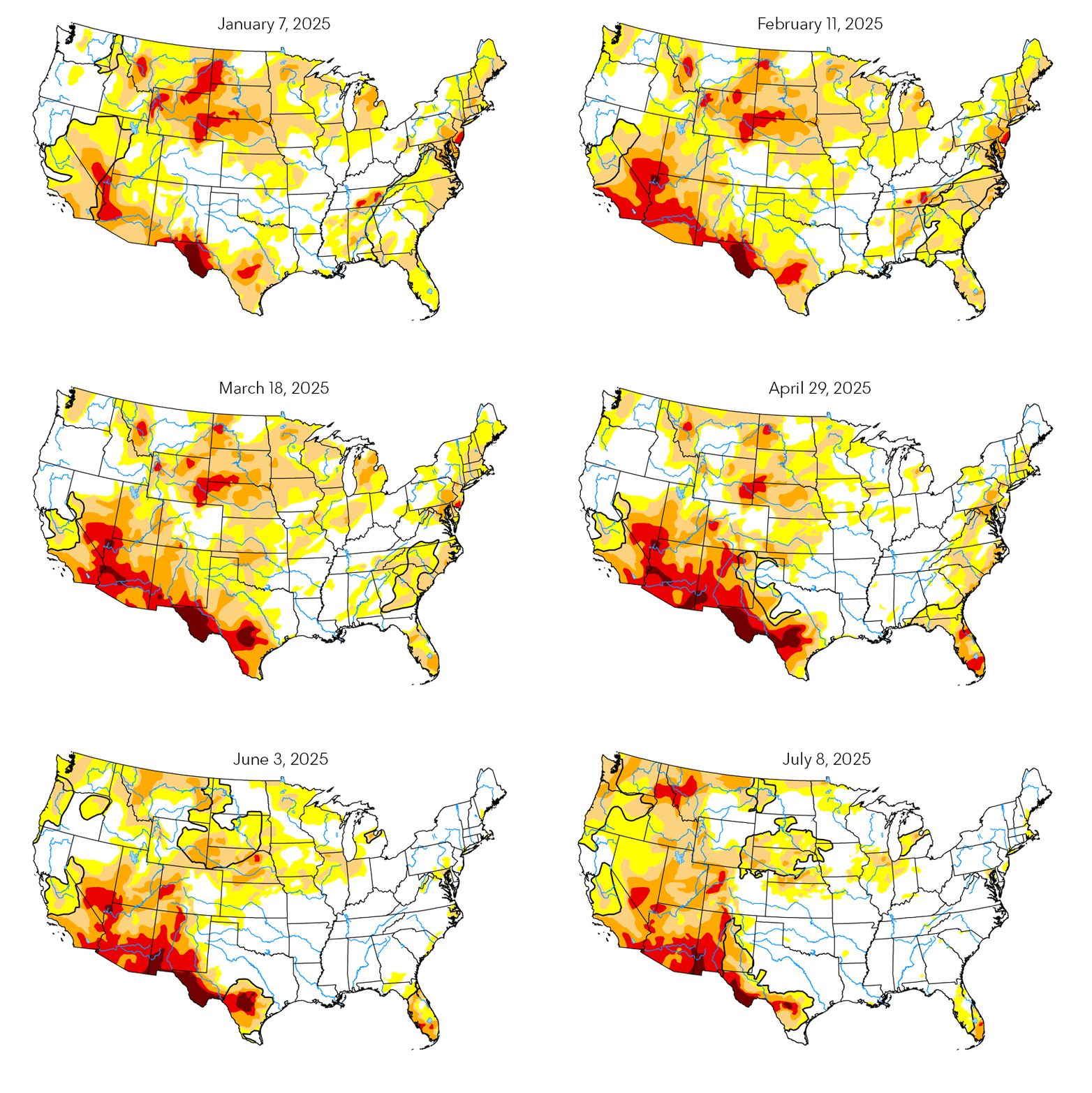
U.S. Drought Monitor

Hot, humid weather was reported in Indiana during the week, with some central areas of the state collecting as much as two inches of rain at midweek. Heavy rain was also reported in parts of eastern Ohio during the week, while scattered rain and slightly cooler temperatures were reported in central and southern Illinois as the week progressed.

Soybean planting had progressed to 89-93 percent complete in the Eastern Cornbelt by June 6, with all three states tracking ahead of their five-year averages. Corn emergence by that date was rated at 93 percent in Illinois, 88 percent in Indiana, and 83 percent in Ohio, with good or excellent ratings assigned to 73-76 percent of the regional acreage.

Corn, Wheat, Soybean Index

Western Cornbelt:

Temperatures rose to the upper-80s and low-90s in central Iowa during the week, with a wide area of moderate-to-severe drought reported across the northern half of the state. Strong thunderstorms tracked through the Nebraska Panhandle on June 8, with reports of damaging winds and large hail in some locations.

High heat and humidity were also reported in central Missouri during the week, with highs expected to reach into the 90s later in the week. Heat index values were projected to reach the middle- to upper-90s by the weekend.

Soybean planting had progressed to 98 percent complete in Iowa and Nebraska by June 6, compared with 65 percent in Missouri. Missouri growers also had 98 percent of the cotton seeded by that date, with rice emergence estimated at 96 percent. The sorghum crop was 73 percent planted in Nebraska by June 6.

Corn emergence was rated at 91-96 percent in the region, with good or excellent ratings assigned to 84 percent of the new crop in Nebraska, 77 percent in Iowa, and 57 percent in Missouri.

California:

California experienced weather extremes in mid-June, with unseasonably hot weather in the southern half of the state and cool, wet weather in the north.

Temperatures across Southern California were in the 80s at midweek, but weekend highs were expected to soar into the 90s and possibly the triple digits in some locations. A Pacific Northwest weather system dropped temperatures across Northern California to about 15 degrees below normal, by contrast, with high winds and light rain at midweek.

The precipitation is expected to do little to alleviate worsening drought conditions across the state. The June 10 U.S. Drought Monitor showed virtually all of California in extreme-to-exceptional drought, with major reservoirs running at half capacity or below in Northern California, including Lakes Oroville and Folsom.

The cotton crops in California and Arizona were 99-100 percent planted by June 6, and fully 75 percent of California’s rice had emerged by that date. USDA rated both of the emerging crops as 90 percent good or excellent on that date.

Pacific Northwest:

A long string of unusually hot, dry days across much of Oregon and Washington in early June worsened drought conditions and fueled a number of early wildfires in the region. In northeast Oregon, high winds fueled the growth of the Joseph Canyon Fire, which has scorched 4,000 acres on the Oregon-Washington border.

A Pacific weather system brought cooler weather and some needed rainfall to both states as the week progressed, but precipitation levels were small. All of Oregon was locked in drought at mid-month, with a wide band of extreme-to-exceptional drought conditions stretching across the center of the state and extending into southeastern Washington.

After excessive heat and record-breaking temperatures in early June, much of southern Idaho enjoyed cooler weather and some rain during the week. Precipitation totals ranged from under a half-inch in the valleys to nearly an inch in the mountains, but another blast of heat was expected by the weekend, with highs expected to soar into the 80s and 90s.

Cooler weather was also reported in Montana after the prior week’s blast of summer heat. Severe thunderstorms moved across north-central and central Montana at midweek, with reports of strong winds and hail in some locations.

Spring wheat and barley crops were 97-99 percent emerged in Idaho and Washington by June 6, compared with 80-87 percent in Montana. Just 17-18 percent of the acreage in Washington was rated as good or excellent, compared with 25-43 percent in Idaho and 47-57 percent in Montana. Fully 41-56 percent of Washington’s spring wheat and barley acres were rated as poor or very poor.

Winter wheat conditions were worse across the region, with good or excellent ratings assigned to only 8 percent of the acreage in Oregon, 25 percent in Washington, and 33-36 percent in Idaho and Montana.

Western Canada:

Strong thunderstorms tracked across the Prairies as the week progressed, coming just days after record-high heat in some locations.

Manitoba broke 14 heat records on June 4, with temperatures soaring past 40 C in some areas. Temperatures in Winnipeg hit a record 36.5 C on that date, while the hottest temperature in the province was recorded in Gretna, which hit a high of 41.3 C.

In the days that followed, however, strong storms moved across Alberta and Saskatchewan, along with much cooler weather in Alberta. Forecasts warned of tennis ball-sized hail and 100 km/h winds in parts of southern Saskatchewan on June 9-10, while heavy rain and high-elevation snow were reported in Alberta.

Temperatures in Alberta dropped to the single digits early in the week, while highs in the 30s were once again expected in southern Saskatchewan and Manitoba by the coming weekend.

Spring planting was 99 percent complete in Saskatchewan, slightly ahead of the five-year average. Planting of pulse crops and soybeans was also nearly complete in Manitoba. “Spring application is basically wrapped up here, with possibly some topdressing to occur if we get some rain this week,” said one Saskatchewan contact at midweek.

Transportation

Handysize Shipping Index

U.S. Gulf:

The ongoing high-water closure at Bayou Sorrel Lock remained in place for the week, essentially shutting the Port Allen Route to all but local travel. Travel through the site has been halted since May 11, and forecasts predicted the shutdown to persist through a likely June 15-18. Dredging penciled to begin at Bayou Sorrel on June 10 was scheduled to run through July 8, with navigation minimally impacted.

Port Allen Lock travel was limited to local vessels only. Unassisted westbound lockages were capped at a single barge per turn, while boats with two or more cargoes in tow were required to make use of an assist vessel. Tows traveling eastward without assistance were capped at 650 feet of length.

Due to the Bayou Sorrel Lock and Port Allen Lock closures, tows were reported detouring through Algiers Lock, effecting lengthy delays. Waits were heard in a 26-39 hour range, with 27 tows queued to lock on June 8.

Ongoing locking restrictions compounded the delays at Algiers, sources indicated. Unassisted travel through the site was restricted to four standard barges or two 30,000 mt tankers, while lengthier tows were permitted to pass when accompanied by an assist vessel. All told, the detours and restrictions combined to increase travel times between the lower Mississippi River and West Canal by approximately one week.

An electrical malfunction was noted blocking operation of the Florida Avenue drawbridge on June 7-8, located adjacent to Industrial Lock, forcing a total halt to navigation through both structures. Waits noted up to 17 hours on June 8 were projected to slowly thin to normal levels by June 10.

Bayou Chene overnight transit remained unavailable due to construction activities and diver operations. The route was shut nightly between 7:00 p.m. and 7:00 p.m., triggering 6-12 hour stoppages. The project was tentatively set to conclude on June 15.

River levels at Baton Rouge were noted flirting with the 30-foot action stage during the week, although forecasts projected a June 15 crest shy of the key 30-foot level, at 29.6 feet. An unseen precipitation event could tip the upper Gulf into restricted territory once again, however, sources speculated.

Harvey Lock waits were clocked up to 50 hours for the week, while 4-9 hour crossings were observed at Bayou Boeuf Lock on June 7-8. Boats locking through the Colorado Floodgates were subject to intermittent 37-hour wait times. Brazos Lock travel carried delays up to 36 hours, according to Corps documents. Intermittent storm delays were noted in the Gulf and Canals through June 9.

Mississippi River:

A grounded vessel was heard blocking travel through the lower Mississippi River’s Victoria Bend, located at Mile 595, for approximately 12 hours on June 5. Following the return of navigation through the area, the Corps was noted keeping an eye out for signs of shoaling, leading sources to brace for possible dredging activities and associated slowdowns in the weeks ahead.

A new round of dredging activity was noted at Mile 757 on the upper river. Sources predicted daytime navigation disturbances while activities are underway.

Burlington Railroad Bridge repairs continued to complicate daylight-hour transit through the upper river’s Mile 410. Transit remains available through the bridge while the operation is underway, although contractors were noted requiring advance notice of at least one hour prior to arrival. Work heard running from 7:30 a.m. and 4:30 p.m. daily was slated to run into the second half of June.

Difficult river conditions necessitated ongoing restrictions between St. Louis and Cairo, Ill. Five-barge cuts remained in place for the week, reducing the region’s typical 25-cargo capacity by 20 percent.

Daylight-hour shutdowns for miter gate installation remain scheduled at Lock 2 in July, expected to result in intermittent 4-12 hour closures. Daytime shutdowns for guidewall repairs at Lock 25 were predicted for both July and August, blocking access daily between 6:00 a.m. and 6:00 p.m.

Delays were heard up to 10 hours at Lock 25 for the week, while nine-hour waits were reported through Mel Price Lock and Dam.

Illinois River:

Falling water levels allowed lock operators to begin raising wickets at LaGrange Lock on June 7, signaling a return to locking on June 8. Waits were noted up to nine hours during the switchover. Wickets continued to be reported in the lowered position at Peoria Lock on June 9, allowing vessels to transit the site via the nonlocking navigational pass.

Ohio River:

The primary chamber at Meldahl Lock is closed through June 29 for machinery repairs. Vessels were noted passing through the site’s 600-foot auxiliary chamber while work is underway, prompting delays in a general 5-13 hour range, down from 37.5 hours noted previously. Intermittent shutdowns affecting both chambers were also noted periodically halting movements through the site.

The auxiliary chamber at New Cumberland Lock was scheduled to return from a repair and maintenance shutdown after June 10, normalizing movements through the structure.

Markland Lock’s auxiliary lock chamber is offline through an estimated Oct. 29 due to structural cracks in the miter gate discovered more than one year ago. Passage through the chamber has been unavailable since early 2020.

The primary chamber at Cannelton Lock is due to close June 21 through Nov. 19 for repairs and maintenance, forcing detours through the site’s secondary chamber. Significant delays are anticipated while the project is underway.

The Tennessee River’s Pickwick Lock and Wheeler Lock were reported shut between 6:00 a.m. and 4:00 p.m. on June 7-10 for inspections. Guntersville Lock and Nickajac Lock travel will be unavailable during daylight hours on June 14-17, while inspections will block Wilson Lock travel during the daytime on June 28 through July 1. Kentucky Lock delays were reported up to 20 hours on June 8-9.

Arkansas River:

Elevated river levels and fast flows triggered ongoing tow-size restrictions on the Arkansas River, cutting maximum lengths by 3-6 cargoes from the typical 12-barge limit. Forecasts predicted a possible return to normal operation by June 13.

Navigation through David D. Terry Lock is set to be completely unavailable Aug. 27 through Sept. 9 for a planned dewatering and repair project. Intermittent stoppages are anticipated ahead of the full shutdown on Aug. 16-26, as contractors work to get machinery and materials in place.

Nutrien Boosts K Production 500,000 mt; Mosaic Provides More Details on Shortfall

Nutrien Ltd., Saskatoon, said on June 7 it expects to increase potash production by approximately 500,000 mt in second-half 2021 compared to earlier expectations, in response to tightening global potash market conditions. Nutrien noted that it has a flexible network of six potash mines with competitively positioned, available capacity that it can utilize to help supply global demand.

“We are responding to strong market fundamentals to ensure our customers have the crop inputs they need to feed a growing population,” said Ken Seitz, Nutrien’s Vice President and CEO of Potash. “Our network of flexible production and extensive logistics is designed to provide reliable supply, and we have a unique ability to be agile and respond to changing market conditions. Our potash asset portfolio is optimally positioned to meet customer needs and drive shareholder value.”

Nutrien said domestic and offshore potash sales volumes are currently fully committed through September, based on its original production profile for 2021. Nutrien said it will be actively hiring additional employees and adapting its resources to help increase production across most of its potash mines, ramping up its Vanscoy facility in particular, and will ensure the highest safety standards are maintained in the process.

Nutrien expects these actions to result in upward revisions to potash-related guidance for second-half 2021 from both a volume and EBITDA perspective, which will be addressed in second-quarter 2021 results. Nutrien said it continues to actively monitor the market and evaluate other potential options to further increase production if demand warrants it and may provide additional information in this regard at a later date.

The Nutrien news quickly followed a June 4 announcement by The Mosaic Co., Tampa, that it would be cutting production by 1 million mt through March 2022 (GM June 4, p. 1) as a result of the earlier-than-expected closure of its K-1 and K-2 shafts in Esterhazy, Sask.

“While we’ve successfully managed brine inflow at K1 and K2 since 1985, inflows accelerated over the past couple of weeks and we were faced with inflow rates that exceeded our pumping capacity,” Mosaic CEO Joc O’Rourke told attendees of the Exane BNP 23rd European CEO Virtual Conference on June 7. “On June 3, we made the decision to stop all work as inflows reached the point where it could be a potential risk to the safety of our underground workers. So we immediately accelerated the transition to K3. We also decided to resume operations at Colonsay.”

The company expects 2021 potash sales volumes to fall to 8 million mt, down 800,000-900,000 mt from original expectations.

O’Rourke reiterated that when K3 reaches full production it will be one of the lowest-cost potash mines in the world. “Looking forward, by the middle of 2022, we will have fully transitioned Esterhazy to K3. As we originally planned, K3 tons combined with Belle Plaine’s capacity will provide 9 million mt of the lowest-cost production in North America.” The company hopes it will get phase two of Esterhazy K3 in operation in fourth-quarter 2021, though it is working to accelerate that into October.

Colonsay production could add another 2 million mt to 2022’s 9 million mt, though the company noted these will be higher cost tons. Costs were put at $100/mt at its idling in 2019. By comparison, first-quarter 2021 costs averaged $64/mt excluding brine management costs.

O’Rourke said the company is changing its Colonsay operating model and believes there is an opportunity to bring costs down, but it will not know that until full operations have resumed. “We’ve always viewed Colonsay as an option to be exercised in a strong market like the current environment and as a way of mitigating inflow risk.”

O’Rourke said near-term revenue losses from lost sales could easily be offset by expected price increases. The company said that before its June 4 announcement, the potash market was already in a rally based on potential sanctions against Belarus Potash Co. After its own announcement, Mosaic said it saw $20 price increases in the U.S. and price quotes in Brazil going up $50-$100/mt.

“My expectation is that Europe will do something,” O’Rourke said regarding sanctions. “I wouldn’t guarantee it, but if I was buying into Europe, I would be very cautious about buying Belarusian product because of the fear of those sanctions. And what we’re hearing in the U.S. is the same sentiment. There’s some 700,000 tons a year from Belarus that comes into the U.S.”

If sanctions are imposed, O’Rourke said he believes it will come down to trade flows, with BPC having to go to lower return markets.

Higher Volumes, Prices, Buoy OCP’s 1Q

OCP Group, Casablanca, reported a 60 percent increase in first-quarter EBITDA to MAD 5.34 billion on revenues of MAD14.29 billion, up from the year-ago MAD3.33 billion and MAD12.27 billion, respectively.

In U.S. dollar terms, EBITDA came in at $596 million, a 73 percent increase on the prior-year $345 million, while dollar-denominated revenues grew 25 percent, to $1.59 billion from $1.27 billion.

The Moroccan phosphates group cited favorable market conditions, coupled with production efficiencies and cost savings programs, as driving the results and performance boost.

It said the higher year-over-year revenues reflected higher volumes across all product categories in the quarter compared with a year-earlier, as well as improved prices in all segments. The group noted the higher product prices in the reporting period mitigated the impact of higher input costs, primarily sulfur.

“The first-quarter results represented a strong start to the year, supporting the group’s positive outlook for 2021,” said OCP. “As anticipated, pricing conditions remain favorable, reflecting increased global demand together with stable supply and rising raw material prices.”

The group reduced its capital expenditures by 18 percent to MAD1.75 billion in the first quarter, down from MAD2.13 billion a year-ago, while U.S. dollar-denominated capex was $196 million, down from $220 million.

Scotts Upgrades Guidance Again

Scotts Miracle-Gro Inc., Marysville, Ohio, on June 1 announced increased sales and earnings guidance for fiscal 2021 based on the continued strength of both its U.S. Consumer and Hawthorne segments.

For the fiscal year ending Sept. 30, 2021, Scotts now expects company-wide sales growth of 17-19 percent. The revision is due mainly to stronger growth in the U.S. Consumer segment, where the company now expects sales growth of 7-9 percent, compared with its previous range of 4-6 percent.

Hawthorne sales also continue to exceed expectations, as the company now expects sales growth of 40-45 percent for the full year, compared with previous guidance of 30-40 percent growth.

Adjusted non-GAAP earnings are expected to be in a range of $9.00-$9.30 per share, versus previous guidance of $8.60-$9.00 per share.

“The level of engagement we’re seeing in our U.S. Consumer segment continues to exceed expectations, with consumer purchases up 10 percent entering June,” said Jim Hagedorn, Chairman and CEO. “Consumer purchases, in units, are up more than 20 percent year-to-date as retailers have resumed a higher level of promotional activity compared with last season.

“While consumer purchases declined in dollars during May, as we expected, it was still the third highest on record for a single month, surpassed only by what we experienced last May and this April,” Hagedorn continued. “In fact, so far this season we have experienced four weeks in which consumer purchases exceeded $160 million. Prior to last year, we had never recorded a single week of consumer purchases at that level.

“Gardening activity continues to be the largest driver of growth with strong consumer engagement in all parts of the U.S. and in all retail channels,” he added. “We also continue to see year-over-year improvement in both our lawns and pest control categories.

“The investments we’ve made to retain the new consumers who entered the category last season are working, which gives us confidence to continue to invest throughout the balance of fiscal 2021 with a goal of once again bringing these new gardeners back to the category next season,” he said.

“We also intend to increase our investment behind the Hawthorne business for the balance of the year, as sales and operating margin continue to exceed our expectations. Sales volume at Hawthorne continues to improve even in the face of difficult year-over-year comparisons as we not only benefit from the growth of the overall marketplace, but also from the unique competitive advantages we have worked so hard to establish,” Hagedorn concluded.

“While commodity prices remain sharply higher than a year ago, we remain focused on ensuring the pricing that will take effect in August will offset commodity pressures as we prepare for next season,” said Cory Miller, Senior Vice president and Interim CFO. “We remain prepared to be more aggressive on our pricing decisions, if needed, to stay ahead of those costs.”

NeuAG LLC – Management Brief

NeuAG LLC, Freeport, Texas, on June 2 announced the addition of Stan Deal as East Region Account Manager and Scott Hornblower as Midwest Region Account Manager.

Deal will focus on the wholesale ammonium sulfate crop nutrient market covering Louisiana, Arkansas, and east to the Atlantic Coast. The company said he is well suited for the position based on his background and experience in the Eastern U.S., as well as his retail and wholesale experience, ranging from specialty fertilizers to biostimulants.

Hornblower was responsible for product management and procurement of ammonium sulfate and other products with a large U.S. agricultural cooperative. His focus will be the wholesale ammonium sulfate crop nutrient market in Minnesota, Iowa, and the western Great Lakes region.

Founded by industry veterans Jerry and Joe Newcomb, NeuAG is constructing an ammonium sulfate storage and distribution facility in Freeport (GM Oct. 9, 2020), and will distribute and market ammonium sulfate for a broad range of end uses in the agricultural, industrial, and sprayable markets.

Haldor Topsoe – Management Brief

Haldor Topsoe, Lyngby, Denmark, has named clean technology executive Chokri Mousaoui as the Executive Vice President of the company’s newly-created Green Hydrogen Development unit. He will also be a member of the senior leadership team.

In 2011 Mousaoui co-founded Eternal Sun, which specializes in equipment for testing solar modules. Under his leadership, the company evolved from a startup to a market leader in solar testing. In 2016, the company acquired the solar simulator division of U.S.-based Spire Solar Corp., and in 2019 ABN AMRO Energy Transition Fund joined as new majority shareholder.

Haldor Topsoe is involved in several green projects, including the Aquamarine project in Germany, NOEM Helios in Saudi Arabia, Green Fuels in Denmark, and Green Methanol in Scandinavia.

OMV AG – Management Brief

The Supervisory Board of Austrian oil and gas company OMV AG, Vienna, on June 1 appointed Alfred Stern, 56, as the new Chairman of the Executive Board and CEO of OMV. Stern will assume the position Sept. 1, 2021, for a three-year period, with an extension option for further two years subject to mutual consent.

Stern is currently OMV Executive Board member for Chemicals & Materials, and was formerly CEO of Vienna-headquartered polyolefins and fertilizers major Borealis AG from 2018 until March 31, 2021 (GM Feb. 5, p. 1). OMV in late October 2020 took majority control of Borealis, upping its stake in the company to 75 percent from the previous 36 percent (GM Nov. 6, 2020).

Current Chairman of the Executive Board and CEO of OMV Rainer Seele will resign from his position in the Executive Board by mutual agreement on Aug. 31, 2021.

Indiana Ammonia Facility Advances

The LaPorte County Plan Commission on May 25 approved a request by Kingsbury Elevator Inc. for rezoning to allow it to store anhydrous ammonia at its location in the Kingsbury Industrial Park in Kingsbury, according to The Times of Northwest Indiana. The change must also be approved by the LaPorte County Commission and the LaPorte County Board of Zoning Appeals.

Kingsbury Elevator already has storage for 10,000 st of dry and liquid fertilizer at the site. The company has already undergone some $8 million upgrades since 2015.

The rezoning allows the company to install two 45,000 gallon ammonia tanks, which will provide FOB product as well as serve trucks going into northern Indiana and southern Michigan. The company will receive railcars via Canadian National and will source product from Canada, Mississippi, and Iowa.

Commission approval was originally expected in March, so the tanks and ammonia were already ordered and are onsite. The company’s attorney told the owners to hold off on further procurement until after the zoning request was finalized.