

Cornbelt:
The NPSZ market was reported at $665-$680/st FOB in the Cornbelt, depending on location.
Cornbelt:
The NPSZ market was reported at $665-$680/st FOB in the Cornbelt, depending on location.
Belarus:
Belarus exported 281,700 mt of NPK fertilizers in the first three months of this year, a decline of close to 5 percent from the same year-ago period, according to Belstat. Ukraine was the main export destination, taking 164,300 mt, with the E.U. taking 113,400 mt.
Great Lakes:
Michigan sources reported no available tons or pricing for SOP in late May.
Great Lakes:
SOP Magnesia supplies were reportedly tapped out in Michigan in late May, with no current pricing reported.
Eastern Cornbelt:
Much of the Eastern Cornbelt enjoyed a stretch of 80-degree days that extended through the previous weekend and into the start of the work week. The warm, dry weather helped fuel a strong push to wrap up planting in the region, with sidedress activity also ramping up in many locations.
Strong thunderstorms moved through central Illinois and into Indiana and Ohio at midweek, however, bringing heavy rain, hail, and damaging winds to some areas. Wet conditions were expected to linger late into the week, with cooler weather on tap for the Memorial Day weekend.
Illinois growers had fully 90 percent of the corn planted by May 23, compared with 76-82 percent in Ohio and Indiana. All three states were tracking 11-16 percent ahead of their five-year averages. Soybean planting was also well advanced, with progress estimated at 80 percent complete in Illinois, 69 percent in Indiana, and 66 percent in Ohio, compared with five-year averages ranging from 38-53 percent.
“We’ve been having very nice weather here,” said one Ohio contact. “I don’t think we’ve ever been through such a busy 13-day cycle as we have this year. Tonnage volumes have been very good, and we’re looking to add to them as we finish up the last little bit of planting and are now starting the sidedress wave, along with all the hay crop topdressing going on at the same time.”
Western Cornbelt:

Much of the Western Cornbelt experienced high temperatures in late May that helped newly planted crops emerge and allowed growers to move quickly to complete planting. The heat and humidity also sparked some severe storms, however, with reports of large hail and high winds from two separate storm systems in eastern Iowa on May 27.
Strong thunderstorms also hit parts of Missouri at midweek, with 40-50 mph winds and heavy rain reported in the Kansas City area on May 26-27. Residents in southwestern Nebraska and northwestern Kansas reported at least two tornadoes late on May 26, with the strong storms also producing 65 mph winds, heavy rain, and large hail.
Planting progress was tracking ahead of the average pace for most crops. The regional corn crop was 90-97 percent planted by May 23, compared with 88-90 percent on average. Soybean planting had progressed to 85-89 percent complete in Iowa and Nebraska, with both tracking roughly 20 percentage points ahead of normal.
Missouri growers had 44 percent of the soybeans planted by May 23, along with fully 85 percent of the cotton and 95 percent of the rice. Planting progress on all three crops was ahead of the five-year average.
Northern Plains:
Daytime highs in North Dakota dropped from the 70s to the high-40s as the week progressed, with a widespread frost expected on May 28. Rain was reported on May 27 across southern Minnesota, with forecasts warning of up to an inch of precipitation in some locations.
Strong thunderstorms were reported across southeastern South Dakota early in the week, with reports of hail and high winds in some locations.
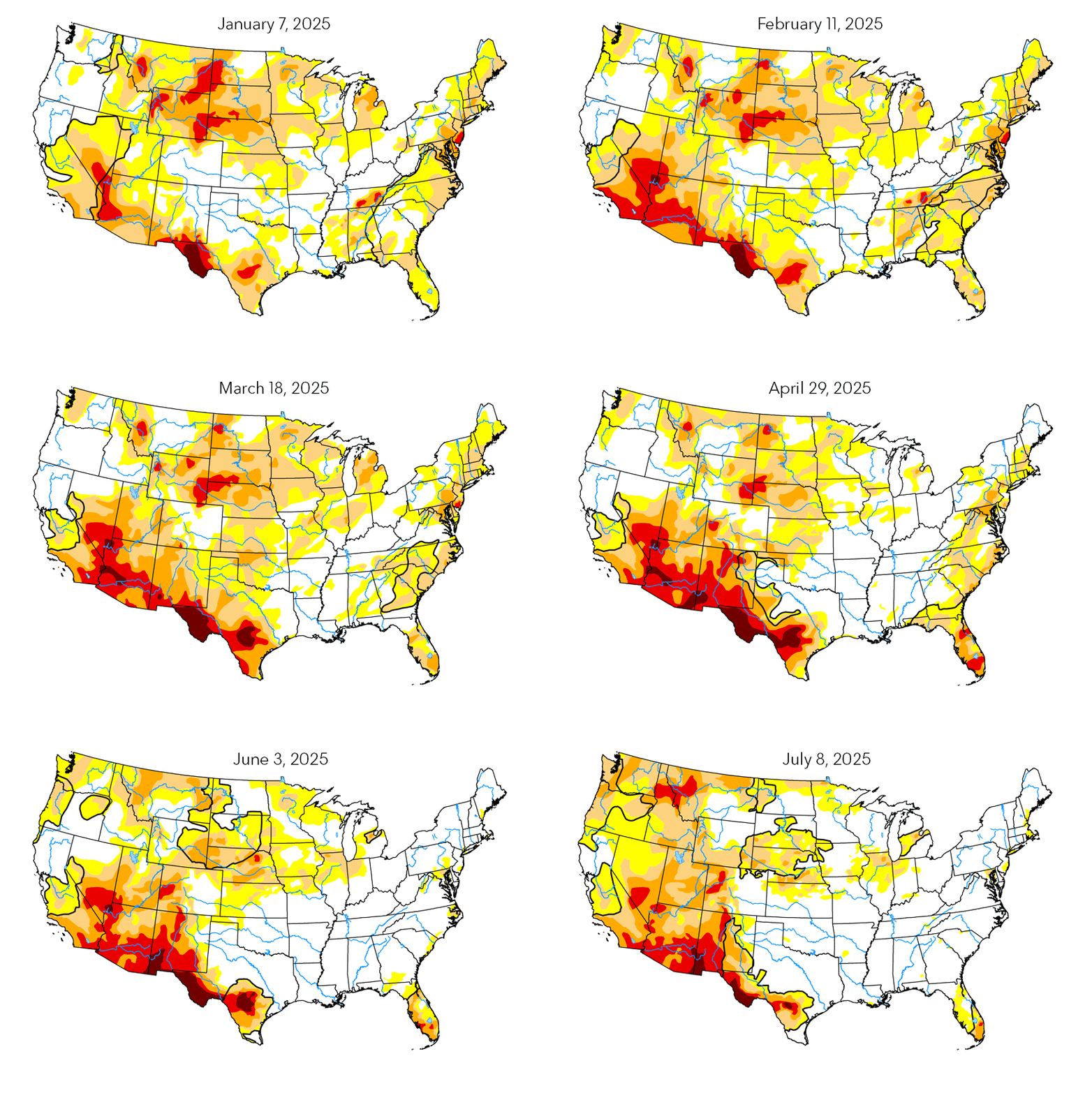
The U.S. Drought Monitor on May 27 continued to show extreme-to-exceptional drought conditions across much of North Dakota. Most of South Dakota was under moderate-to-severe drought conditions in late May, with a wide area of extreme drought across northern areas of the state.
“It’s been very dry until this last week, when we started to get some rain,” said one North Dakota contact. “It is spotty, but over the weekend pretty much everyone got something for moisture. I hope we are starting to break the dry spell.”
The dry conditions allowed growers to move quickly on planting in May, with progress tracking ahead of the five-year average for all crops. Minnesota growers had 97-98 percent of the soybeans and corn planted by May 23, compared with 83-93 percent in South Dakota and 75-84 percent in North Dakota.
The planting of small grains was virtually complete in the region, with progress estimated at 93-95 percent complete on barley, 94-100 percent on spring wheat, and 88-98 percent on oats. Sunflower planting was estimated at 18-30 percent complete in the Dakotas by that date.
Great Lakes:
Unseasonably warm temperatures were reported across much of Michigan early in the week, with highs climbing into the 80s. Those conditions helped growers progress quickly on planting in late May, although cold, wet weather moved into the state late in the week.
Similar conditions were reported in Wisconsin, with summer temperatures replaced by cold, windy, and rainy weather as the week progressed. Forecasts warned of potentially severe storms in central and northern areas of the state at midweek.
Parts of the region were actually in need of moisture after the mid-May heatwave. Most of Michigan was experiencing moderate drought, with smaller patches of severe drought showing up in southwestern areas of the state. The first cutting of hay was already underway in parts of the state in late May.
Corn planting had progressed to 88-90 percent complete in Michigan and Wisconsin by May 23, some 20-30 points ahead of the five-year averages for both states. Soybean planting was fully 82-83 percent complete in the region by that date, nearly double the 40-48 percent five-year average.
Northeast:
Temperatures soared to an unseasonably hot 80-90 degrees in parts of southern New England during the second half of May. The high heat and humidity sparked a number of strong thunderstorms, with reports of heavy rain, powerful winds, and large hail from Connecticut to Maine at midweek.
Pennsylvania, New York, and much of the Mid-Atlantic region were also hit by severe thunderstorms at midweek after a stretch of hot weather and high humidity. More than 23,000 power outages were reported in Pennsylvania on May 26, along with 22,000 in New York, more than 19,600 in Vermont, nearly 14,000 in Virginia, and more than 10,000 in Maryland.
The hot, dry weather in May allowed growers to move quickly on planting. USDA reported that Pennsylvania growers had 77 percent of the corn crop planted by May 23, well ahead of the 54 percent five-year average and last year’s 42 percent progress by that date.
U.S. Gulf:

Daylight-only transit restrictions on the Upper Mississippi River due to high water were projected to end by May 23. The restrictions were in effect from the Thebes Bridge at Mile 47 to Cape Girardeau’s Mile 51.
Bayou Sorrel Lock was reportedly closed to navigation once again due to high water, after a brief reopening during the previous week. Updated opening estimates signaled a potential return to navigation in early June. The lock was originally shut on May 11. Boats were reported detouring through Algiers Lock during the shutdown.
Port Allen Lock guidewall damage continued to necessitate towing restrictions through the site. Assist vessels were mandated on westbound tows of two barges or more, while vessels traveling to the east required an assist boat on all tows longer than 650 feet.
Heavy rain prompted an extension of high-water towing restrictions on travel above New Orleans, causing a capacity reduction of 5-10 barges per tow. The region typically allows for tows up to 25 barges.
The National Weather Service (NWS) gauge at Baton Rouge, La., returned an action-stage 32.1-foot reading on May 23. Forecasts called for levels to hold above action stage into early June. A May 23 Flood Warning issued for the Mississippi River at Red River Landing, West Feliciana, Baton Rouge, and Pointe Coupee was scheduled to end on May 25.
Harvey Lock reportedly resumed operation on the evening of May 21, ending a shutdown necessitated by repairs to the 4th Street Bridge, located near the lock. Traffic detoured through Algiers Lock during the closure, contributing to substantial delays at that site. Residual delays were noted up to 48 hours through Harvey Lock on May 25-27.
Algiers Lock delays were reported easing on May 22-23, although restrictions persisted on unassisted lockages. Length and width caps effectively limited tows to four standard barges or two 30,000 mt tankers. Lengthier tows were possible with the use of an assist vessel, however. Combined with the Bayou Sorrel Lock detour, the restrictions were noted pushing delays to 96 hours for the week.
Ongoing floodgate construction and dive activities necessitated overnight navigation closures through Bayou Chene, blocking travel nightly between 7:00 p.m. and 7:00 a.m. Transit delays were noted in the 6-12 hour range. A requirement to utilize an assist vessels on movements through the channel was also reported.
Sources reported travel delays in both the East and West Canals due to inclement weather in the Gulf.
Industrial Lock waits were quoted in a general 10-19 hour range, while sources put Bayou Boeuf Lock and Colorado Lock delays up to 13 hours for the week. Boats passing Brazos Lock experienced wait times up to 27 hours.
Mississippi River:
Burlington Railroad Bridge repairs required shippers to provide one-hour advance notice of arrival. The requirement, in place daily from 7:30 a.m. to 4:30 p.m., was projected to continue into second-half June.
Elevated water levels affected travel on the lower river, reducing barge counts between Cairo, Ill., and the Gulf by 5-10 units from the usual 25-barge maximum. Twenty-four hour navigation continued through bridges in the Memphis and Vicksburg areas, while levels holding above action stage at Baton Rouge limited overnight passages on a case-by-case basis.
The NWS gauge at Vicksburg moved below the 35-foot action stage on May 20, and was reportedly holding at 33.4 feet on May 24.
Revetment operations in progress at Randolph Bluff, located at Mile 770 on the Lower Mississippi River, blocked traffic daily from 6:00 a.m. to 6:00 p.m. Contractors were noted attempting to pass traffic in both the northbound and southbound directions on a case-by-case basis, reducing waits to 6-12 hours from 12-24 hours reported at the start of the project. Work at the site is scheduled to conclude around May 31.
A Lock 2 miter gate installation project on the books for July was expected to trigger daily 4-12 hour shutdowns. Twelve-hour navigation stops are anticipated at Lock 25 in July and August for lower guidewall repair. Navigation is expected be limited from 6:00 a.m. to 6:00 p.m. daily while work is underway.
Most Lock 14 delays were heard in the 5-10 hour range for the week, while boats passing Lock 15 saw 6-10 hour waits on May 26-27. Delays at Lock 21 were typically noted at 4-7 hours, while Lock 24 crossings ran as high as six hours for the week. Waits were reported at 4-7 hours through Lock 25.
Illinois River:
Elevated river levels kept wickets at both Peoria Lock and LaGrange Lock down through the week. As a result, vessels were able to pass both sites without locking.
Ohio River:
The primary chamber at Meldahl Lock closed on May 17 for miter gate repairs and maintenance, pushing delays to as high as 16 hours for the week. Set to run through June 29, tows will be routed through the auxiliary chamber, with lengthy delays expected. Intermittent total-lock shutdowns were also expected to be peppered throughout the project.
Fully closed since early 2020 due to structural cracks in the miter gate, the Markland Lock auxiliary chamber is scheduled to remain shut to navigation through Oct. 29, routing all traffic through the primary chamber. The secondary chamber at New Cumberland Lock is closed to traffic through June 10 for repairs.
The primary chamber at Cannelton Lock is planned to shut from June 21 through Nov. 19 for maintenance. With traffic projected to detour through the site’s smaller secondary chamber, significant delays are expected.
On the Tennessee River, Chickamauga Lock was scheduled to return from an electrical overhaul on May 25. Transit had been wholly unavailable through the site since May 3. Kentucky Lock delays were quoted in the 1-3 day range for the week.
The Cumberland River’s Cheatham Lock was noted undergoing a series of shutdowns due to bio-acoustic fish fence (BAFF) repairs. Navigation through the site is projected to be unavailable on May 17-27; June 1-10; June 14-24, June 28-July 1; and July 12-22.
Arkansas River:
A dewatering and repair operation is scheduled to shut David D. Terry Lock to navigation from Aug. 27 through Sept. 9, fully closing the river at the site. Ahead of the shutdown, intermittent outages are projected during the Aug. 16-26 period.
Gardeners can unwittingly bring toxic chemicals into their homes with fertilizers made from sewage sludge, according to Bloomberg, citing a report by the environmental group Sierra Club. The group tested nine fertilizer products from across the U.S. marketed as “eco” or “natural.’’
All nine contained levels of per- and poly-fluoroalkylsubstances, or PFAS, a class of widely used industrial chemicals that persist for decades in the environment. Eight of the products exceeded screening limits for the chemicals set by Maine, where the laws are the most robust in the U.S.
PFAS chemicals don’t break down and can accumulate in the environment and the body over time, according to the U.S. EPA. The group is calling for EPA to “act with urgency” to keep PFAS out of sewer systems, and for fertilizer companies to clearly label products that are made with sludge.
Sherritt International Corp., Toronto, on May 18 announced the appointment of Leon Binedell, a 25-year mining industry veteran, as President and CEO, effective June 1, 2021. He was most recently CFO of Guyana Goldfields Inc., a Canadian-based gold producer focused on gold deposits in Guyana.
Binedell has also worked as Finance Operating Executive with Resource Capital Funds, a private equity fund focused on the mining sector. Additional experience includes time as National Leader of Finance Consulting in Mining & Energy at PricewaterhouseCoopers LLP, General Manager of Business Services at Xstrata Nickel (now Glencore), and CFO at Koniambo Nickel SAS.
Binedell, a native of South Africa, succeeds current President and CEO David Pathe, who in November 2020 announced his intention to step down from the role in 2021. He will remain with Sherritt for a period of time to ensure an orderly transition. The company said he leaves after almost 10 successful years as Chief Executive improving every aspect of its business.
Australian co-operative CBH Group, West Perth, reported that it has begun the search for a new CEO following the resignation of CEO Jimmy Wilson, effective June 30, 2021. CBH Chair Simon Stead said after nearly four years with CBH and with much of the change he was mandated to implement now completed, Wilson decided it is the right time to move on to the next stage of his career.
Bill Erickson, a member of International Raw Materials Ltd.’s (IRM) North American Fertilizer Sales team, passed away on May 17 after a very brief respiratory illness. Erickson was based in IRM’s Spokane, Wash., office, and was highly respected by his colleagues and customers in California and the Pacific Northwest.
IRM described him as a “knowledgeable agronomist and sales professional,” who was instrumental in growing the company’s business on the U.S. West Coast. Erickson also served on the board and on various committees of the Western Plant Health Association (WPHA). He is survived by his wife, Lynn, and their four adult children.