All posts by mickeybarb@charter.net

Crops/Weather

Eastern Cornbelt:

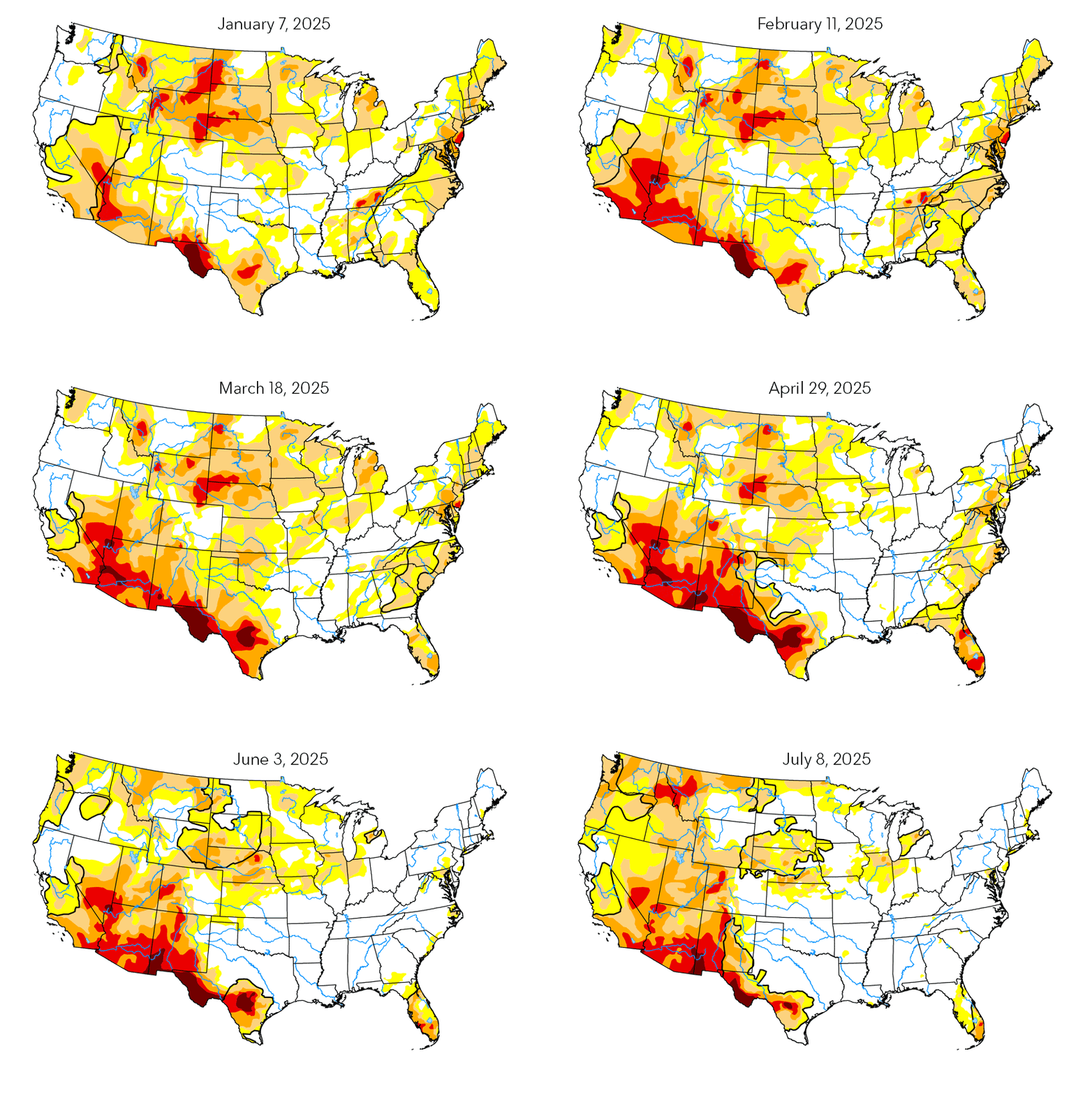
U.S. Drought Monitor

After a weekend storm that dumped up to 4-7 inches of snow on parts of Illinois and Indiana, the region was bracing for another winter storm on Feb. 4-5, with forecasts warning of several inches of snow and strong winds up to 40 mph across portions of Illinois, Indiana, and Ohio.

Much colder weather was expected to move in after the precipitation. Weekend highs were predicted to top out in the 20s, with lows predicted to fall to near or below zero and wind chills dropping to -20 or colder in some locations.

Western Cornbelt:

Blizzard conditions were reported in northern and central Iowa on Feb. 4, with winds gusting up to 45 mph and snowfall ranging from 1-3 inches across much of central Iowa and up to 3-5 inches in northeastern Iowa.

Parts of southeastern Nebraska were also under a winter weather advisory as the week progressed, with reports of 40 mph wind gusts and up to two inches of snow in some locations on Feb. 4. Frigid temperatures were expected to move in behind the precipitation, with a high of only 10 degrees and wind chills expected to drop to -25 in Des Moines on Feb. 6-7.

Missouri saw a wintry mix of precipitation as the week advanced. Up to 1-2 inches of snow accumulation was expected across areas of northern Missouri by the weekend, with low temperatures dropping to the single digits by Feb. 7.

California:

Corn, Wheat, Soybean Index

Northern California saw heavy rain in the valleys and heavy snow in the mountains during the last week of January and the first week of February.

A powerful storm on Feb. 1 brought 1-2 inches of rain and as much as two feet of snow in the Sierra, which followed an even stronger system in late January the deposited up to nine feet of snow on Mammoth Mountain and seven feet in parts of the Lake Tahoe area.

The precipitation is definitely needed in the state. Electronic snow surveys in early February showed a statewide snowpack water level equivalent to 12. 5 inches, which is roughly 70 percent of average and only 45 percent of the April 1 average.

Strong Santa Ana winds were reported in Southern California late in the week, with temperatures hovering in the upper-60s and low-70s. “With the weather warming up next week, we are expecting to see some strong almond bloom by the week of the 22nd,said one regional contact.

Pacific Northwest:

While coastal areas of the Pacific Northwest experienced rain and chilly temperatures in early February, many inland foothills and mountains were hit with heavy snow.

Forecasts warned of 8-16 inches of snow in Oregon and Washington during the week at elevations above 2,000 feet, with mostly rain and only a dusting of snow reported in the Willamette Valley.

Heavy snow was also reported in northern Idaho, while southern areas of the state were hit with windy conditions and only light snowfall. Much of western Montana was blanketed with up to six inches of snow in the valleys and a foot in the mountains at midweek, and forecasts warned of subzero lows by the weekend across northern and central Montana.

Western Canada:

Weather extremes were reported across Western Canada as the week progressed. On Monday, highs in southern Alberta reached the upper single digits and low double digits in some locations, but snowstorms at midweek dropped 50-70 cm of snow in the Canadian Rockies.

Snowfall was also reported in southern Manitoba, with 5-7 cm blanketing Winnipeg and Brandon at midweek. The snow was accompanied by 60 kmh wind gusts, followed by much colder temperatures.

Weekend highs across southern Saskatchewan were predicted to stay below -18 C, with some locations expecting lows down to -30 C. Forecasts warned of frigid temperatures across the Prairies during the second week of February.

Transportation

U.S. Gulf:

Handysize Shipping Index

A sunken barge reported at Mile 236 in the West Canal on Jan. 30 resulted in alternating one-way travel restrictions through the site, sources said. Salvage operations scheduled to kick off on Feb. 1 were projected to close the area to navigation until the clearance operation is completed. Delays were noted in the 15-69 hour range for the week.

Sources reported continued towing restrictions at Port Allen Lock after a barge collided with the site’s guidewall in January, damaging the structure. Tows traveling in the westbound direction with more than one barge were required to use an assist vessel, while vessels locking without assistance were capped at one barge per turn. Eastbound vessels longer than 650 feet were required to lock with an assist vessel. Sources reported intermittent delays in the 6-19 hour range.

Length restrictions were also ongoing through Algiers Lock, with tows greater than 60 feet in width limited to 600-foot lengths. Vessels with widths under 60 feet were permitted 700-foot tows. The restrictions effectively limited lockages to four dry barges or two 30,000 mt tankers per tow. Dolphin repair scheduled for Feb. 22 will close the lock from 7:00 a.m. to 6:00 p.m., sources said.

Repairs in progress at the Rigolets Bridge in the East Canal were reported limiting access to the Pearl River to three openings per day. Vessels were permitted to pass the 1930s-era structure daily at 5:30 a.m., 1:30 p.m., and 9:30 p.m. through March 12.

Shippers reported mostly good daytime travel conditions for the week, although seasonal fog-related slowdowns continued to play a factor in overnight travel.

Bayou Sorrel Lock waits were noted up to five hours, while Industrial Lock delays were typically clocked at six hours or less. Boats transiting Bayou Boeuf Lock reported 4-7 hour delays on Feb. 2, and Colorado Lock passages ran in the 5-7 hour range. Shippers reported sporadic Brazos Lock delays as high as 16 hours during the week.

Mississippi River:

Sources noted revetment operations underway at Mile 306 limiting southbound travel during daytime hours. Northbound travel was permitted on a case-by-case basis.

Auxiliary chamber maintenance at Lock 27 concluded on Jan. 29, briefly normalizing movement through the site ahead of a planned Feb. 1-18 primary chamber closure. Although substantial delays have been predicted as the project continues, waits were noted topping out below 12 hours for the week.

Upper Mississippi River travel is unavailable for the winter navigation season. Upper river locks are set to resume operation as early as March 15, starting with Locks 13-19, while Lock 25 could begin spring lockages as soon as March 31, weather permitting.

Illinois River:

Lake Peoria ice coverage was reported up to three inches thick on the upper pool, prompting strong recommendations for the use of ice couplings through the early week. Extreme temperatures in the forecast for the entirety of the Illinois Waterway were projected to trigger new ice coupling requirements at all locks, with the exception of Brandon Road Lock. The updated requirements were projected to kick in on Feb. 6.

Demolition of the Utica Bridge at Mile 229.6 on the Illinois River remains on track for Feb. 11, sources noted. Transit through the area is likely to be interrupted for at least 24 hours due to the event. The project has been continually delayed from its original December schedule.

Wickets remained in the raised position at Peoria Lock and LaGrange Lock due to reduced water levels, triggering delays of up to six hours at both sites. Six-hour delays were also quoted on Marseilles Lock travel.

Ohio River:

The auxiliary chamber at Markland Lock is shut through Oct. 29 due to structural damage to the chamber’s miter gate, sources said. The chamber was offline for the majority of 2020, although tows have been able to pass through the lock’s primary chamber.

The Meldahl Lock main chamber is set to close to navigation on Feb. 1-11 for fill valve repairs, sources said. The chamber will shut again on April 12 through June 11 to conduct miter gate machinery repairs. Delays are expected during both closures.

Smithland Lock is scheduled to undergo consecutive shutdowns of the site’s two secondary lock chambers for maintenance and repairs. The work is slated to run from Feb. 1 through approximately April 1, during which navigation will continue through the main chamber. Sources are anticipating minimal delays.

The secondary chamber at New Cumberland Lock is scheduled to go offline on March 8 through June 10. Passage is anticipated to remain available through the primary chamber, limiting delays.

Greenup Lock is scheduled to shut its main chamber on Feb. 11 through March 11 for miter gate machinery repairs, pushed forward from the previous May 10-June 11 schedule. Transit will remain available via the smaller secondary chamber, with lengthy delays expected, although sources warned of intermittent full-lock shutdowns as well. Following the main chamber project, the site’s auxiliary chamber will close on March 11 through April 11, with traffic continuing to pass through the primary chamber.

Navigation will be unavailable through the Cannelton Lock primary chamber on June 21 through Nov. 19, triggering delay predictions. Increased flows prompted Olmsted Lock operators to lower wickets during the week, sources noted, allowing tows to pass the site via the non-locking navigational pass.

On the Tennessee River, Watts Bar Lock saw intermittent four-hour shutdowns daily through Feb. 4. Sporadic Kentucky Lock delays were also noted at 4-9 hours for the week, sources said.

The Cumberland River’s Cheatham Lock will see a main chamber closure on April 12 through June 21. The Corps will open the site to pass waiting vessels four times during the shutdown, remaining open three days on each occasion. The opening windows remained unscheduled on Feb. 3, sources said.

Arkansas River:

Norrell Lock, located at Mile 10 on the Arkansas River, closed to navigation at 6:00 a.m. on Feb. 2 for repair operations, effectively blocking tows from entering and exiting the river. Movements were scheduled to resume at 6:00 p.m. on Feb. 6.

AdvanSix Acquires CIS Assets, Boosts Granular Production, Touts AS Soy Benefits

AdvanSix, Parsippany, N.J., reported three initiatives with respect to ammonium sulfate, including the purchase of certain assets of Commonwealth Industrial Services Inc. (CIS), Hopewell, Va., an ammonium sulfate packaging, warehousing, and logistics services business, as well as selected industrial services businesses, including truck scales.

In addition, the company is targeting the production of 65 percent of its AS as granular, up 5 percent. It is also working to educate growers and retailers on how sulfur can boost soybean production.

“AdvanSix has been both a supplier to and customer of CIS for many years, and we understand the business well,” said Mike Hamilton, AdvanSix Vice President, Plant Nutrients. “This acquisition extends our industry-leading value chain for ammonium sulfate and creates further opportunities for us to quickly diversify and optimize our offerings to serve existing and new customers.”

AdvanSix said the CIS acquisition enables it to expand its offerings to directly supply packaged ammonium sulfate to customers, primarily in North and South America. It said it diversifies and optimizes offerings into stable agricultural and industrial uses to include spray-grade adjuvant to support crop protection, as well as other specialty fertilizers and products for industrial use. It also includes the opportunity to upgrade standard grade material to other applications and end uses that are generally of higher value. The company also expects the addition of packaging and warehousing capabilities to bolster logistics and operational efficiency in the Richmond, Va.-area plants.

AdvanSix said the CIS carve-out includes associated employees who will be integrated into the AdvanSix plant nutrients business.

As a result of recent operational excellence initiatives and enhancements in crystallizer technology and operations, AdvanSix said it is now producing more high-quality granular grade ammonium sulfate to meet the growing demand.

“AdvanSix is a leader in plant nutrients, producing top-quality ammonium sulfate at our Hopewell facility – which is the largest single-site producer in the world – for nearly 70 years,” said Erin Kane, AdvanSix President and CEO. “We continue to see increased demand for sulfur nutrition, and ammonium sulfate is proven to deliver pound-for-pound the most readily available sulfur and nitrogen to a wide variety of crops, including wheat, cotton, corn and soybeans.

“We remain committed to our growth in this area and to advancing grower education and research that validates the return on investment and effectiveness of ammonium sulfate to support the success of our customers,” Kane continued.

The company said modern soybean varieties require better management of essential nutrients, such as nitrogen and sulfur, throughout the planting season to maximize and enhance their yield potential.

AdvanSix said lab and field trials conducted by university researchers show the benefits of ammonium sulfate, which adds sulfur and supplemental nitrogen for soybeans and could mean a yield increase of as much as 10 or more bushels per acre. The company noted that soybean prices are currently at a seven-year high and season-ending stocks are projected to be down over 70 percent from the previous year.

Nutrien Expanding Use of Monitoring Device for COVID-19 Protection

Nutrien Ltd., Saskatoon, said on Jan. 26 it is expanding the use of monitoring and contact tracing technology Proximity Trace™ from Triax Technologies, Norwalk, Conn., which it said has emerged as an important tool to help track and combat the spread of COVID-19. More than 8,000 employees are using the technology to date, with an additional 6,500 expected to be part of the expansion in the coming months, representing 65 percent of Nutrien’s global employee base.

To help mitigate the spread of the virus, Nutrien partnered with Triax to help its workers maintain a minimum of six feet of physical distancing and automatically capture data about their interactions with coworkers, as part of its COVID-19 protocols.

Originally deployed last July at Nutrien’s nitrogen and phosphate sites in the U.S., Proximity Trace is now being rolled out at Nutrien’s potash mines in Saskatchewan and at corporate offices in Alberta, Colorado, Illinois, and Saskatoon.

“In the early days of the pandemic, global health authorities called upon the private sector to step up and do our part to help flatten the curve and slow the spread of COVID-19,” said Nutrien EVP & Chief Information Officer Brent Poohkay. “Nutrien developed a playbook that articulates a strategy and a plan for handling the virus, and the Triax system has been valuable in keeping our essential workers safe to help ensure a health crisis doesn’t become a food crisis. Now we are expanding the playbook as we redefine the future of work with safety and integrity at the forefront.”

Proximity Trace tags are attached to workers’ clothing or hard hats and produce an audio and visual alert to those who come within six feet of one another. These wearable sensors also automatically log data for leaders to quickly perform contact tracing if a positive case arises, thereby preventing further spread at the site and reassuring those who are not at risk. Since it pinpoints the individuals who may have been exposed, the solution also helps Nutrien minimize operational shutdowns and reduces the risk of associated costs and product delivery delays.

“At the workplace, if you maintain proper physical distancing, then your risk of spreading the virus is very low,” said Dr. Tarek Sardana, one of the medical experts who has been advising Nutrien’s executive leadership team regarding COVID-19 responses and protocols. “I encourage people to think of themselves as if they’re living within six-foot bubbles, and if no one penetrates the bubbles, it’s harder for the virus to spread.”

Since the implementation of the Triax technology, Nutrien said it has been able to safely support as many as 1,700 employees and contractors at a time at its Nitrogen and Phosphate sites. The physical distancing alerts have reduced the number of close contacts, positive cases and quarantines. Additionally, it said the automated data system has improved the efficiency and accuracy of contact tracing.

Nutrien said as it explores how to safely return more employees who have been working remotely to the workplace, the Triax technology will support additional prevention and protection across Nutrien’s North American footprint.

Biden Administration Highlights Climate Goals; Seeks Input on Climate-Friendly Ag Practices

The Biden Administration on Jan. 27 released a detailed fact sheet highlighting numerous steps it plans to take as part of an executive action to tackle climate change. Among these are the pausing of new oil and natural gas leases on public lands and offshore waters; the elimination of fossil fuel subsidies; significantly increasing land conservation acres in the U.S.; and the adoption of “climate-smart agricultural practices” that produce verifiable carbon reductions.

“These Executive Orders follow through on President Biden’s promise to take aggressive action to tackle climate change and build on the executive actions that the President took on his first day in office, including rejoining the Paris Agreement and immediate review of harmful rollbacks of standards that protect our air, water, and communities,” the White House said.

The administration said its “ambitious goals” are intended to achieve a carbon pollution-free power sector by 2035 and a “net-zero” emissions economy in the U.S. by 2050, while identifying climate considerations as “an essential element of U.S. foreign policy and national security.”

The order directs the Secretary of Agriculture to collect input from farmers, ranchers, and other stakeholders on how to use federal programs to encourage adoption of climate-smart agricultural practices that the administration promises will create new sources of income and jobs for rural Americans.

The order also commits to the “goal of conserving at least 30 percent of our lands and oceans by 2030, and launches a process for stakeholder engagement from agricultural and forest landowners, fishermen, Tribes, States, Territories, local officials, and others to identify strategies that will result in broad participation,” the White House said.

The order further directs the Secretary of the Interior to “pause on entering into new oil and natural gas leases on public lands or offshore waters to the extent possible,” and directs federal agencies to eliminate fossil fuel subsidies while identifying opportunities to “spur innovation, commercialization, and deployment of clean energy technologies and infrastructure.”

The order also formally establishes a Civilian Climate Corps Initiative; an Interagency Working Group on Coal and Power Plant Communities; a National Climate Task Force with representation across 21 federal agencies and departments; and a White House Office of Domestic Climate Policy, which will be led by the first-ever National Climate Advisor and Deputy National Climate Advisor.

Biden also promised to sign an Executive Order re-establishing the President’s Council of Advisors on Science and Technology, as well as a Presidential Memorandum on Scientific Integrity and Evidence-Based Policymaking, which the administration said will “protect scientists from political interference” so they can “make evidence-based decisions guided by the best available science and data.”

CHS Inc. – Management Brief

CHS Inc., St. Paul, on Jan. 25 announced that it has named Brandon Smith as Executive Vice President and General Counsel. He will be a member of the CHS strategic leadership team and will report to CHS President and CEO Jay Debertin.

Smith will join CHS in late March 2021 and succeeds James Zappa, who has been EVP and General Counsel since 2015. Zappa will be assuming another leadership role in the company.

CHS said Smith brings more than 15 years of experience, most recently as Senior Vice President, General Counsel, and Corporate Secretary at Tenneco Inc., a multinational industrial company based in Lake Forest, Ill. Previously, he was an attorney with Kirkland & Ellis LLP in Chicago, Ill.

Smith earned a juris doctor degree from Cornell Law School, Ithaca, N.Y., and a bachelor’s degree from Hiram College, Hiram, Ohio.

Obituary

Charles Richard “Chuck” Locker, 87, passed away on Jan. 16 at his home in Owasso, Okla. He was a long-time fertilizer industry veteran, having completed his career as a consultant for Ben-Trei Ltd., Tulsa. He began his career as a laboratory chemist before working his way up to Purchasing Agent, then Product Manager with Agrico. He attended college at John Carroll University, Kent State University, and Memphis State University, and served in the U.S. Army.

Locker was preceded in death by his wife, Phyllis, and is survived by five children, three grandchildren, two sisters, and a brother. In lieu of flowers, donations may be made to the American Kidney Fund at https://www.kidneyfund.org.