

Southern Plains:
Intrepid’s latest post-fill Trio postings FOB Carlsbad included $290/st for standard; $320/st for granular; $330/st for premium; $365/st for OMRI standard and fine standard; and $395/st for OMRI granular.
Southern Plains:
Intrepid’s latest post-fill Trio postings FOB Carlsbad included $290/st for standard; $320/st for granular; $330/st for premium; $365/st for OMRI standard and fine standard; and $395/st for OMRI granular.
Eastern Cornbelt:
Potassium thiosulfate pricing in the Eastern Cornbelt remained at $730/st FOB Terre Haute for the last confirmed offers.
Eastern Cornbelt:
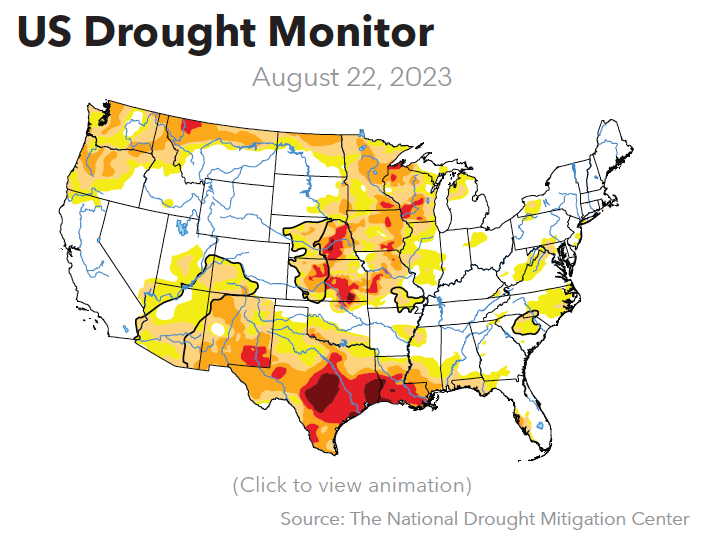
Much of the Eastern Cornbelt enjoyed beautiful weather during the last week of August, with temperatures down from recent highs in the 90s and triple digits. Another blast of heat was expected over the Labor Day weekend, however.
Good or excellent ratings were assigned to 76-79% of Ohio’s corn and soybeans on Aug. 27, compared with 67-70% in Indiana, 67-68% in Illinois, and 43-50% in Michigan.
Western Cornbelt:
Pleasant temperatures were reported across much of the Western Cornbelt during the week, but hot weather was once again in the weekend forecast, with highs expected in the 90s and heat indices rising to the low triple digits by Labor Day.
Drought conditions expanded in the region in late August, with extreme-to-exceptional drought now covering portions of northeastern and southeastern Iowa, eastern Nebraska, and western Missouri. The Des Moines Register reported on Aug. 31 that drought conditions across Iowa are the worst they’ve been since March 2013.
With 6-16% of the regional corn crop mature, USDA on Aug. 27 assigned good or excellent ratings to 54-55% of the crop in Iowa and Nebraska and 41% in Missouri. Some 49-53% of the regional soybean crop also fell in the good or excellent categories, along with 75% of Missouri’s cotton, 64% of Nebraska’s sorghum crop, and fully 81% of Missouri’s rice.
Southern Plains:

Dry, hot conditions were reported across much of the Southern Plains during the last days of August, with temperatures climbing to the mid-90s in Kansas, Oklahoma, and Texas. Gusty winds prompted a fire weather watch in northern Kansas late in the week.
Drought conditions expanded across Kansas, Texas, and New Mexico in late August, with large areas of extreme-to-exceptional drought reported in eastern Texas, southeastern New Mexico, and central Kansas.
The drought has impacted the regional cotton crop significantly, with just 12-14% of the acreage in Texas and Oklahoma rated as good or excellent, compared with 44% in Kansas. Fully 67-75% of the cotton in Texas and Oklahoma fell in the poor or very poor categories in late August.
Texas growers had 63% of the sorghum harvested by Aug. 27, with 45% of the crop rated as good or excellent, compared with 37% in Kansas, 56% in Oklahoma, and 80% in Colorado. The Kansas soybean crop was 37% good or excellent, while cotton in those two categories totaled 70% of Colorado’s crops, 49% in Texas, and 35% in Kansas.
South Central:
Slightly cooler temperatures were reported across the South Central region during the week, with parts of southern Mississippi picking up heavy rain from Hurricane Idalia.
Midweek highs in Kentucky topped out in the upper-70s with lows falling to the 50s across Kentucky and Tennessee. Hot weather was expected to return by Labor Day weekend, however, with highs reaching the mid- to upper-80s.
Highs in Louisiana on Aug. 27 included 109 degrees in Lake Charles and 110 degrees in Lafayette before dropping to the upper-90s for the balance of the week. Parts of southern Mississippi were hit with 2-4 inches of rain from Idalia, though high winds were not a factor in the state.
USDA rated 29-32% of the corn crop in Kentucky and Tennessee as mature and 71-75% of the acreage as good or excellent on Aug. 27. Soybeans in the good or excellent categories totaled 77% of the crop in Tennessee, 72% in Kentucky, 69% in Arkansas and Mississippi, and 56% in Louisiana.
Fully 80% of Tennessee’s cotton was rated as good or excellent in late August, compared with 68-70% in Arkansas and Louisiana and 55% in Mississippi. The rice harvest as of Aug. 27 was 81% complete in Louisiana, 70% in Texas, 15% in Mississippi, and 11% in Arkansas, with good or excellent ratings assigned to 78% of the crop in Arkansas, 63% in Texas, 60% in Mississippi, and 52% in Louisiana.
Southeast:
Hurricane Idalia caused extensive damage on Florida’s west coast before unleashing torrential rain in Georgia and the Carolinas.
Idalia’s landfall on Aug. 30 inundated Florida’s Big Bend region with a storm surge up to 16 feet and 120 mph winds, while southern coastal areas of the state were hit with heavy rain as the storm churned through the Gulf on Aug. 29-30. As Idalia moved inland, up to 10 inches of rain fell in eastern Georgia and South Carlina, with 4-6 inches reported in central North Carolina.
The storm caused significant structural damage and widespread flooding, but sources in the Carolinas said the heavy rainfall was probably a good thing for most crops after weeks of drought.
Good or excellent ratings were assigned on Aug. 27 to 56% of North Carolina’s soybeans and 74% of the state’s corn, with 68% of the corn crop rated as mature. Cotton in the good or excellent categories totaled 48% of the acreage in North Carolina, 66% in Georgia, 69% in South Carolina, 74% in Alabama, and 88% in Virginia.
Florida’s peanut crop was 59% good or excellent in late August, compared with 60% in Georgia and North Carolina, 61% in Alabama, 89% in Virginia, and 90% in South Carolina.
US Gulf:
Leland Bowman Lock operators instituted two-hour wait times between lockages during the week due to extremely low water levels, resulting in delays up to 52 hours. Thirty-five vessels were queued to lock on Aug. 31, according to Corps data.
Harvey Lock remained shut due to reverse head conditions. Repairs to the BNSF railroad bridge in Morgan City, La., were projected to kick off early in September. Algiers Lock is expected to close for 45-60 days for side gate repairs, beginning on Oct. 1. Algiers saw intermittent nine-hour waits during the week.
Ongoing guidewall repairs at Bayou Sorrel Lock limited navigation between 7:00 a.m. and 4:00 p.m. daily, triggering waits up to six hours. The project is scheduled to continue into March 2024.
Slow-travel warnings were in effect at Bayou Chene due to dredging, which is scheduled to continue through Nov. 30. Daytime closures at Brazos Lock ran from 7:00 a.m. to 7:00 p.m. daily, prompting intermittent waits up to 23 hours. A mechanical malfunction on Aug. 29 forced an emergency shutdown at Colorado Lock, resulting in delays of up to seven hours. Service resumed later the same day.
Persistent delays in the Panama Canal stretched delivery windows in the US Gulf, sources said. Larger vessels were reportedly delayed by several days, while smaller cargoes were slowed by two weeks or more.
Industrial Lock delays were noted in a wide 5-22 hour range.
Mississippi River:
Maximum loading drafts were reduced by 15% on travel through the St. Louis area due to low water levels. Draft reductions between Cairo, Ill., and St. Louis improved slightly, to 15% from 20% reported last week.
On the lower river, drafts were cut by 20% on northbound movements between the Gulf and Cairo, while tows traveling downriver were reduced by 15-20%. Maximum tow sizes were also down 10-15% on lower river travel, depending on horsepower. Delivery delays ran up to 24-48 hours as a result.
The St. Louis river gauge was reported at (-)2.04 feet and falling on Aug. 31. Forecasts showed the gauge holding at a negative reading through at least Sept. 14. The gauge at Memphis fell to (-)3.55 feet on Aug. 31 and was projected to slip to a low-stage (-)6.00 feet on Sept. 14.
Dredging continued at Mile 540, where sources noted rolling 24-hour shutdowns and delays stretching to 24-36 hours. Dredging reported at Mile 653 did not impact navigation during the week. Repairs and maintenance at Old River Lock were scheduled to continue through Sept. 15, with delays reported in the 4-6 hour range.
The upper river’s planned shutdown for the winter navigation season is tentatively scheduled to run from Dec. 5 through March 5, 2024. In advance of the closures, final loadings from NOLA for barges destined north of Clinton, Iowa, are expected in the first week of October. Tons heading below Clinton will continue loading through the third week of October. Locks 18-27 are currently projected to remain open throughout the winter.
Illinois River:
Loading drafts were reduced by 15% for vessels transiting the Illinois Waterway, sources said, below the 5% level reported in mid-August. Wickets remained in the raised position at Peoria and LaGrange Locks due to low river levels.
Repair and maintenance work continued at Brandon Road Lock, Dresden Island Lock, and Marseilles Lock, shutting the river to commercial travel. The project is reportedly on track to conclude as scheduled on Sept. 30.
Ohio River:
Loading drafts were restricted to 10.0-10.5 feet on the Ohio River due to low water levels. On the Monongahela River, severely reduced flows held drafts to 8.5 feet.
The John T. Myers Lock auxiliary chamber is offline through Sept. 10 for miter gate repairs, with minimal delays reported. The primary chamber will be closed from Sept. 11 through Nov. 17, forcing detours through the auxiliary chamber. Repairs at Olmsted Lock, planned through Sept. 24, triggered delays up to seven hours during the week.
Alternating main and auxiliary chamber shutdowns are scheduled to begin on Sept. 2 at Montgomery Lock. Auxiliary chamber travel will be unavailable on Sept. 2-5, Sept. 25-Oct. 17, and Nov. 22-26, while the main chamber will close on Sept. 5-25, Oct. 17-Nov. 22, and Nov. 26-Dec. 22.
The Smithland Lock land chamber is due to shut from Sept. 22 through Oct. 21 for repairs and maintenance, followed by a river chamber outage running from Oct. 22 through Nov. 20. Tows were required to use an assist boat on southbound lockages during the week due to strong outflows.
Arkansas River:
Daytime-only navigation remained in place at the Port of Catoosa, sources noted. Webbers Falls Lock will close to navigation on Sept. 11-17 for repairs, while Joe Hardin Lock travel will be unavailable on Sept. 11-15 due to repairs and maintenance.
The Australian Competition and Consumer Commission (ACCC) on Aug. 21 announced that fertilizer suppliers have agreed to amend their contracts after an ACCC investigation into unfair contract terms.
“We initiated an investigation after receiving complaints that fertilizer suppliers were using contracts in a way that could disadvantage farmers,” ACCC Deputy Chair Mick Keogh said. The ACCC said it obtained copies of standard form fertilizer supply agreements and identified potentially unfair contract terms in those agreements.
ACCC said all fertilizer suppliers that it engaged with during its investigation cooperated and changed the contract terms to address the ACCC’s concerns.
ACCC said a term in a standard form contract may be unfair where it creates a significant imbalance in the parties’ rights and obligations under the contract, is not reasonably necessary to protect a party’s legitimate business interests, or is likely to cause financial or other harm to the other party if enforced.
Some of the potentially unfair terms identified by the ACCC included terms giving the supplier the right to unilaterally vary the quantity to be delivered to the buyer or to terminate the agreement if the supplier believed it would not be able to supply the goods. Some terms restricted buyers’ rights to raise issues about defects with the goods.
Under the new unfair contract term laws that come into effect on Nov. 10, 2023, the ACCC will be able to take court action to seek pecuniary penalties for breaches of the law. The maximum penalty will be the greater of $50 million or three times the value of the benefit derived, or, if that value cannot be determined, 30% of the company’s turnover during the period it engaged in the conduct.
“This is an important reminder to all businesses in the agricultural sector of the need to review their standard form small business contracts and remove unfair contract terms now, or they risk significant penalties when the new laws take effect,” Keogh said. The new unfair contract terms provisions will also expand the definition of a “small business” to include businesses with up to 100 employees or up to $10 million in annual turnover.
“We will continue to monitor traders in the fertilizer industry and, more broadly, across the agricultural sector, and we will investigate if we have concerns with contract terms,” Keogh added. “If a small business thinks an unfair contract term is being included or enforced in their agreement, we recommend they obtain independent legal advice to understand the options available to them.”
An ACCC spokesperson told Green Market the investigation was an industry-wide compliance exercise, so it would not be naming individual traders. It said it does not comment on the specifics of its investigations or potential investigations.
An ammonia tank explosion around 2:30 p.m. Aug. 23 at the Three Rivers FS location in Manchester, Iowa, was caused by excessive heat, according to the Telegraph Herald, citing Manchester City Manager Tim Vick. The explosion caused at least one other tank to tip over and leak, according to local reports. Early reports stated that two tanks tipped over.
While no injuries were initially reported, six people were eventually treated at Manchester’s hospital and one was admitted, according to Radio Iowa citing Delaware County Emergency Management. Nearby residents were asked to shelter in place for about an hour while the threat was being assessed.
Much of Iowa was under an excessive heat warning during the week. Several daily temperature records were set, including 100 degrees in Des Moines on Aug. 23, 101 in Sioux City on Aug. 22, and 98 in Waterloo on Aug. 22.
Founded in 1930, Three Rivers FS is based in Dyersville and has nine locations in northeast Iowa. The cooperative had not responded to inquiries at press time.
An American Plant Food Corp. (APF) fertilizer blending facility at Bartlett, Texas, north of Austin, was destroyed by a fire that started on Aug. 20 around 8:30 p.m. The fire lasted well into the night with firefighters opting to let the fire burn out.
APF Technical Director Dr. Larry Unruh told Green Markets the goal was to keep the fire contained so it would not spread to the town or local corn fields in this drought-stricken area. The fire did spark a six-acre grass fire behind the facility, which was contained early on Aug. 21.
APF said there were no injuries to employees or firefighters and confirmed that there were no flammable or explosive fertilizers stored at the facility. Local firefighters said they had visited the site in the past and were prepared. APF said that in a situation like this, employee and community safety are the company’s top priorities.
Initially residents were encouraged to stay indoors as much as possible on Aug. 21, but the Texas Commission on Environmental Quality monitored the air and said it was safe. Local schools were allowed to be in session.
Unruh said the cause of the fire is under investigation and it is too early to assess the monetary damage. Luckily, he said it was the end of the fertilizer season and the inventory level at the plant was only 10-20%. He expects it will take about a month to clean up the site.
He said there will be salvage fertilizer from the site and it will be made available to local farmers at reduced prices. In the meantime, he said APF will make sure local needs are met, providing fertilizer from its other locations at discounted freight. He expects the company will find a place for the location’s three employees.
Founded in 1964, APF has served the greater Bartlett community for almost five decades. The company has ten additional locations in Texas.
The US EPA, the US Department of Justice (DOJ), and the Mississippi Department of Environmental Quality (MDEQ) on Aug. 22 announced a proposal to enter into a Bona Fide Prospective Purchaser Agreement with Seven Seas Terminals LLC for the purchase of the former plant portion of the Mississippi Phosphates Corp. (MPC) Superfund Site in Pascagoula, Miss.
Seven Seas, which is based in Gulfport, Fla., and was incorporated in October 2022, plans to purchase and redevelop the former MPC manufacturing plant area at 601 Industrial Road in Pascagoula as a dry bulk storage and tank terminal operation. The demolition and construction work will require several years and is anticipated to create 25-30 jobs when complete.
Under the agreement, which is subject to a 30-day public comment period ending on Sept. 20, 2023, Seven Seas will conduct a Removal Action under EPA oversight that includes demolition of the sulfuric acid plants; demolition and/or reuse of the phosphoric acid plant, diammonium phosphate (DAP) plant, and two bulk storage warehouses; installation of an impermeable cap as a containment control for the area proposed as a tank terminal operation; sampling of soils under demolished structures and slabs; removal, treatment, or containment of contaminated soils outside of the capped area; and payment of EPA’s oversight costs.
Seven Seas will also allow the EPA continuing access to the water treatment plant, laboratory, shops, and other buildings/equipment at the plant to support EPA response actions on other portions of the site. The agreement will provide Seven Seas with legal protections against Superfund liability for legacy contamination at the site.
MPC manufactured DAP fertilizers at its Pascagoula facility from the late 1950s until it filed for bankruptcy in October 2014 (GM Nov. 3, 2014). As a result of former phosphate ore processing operations, including phosphoric and sulfuric acid plants, the soil at the site is contaminated, primarily by heavy metals, radium-226, and low pH.
Groundwater beneath the former plant contains elevated metals concentrations and low pH, generally located in the central portion of the property. The EPA placed the site on the Superfund National Priorities List in January 2018 and is overseeing the ongoing cleanup of the site.
The federal register notice and instructions for submitting public comments are posted at www.federalregister.gov/documents/2023/08/21/2023-17943/mississippi-phosphates-corp-superfund-site-pascagoula-mississippi-notice-of-proposed-settlement.
Low water levels have led local authorities to restrict travel through the Panama Canal, forcing ships to reduce drafts since late May and causing a backup of vessels waiting to transit the waterway, Bloomberg reported.
The canal is one of the world’s most important trade arteries, providing a shortcut between the Atlantic and Pacific oceans. Heat and drought have caused water levels to fall to a seven-year low at Lake Gatun, the largest of two lakes that supply water to the canal. Panama’s rainy season extends from May to December, but the canal region is enduring one of its driest years on record.
Vessels have been waiting almost four days on average, with some reportedly delayed as much as 20 days, when typical travel through the site takes little more than a day, according to Clarkson Research Service, a unit of the world’s largest shipbroker. More than 120 ships were waiting to enter the canal this week, up from 90 normally, and as many as 160 ships were in the queue earlier this month, the Washington Post reported.
The Panama Canal Authority has cut the depth limit for large vessels from 50 feet to 43.5 feet and has reduced the number of booking slots for the biggest ships, Bloomberg reported. The restrictions mean that fewer tons are transiting the canal, which moves more than a half billion tons of cargo annually and serves as a vital route for Latin American commodities, including crops and fertilizer.
“There is very little slack, if anything at all, in terms of transiting more ships than right now,” said Peter Sand, Chief Analyst at Xeneta, which analyzes ocean and air freight markets. This has forced some shippers to seek alternate routes, Sand told Bloomberg, including the use of inland railways to offload goods shipped by container to the US West Coast, and to transfer them across the country.
About 40% of containers shipped from Asia to Europe also pass through the canal, according to Container xChange, a container logistics platform. This means the impact of sharply curtailed traffic through the canal could reach far beyond North America, Container xChange CEO and Co-Founder Christian Roeloffs told Bloomberg.
There isn’t much rerouting of dry-bulk cargoes yet, but that could become more of an issue if the dryness persists beyond September, when US corn and soybean exports pick up after harvest, said Bilal Muftuoglu, Director of Dry-Bulk Research at shipbroker Howe Robinson Partners. Given the congestion at the canal, fewer shipowners are willing to charter for the US Gulf to East Asia route, he said.
The Panama Canal restrictions have also pushed Atlantic freight rates higher for ships hauling refined fuel like gasoline and diesel, as well as liquefied petroleum gas, in part because container ships are being prioritized over other types of vessel when passing through the canal, Bloomberg reported.
With Panama’s rainy season ending in December and a developing and powerful El Niño underway, shippers are already preparing for further restrictions next spring.
The Tessenderlo Group’s Agro segment reported a 64.2% drop in adjusted EBITDA for the first half ending June 30, 2023, to €43.5 million from the year-ago €121.6 million. Agro revenues declined 18.8%, to €443.5 million from €546 million.
The company said adjusted EBITDA was down for Crop Vitality, Tessenderlo Kerley International, and Violleau on lower sales volumes, while margins were under pressure following lower selling prices in combination with higher-valued stock. Adjusted EBITDA for NovaSource increased thanks to the contribution of the Lannate® product line acquired in second-half 2022.
The company reported that Violleau’s new organic fertilizer plant in Aisne, France, started up its new production line in July. Construction on new plants in Defiance, Ohio, and Geleen, the Netherlands, remain on schedule.
Defiance will produce liquid and sulfur-based fertilizers Thio-Sul®, KTS®, and K-Row 23®, as well as sulfite chemicals for industrial markets. Defiance is scheduled to start operations by the end of 2024. The Thio-Sul plant in Geleen is expected to be operational by mid-2024.
CFO Stefaan Haspeslagh told analysts that demand for the company’s sulfur-based liquid fertilizers is picking up in the second half. He added that precision agriculture remains a hot topic and Tessenderlo is supporting trend. He said the company sees potash prices as bottoming out with possible price increases in the second half, though he said there is no problem with availability.
Company-wide adjusted EBITDA was down 17.1%, to €205.1 million from €247.6 million, while revenues were up 21.4%, to €1.63 billion from €1.34 billion. Bio-valorization adjusted EBITDA was down 30.6%, with Industrial Solutions up 9.6% and T-Power up 4.2%. The Picanol Group, which became a business unit in January 2023 in the Machine & Technologies segment, contributed €45.2 million.
Revenue for Bio-valorization and Industrial Solutions remained stable, while T-Power was up 5.8% and Picanol added €367.7 million.