

| 7/28/2023 | Last Week | |
| Memphis | 18.50-19.00 | 18.50-19.00 |
| St. Louis | 20.00 | 20.00 |
| Peoria | 27.00-28.50 | 27.00-28.50 |
| Cincinnati | 30.00 | 30.00 |
| St. Paul | 33.00 | 33.00 |
| Catoosa/Inola | 36.00 | 36.00 |
All posts by hlancey@bloomberg.net
Crops/Weather
Eastern Cornbelt:
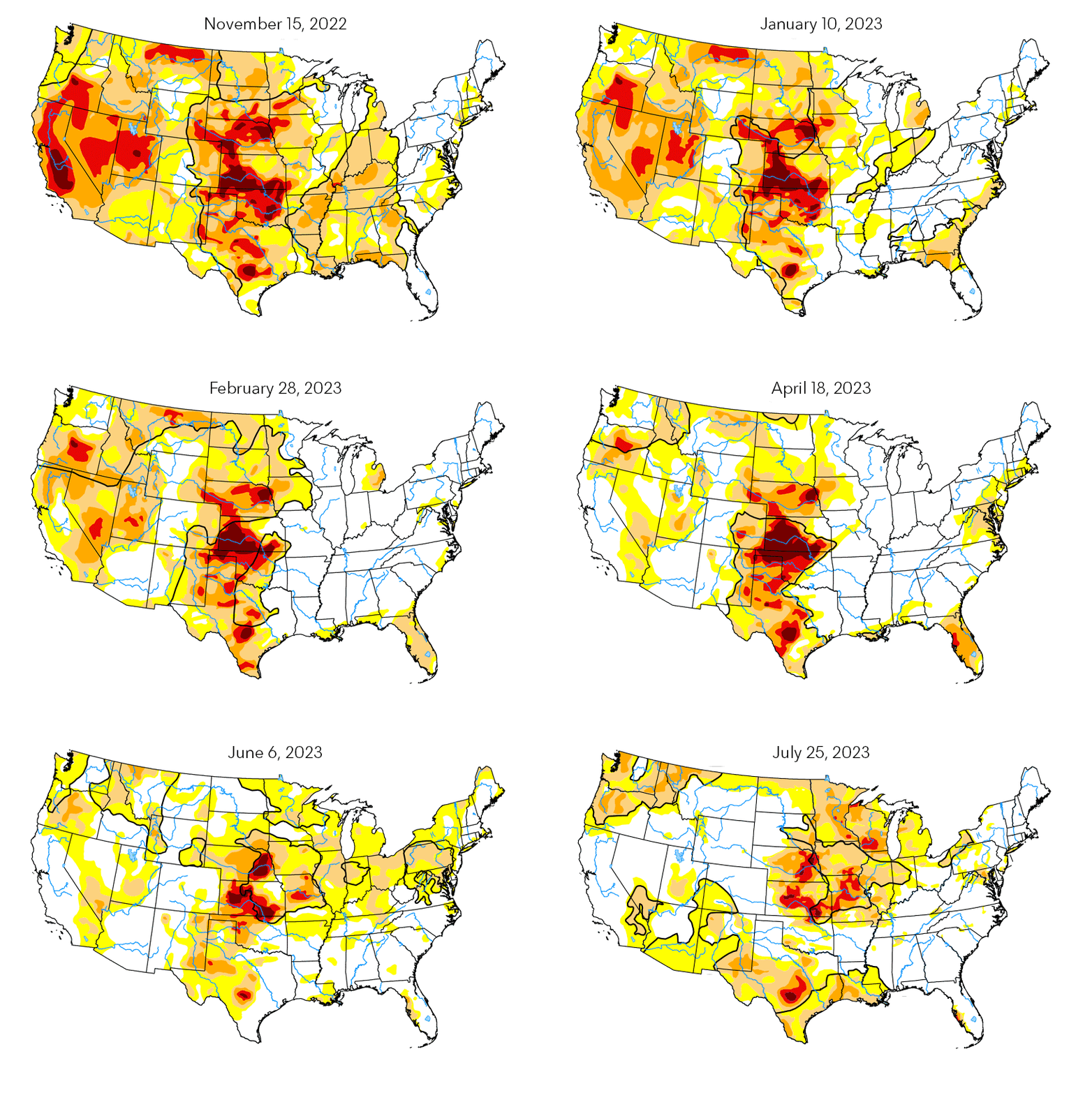
A heat wave blanketed much of the Eastern Cornbelt during the week, prompting heat advisories in all three states.
Highs in central Illinois and central Indiana climbed to the mid-90s as the week progressed, with high humidity pushing the heat index to 100-115. Sweltering temperatures in Ohio and southern Michigan sparked severe thunderstorms at midweek, leaving 200,000 Michigan customers without power due to strong winds and locally heavy rainfall.
In terms of crop quality, Ohio remained the region’s garden spot in late July, with 63-68% of the state’s corn and soybeans rated as good or excellent, compared with 59-61% in Indiana and 44-45% in drought-stressed Illinois. Drought has also taken a toll in Michigan, where good or excellent ratings were assigned to just 33-39% of the state’s corn and soybeans.
Western Cornbelt:
Excessive heat was reported across the entire Western Cornbelt region during the week. All of Iowa was under a heat advisory as the week progressed, with temperatures reaching the upper-90s and heat index values soaring to 110 in many locations.
Similar conditions were reported in Nebraska, with most of the state seeing highs around 100 and heat index readings in the 105-113 range. Heat advisories were in effect for most of central and northern Missouri as well, with heat index values climbing to 108 on July 26-28.
Crop conditions continued to deteriorate in Missouri due to drought, with just 27% of the state’s corn and soybeans rated as good or excellent on July 23, compared with 56-63% in Iowa and Nebraska. Cotton and rice crops in Missouri were much better at 76-79% good or excellent, while 63% of Nebraska’s sorghum fell into those two categories.
California:
Extreme heat continued to grip parts of Southern California and the Southwest in late July, with highs in Death Valley climbing above 122 for several days. Phoenix, Ariz., also notched a record with 19 consecutive days above 110 degrees. Milder temperatures moved into Northern California for the week, with highs topping out in the low-90s.
California’s cotton was 95% good or excellent on July 23, with 25% of the crop setting bolls, well behind the 38% five-year average. California’s rice crop was 20% headed by that date, with fully 100% of the acreage rated as good or excellent.
Pacific Northwest:
Red flag fire warnings were in effect across the Pacific Northwest in late July due to dry conditions, high heat, and afternoon winds. Washington on July 24 declared a drought emergency in parts of 12 counties. Highs in the upper-90s were reported in southern Idaho as the week progressed.
The winter wheat harvest had progressed to 44% complete in Oregon by July 23, compared with 20% in Washington, 12% in Idaho, and 2% in Montana. USDA placed 63-77% of Idaho’s spring wheat and barley crops in the good or excellent categories, well ahead of Washington’s 40-50% and Montana’s 35-38%.
Western Canada:
High heat sparked several strong storms across Western Canada during the week, including one that dropped 1-2 inches of rain in parts of southern Manitoba on July 24. Tornado watches were in effect for a swath of Manitoba again on July 26, while parts of central Alberta were hit with heavy rain, lightning, and damaging winds on July 24.
Record-high temperatures were notched in several Saskatchewan communities at midweek, with highs reaching the mid-30s C.
The week’s spotty precipitation helped crop conditions in some areas, though drought continued to take a toll in southern and central Alberta and western Saskatchewan. Conditions were better in eastern Saskatchewan and Manitoba, but growers expect yields to take a hit even in those areas, particularly for durum and lentils.
Muriate of Potash
US Gulf:
The NOLA potash market remained under pressure following the launch of fill programs from Nutrien and Mosaic. New NOLA business was confirmed at $310-$325/st FOB during the week, down from last week’s broad $330-$350/st FOB range. Offers were pegged as high as $335/st FOB, with no trades reported at that level.
Potash fill pricing was quoted at $360-$370/st FOB in the Eastern Cornbelt. Following Nutrien’s July 21 fill program announcement at $370/st FOB Midwest terminals, Mosaic confirmed its fill offer at $365/st FOB river terminals and $370/st FOB inland warehouses. The company added that it expects strong interest, with pricing and availability “subject to change at any time.”
Potash was pegged at $360-$370/st FOB in the Western Cornbelt for fill program offers.
California:
Potash fill pricing was quoted at $495-$503/st FOB or DEL in California in late July, down sharply from earlier prompt offers at $605-$615/st FOB and $610-$620/st DEL.
Pacific Northwest:
Potash fill offers in the Pacific Northwest fell to $450-$458/st FOB or DEL, with the low for 60% and the high for 62% MOP. The program is slated to close on July 28, however, with prices moving up $30/st after that date.
Western Canada:
Potash truck pricing in Western Canada dropped to C$515/mt FOB Saskatchewan mines for July-September fill shipments, well below spring offers in the C$680-$695/mt FOB range, depending on grade.
China:
Arab Potash Co. (APC) on July 18 signed an agreement with Sinochem Macao to supply potash to China at a price of $307/mt CFR under the same terms reached with other international suppliers for 2023, the producer said in a filing to Amman Stock Exchange. APC did not comment on the volumes negotiated with Sinochem Macao.
Canpotex was the first international supplier to reach a deal with its Chinese customers for seaborne shipments of standard potash in 2023, setting the price at $307/mt CFR for shipments through Dec. 31, 2023 (GM June 9, p. 15). The new price marks a drop of $283/mt, or 48%, from the 2022 price of $590/mt CFR.
Potash imports in China totaled 5.2 million mt for the first half of 2023, according to Trade Data Monitor, up28% from the year-ago 4.1 million mt. Belarus supplied 2 million mt, followed by Russia with 1.1 million mt. Laos added 713,000 mt, while Canada sent 686,000 mt.
Southeast Asia:
Despite offers of material from Uzbekistan at $330/mt CFR, sources reported the market at $300/mt CFR. Traders said buyers would be willing to pick up the Uzbek material, but only after the price is lowered. One trader noted that buyers are in no rush to purchase potash at this time. Reserves are reportedly high enough that buyers can wait out sellers.
Thailand imported 294,000 mt of potash in January-June, Trade Data Monitor reported,a 49% decline from last year’s 492,000 mt. Canada and Laos supplied 78,000 mt and 60,000 mt, respectively.
June imports firmed 36% year-over-year, to 110,000 mt from 81,000 mt. Thailand received 199,000 mt in the second quarter, down from 322,000 mt recorded in April-June 2022.
Brazil:
Potash prices in Brazil strengthened $5/mt, to $335-$355/mt CFR. Players reported a large purchase at the top of the range, while tons remained available toward the lower end. Despite supply constrictions exacerbated by the Vancouver port strike, sizable inventories in Brazil kept a lid on prices even as a number of large suppliers remained out of the market.
Potash inventories also remain high throughout the country, including at Rondonopolis. Prices at Rondonopolis followed the phosphate and nitrogen markets higher, however, firming to $470-$490/mt FOB ex-warehouse.
Sulfur
Tampa:
Sources reported no changes at Tampa following the market’s $55/lt CFR settlement for third-quarter contracts. Pricing for the quarter fell 46.6%, from $103/lt CFR in the prior period.
US Gulf:
Describing the US Gulf market as “dead,” sources called prices steady at $57-$61/mt FOB. Some players warned of tighter supply due to an outage at the ExxonMobil Corp. refinery in Baton Rouge, La. At the same time, sources noted strong operating rates at phosphate production centers.
Brazil:
Market players reported prices unchanged from the week-ago $80-$90/mt CFR.
Vancouver:
While prices remained at last week’s $60-$70/mt FOB, sources questioned how the region’s port strikes might impact the market, should they be extended.
Alberta:
Prices were estimated in a (-)$60-$0/mt FOB range, unchanged from the prior report. The range included both molten sulfur cargoes contracted into the US market and solid tons sold through the Vancouver export market.
West Coast:
West Coast prills remained even with Vancouver at $60-$70/mt FOB, unmoved from one week earlier. Molten sulfur contracts were reported at $45-$50/lt FOB for third-quarter loading, falling from $98-$106/lt FOB in the prior period.
China:
Prices firmed to $95-$100/mt CFR from the week-ago $90-$95/mt CFR. Players cited possible supply concerns due to the port strikes in Vancouver.
ADNOC:
Prilled sulfur produced by the Abu Dhabi National Oil Co. (ADNOC) was posted at $68/mt FOB Ruwais for July, sources said.
Qatar:
July solid sulfur cargo postings from Muntajat were reported at $63/mt FOB Ras Laffan.
Sulfuric Acid
US Gulf:
Production interruptions reported at a number of sulfur burners were said to tighten sulacid supply. Import prices have yet to be impacted, however, leaving the market in the $55-$65/mt CFR range for the week.
Brazil:
Price ideas at Brazil were steady at $70-$75/mt CFR, unchanged from last week.
Fertilizer Futures
Dry Fertilizer Barge Rates
| 7/14/2023 | Last Week | |
| Memphis | 18.50-19.00 | 18.50-19.00 |
| St. Louis | 20.00 | 20.00 |
| Peoria | 27.00-28.50 | 27.00-28.50 |
| Cincinnati | 30.00 | 30.00 |
| St. Paul | 33.00 | 33.00 |
| Catoosa/Inola | 36.00 | 36.00 |
Data Signals


Crops/Weather

CROPS/WEATHER
Eastern Cornbelt:
A severe thunderstorm watch was in effect for much of central and northern Indiana on July 20, with forecasts warning of heavy rain, large hail, and damaging winds. The threat extended across northern Ohio as well, with parts of southern Michigan also bracing for potentially strong storms.
Drought conditions continued to cover most of Illinois, Indiana, and Michigan at mid-month. Good or excellent ratings were assigned to 40-41% of the corn and soybeans in Illinois on July 16, compared with 60% in Indiana, 63-72% in Ohio, and 34-41% in Michigan.
Western Cornbelt:
High heat and humidity sparked strong storms across the Western Cornbelt at mid-month, though a cold front was expected to drop temperatures to the low-80s as the week progressed.
Rain, hail, and damaging winds moved through parts of Nebraska and western Iowa at midweek. The worst storms were reported in western Missouri, however, where hailstones as large as tennis balls and softballs hit areas near Pleasant Hill, Harrisonville, and Garden City on July 18.
USDA placed 30-31% of Missouri’s corn and soybeans in the good or excellent categories on July 16, compared with 53-63% in Nebraska and 58-64% in Iowa. Missouri’s cotton and rice were 68% and 79% good or excellent, respectively, while 66% of Nebraska’s sorghum crop fell into those two categories on July 16.
Southern Plains:
High heat and strong storms battered the Southern Plains in mid-July. Large hail and 70-mph winds in central Kansas on July 16 caused structural damage and closed a portion of Interstate 70 due to toppled semis and campers.
Heat index readings reached the upper-90s and low triple digits across Oklahoma as the week progressed. Texas, meanwhile, continued to bake under a record-breaking heatwave, with Austin on July 19 notching 10 consecutive days of temperatures at or above 105 degrees.
Parts of New Mexico were also under excessive heat warnings and heat advisories on July 18, while some northern areas of the state were hit with large hail and damaging winds early in the week. El Paso on July 19 registered its 34th consecutive day with triple-digit temperatures.
Crop conditions varied widely across the region. Just 26% of the Texas cotton crop was rated as good or excellent on July 16, compared with 53% in Kansas and 68% in Oklahoma. Corn in the good or excellent categories totaled 74% of the acreage in Colorado, 61% in Texas, and 54% in Kansas, with 58% of the Kansas soybean crop also rated as good or excellent.
The sorghum crop was fully 83% good or excellent in Colorado on July 16, compared with 72% in Oklahoma, 63% in Texas, and 50% in Kansas.
South Central:
Sweltering temperatures were reported in Arkansas during the week, with highs in the upper-90s and heat index readings reaching the 110-120 range. The heat dome stretched across Louisiana and Mississippi as well, pushing temperatures to the mid-90s for multiple days.
Heavy rain and gusty winds plowed through Middle Tennessee and western Kentucky at midweek, prompting flood warnings after rainfall totals reached 4-6 inches in some locations.
Crop conditions were generally favorable in the region at mid-month. Fully 78% of Tennessee’s corn was rated as good or excellent on July 16, compared with 55% in Kentucky. Soybeans in those two categories totaled 77-78% of the acreage in Louisiana and Mississippi, 65% in Arkansas, and 59% in Kentucky.
Louisiana’s cotton crop was 84% good or excellent, along with 73% of the acreage in Mississippi and 69% in Arkansas. The regional rice crop was 79% good or excellent in Texas, compared with 68% in Arkansas and Mississippi, and 60% in Louisiana.
Southeast:
A powerful EF3 tornado caused extensive damage in parts of central North Carolina on July 19, and forecasts warned of potentially strong thunderstorms in the Sandhills again on July 20. The midweek storm also hammered parts of Virginia and West Virginia.
Strong thunderstorms tracked through northern Alabama and northern Georgia on July 20 as well. A heat advisory was in effect on July 20 for Middle Georgia, with heat index values climbing to 105 degrees. Florida was also on track to record its hottest July on record.
Favorable crop conditions were reported in the Southeast at mid-month. Fully 80-81% of North Carolina’s corn and soybeans were rated as good or excellent on July 16, while cotton in those two categories totaled 64% of the acreage in the Carolinas, 67% in Georgia, 80% in Alabama, and 96% in Virginia.
Peanuts were also flourishing, with good or excellent ratings assigned to 64% of the acreage in Georgia, 75% in Florida, 80% in Alabama, 80-81% in the Carolinas, and 96% in Virginia.
Crops/Weather

Eastern Cornbelt:
Strong thunderstorms pushed through northern Illinois and northwestern Indiana at midweek, causing widespread power outages and prompting tornado warnings and flood advisories for multiple counties. Several tornadoes were confirmed in the Chicago area late on July 12.
High heat and humidity blanketed much of the Eastern Cornbelt during the week, fueling the stormy weather. Rain showers were expected to push through central and northern Ohio as the week progressed, with tornado watches in effect for parts of southeastern Michigan at midweek.
Moderate-to-severe drought continued to cover most of Illinois, northern Indiana, and Michigan. Just 30-36% of Michigan’s corn and soybeans fell in the good or excellent categories on July 13, compared with 36-39% in Illinois, 53-55% in Indiana, and 59-67% in Ohio.
Western Cornbelt:
Strong thunderstorms pounded parts of eastern Nebraska and much of Iowa at midweek with strong winds, hail, and heavy rain in some locations. Rainfall totals in Iowa on July 12 included 4.4 inches in Boone, 3.5 inches in Huxley, and 2.25 inches in Des Moines.
After an earlier storm brought damaging winds to northeastern Nebraska on July 10, eastern areas of the state were hit again on July 12 with at least two confirmed tornadoes, large hail, and heavy rain. Severe weather was also reported in Missouri at midweek, including reports of large hail and strong winds.
Drought conditions continued to take a toll on crops in the region, but conditions were slightly improved from last week. Just 25-26% of Missouri’s corn and soybeans were rated as good or excellent on July 9, compared with 52-61% in Iowa and 55-62% in Nebraska. Missouri’s cotton and rice were 69% and 76% good or excellent, respectively, while fully 67% of Nebraska’s sorghum crop fell into those two categories on July 9.
Northern Plains:
High heat and humidity sparked several thunderstorms across the Northern Plains during the week. Large hail and damaging winds were reported in parts of central and southern Minnesota early in the week, with central and southern areas of South Dakota experiencing the same conditions at midweek.
Despite worsening drought conditions across the state, fully 61% of Minnesota’s corn and soybeans were rated as good or excellent on July 9, compared with 53-56% in South Dakota. North Dakota’s corn was 67% good or excellent, with 51% of the state’s soybeans falling in those two categories.
Minnesota’s spring wheat and barley were 60-62% good or excellent in early July, compared with 42-45% in North Dakota. Oats in the good or excellent categories totaled 50-52% of the acreage in the Dakotas and 47% of Minnesota’s crop, with 53% of the sorghum crop in South Dakota also rated as good or excellent.
Northeast:
Parts of New York State were hit with up to eight inches of rain on July 9, causing flash flooding that resulted in road closures and evacuations for some communities.
The powerful system also dropped as much as five inches in western Connecticut and prompted flood watches across Massachusetts early in the week. The Lake Champlain area in northern Vermont was bracing for up to four inches of rain by July 11.
The same system also produced an EF1 tornado in Middleton, Del., while some Philadelphia suburbs were hit with 5-7 inches of rain in just 24 hours, pushing area rivers and streams out of their banks.
Eastern Canada:
Tornado warnings were in effect for parts of eastern Ontario and southern Quebec on July 12-13 as powerful thunderstorms pushed through the region. The strong system also produced heavy rain, with flash flooding reported in parts of Montreal on July 13.
Heat warnings were in effect earlier in July for much of the Maritimes. The combination of heat and precipitation contributed to good crop conditions in Eastern Canada, though some areas were hoping for drier weather after several weeks of surplus moisture.