

Cornbelt:
NPSZ pricing edged up to $810-$835/st FOB in the Cornbelt, depending on location.
Cornbelt:
NPSZ pricing edged up to $810-$835/st FOB in the Cornbelt, depending on location.
Eastern Canada:
The SOP market jumped again to a tight range of C$1,390-$1,400/mt FOB in Eastern Canada, up from a low of C$1,330/mt FOB at last report.
Eastern Canada:
SOP Magnesia prices in mid-February were quoted at C$870-$940/mt FOB in Eastern Canada, depending on grade and location.
Eastern Cornbelt:
Potassium thiosulfate pricing remained at $700/st FOB Terre Haute, Ind., for the last reported offers.
Eastern Cornbelt:
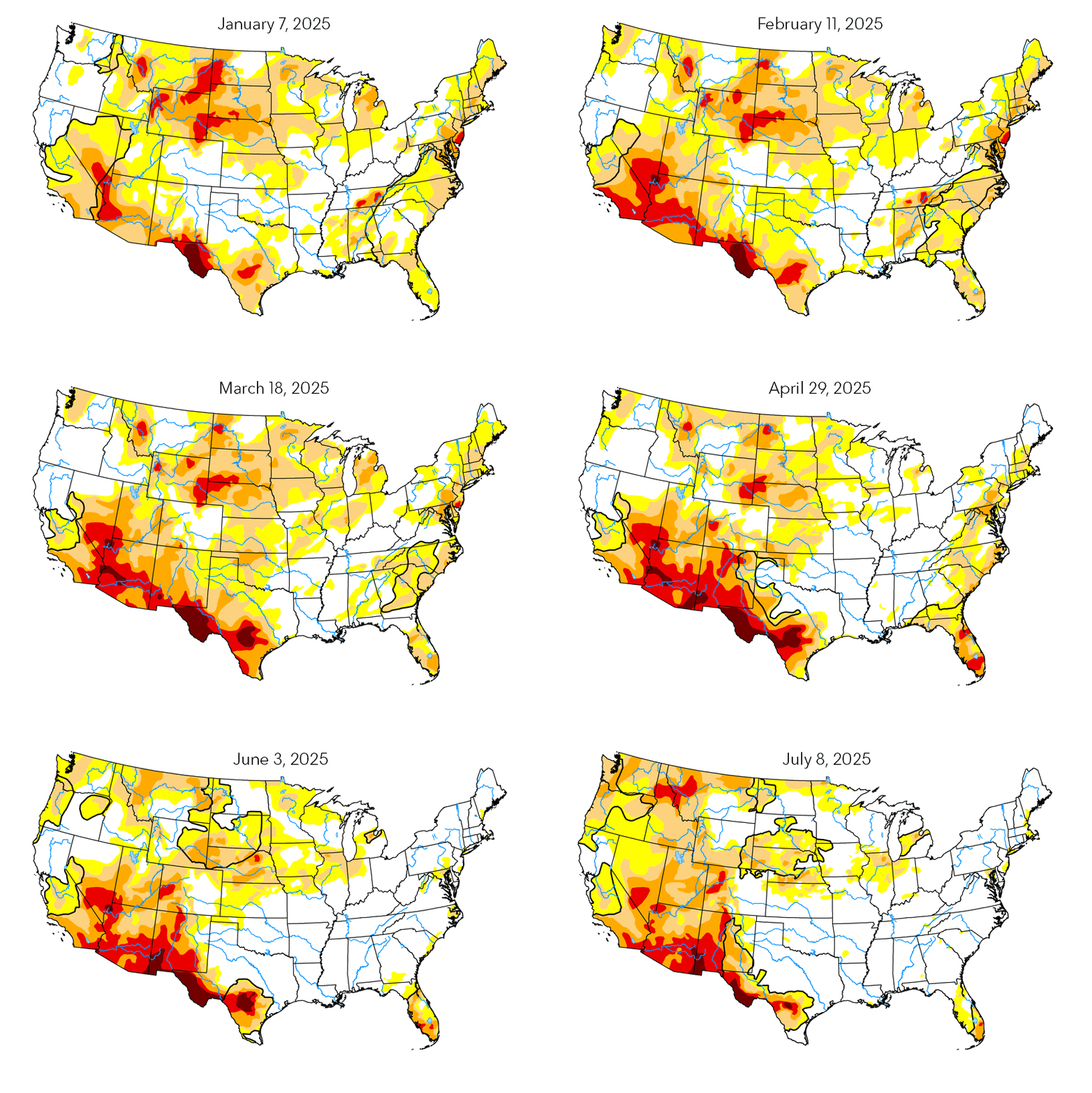
Temperatures in central Illinois plummeted from the upper-50s at midweek to the single digits by Feb. 18, and the colder weather was accompanied first by heavy rain and then 2-3 inches of snow.
Similar conditions were reported in Indiana. Heavy rain at midweek was replaced by freezing rain on Feb. 17, with reports of 3-6 inches of snow possible in central areas of the state by the end of the week, and up to 6-9 inches in the northern counties. Temperatures on Feb. 18 were expected to fall to the low single digits, with wind chills down to 10 below zero.
Steady rain was also reported across northern Ohio at midweek, followed by freezing rain and 1-3 inches of snow later in the week. Heavier amounts of accumulation were expected in southern Michigan, where forecasts warned of 5-9 inches by Feb. 18 and temperatures falling to the low teens.
Western Cornbelt:
Temperatures across central and southern Iowa fell from the upper-30s to the low-20s and teens on Feb. 17-18, with reports of freezing rain and an inch or two of snow in southeastern Iowa late in the week. Temperatures over the weekend were expected to rebound into the 40s and 50s, however.
Heavier snow and colder temperatures were reported in Missouri as the week progressed. Snow accumulation across a wide swath of central and northern Missouri reportedly ranged from 3-9 inches on Feb. 17-18, with temperatures dropping to the upper teens and wind chills falling to the single digits.
Northern Plains:
Gusty winds, snow, and cold temperatures blanketed much of the Northern Plains during the week. Forecasts warned of near blizzard conditions across North Dakota late in the week, along with subzero wind chills.
Highs in the single digits were reported in the Twin Cities area at midweek, prompting wind chill advisories for central and northern areas of the state. A winter storm watch was also in effect for parts of the state on Feb. 18, with forecasts warning of 60 mph winds, an inch or more of snowfall, and wind chills as low as 35 below zero.
Northeast:
After a cold and snowy start to the work week, temperatures warmed considerably across much of the Northeast as the week progressed.
Subzero lows were reported across New England on Feb. 14-15, but highs climbed to the 40s by midweek, with forecasts suggesting a possible high of 60 in Boston on Feb. 17. The warmer weather was accompanied by strong winds, however, followed by a return to cooler weather over the weekend, with highs expected in the 30s.
Strong winds and balmy temperatures were also reported in Pennsylvania and Maryland during the week, with highs reaching the 50s and 60s on Feb. 16-17, up from lows in the 20s on Valentine’s Day.
Eastern Canada:
A wintry mix of rain, freezing rain, and snow was reported across southern and central Ontario at midweek, prompting a number of advisories and special weather statements from Environment Canada. Forecasts warned of 10-15 mm of rain and up to 10-20 cm of snow in some locations, along with much cooler temperatures.
Similar conditions were reported across Quebec, with Montreal bracing for 30-40 mm of rainfall. The storm was expected to impact the Maritimes late in the week, as forecasts warned of 25-50 mm of rain and high winds in Nova Scotia by Friday, followed by colder weather over the weekend.
Earlier in the week, Newfoundland, Prince Edward Island, and Nova Scotia were battered by strong winds and 20-35 cm of snow, with reports of as much as 40 cm of snow in Cape Breton.
Sources said it is still weeks away from any early fieldwork or fertilizer movement in the region. “There is still lots of snow cover and well-below-freezing temperatures,” said one contact at midweek. “In past years, late March is about the earliest, but usually we get started mid-April or so.”
U.S. Gulf:
Wait times were noted up to 42.5 hours for the week at Port Allen Lock due to lingering delays from emergency repairs conducted in the previous week. Waits noted in a wide 5-23 hour range on Feb. 15 were projected to slowly taper in the days ahead.
Guidewall repairs at Industrial Lock concluded on Feb. 11, ending a five-day run of intermittent daylight-hour transit stoppages. Longer-than-usual waits persisted on Feb. 15 due to the shutdown, however. Corps data showed delays up to 25.5 hours on Feb. 15, with 17 tows queued for locking.
Daytime travel shutdowns at Brazos Lock were extended through mid-March, beyond the previously reported late-February end point. Transit through the site was described as unavailable from 7:00 a.m. to 5:00 p.m., Monday through Friday. Delays in the 8-14 hour range were reported for the week, down from 31.5 hours noted previously.
Labor shortages continued to affect transit operations throughout the Gulf and eastern waterways during the week. Average delivery times were heard increasing by several days as a result.
Bayou Sorrel Lock guidewall demolition, part of a larger repair project scheduled to run through the end of May, was set to end on March 3, with sporadic lock closures expected as a result. Intermittent delays were quoted in the 4-6 hour range for the week.
Weekday lockages through Bayou Boeuf Lock were limited to overnight hours due to maintenance. Locking was available between 7:00 p.m. and 7:00 a.m. Monday through Friday, followed by a resumption of 24-hour transit on Saturday and Sunday. Delays were counted up to 7.5 hours for the week.
Movements continued to be unavailable during overnight hours at Bayou Chene due to floodgate construction, leaving access unavailable nightly between 7:00 p.m. and 7:00 a.m. Navigation was permitted during daylight hours, albeit limited to 600 feet of length, according to Coast Guard documents. Tows measuring wider than 54 feet were required to use an assist vessel. Intermittent delays were expected up to 6-12 hours.
Atchafalaya River drafts were posted at a maximum 10 feet at Miles 113-116 due to shoaling. Vessel lengths were limited to 600 feet due to the conditions, while tows longer than 400 feet were advised to travel with an assist tug. In addition to length restrictions, maximum widths were noted at 70 feet. Vessels were able to circumvent the restrictions by running through the Port Allen Route.
Unassisted Algiers Lock navigation continued to be limited to four standard barges or two 30,000 mt tankers per lockage. Larger passes remained possible when traveling with an assist boat, however.
Belle Chasse Bridge construction activities, projected to continue through late 2022, were likely to trigger intermittent navigation stoppages lasting up to 12 hours at a stretch. The structure is located at Mile 3 in the West Canal.
Mississippi River:
Improving water levels at St. Louis and below allowed for easing draft limitations on the lower Mississippi River during the week. Maximum drafts were heard lifting from the week-ago 9.5-10 feet to the 9.5-12.5 foot range, with northbound tows receiving the strictest draft limits.
The river gauge at St. Louis was posted at 2.17 feet and rising on Feb. 16, while heavy rain in the forecast was projected to spike levels to 12.1 feet on Feb. 19. A flood watch dated Feb. 16 was in effect through Feb. 17 for numerous locations in Illinois and Missouri.
Channel reinforcement work at the lower river’s Mile 642 was extended through March 15 from the previously planned late-February end. Tows traveling in the southbound direction were delayed up to 12 hours at the site, while upbound tows were generally unaffected.
Upper Mississippi River Locks 1-20 remained shut to vessel traffic due to seasonal maintenance that began in November 2021. Backing off from an earlier March 22 extension for the upper river’s spring opening, Locks 15 and 19 are now tentatively slated to resume lockages on March 3, followed by Locks 5A, 8, and 10 on March 17.
Should warmer temperatures prevail, some expect the upper river to begin opening closer to the start of March.
Illinois River:
Improved travel conditions were noted on the Illinois Waterway for the week, allowing for increased barge counts and faster travel times. Ice couplings continued to be required for much of the river, although warmer weather in the extended forecast could render that restriction unnecessary by early March.
Wickets were reported in the raised position at Peoria Lock. Wickets were down at LaGrange Lock, however, allowing for lockless navigation through that site. Navigation was reported to resume through O’Brien Lock during the week.
Starved Rock Lock delays were counted up to eight hours for the week, while 4-7 hour wait times were seen through Peoria Lock. The Corps noted 3-7 hour crossings at LaGrange Lock.
Brandon Road Lock is scheduled to undergo a repair and maintenance project from May 9 through Aug. 14. Restrictions will be in place during the work, with overnight-only navigation and widths capped at 70 feet. Navigation will stop completely from Aug. 15 through Sept. 4, while overnight-only lockages will resume on Sept. 5-8. Twenty-four-hour movements are slated to resume on Sept. 9.
Ohio River:
Transit resumed for the week at Newburgh Lock after a number of loose barges were successfully corralled after shutting the site one week earlier. Delays were reported at 24 hours or more immediately following the lock’s reopening.
Cannelton Lock repairs that began on Jan. 26 were noted impacting daytime movements through the site, specifically on Wednesdays and Thursdays. The project is slated to run through May 26.
Primary chamber work at Emsworth Lock is scheduled to begin on Feb. 22, forcing movements through the auxiliary chamber, limited to one barge per turn. Extensive delays were expected while work is underway, currently anticipated through April 16.
Dashields Lock auxiliary chamber shutdowns continued for the week due to an underwater obstruction, relegating movements to the primary chamber. The main chamber is scheduled to close for planned maintenance on March 7-31, after which the auxiliary chamber will shut on April 1-22 for repairs.
Belleville Lock is slated to close to navigation from May 2 through June 22 due to repairs and maintenance. Traffic will lock through the secondary chamber while the project is underway.
The Hannibal Lock auxiliary chamber was reported closed through the end of the month. The site’s primary chamber is scheduled to go offline from July 5 through Oct. 8 for repairs. Proposed Cannelton Lock maintenance would run from July 5 through Nov. 11, limiting primary chamber access.
The Tennessee River’s Kentucky Lock is closed for repairs through Feb. 24, according to a Corps posting. Vessels were noted detouring through Barkley Lock while work is underway, adding roughly1-2 days of travel in each direction.
Main chamber work at Wilson Lock will limit lockages through the secondary chamber from Feb. 23 through April 28, prompting expected delays up to seven days or more. The Corps has scheduled a single relief opening to pass waiting vessels on March 18-23. Intermittent Wilson Lock delays were reported up to 35.5 hours for the week.
On the Cumberland River, Bio-Acoustic Fish Fence (BAFF) maintenance and inspections will shut Barkley Lock between 6:00 a.m. and 6:00 p.m. daily on March 21-27, according to a Corps notice. Detours will be available via Barkley Lock and Kentucky Lock.
Cheatham Lock is scheduled to undergo large-scale shutdowns from May 31 through Aug. 5 for miter gate machinery repairs. Intermittent lock openings are likely during the closure.
Technology company AmmPower Corp., Vancouver, said on Feb. 9 that fertilizer dealers and distributors can have their very own green anhydrous ammonia plant for $3-$3.5 million.
The company said its Independent Ammonia Making Machines (IAMM™) can make four metric tons of ammonia per day, and the company aims for the first units to be available by late third-quarter 2022. Ammpower said it is now in discussions with potential customers regarding placing orders and delivery times.
“The market has been extremely receptive to the concept of distributed ammonia production,” said Eric Kelley, AmmPower Director of Sales and Marketing, Agriculture. “The targeted pricing of the unit is intended to be disruptive and will represent an economically feasible solution for our intended customer base.”
“We are pleased with the response that our planned IAMM™ units are receiving,” said AmmPower CEO Gary Benninger. “The distributed production concept puts the control of the ammonia production closer to the end user and allows distributors and retailers to avoid the logistical supply problems that they so often encounter.”
AmmPower is currently completing assembly of its green ammonia synthesis demonstration unit, which will have a capacity or 50 kilograms per day (GM Nov. 5, 2021). It said this technology is scalable and will be used for the IAMM™ units.
In addition to the small ammonia plants aimed at the agriculture market, AmmPower has also recently announced plans for large green ammonia plants in Louisiana and Brazil (GM Feb. 4, p. 28; July 30, 2021).
Compass Minerals, Overland Park, Kan., said on Feb. 8 that its Plant Nutrition segment posted fourth-quarter operating earnings of $9.5 million, up from the year-ago $3.3 million, on higher prices and lower volumes. Average prices were $660/st, up from $548/st, while volumes were off at 83,000 st from 143,000 st.
Total sales for the segment were $54.6 million, down from $78.2 million. EBITDA was up at $18.3 million from $12.3 million.
On a year-over-year basis, the company continues to expect sulfate of potash pricing strength in the fiscal 2022 first half to more than offset lower sales volumes, resulting in improved Plant Nutrition margins and profitability.
Compass anticipates first-half 2022 Plant Nutrition revenue of $85-$110 million and EBITDA of $25-$35 million. It expects full-year volumes of 280-320,000 st.
Compass-wide net earnings from continuing operations were $7.9 million ($0.23 per diluted share) on sales of $331.5 million, down from $14.7 million ($0.42 per share), up from $309.2 million. Net income, however, was $2.4 million ($0.07 per share), down from $28.1 million ($0.81 per share). Adjusted EBITDA was $67 million, down from $87.7 million.
Full-year net income was $14.3 million on revenue of $1.17 billion.
The company has lowered its fiscal 2022 outlook for adjusted EBITDA to $200-$235 million from $220-$250 million, largely due to trends in its Salt segment. Compass shares dropped as much as 10 percent on Feb. 9, the most since Nov. 16, after cutting its guidance, according to Bloomberg.
“We expect inflationary pressures and higher logistical costs to dampen our underlying earnings potential over the course of the fiscal year,” said Kevin S. Crutchfield, President and CEO. “In response, we are focused on offsetting these costs through continued pricing actions in our Plant Nutrition and consumer and industrial businesses, as well as throughout the upcoming highway salt bid season. Concurrently, as we advance our growth strategy into attractive, adjacent markets – lithium and next-generation fire retardants – I am confident these actions should result in attractive returns on capital, driving long-term value for shareholders.”
Fourth-quarter Salt operating earnings were $39.4 million on sales of $273.9 million, down from the year-ago $44.5 million and $228.5 million, respectively. EBITDA was off at $55.6 million from $61.9 million. Total salt sales were up at 3.44 million st from 2.78 million st, however, average prices were down at $79.63/st from $82.10/st.
Salt segment first-half revenues are seen as $590-$690 million, with EBITDA guidance dropped to $120-$160 million. Full-year Salt volumes are put at 11.8-12.8 million st.
Three major North American fertilizer companies are expected to see a tripling or doubling in earnings results for the fourth-quarter ending Dec. 31, 2021, according to the Bloomberg Consensus, the average estimate from major financial analytical firms.
CF Industries Holdings Inc., Deerfield, Ill., and Nutrien Ltd., Saskatoon, are both expected to triple their fourth-quarter adjusted EBITDA compared to year-ago levels, while The Mosaic Co., Tampa, would more than double its results.
CF, which will release results on Feb. 15, is expected to show fourth-quarter adjusted EBITDA of $1.2 billion, according to the analyst average, more than tripling the year-ago $338 million. The analyst range was $906 million to $1.34 billion. Full-year analyst estimates are $2.67 billion, up from 2020’s $1.35 billion.
Analysts are projecting fourth-quarter Nutrien adjusted EBITDA at $2.41 billion, versus the year-ago $768 million. Full-year adjusted EBITDA is seen as $7.07 billion, up from $3.67 billion. Nutrien will release results on Feb. 16.
Mosaic, which will release data Feb. 22, would more than double its fourth-quarter adjusted EBITDA, with the analyst estimate at $1.25 billion, up from the year-ago actual $508 million. Full-year adjusted EBITDA was put at $3.6 billion, up from 2020’s $1.56 billion.
Bloomberg Consensus
| CF | 4Q-21 | Full-Year 21 |
| Net Income | $678.1 M | $922.6 M |
| Revenue | $2.48 B | $6.45 B |
| Adj. EBITDA | $1.2 B | $2.67 B |
| Adj. Dil. EPS | $3.54 | $5.15 |
| Mosaic | 4Q-21 | Full-Year 21 |
| Net Income | $720.8 M | $1.73 B |
| Revenue | $3.83 B | $12.4 B |
| Adj. EBITDA | $1.25 B | $3.6 B |
| Adj. Dil. EPS | $1.96 | $5.07 |
| Nutrien | 4Q-21 | Full-Year 21 |
| Net Income | $1.33 B | $3.3 B |
| Revenue | $6.44 B | $26.3 B |
| Adj. EBITDA | $2.41 B | $7.07 B |
| Adj. Dil. EPS | $2.35 | $6.06 |
Itafos Inc. Houston, said on Feb. 8 it has resumed sulfuric acid production at its Arraias plant in Brazil. It said it has completed the recommissioning of the previously idled plant on schedule, within budget, and with no reportable environmental releases or recordable incidents. The company announced in October that it planned to bring the plant back up (GM Oct. 22, 2021).
“We are pleased to have safely and successfully completed the recommissioning of the sulfuric acid plant at Arraias,” said G. David Delaney, Itafos CEO. “While we continue to evaluate strategic alternatives for Arraias, we are opportunistically restarting the sulfuric acid plant to supply market demand and deliver positive margins.”
The Arraias sulfuric acid plant has production capacity of 220,000 mt/y. The company expects to operate the plant with a base load capacity of approximately 10,500 mt/m.
Itafos said it has secured short-term sulfuric acid offtake agreements for the plant’s base load capacity with pricing linked to sulfur benchmarks. Based on market demand, the company expects to opportunistically produce additional volumes of sulfuric acid to be sold on the spot market.
The surge in fertilizer prices has also carried over to Brazil sulfuric acid mt CFR, which as of Feb. 4 was reported at $270-$275/mt CFR, compared to the year-ago $85-$90/mt CFR.
Itafos said the remainder of the infrastructure associated with Arraias’ vertically integrated phosphate fertilizer business, including its mine, beneficiation plant, acidulation plant, and granulation plant, remain idled following best practices.
Arraias has approximately 500,000 mt/y of single superphosphate (SSP) capacity, which can also include SSP with micronutrients (SSP+). At full SSP capacity it has approximately 40,000 mt/y of excess sulfuric acid, with gross sulfuric acid capacity of 220,000 mt/y.