All posts by mickeybarb@charter.net

Ammonium Polyphosphate

Eastern Cornbelt:

10-34-0 was steady at $580-$600/st FOB in the Eastern Cornbelt for the last reported offers, with the low at Cincinnati.

Western Cornbelt:

The 10-34-0 market remained at $575-$595/st FOB for the last reported business in the Western Cornbelt.

Northern Plains:

10-34-0 pricing was unchanged at $590-$600/st FOB and $600-$610/st DEL for the last reported offers in the Northern Plains.

Northeast:

The 10-34-0- market in upstate New York was pegged at the $600/st FOB level, unchanged from last report.

Muriate of Potash

U.S. Gulf:

The most recent NOLA potash barge business was reported at $540-$550/st FOB, up from $525-$550/st FOB. Most expected the next trade to go higher, though news of new trades or quotes was scarce.

Eastern Cornbelt:

Potash was quoted at $575-$595/st FOB in the Eastern Cornbelt, depending on location, with the Cincinnati market pegged in the $585-$595/st FOB range for limited offers. Out of Illinois terminals, the market was reported at a firm $585/st FOB East Dubuque, Ottawa, and LaSalle.

Western Cornbelt:

Sources said the potash market had firmed to $575-$585/st FOB in the Western Cornbelt, depending on location, with the low confirmed at St. Louis and the high at Camanche, Iowa.

Northern Plains:

Sources quoted the potash market at $555-$575/st FOB St. Paul in late July, with tons described as very tight. The market to U.S. buyers FOB Saskatchewan mines was pegged at $410-$420/st after netbacks, depending on grade.

Northeast:

Potash prices were up in the Northeast, with new reference levels for July-August tons reported at the $600/st mark FOB Fairless Hills, Pa., as of July 26. Many suppliers, however, continue to withhold new published prices since the rapid increases that occurred earlier this summer amid tightening supplies.

Eastern Canada:

Sources pegged the potash market firmly at the C$660/mt level FOB regional warehouses in Eastern Canada, up C$100/mt from the last prompt spring business.

Canpotex reported on July 27 that it is fully committed on volumes for potash sales into November 2021, citing continued strong demand and solid fundamentals for major agricultural commodities in key offshore markets. It said the focus on food security continues in a number of Canpotex’s markets.

Israel:

ICL is now sold out of potash through October, ICL President and CEO Raviv Zoller told analysts at the company’s second-quarter earnings call on July 28. Zoller said the group has an “all-time” low level of potash inventory at the Dead Sea “because the market is undersupplied, and there is excess demand.” He described potash pricing as “very, very attractive.”

Zoller said the group’s last sale in Brazil was at $620/mt CFR, and in the U.S. at around $540/st, but he did not indicate when the sales were done. In Thailand, Zoller said ICL had achieved $600/mt CFR on its latest potash sale concluded last weekend, although he did not specify whether the product was standard or granular.

Brazil:

Potash prices keep going up in Brazil. Paranagua is now reported at $670-$700/mt CFR, representing at least a $50/mt jump in just one week. Sources said the price increase is directly connected to a lack of product and strong demand.

Rondonopolis is showing a wider spread in its price from a week ago, with the market now quoted at $700-$800/mt FOB ex-warehouse. Some of the uncertainty in the pricing is coming from fears that a possible trucker strike, or even a continued shortage of trucks, could affect availability of product in the near future.

Thailand:

Imports of MOP in Thailand for the first half of the year were up 51 percent, to 514,000 mt from 327,000 mt during the same period last year, according to Trade Data Monitor.The main suppliers this year were Canada at 194,000 mt and Belarus at 155,000 mt.

June 2021 imports were also up, to 74,000 mt from 65,000 mt in June 2020. Second-quarter 2021 imports were also up 302,000 mt, compared with 217,000 mt last year. Canada led the second quarter at 154,000 mt, followed by Belarus at 60,000 mt.

Sulfur

Tampa:

Sources reported an early start to 2022 domestic sulfur talks during the week, with a number of buyers and sellers seeking greater stability in the face of the market’s whipsaw action of 2020 and 2021. The third-quarter Tampa molten contract was valued at $195/lt CFR, up $3/lt from $192/lt CFR in the prior period.

“Believe it or not, (players are) already having discussions for next year’s business,” said one source. “Entities (are trying) to reposition themselves in the upcoming contract year.”

On the supply side, domestic U.S. refinery production was portrayed as considerably improved so far in 2021, although tightness remained from producers in Alberta.

Operable domestic refining capacity softened for a fourth consecutive week, according to the U.S. Energy Information Administration, slipping to 91.1 percent from the week-ago 91.4 percent. The weekly rate nevertheless held above both the year-ago 79.5 percent and the 90.3 percent five-year average.

Daily crude inputs slipped below the 16 million barrel/d day mark for the first time since June 4, softening to 15.875 million barrels/d from the week-ago 16.007 million barrels/d, a 132,000 barrel/d decline.

U.S. Gulf:

The 50,000 barrel/d hydrofiner at the Citgo West refinery in Corpus Christi, Texas, returned to normal levels on July 22 after an earlier decrease in activity, Genscape reported. Intermittent activity decreases noted since mid-June were most recently observed starting on July 19.

A restart of the 69,000 barrel/d No. 2 fluidic catalytic cracking unit (FCC) at the Citgo East plant in Corpus Christi was slated to begin no later than July 27.

Genscape reported successful restarts of the 72,000 barrel/d crude distillation unit (CDU) and 17,000 barrel/d vacuum distillation unit (VDU) at Marathon’s El Paso, Texas, refinery on July 22. The units were taken offline on July 21.

Valero halted operation of the 65,000 barrel/d FCC at the company’s Houston, Texas, refinery on the morning of July 24. Restart procedures were reportedly underway on July 27.

Price ideas on the U.S. Gulf prilled sulfur export market were reported holding steady in the $185-$195/mt FOB range, unmoved from the prior report. Firming freight costs could further weigh on potential netbacks in the short term, players warned.

Brazil:

Recent Brazil market imports continued to be quoted in the $221-$230/mt CFR range, unchanged from one week earlier. Third-quarter contracts were heard in the $221-$223/mt CFR range, up from $213-$214/mt CFR in the previous quarter.

Vancouver:

Sources continued to portray the July 18 sulfur terminal fire at the Vancouver area’s Port Moody as a non-issue for the market. “(The) port fire has been of no consequence, as (the terminal) was going into turnaround anyway,” said one industry contact.

Vancouver prill pricing remained in the $175-$178/mt FOB range, steady from the previous report.

Alberta:

Suncor restarted a 12,000 barrel/d catalytic reforming unit at its Edmonton refinery, Genscape reported on July 27. The unit had been offline since April 16 as part of a planned turnaround.

Ongoing turnarounds in the Oil Sands region, combined with rumored production issues from Syncrude, were reportedly keeping Alberta-originating supply snug.

Alberta sulfur netbacks were steady in the $68-$108/mt FOB range, and included molten material contracted into the U.S. market at the low and prilled tons shipping offshore through the Vancouver export market at the high.

West Coast:

Genscape on July 26 reported the unplanned shutdowns of a 65,000 barrel/d hydrotreater, a 44,000 barrel/d South Isomax hydrocracker, and a 60,000 barrel/d North Isomax hydrocracker at the Chevron Corp. refinery in Richmond, Calif. The shutdowns were reported to result from a power outage.

PBF Energy shut a 25,000 barrel/d coking unit at the company’s plant in Martinez, Calif., on Jul 26.

No changes were reported for the West Coast prill market, leaving price ideas flat at $175-$178/mt FOB.

Contracts for the sale of molten sulfur from West Coast locations in the third quarter were noted in the $150-$155/lt FOB range, sources said, rising from $140-$155/lt FOB in the prior period.

China:

Refinery utilization from China state-owned refiners Sinopec, PetroChina, CNOOC, and Sinochem edged lower in July, according to Platts, dipping to 82.0 percent from 82.4 percent in June. Average throughput was noted at 7.58 million barrels/d against a nameplate 9.24 million barrels/d capacity. Run rates were widely expected to slip lower in August.

Last-done business from China continued to be noted in the $213-$216/mt CFR range, steady from the prior report.

ADNOC:

The Abu Dhabi National Oil Co. sulfur price for July reportedly fell $10/mt, to $175/mt FOB Ruwais. ADNOC offers stood at $185/mt FOB in June.

Qatar:

Muntajat offered July prills at $179/mt FOB Ras Laffan, down $4/mt from June’s $183/mt FOB price.

Kuwait:

The Kuwait solid sulfur market was reported at $180/mt FOB for July loading, a $3/mt decrease from $183/mt FOB in the previous month.

Benelux:

Third-quarter molten sulfur contracts in the European Benelux region were reported firming to the $202-$222/lt range, up from $190-$210/lt in the second quarter.

Sulfuric Acid

U.S. Gulf:

Sources noted steady sulfuric acid pricing, calling price ideas in the $210-$215/mt CFR range.

Gulf Coast:

Sulfuric acid volumes delivered to domestic U.S. Gulf Coast locations were reported at $85-$110/st DEL.

Midwest:

Annual Midwest contracts were quoted even with the Gulf Coast at $85-$110/st DEL.

West Coast:

Falling production at a Rio Tinto aluminum smelter in British Columbia is unlikely to impact either the domestic U.S. or international sulfuric acid markets, players indicated.

Rio Tinto on July 26 announced it had begun reducing production at its BC Works smelter in Kitimat, B.C., in response to a 72-hour strike notice issued by the Unifor Local 2301 union. Production at the 432,000 mt/y facility is expected to taper to approximately 35 percent of total capacity.

Unifor called for the work stoppage after failing to agree on an updated employment contract at the site. About 900 of the plant’s 1,050 employees are Unifor members.

Annual West Coast contracts were reported in the $100-$130/st DEL range, unmoved from the prior report.

Brazil:

Brazil spot cargoes were noted holding at the $225-$230/mt CFR level after recording a large jump in the prior report.

Sources attributed the market’s recent firming in persistent supply tightness and uncertainty in the Northwest European market, where historic flooding in Germany was reported to impact production at the 155,000 mt/y Berzelius Stolberg lead smelter, prompting a declaration of force majeure earlier in July.

“Stolberg will keep things tight, as they have been,” said one player. Production was also reportedly halted at the nearby Aurubis copper products factory due to flooding.

Ammonium Thiosulfate

Eastern Cornbelt:

Ammonium thiosulfate pricing was pegged at a flat $400/st FOB in the Eastern Cornbelt, reflecting both the latest fill offers out of Terre Haute, Ind., and the fill price announced by IOC on July 22 FOB Ohio River terminals. IOC was also referenced at the $400/st level for rail-DEL ammonium thiosulfate in the Cornbelt.

Western Cornbelt:

The ammonium thiosulfate market was pegged at the $400/st FOB level in Iowa for fill tons in late July.

Northern Plains:

The last ammonium thiosulfate offers remained at the $405/st FOB level in central North Dakota.

Eastern Canada:

Ammonium thiosulfate pricing continued to be reported at C$460-$480/mt FOB in Eastern Canada for the last business.

Crops/Weather

Eastern Cornbelt:

Strong thunderstorms rolled through northern Illinois and northern Indiana at midweek, producing wind gusts in excess of 60 mph in the Chicago area. Sources also reported small hail and heavy rain in some locations as the storms passed through.

U.S. Drought Monitor

Scattered showers were also reported in northern Ohio during the week, with some areas reportedly picking up more than a half-inch of precipitation. Highs in the low-90s were reported in central Indiana during the week, with high humidity driving heat indices into the triple digits.

The plentiful summer moisture, along with plenty of heat units, continued to benefit crops in the region. Fully 76-78 percent of Ohio’s corn and soybeans were rated as good or excellent on July 25, along with 68-72 percent of the acreage in Indiana and 64-68 percent in Illinois.

Western Cornbelt:

Corn, Wheat, Soybean Index

Iowa was wilting under sweltering heat and humidity during the last days of July. Temperatures climbed to the low-90s across central and northern Iowa at midweek, with high humidity pushing the heat index to an astounding 132 degrees in Clarion and 141 degrees in Maurice.

Nebraska and Missouri were also enduring a heatwave, with highs hitting 100 degrees and heat indices climbing to 107-110 degrees near Lincoln, Neb., and Kansas City, Mo., at midweek.

Northerly winds were expected to cool things down a bit later in the week, but forecasts warned that the breezy weather would also push a smoky haze into the region from wildfires burning in the western U.S. and Canada.

USDA rated 61-66 percent of the corn and soybeans in Iowa and Nebraska as good or excellent on July 25, compared with 76-82 percent in Nebraska. Missouri’s cotton and rice were 67-69 percent good or excellent, with 40 percent of the rice crop headed by July 25. Nebraska’s sorghum crop was 20 percent headed and 75 percent good or excellent.

Northern Plains:

Hot, humid weather continued to blanket the Northern Plains in late July. Highs in the low- to mid-90s were reported across the Dakotas at midweek, while southern Minnesota posted highs in the low-90s and heat indices climbing well into the triple digits.

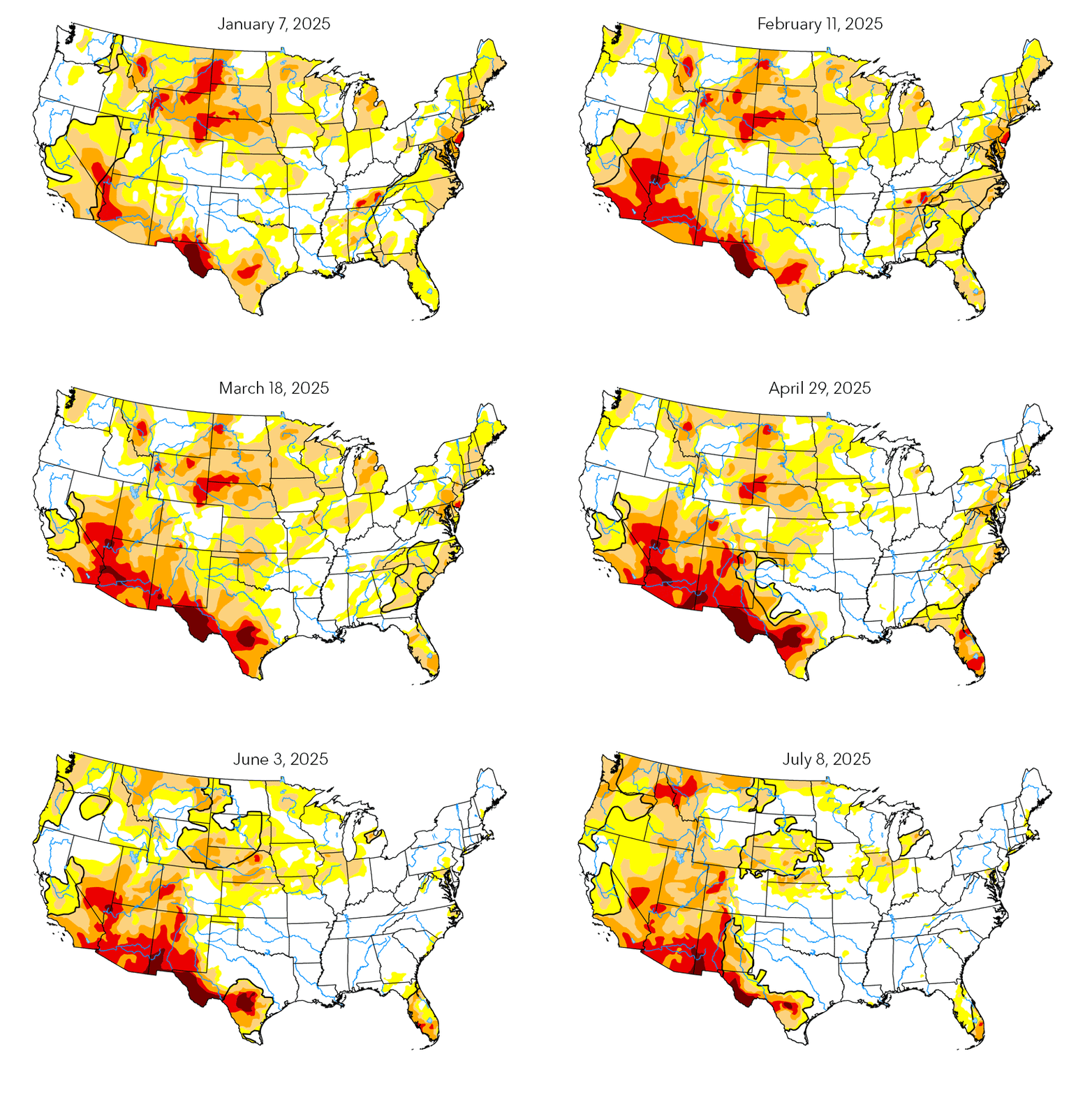
The July 29 U.S. Drought Monitor continued to show drought conditions covering virtually the entire Northern Plains, with a vast section of central North Dakota registering extreme-to-exceptional drought. Most of South Dakota and Minnesota reported severe-to-extreme drought conditions in late July.

Crop quality was suffering as a result. “It’s very dry, and a lot of crops are getting baled up for the cattle,” reported one North Dakota contact at midweek. “A lot of cattle are moving to market. With beans and corn, some are wait-and-see and some are not looking very well at all.”

Good or excellent ratings were assigned to just 17-21 percent of North Dakota’s corn and soybeans on July 25, compared with 26-30 percent in South Dakota and 36-38 percent in Minnesota. Corn and soybeans rated as poor or very poor totaled 39-41 percent of the acreage in North Dakota in late July.

Small grains crops were also parched. Only 16 percent of South Dakota’s sorghum crop fell in the good or excellent categories on July 25, compared with 31 percent in the poor or very poor categories. With the spring wheat and barley harvest just starting in the region, USDA rated 5-11 percent of the regional spring wheat as good or excellent, with fully 61-69 percent of the acreage in the Dakotas described as poor or very poor. The regional barley crop was 9-15 percent good or excellent and 36-63 percent poor or very poor.

Northeast:

Severe thunderstorms swept through parts of New England on July 27, leaving more than 10,000 customers without power. Maryland was also hit by strong thunderstorms on July 26, but high heat and humidity moved in as the week progressed, with highs reaching the mid-90s at midweek.

Smoke from wildfires in parched areas of Canada and the western U.S. continued to blanket much of the Northeast, but drought conditions in the Northeast were nearly nonexistent in late July. The only exception was a patch of moderate to severe drought across the northern edge of New York, New Hampshire, and Maine.

Crops continued to flourish in much of the Northeast. Fully 88 percent of Pennsylvania’s corn was rated as good or excellent on July 25, with 36 percent of the acreage at the silking stage and two percent in the dough.

Eastern Canada:

Eastern Canada weather in late July was dominated by heat and humidity, along with smoky conditions in some areas due to wildfires.

Forecasts warned of 30 C highs and strong thunderstorms across southern Ontario during the week, with reports of heavy rain, hail, and damaging winds in some locations. Despite the threat of hail and wind damage, most sources described Ontario crops as good in late July, although excessive moisture has taken a toll in some locations.

“There is lots of heat and lots of moisture, not at all dry,” said one contact at midweek. “In fact, it’s causing some issues with sprouting in the wheat that’s coming off. We have had flooding in some areas, which I’m sure will impact some of the crops in those areas.”

Added another source: “There has been lots of rain across Ontario, which has been bad for wheat harvest but great for corn and not bad for soys, either. Disease may rear its ugly head, but farmers are managing the crop for maximum yield.”

Dealers and growers are generally optimistic about the fall application season, although there is some concern that farmers will push back on higher fertilizer prices. “We’re expecting a normal application season for winter wheat planting, but resistance on fall applications of P and K on harvested corn and soybean cropland given the high prices,” said one contact.

Transportation

U.S. Gulf:

Handysize Shipping Index

A mechanical failure at the Belle Chasse Bridge, located at Mile 3 in the West Canal, was reported impacting travel in the Port Allen Route during the week. Vessels under 40 feet in height were able to transit the site, while taller boats were required to detour through Algiers Lock, adding up to 96 hours to travel times.

Port Allen Lock restrictions continued to be reported due to a damaged guidewall. Unassisted westbound vessels were limited to a single barge per tow, while larger lockages were required to utilize industry assistance. An assist boat was necessary on all eastbound movements measuring over 650 feet. Port Allen Lock delays were noted up to 22.5 hours for the week.

Unassisted tows passing through Algiers Lock faced ongoing restrictions as well. Limitations on tow lengths and widths effectively capped unassisted lockages at four standard barges or two 30,000 mt tankers, although larger passages were available with the use of an assist vessel. Wait times at the lock were reported up to five hours during the week.

Travel through Bayou Chene remained unavailable during overnight hours due to ongoing construction and dive operations. Movements were stopped nightly between 7:00 p.m. and 7:00 a.m., resulting in 6-12 hour delays. An assist boat was reportedly necessary for travel during daytime hours.

Bayou Sorrel Lock delays ran in the 5-12 hour range for the week, Corps data indicated, while tows passing Industrial Lock were delayed up to nine hours.

Mississippi River:  

Staggered one-way traffic was allowed at Mile 933 on the lower Mississippi River to ease blocked daytime restrictions caused by rock-laying operations at the site. One-way access was available daily between 6:00 a.m. and 6:00 p.m., with normal navigation possible during overnight hours.

Previously scheduled to run through July 27, contractors were expected to complete work at Mile 933 by July 31 before moving to a new location in the week ahead.

Falling water levels at St. Louis allowed for eased restrictions between St. Louis and Cairo, Ill., in late July, ending a spate of overnight limitations previously imposed on a case-by-case basis through the bridge at Thebes, Ill.

Movement also returned through the Lock 27 secondary chamber on July 27 through Aug. 1, ending the first phase of a planned bullnose repair project at the site. The main chamber will shut again on Aug. 2-19 for repairs to the upper bullnose, with significant waits expected. Intermittent delays were noted up to eight hours for the week.

Miter gate installation triggered wait times up to 10 hours at Lock 2 for the week. Sporadic waits were projected to run 4-12 hours for the duration of the project.

Wait times were posted up to 23 hours at Lock 16, while boats passing Lock 21 experienced 3-12 hour delays for the week. Tows locking through Mel Price Lock required up to seven hours to pass.

Illinois River:

Wickets were reported in the lowered position at both Peoria Lock and LaGrange Lock for the week, allowing lockless navigation through both sites. Wait times were noted up to five hours at Starved Rock Lock and Dam.

Ohio River:

The Montgomery Lock main chamber shut to navigation on July 26 for repairs and maintenance. Vessel traffic will detour through the secondary chamber for the duration of the project, currently scheduled through Aug. 24, with multiple passes needed to lock through the smaller chamber.

A second main chamber project at the site, scheduled to run between Oct. 18 and Dec. 17, will prompt similarly rerouted navigation. Delays were quoted up to 20 hours for the week.

Main chamber repairs and maintenance underway at Cannelton Lock prompted detours through the site’s auxiliary chamber. The project started on June 21 and is expected to run through Nov. 19. Work at the site reportedly resulted in minimal delays for the week. Following the main chamber repair, the secondary chamber is scheduled to close for work on Nov. 1-19.

The Markland Lock secondary chamber is projected to remain offline through an estimated Oct. 29 due to structural damage to the miter gate. Tows have continued to pass through the site’s main chamber throughout the navigation interruption, with minimal delays reported.

The Braddock Lock main chamber will shut to navigation from Sept. 13 through Oct. 15, with tows expected to transit through the secondary chamber. Hannibal Lock will shut from Sept. 13 through Oct. 29 for repairs to the 1,200-foot main chamber, forcing tows to pass through the 600-foot secondary unit. The primary chamber at Willow Lock is also due to be offline for repairs on Oct. 1-31, with delays anticipated.

Sources reported a multi-day shutdown at the Tennessee River’s Kentucky Lock during the week, resulting in lengthy delays. Kentucky Lock is in the midst of a long-term construction project slated to run through the end of 2024.

The Monongahela River’s Lock 2 is scheduled to undergo a main chamber closure from Sept. 13 through Oct. 15, forcing tows to run through the auxiliary chamber.

Arkansas River:

David D. Terry Lock will experience a complete shutdown for dewatering and repairs from Aug. 27 to Sept. 9, blocking river travel at that site. Intermittent shutdowns are expected in advance of the closure on Aug. 16-26.

Joe Hardin Lock will see intermittent delays on Oct 19-21, Corps postings indicated. Sporadic shutdowns are also scheduled at Emmett Sanders Lock on Oct. 26-28.