

Cornbelt:
The NPSZ market remained in a broad range at $620-$665/st FOB in the Cornbelt, with the low out of river terminals and the high out of inland warehouses.
Cornbelt:
The NPSZ market remained in a broad range at $620-$665/st FOB in the Cornbelt, with the low out of river terminals and the high out of inland warehouses.
Southeast:
Sulfate of potash (SOP) pricing was steady at $605/st FOB in the Florida market for all grades, with inventories described as plentiful in late April.
Southern Plains:
Trio postings from Intrepid FOB Carlsbad, N.M., remained at $310/st for premium, $300/st for granular, $265/st for standard, $375/st for OMRI-listed granular, and $340/st for OMRI-listed standard.
Southeast:
SOP Magnesia pricing in Florida remained at $360/st FOB for standard and $395/st FOB for premium grade, but sources reported very tight supply in late April.
Eastern Cornbelt:
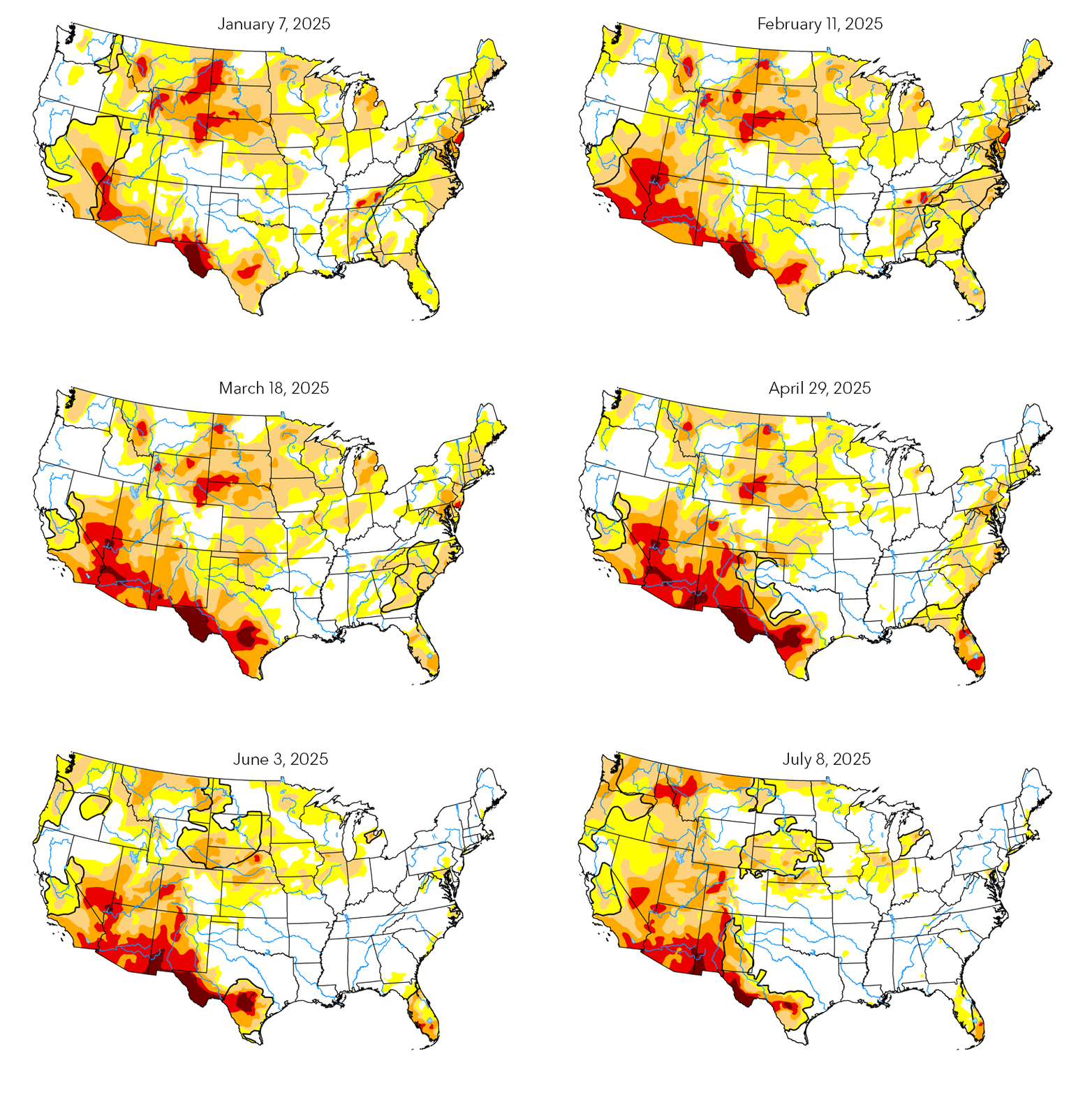
Cold temperatures resulted in a hard freeze in parts of northern Illinois on April 20-22, with snow flurries and 30-40 mph winds also reported in some areas. Lows in central Illinois dropped to the 40s, with an increased chance of rain as the week progressed.
Parts of Indiana were also blanketed in up to two inches of snow on April 20-21, with temperatures expected to drop into the upper-20s and low-30s, prompting a freeze warning for multiple areas across the state. Snow accumulation in parts of northern Ohio reached four inches or more during the week, but highs near 60 were expected again by the coming weekend.
Planting progress in the Eastern Cornbelt was tracking ahead of the five-year average. USDA estimated that 12 percent of the Illinois corn crop was planted by April 18, along with 7 percent of the crop in Indiana and 4 percent in Ohio. Soybean planting had progressed to 5 percent complete in Illinois and Ohio by that date, just slightly ahead of Indiana’s 4 percent.
Western Cornbelt:

Scattered snow showers were reported in Iowa at midweek as freezing temperatures threatened to deliver record-lows in some locations on April 22. Sources reported thunderstorms in northern Iowa, with highs only reaching the mid-50s.
Winter was also refusing to ease its grip on Nebraska, as another storm brought 4-8 inches of snow to northern areas of the state on April 18-19. Highs topped out in the 40s at midweek in Lincoln, Neb., with a freeze warning in effect for much of southeastern Nebraska.
In Missouri, the Kansas City area collected 3.5 inches of snow on April 20, a record for that date. As the week progressed, rain was expected across central and southern Missouri, but forecasts said a weekend warmup was on the way, with highs possibly reaching the low-80s by April 26-27.
Missouri growers had 14 percent of the corn planted by April 18, compared with 2-4 percent in Nebraska and Iowa, with all three states trailing their five-year averages. Just 1 percent of the soybeans were planted in Iowa and Missouri by that date, while Missouri growers had 26 percent of the rice seeded. Oat planting had reportedly progressed to 66-70 percent in Iowa and Nebraska.
Southern Plains:
Colder temperatures were reported in Kansas during the week, with rain and snow observed in some eastern areas of the state on April 20.
The cold weather also drifted down into Oklahoma and Texas, where temperatures fell into the 30s and 40s at midweek. Lows in Oklahoma City were expected to dip below freezing at midweek, with an increased chance of rain as the week progressed.
In northern Texas, a record low of 37 degrees was recorded in Dallas-Fort Worth on April 21, with freezing temperatures in other parts of northern and western Texas. Northern Texas was bracing for an increased chance of rain and thunderstorms later in the week. Rain, thunderstorms, and snow were also reported in New Mexico early in the week.
Planting continued at a brisk pace in the region, despite the presence of extreme-to-exceptional drought conditions in western and southern Texas. As of April 18, corn planting was fully 60 percent complete in Texas, compared with 15 percent in Kansas and 6 percent in Colorado. Texas growers also had 16 percent of the cotton and 51 percent of the sorghum planted by that date.
“Fieldwork on range and pasture is wide open, and a rain this weekend will give it a big push,” said one Texas contact.
South Central:
Planting progress was mixed across the South Central region at mid-month, with some areas experiencing delays due to cold, wet weather.
Freeze warnings and watches were in effect at midweek for much of northern and western Arkansas, with some parts of northwestern Arkansas picking up a dusting of snow. Lows in the 20s and 30s were reported early on April 21 in northern and central Arkansas. Although things warmed up a bit as the week progressed, another system was expected to bring 1-3 inches of rain to southern areas of the state by the weekend.
A mix of rain and snow was also reported in Middle Tennessee at midweek, while heavy rains across Louisiana during the previous week dropped as much as 5-8 inches of precipitation and caused flooding in some locations.
USDA reported that growers in Kentucky and Tennessee had 26 percent of the corn planted by April 18, while soybean planting had progressed to 2 percent complete in Tennessee, 4 percent in Kentucky, 12 percent in Arkansas, and 10-15 percent in Louisiana and Mississippi. Cotton planting was just 1-2 percent complete in Mississippi and Louisiana by that date.
Rice planting in the region was much further along, with progress rated at 26 percent complete in Arkansas, 36 percent in Mississippi, and 74-79 percent in Louisiana and Texas.
Southeast:
After highs in the 80s during the previous week, much of the Southeast was hit with cold temperatures that prompted several freeze warnings at midweek.
In addition to freeze warnings, parts of North Carolina and northern Georgia were also under red flag fire warnings due to windy and dry conditions. Forecasts warned of up to two inches of rain across northern Georgia over the coming weekend, however.
Temperatures in the upper-80s were common across southern Florida over the prior weekend, but colder temperatures also moved into the Sunshine State during the week. Forecasts warned of thunderstorms in northern and central Florida early in the week, with the precipitation shifting to southern Florida at midweek. Temperatures in the 70s were common throughout the state as the week progressed.
Sources reported an active planting pace in the region during the week, along with some logistics headaches. “Everyone is wide open right now with application,” said one Georgia contact. “Planting has started as well. Railcars are our biggest issue right now; they get bottlenecked in spots and aren’t getting to us fast enough.”
North Carolina growers had 40 percent of the corn and 2 percent of the soybeans planted by April 18, with cotton planting estimated at 5 percent in Georgia, 2 percent in Alabama, and 1 percent in South Carolina and Virginia. Peanut planting was also off to a good start, with progress estimated at 11 percent complete in Florida and 1 percent in Georgia and the Carolinas.
“Corn is 75 percent planted and we’re begging for a rain,” said one South Carolina source at midweek. “Sidedress should start next week, and we’re expecting a big run.”

U.S. Gulf:
High water levels on April 16 forced a full stop to navigation on the Port Allen Route, sources said. Vessels detoured through Algiers Lock, increasing travel times by an estimated one week. Port Allen lock continued minimal operation during the shutdown, although service was reportedly limited to local vessels only.
Gross Tete Bridge repairs are scheduled to continue through May 15, with limited movements when Port Allen Route navigation resumes.
Unrepaired guidewall damage continued to limit Port Allen lockages, capping unassisted westbound movements to tows with one or zero barges. Boats with two or more barges in tow were required to utilize an assist vessel. For eastbound travel, an assist boat was required for all tows longer than 650 feet. Intermittent four-hour shutdowns were reported for repairs, running from 6:30 a.m. to 7:00 p.m. daily through May 17.
Harvey Lock movements are unavailable through May 21 due to repairs to the 4th Street Bridge, located adjacent to the lock. Tows detoured through Algiers Lock, exacerbating previously existing slowdowns due to high water, the Port Allen Route shutdown, and unrepaired lock damage. Most reported Algiers Lock delays at 62 hours, with a small number of crossings noted up to 75 hours. A total of 69 tows were in line to lock at Algiers on April 20.
Towing restrictions continued at Algiers Lock, restricting unassisted tows measuring 60 feet or wider to a maximum 600 feet of length. Tows under 60 feet in width were granted unassisted access on lengths up to 700 feet. The restrictions capped locking capacity to four standard barges or two 30,000 mt tankers per turn, although longer tows were possible with an assist vessel.
Bayou Chene was shut to overnight travel due to construction and dive operations, driving potential 6-12 hour delays.
Bayou Sorrel Lock was slated to close to daytime navigation on April 21 due to repairs and maintenance. Transit through the site was unavailable on April 20 ahead of the planned shutdown. The project is scheduled to run through May 15.
High water continued to limit tows operating in the Gulf above New Orleans, slashing maximum barge counts by 5-10 units. Water levels at Baton Rouge, La., broke below the 38-foot moderate-flood threshold, falling to 37.8 feet on April 20, although forecasts projected the gauge to remain above the 30-foot action stage into early May, prolonging towing restrictions.
An NWS Flood Warning issued on April 20 for the Mississippi River at Baton Rouge and Red River Landing was scheduled to expire on May 3.
Most Industrial Lock delays were quoted up to 15 hours for the week, although sources said intermittent waits spiked to 25 hours. Bayou Boeuf Lock wait times were quoted up to 15 hours, while sources reported Brazos Lock crossings in the 10-23 hour range.
Mississippi River:
High water levels and fast flows limited fleet availability at Cottonwood, La., located at Mile 833 on the lower Mississippi River. Inclusion requests were considered on a case-by-case basis, sources said.
A revetment operation previously planned to kick off in late February at Mile 770 was rescheduled for April 26, sources reported. The operation is projected to block navigation daily from 7:00 a.m. to 7:00 p.m. through the site, likely running through late May or early June.
Improving conditions reported on the upper Mississippi River allowed for a return to full barge complements above St. Louis. Tows were earlier limited to nine barges between St. Paul and Prairie du Chien, Wisc., and 12 barges from Prairie du Chien to St. Louis.
Restrictions were easing somewhat between St. Louis and Cairo, Ill., with sources noting looser limitations on bridge travel through St. Louis and Thebes, Ill. Barge counts continued to be reduced by five units, however.
Elevated water levels and fast flows persisted below Cairo, however, reducing maximum cargoes to 15-20 per tow, down from the usual 25. In addition, daylight-only travel restrictions remained in force through bridges at Memphis, Vicksburg, Miss., and Baton Rouge. The NWS river gauge at Vicksburg was clocked at an action-stage 41.4 feet and falling on April 21, with levels projected to drop below action stage on May 4.
Travel through the railroad bridge at the upper river’s Mile 699 was unavailable nightly from 8:00 p.m. to 8:00 a.m. due to a shortage of qualified bridge tenders, sources said.
Sources continued to predict a planned Lock 2 shutdown in July, needed for miter gate installation. Work at the site is anticipated to block travel for 4-12 hours at a stretch during daylight hours. Lock 25 is projected to undergo daytime shutdowns in July and August for guidewall repairs.
Lock 22 delays were quoted up to five hours for the week, while boats passing Lock 25 noted waits up to eight hours. Passages were clocked up to six hours through both Mel Price Lock and Lock 27.
Illinois River:
Lockport Lock was scheduled to shut for repairs from 8:00 a.m. to 2:00 p.m. on April 24. Wickets remained down at Peoria Lock and LaGrange Lock, permitting tows to pass both sites without locking.
Ohio River:
Sources reported a 48-hour river closure at Mile 75.5 due to bridge construction. The closure started on the morning of April 21, with movement through the area scheduled to resume on April 23.
The Corps announced revised dates for the planned Meldahl Lock main chamber shutdown for miter gate machinery repairs. Travel through the chamber will be largely unavailable from May 17 through June 29, prompting detours through the site’s 600-foot auxiliary chamber. Sources predicted significant delays. The project was previously slated to run from April 12 through June 11.
Main chamber work scheduled for June 21 to Nov. 19 at Cannelton Lock is likely to trigger substantial delays, sources said. Traffic is projected to pass through the smaller auxiliary chamber while work is underway.
The auxiliary chamber at Markland Lock, closed to traffic since early 2020 due to cracks in the miter gate, is anticipated to remain shut through Oct. 29. Transit has remained available through the main chamber, with minimal delays reported. The New Cumberland Lock secondary chamber is shut through June 10 for repairs and maintenance, sources said.
The Tennessee River’s Wilson Lock main chamber is slated to shut for repairs on May 4-13, leaving boats to pass through the secondary chamber. Kentucky Lock wait times were clocked up to 24.5 hours for the week.
Repairs to the bio-acoustic fish fence (BAFF) system at the Cumberland River’s Cheatham Lock were rescheduled for May 10 through July 15. The Corps is expected to open the lock three times during the project to pass waiting vessels.
Arkansas River:
David D. Terry Lock is scheduled to shut for dewatering and repairs from Aug. 27 through Sept. 9. Intermittent delays are expected prior to the closure, on Aug. 16-26.
While the U.S. International Trade Commission issued its four-to-one vote in favor of The Mosaic Co.’s petition for countervailing duties (CVD) against phosphate imports from Morocco and Russia on March 11 (GM March 12, p. 1), it just recently released the official decision and dissent. Chair Jason Kearns, Vice Chair Randolph Stayin, and Commissioners Rhonda Schmidtlein and Amy Karpel voted in the affirmative. Commissioner David Johanson voted in the negative.
The majority decision honed in on the actual number of imports during the period of inquiry (POI) and said that the presence of other economic factors, such demand and management decisions by domestic producers, does not compel a negative determination. It said dumping itself does not have to be the sole or principal cause of the injury.
The majority noted that the U.S. market experienced unusually wet weather conditions that impacted three consecutive planting seasons beginning in the fall of 2018. Consequently, crop planting fell and U.S. demand for phosphate fertilizer declined in 2019, though U.S. demand did rebound in interim 2020 with increased crop plantings.
The majority also acknowledged that both Mosaic and Nutrien Ltd. idled major phosphate production during this period. While respondents said this opened a “gaping hole,” for imports, the decision noted Mosaic’s argument that while the idling of its Plant City plant resulted in 700,000 st of reduced supply to the U.S. market between 2017-2018, subject imports increased by a greater amount – more than 1 million st during this time. It also cited Mosaic’s claim that despite “Black Swan” weather conditions in late 2018 into 2019, imports remained at elevated levels in 2019.
The majority said subject imports from Morocco and Russia rose 37.4 percent between 2017 and 2019.
“We find that the volume of cumulated imports and the increase in that volume were significant in absolute terms and relative to apparent consumption in the United States during the period of the investigation,” said the majority decision.
“Notwithstanding that some purchasers were unable to obtain supply from Mosaic at times during the POI, we find that the record as a whole shows that subject imports contributed significantly to oversupply conditions in a declining market and had significant price-depressing effects on prices in the U.S. market in 2019.”
Despite arguments of declines in global prices and U.S. demand, the majority said these do not negate the significant role that the subject imports played in depressing domestic prices. Moreover, it said in 2019, as subject imports remained at elevated levels in an oversupplied and declining market, U.S. prices were lower than global prices.
“Although the domestic industry attempted to offset the collapse in U.S. prices by idling capacity and curtailing production, the record as a whole indicates that subject imports contributed significantly to the market imbalance between supply and demand that occurred in the latter half of the POI and … depressed prices to a significant degree.”
The decision said subject imports poured into the U.S. during the POI, gaining market share, forcing the domestic industry to reduce prices, and causing revenues to be lower than they would have been otherwise.
The majority also noted that rather than repositioning their overhang of imports, importers opted to simply import more product. It also said that some of them were contractually obligated to import more tons into an oversupplied market.
The majority also rejected respondent claims that Mosaic favored exports over the domestic market, noting at once the subject imports declined after the CVD petition was filed in June 2020, that the U.S. industry increased production, and U.S. shipments and diverted exports to make more material available for the U.S. market.
ITC Commissioner David Johanson dissented from the majority decision, saying Moroccan and Russian imports were pulled into the U.S. market by a supply shortage that was intentionally created and recognized by the domestic industry.
“When Mosaic announced its intention to idle Plant City in late 2017 and Nutrien announced the closure of its Redwater facility in early 2018, they did so fully expecting that the U.S. market would need more imports to fill the supply gap, a gap only widened by the domestic industry’s refusal to supply major U.S. purchasers and its prioritization of exports,” wrote Johanson.
“U.S. purchasers immediately scrambled to secure volume from alternative sources of supply, including subject imports, in advance of the closures coming into effect, without ever exceeding the supply gap created by the domestic industry during the POI,” he added.
While the majority opinion stressed the volume of imports themselves, Johanson said the imports must be considered in the context of relevant market conditions.
“This is not a case of surging imports out to take domestic market share. In my view, this is a case of imports having been pulled into the market due to unique supply conditions created by the domestic industry. This is an unusual case in that subject imports were not simply pulled into the U.S. market but were invited by the domestic industry,” Johanson continued.
“So we gave up 1 million mt (1.1 million short tons) of market here in the U.S. intentionally,” he quoted Mosaic CEO and President Joc O’Rourke as saying on March 28, 2019 at the company’s Analyst Day. Johanson noted that some 16 out of 28 purchasers surveyed by ITC reported experiencing supply constraints during the POI, with several noting specifically that Mosaic and other domestic producers refused, declined, or were unable to supply fertilizer products.
Gavilon, EuroChem, ADM, Koch, Heartland, and others came forward during the investigation process to say Mosaic refused to supply them with fertilizer. The Plant City idling itself cost CHS Inc. some 200,000 st and Gavilon 100,000 st, according to the record.
Johanson also said the data collected by ITC did not support the claim of significant underselling by importers. In fact, he said it showed the imports oversold in 80 percent of the cases.
“I decline to blame the effects of bad weather and demand decline on subject imports,” he said, “which are in the market in the first place filling a supply gap of the domestic industry’s making. Any declines in domestic producers’ prices on this record are not indicative of price depression attributable to subject imports.”
Contrary to the majority decision, Johanson’s view was that import volumes did not exceed the supply deficit they were pulled into the market to fill. He also argued that Mosaic saw the U.S. market as limited and preferred a growing export market, such as Brazil. He added that Mosaic had invested billions of dollars in facilities in Brazil, Peru, and Saudi Arabia to serve the U.S. and global markets.
In the meantime, conservative think tank The Heritage Foundation called the CVD duties a “fertilizer tax,” and said they will likely drive up food prices. “Congress and the Biden administration should move away from policies that increase government intervention that hinders agricultural trade,” said the group in a commentary earlier this month. “Americans need policymakers to increase freedom when it comes to agricultural trade. Removing these duties would be an important step in that direction.”
Several farm state GOP Congressmen lobbied against the CVD decision, with Ohio Democrat Tim Ryan later making it a bipartisan effort. Republican Congressmen from phosphate-producing states of Florida and Idaho, including Sen. Marco Rubio, lobbied for the CVD action.
Netherlands-based OCI N.V. and Abu Dhabi National Oil Co. (ADNOC) confirmed on April 12 that they are considering an initial public offering (IPO) of their nitrogen partnership Fertiglobe, headquartered in Abu Dhabi. The companies declined to provide any additional information at this time.
Fertiglobe has a production capacity of 5 million mt/y of urea and 1.5 million mt/y of merchant ammonia, with OCI currently holding a 58 percent stake and ADNOC a 42 percent stake. The joint venture was formed in September 2019 following the two companies’ agreement to combine ADNOC’s fertilizer business into OCI’s Middle East and North Africa (MENA) nitrogen fertilizer platform (GM Oct. 4, 2019).
“The new combined company is underpinned by a young asset base and a robust storage and distribution infrastructure with access to key ports on the Mediterranean, Red Sea, and Arabian Gulf,” OCI and ADNOC said in a combined media statement at the time of Fertiglobe’s launch. “Fertiglobe’s complementary production and distribution locations bring geographical diversity and enhanced market access, benefiting both existing and new customers.”
The business is expected to be next in line for a listing, after ADNOC completes an IPO of its drilling business, according to a Reuters report, citing unnamed sources. ADNOC and OCI invited international and local banks to bid for potential roles in Fertiglobe’s public share-sale, with the firms submitting bids last week for the deal that could raise at least $1 billion, Reuters said.
At the time of its launch, Fertiglobe was pitched by OCI and ADNOC as the largest export-focused nitrogen fertilizer platform globally and the largest producer in the MENA region, with combined saleable capacity representing approximately 10 percent of the combined ammonia and urea global seaborne exports in 2018.
ADNOC’s sole IPO to date was the listing of its fuel-retailing unit, Abu Dhabi National Oil Co. for Distribution PJSC, in 2017. According to Bloomberg, Petrostates in the Persian Gulf are trying to bolster their economies after they were hit last year by coronavirus lockdowns and the crash in oil prices. They also want to diversify from fossil fuels by using money raised from their oil assets to invest in other industries.
In recent years, international and local funds have invested more than $20 billion in ADNOC assets such as pipelines and property. Last June, the company sold leasing rights over natural-gas pipelines to a consortium including Global Infrastructure Partners and Brookfield Asset Management Inc. in a deal worth $10.1 billion.
Neighboring Saudi Arabia – the world’s biggest oil exporter – has a similar strategy. It raised almost $30 billion from the IPO of state energy firm Saudi Aramco in late 2019. Last week, Aramco announced that it was selling leasing rights in pipelines for $12.4 billion to a consortium led by U.S. investor EIG Global Energy Partners LLC.
The state of Florida plans to budget as much as $115 million to treat contaminated water and take steps to permanently close the site of the former Piney Point phosphate plant after a recent leak at a phosphogypsum stack (GM April 2, p. 29) caused the release of an estimated 215 million gallons of contaminated water into Port Manatee and Tampa Bay.
During a visit to the site on April 13, Florida Governor Ron DeSantis said he was redirecting $15.4 million in Florida Department of Environmental Protection (FDEP) funds to pretreat water at the Piney Point site in case additional controlled discharges are needed to reduce pressure in the reservoir, the Orlando Sentinel reported. DeSantis also said investigators are working to determine if legal action can be taken against HRK Holdings, the owner of the Piney Point site.
“Rigorous water quality monitoring will continue so the state can assess any potential ecological impact from this event,” DeSantis said. “This data will be used by DEP as they move forward with enforcement to hold HRK accountable. And I’m further directing DEP to fully investigate the incidents here at Piney Point and to take any and all legal actions to ensure we hold HRK and any other actors fully accountable.”
Florida Senate President Wilton Simpson also said the state legislature is expected to provide $100 million, according to the Orlando Sentinel, with the hope that the FDEP will be able to complete a closure plan for the site by the end of the year. The Florida Senate on April 7 added $3 million in its proposed budget to start cleanup efforts at Piney Point. Simpson had earlier estimated the total cleanup cost at $200 million, and suggested using money from the state’s share of the American Rescue Plan federal stimulus package.
The recent troubles at Piney Point began on March 26, when an HRK site manager warned the FDEP of a leak at the site. HRK notified FDEP again on March 28 that a boil was observed at the foot of the gypstack, prompting the FDEP to allow an emergency release of wastewater from the stack. On March 30, HRK began controlled discharges as part of its efforts to ensure the structural integrity of the water management system at the site.
Fears of a stack collapse prompted the evacuation of some 316 local residents on April 2, with DeSantis issuing an executive order on April 3 declaring a state of emergency in the three counties potentially affected by the 79-acre reservoir. The evacuation was lifted on April 6 when the discharges were able to reduce water levels in the NGS-South compartment of the reservoir to 232 million gallons from the initial 480 million gallons (GM April 9, p. 1).
The discharges were stopped on April 9, and FDEP reported on April 10 that the leak in the gypstack had been sealed with a steel plate. Heavy rains over the weekend added additional water to the stack, however, with FDEP on April 11 estimating that rainwater had increased water levels in the south pond from 217 million to 221 million gallons.
FDEP has stressed all along that the major problem with the water was its nutrient content, and that it was not radioactive. It said teams are now deploying nutrient reduction and removal treatments onsite to address any required discharges in the future. Environmental groups and local residents, however, are concerned that the discharged wastewater could result in algal blooms and fish kills in Port Manatee and Tampa Bay.
“The state has to make adequate investment to clean the water, close the site, and make commitments to regulation and enforcement that ensures we are never on the edge of a disaster like this again,” Earthjustice Attorney Bonnie Malloy said in an April 13 statement. “This is a first step, and we need to see the follow-through before we celebrate. The DEP needs to investigate the other Florida phosphate waste sites and be proactive in managing this threat. At this point, there’s no excuse for any of these phosphate facilities to escape scrutiny.”
The southern pond is the largest of three reservoirs of contaminated water on the Piney Point site, which was abandoned by Mulberry Phosphates when it declared bankruptcy in February 2001. Emergency discharges from the stack have occurred several times in the past due to heavy rains, including in 2003 (GM Jan. 13, 2003), and again in 2013 (GM Sept. 9, 2013).
Agricultural cooperative Conserv FS on April 15 announced a large expansion of its Waterman, Ill., facility, with a recent groundbreaking event held for a new 7,500-ton dry fertilizer building equipped with a 24-ton blender and a NTEP certified Auto-Batch blending system. The new dry building will have the capacity to load eight semi-trucks per hour, the company said.
The project will also include 1.3 million gallons of liquid fertilizer storage integrated with a crop protection mixing facility and warehouse. The new liquid facility will be equipped with three load bays providing both top and bottom load options with “hot-load” capabilities, with each bay capable of filling six semi-loads per hour. Also included will be a 24/7 unattended bay for after-hours availability of nitrogen solution loads with nitrogen stabilizers.
“The loading speed of this updated facility will be up to five times faster than the existing facility, allowing us to service our customers at an increased pace while lowering our daily operating expenses through improved efficiencies,” said Adam Day, Agronomy Marketing and Sales Manager at Conserv FS. “Storage capacities will allow for us to effectively handle customers in-season needs and keep them moving efficiently.”
Both the dry fertilizer and the liquid facility will contain automated systems integrated with ordering, operations, and accounting software, providing a streamlined process and improved flow of information to the customer. In addition, the expansion will include 72,000 gallons of bulk crop protection product storage at the facility, along with ample mini-bulk and packaged good storage. All inbound and outbound loading will be indoors for ease of operation and environmental stewardship.
“These state-of-the-art facilities are built with safety and the environment being foremost in our thoughts, while at the same time providing an outstanding customer experience to our patrons, gaining them valuable time during peak-season operations,” said Jeff Kimmel, Facility Projects Manager at Conserv FS.
Greystone Construction is serving as contractor for the expansion, which is predicted to be completed before the end of the year. “This large project at our Waterman facility demonstrates our commitment to the future of agriculture in our territory,” said Dave Swigart, General Manager of Conserv FS. “We’ve been serving agriculture for nearly 100 years, and this project is an example of our commitment to serve the farmer of the future.”
Conserv FS was incorporated in 1928 and is a member of the Growmark System. The company offers agronomy, grain marketing, energy, and turf services and products from nearly 20 locations in Illinois and Wisconsin.
Landus, a farmer-owned cooperative based in Ames, Iowa, announced on April 12 that it has entered into an agreement with NuWay-K&H, another Iowa cooperative, on a new model designed for collaboration that the companies describe as “an innovative alternative to traditional mergers and acquisitions.”
According to a statement from Landus and NuWay, the new strategy is aimed at linking cooperatives and independents to collaborate on grain, feed, soybean processing, agronomy, data, technology, logistics, and back-office functions, while allowing each entity to maintain its autonomy and preserve its local community presence.
“Locally-based agricultural cooperatives and independent businesses have long played an important role contributing to farmer livelihoods and rural vitality,” said Matt Carstens, Landus President and CEO. “This strategy of local ag companies collaborating together is designed to modernize and protect the viability of these vital business offerings and services.”
Financial terms and additional details of the agreement were not disclosed, but a statement provided by the two companies said NuWay will become an optimization account with Landus while continuing to maintain a separate board of directors, employees, and operations. The two business said additional cooperatives and business are expected to join, with each agreement developed on a case-by-case basis and tailored to the strengths of each party.
Landus and NuWay said the strategy is “focused on improving service and competitiveness to drive more value for its collective membership and customers, while maintaining local influence and identity.” The companies said this approach also provides the opportunity to maximize capital investments, infrastructure capacity, and employee talent.
“NuWay-K&H is proactively entering this agreement with Landus to build on our cooperatives’ strengths and stay ahead of the marketplace,” said Kevin Jones, President and CEO of NuWay, who also joined Landus as Minnesota Business Unit Leader, effective April 12. “I’m looking forward to working with the Landus team and continuing my commitment to the success of NuWay-K&H Cooperative customers in my expanded role,” he said.
Landus was formed in 2016 through the merger of Farmers Cooperative Co. (FC) in Ames and West Central Cooperative in Ralson, Iowa (GM April 15, 2016). With 7,000 farmer-owners and 600 full-time employees at locations in more than 60 communities, it ranks as Iowa’s largest agricultural cooperative, providing products and services in agronomy, grain, feed, animal nutrition, and data.
NuWay-K&H has locations in northern Iowa and southern Minnesota, serving roughly 5,500 farms and non-farm customers with agronomy and energy products and services. The company has 85 full-time and 50 seasonal employees, and is headquartered in Clear Lake, Iowa.