

Eastern Cornbelt:
Potassium thiosulfate pricing remained at $700/st FOB Terre Haute, Ind., for the last reported offers.
Eastern Cornbelt:
Potassium thiosulfate pricing remained at $700/st FOB Terre Haute, Ind., for the last reported offers.
Eastern Cornbelt:
Winter weather was once again moving into the Eastern Cornbelt in late February, with reports of up to six inches of snow along the Illinois-Wisconsin border, 1-4 inches in other areas of northern Illinois, and freezing rain in central and northern Indiana.
Northern Ohio was also bracing for 2-4 inches of snow as the week progressed, with some central areas of the state reporting up to a quarter inch of ice. Flood watches were in effect during the week for several parts of central and southern Ohio after up to an inch of rain fell on Feb. 22-23.
Western Cornbelt:
Winter weather conditions were reported throughout the Western Cornbelt in late February. A Feb. 23-24 system brought 1-3 inches of snow to eastern Iowa and 1-2 inches to eastern Nebraska and western Iowa, along with 15-20 mph winds.
The St. Louis, Mo., area was blanketed with an inch or more of snow and sleet on Feb. 23-24, while parts of the Ozarks were expecting a half-inch coating of ice by Feb. 25.
Southern Plains:
Freezing rain, snow, and cold temperatures were reported across Kansas at midweek. One contact said highs in his location plunged from 72 degrees on Feb. 21 to just 10 degrees on Feb. 22, with some parts of the state collecting 6-8 inches of snow.
Winter Storm Oaklee also brought sleet and freezing rain to Texas and Oklahoma at midweek, along with subzero wind chills in some locations. McAlester and Norman, Okla., received 1-2 inches of sleet from the storm, while temperatures dropped to the teens across western and northern Texas.
Northern and western New Mexico were also hammered by cold, windy weather at midweek, along with snow flurries in the valleys and heavy accumulation in the San Juan Mountains.
One central Texas source reported temperatures down to the low-20s at midweek. “We had planters loaded up and ready to run,” he said, but the combination of cold temperatures and freezing rain kept fieldwork to a minimum during the week.
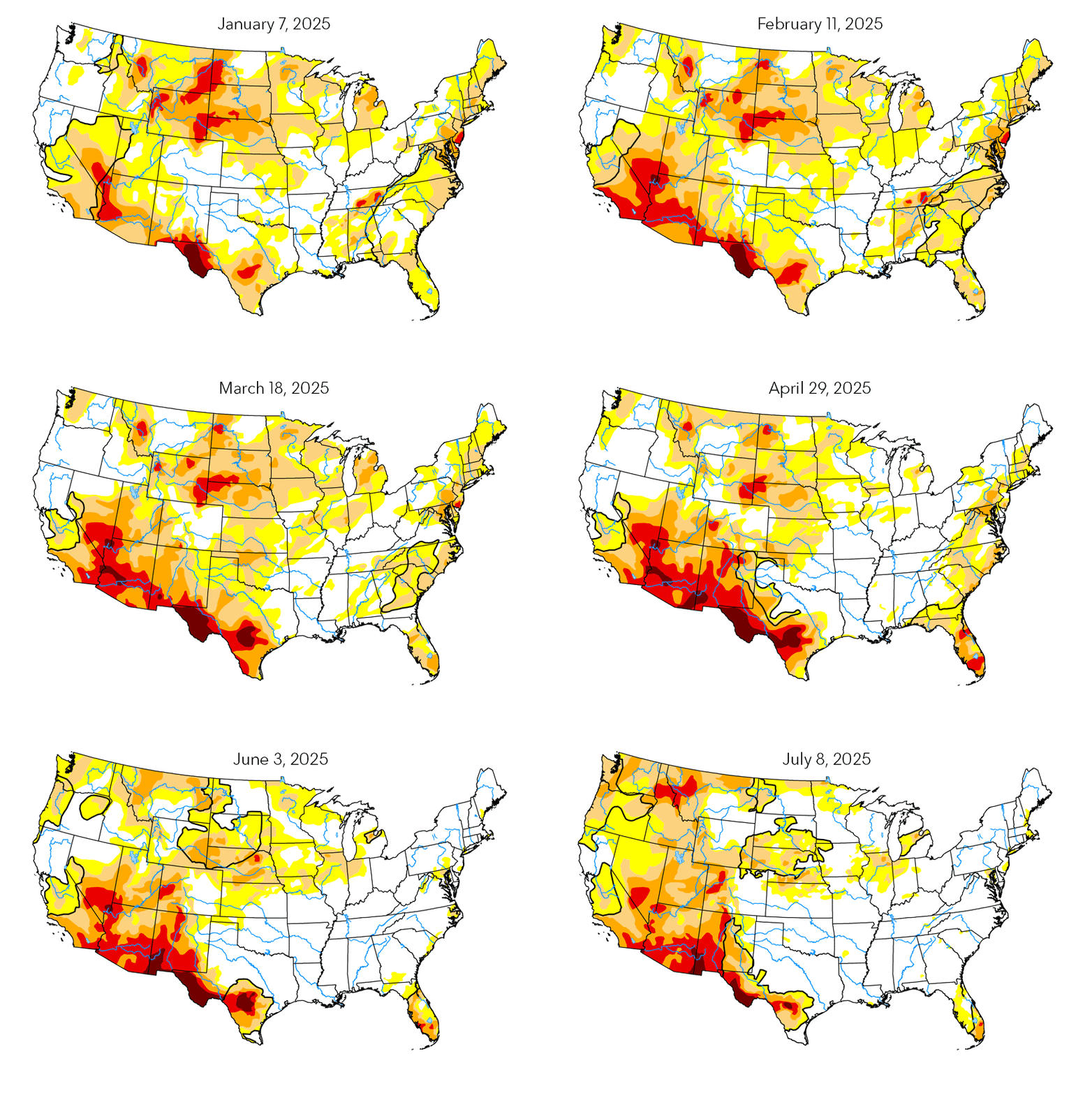
Corn planting was underway on the coastal bend and in parts of the Texas Blacklands, but severe-to-extreme drought also limited planting in the northern half of the state. “If we don’t get real lucky real quick, it’ll be a lost crop very soon,” said one Texas contact in reference to the worsening drought conditions. “If there’s no change in two weeks, it’ll be a bad, bad problem.”
South Central:
Winter Storm Oaklee brought freezing rain and sleet to much of Arkansas at midweek, along with heavy rain to portions of Tennessee. Local news reports confirmed many cancelled flights into and out of Little Rock, Ark., at midweek due to ice and freezing rain.
A number of flood watches were in effect in Tennessee stemming from 1-3 inches of rainfall by midweek, with another 1-3 inches possible through the end of the week. Kentucky also collected a wintry mix of rain and ice from the storm, while a large portion of Louisiana was at a marginal risk for severe weather on Feb. 23.
Southeast:
The Southeast experienced a mix of weather conditions in late February, ranging from summerlike heat in southern Florida to wet and cold in Virginia. In areas where weather conditions allowed, spring fieldwork was off to a good start in the region.
“We are actually not as busy as we should be this time of the year,” said one source. “I think the cold weather has put everyone behind.”
Temperatures in the 50s were reported across North Carolina at midweek, while cool, wet weather conditions were dominant in Virginia. South Carolina and Alabama enjoyed highs in the 70s during the last days of February, ahead of an increased chance of showers by the weekend.
After heavy rain and damaging winds late the previous week, most of Georgia enjoyed warm and dry conditions during the week, despite reports of heavy rain in the North Georgia mountains at midweek. Southern Floridians enjoyed temperatures in the 80s during the week, with an increased chance of rain by the weekend.
U.S. Gulf:
Daytime transit was unavailable through Brazos Lock due to an ongoing maintenance operation, blocking Monday-through-Friday movements from 7:00 a.m. to 7:00 p.m. Delays of 5-12 hours were reported on Feb. 22.
COVID-related labor shortfalls continued to impact travel throughout the eastern river system during the week. Impacts to navigation were believed to stretch average delivery times.
Intermittent closures were expected at Bayou Sorrel Lock through March 3 due to guidewall demolition in progress since Feb. 8. Construction of the replacement guidewall, currently set to begin on March 4, will block navigation from 6:30 a.m. to 5:00 p.m., Monday through Friday, through the end of May. Intermittent delays were reported up to 29 hours for the week.
A Coast Guard posting said Bayou Boeuf Lock movements are restricted to overnight hours on weekdays, leaving the site closed to navigation between 7:00 a.m. and 7:00 p.m., with 24-hour access allowed on Saturday and Sunday.
Bayou Chene was inaccessible nightly due to ongoing floodgate construction. Coast Guard data showed the waterway closed between 7:00 p.m. and 7:00 a.m., confining navigation to daytime hours, subject to a maximum length of 600 feet. Tows wider than 54 feet were also required to travel with an assist vessel. Wait times were reported in the 6-12 hour range.
Shoaling reported at Miles 113-116 of the Atchafalaya River prompted 10-foot draft limitations through the area, a Coast Guard posting indicated. In addition, tow lengths were limited to a maximum 600 feet, while strings measuring over 400 feet were requested to utilize an assist vessel. Widths were reportedly capped at 70 feet. Tows were advised to bypass the restrictions by detouring through the Port Allen Route.
Algiers Lock remained subject to limits on unassisted lockages, effectively capping independent tows at four standard barges or two 30,000 mt tankers per turn. Larger lockages could be achieved when accompanied by an assist vessel. Delays were generally reported in the 4-6 hour range.
Construction underway at Belle Chasse Bridge, located at Mile 3 in the West Canal, was projected to result in intermittent travel delays lasting up to 12 hours at a time. The project is tentatively slated to run into late 2022.
Port Allen Lock delays were reported in a wide 13-42 hour range for the week. Boats passing through the Colorado Floodgates saw intermittent delays up to 37 hours on Feb. 20-22.
Mississippi River:
Barge drafts on the lower Mississippi River continued to be restricted to a 9.5-12.5 foot range for the week, depending on location and direction of travel. The St. Louis river gauge showed a depth of 10.17 feet on Feb. 23, but levels were expected to fall to 3.7 feet on March 9. Conversely, the river gauge at Vicksburg, Miss., was predicted to rise to an action-stage 36.2 feet on March 9.
Channel work in progress since Jan. 5 at Mile 642 on the lower river was scheduled to continue through March 15. Tows moving downriver were expected to encounter delays up to 12 hours. Boats headed upriver were generally unaffected by the project.
On the upper Mississippi, locks 1-19 remain closed to navigation due to ongoing seasonal maintenance, according to Corps data. Locks 15 and 19 are tentatively slated to open for the spring navigation season on March 3, while Locks 5A, 8, and 10 were predicted to resume service as early as March 17, conditions permitting.
Illinois River:
High water conditions stemming from Winter Storm Miles caused navigation delays on the Illinois River during the week.
A Flood Warning was issued on Feb. 23 for the Illinois River at Peoria and Havana, Ill. The river gauge at Peoria was at 16.76 feet and rising on Feb. 23, approaching the 17-foot action stage threshold. The gauge was expected to crest at a minor-flood 19.2 feet on Feb. 26-28.
In addition to high water, ongoing icy conditions continued to impact travel on the waterway during the week, forcing ice coupling usage on all lockages.
Intermittent delays at Marseilles Lock were reported in the 30-39 hour range during the week. Wickets were in the lowered position at Peoria Lock and LaGrange Lock for the week, allowing tows to pass via those sites’ nonlocking navigational passes.
Repairs and maintenance scheduled at Brandon Road Lock will result in transit interruptions from May 9 through Sept. 8. Travel will be limited to overnight hours and subject to 70-foot width restrictions between May 9 and Aug. 14, followed by a total navigational outage from Aug. 15 through Sept. 4.
Overnight-only passage and width restrictions will resume on Sept. 5-8 at Brandon Road Lock, preceding a return to 24-hour access on Sept. 9. Extensive delays are predicted through all phases of the project.
Ohio River:
High flows slowed travel throughout the Ohio River system during the week, and were expected to persist through the two-week outlook.
Emsworth Lock main chamber repairs and maintenance were scheduled to kick off on Feb. 22, routing movements through the site’s auxiliary chamber, limited to a single barge per pass. Delays were reported at eight hours on Feb. 23. The project is scheduled through April 16.
Daytime travel is unavailable at Cannelton Lock weekly on Wednesdays and Thursdays through May 26 due to ongoing repairs. The project was started on Jan. 26.
Main chamber maintenance scheduled for March 7-31 at Dashields Lock is expected to move all traffic through the secondary chamber. Following the main chamber project, the secondary chamber is scheduled to shut on April 1-22 for repairs.
Scheduled repairs and maintenance at Belleville Lock will run from May 2 through June 22, blocking access to the main chamber. Navigation will remain available through the auxiliary chamber.
The secondary chamber at Hannibal Lock is shut through late February for maintenance. A main chamber maintenance effort proposed to run from July 5 through Oct. 8 would limit traffic to the use of the auxiliary chamber.
A maintenance and repair proposal at Cannelton Lock would potentially limit primary chamber access from July 5 through Nov. 11, forcing detours through the lock’s secondary chamber.
On the Tennessee River, lock repairs initiated on Jan. 31 at Kentucky Lock were reportedly concluded ahead of the scheduled Feb. 24 end date. Vessels had been detouring through Barkley Lock while the project was underway, increasing travel times by 1-2 days in each direction. Corps data put most Kentucky Lock delays in the 33-49 hour range on Feb. 23.
Wilson Lock, located at the Tennessee River’s Mile 259.4, is scheduled to undergo main chamber maintenance from Feb. 23 through April 28, leaving passage available solely through the secondary chamber. The main chamber is scheduled to open on March 18-23 to pass waiting traffic. Wilson Lock delays were reported in a wide 28-55 hour range for the week.
The Cumberland River’s Barkley Lock will close to daytime navigation on March 21-27 for Bio-Acoustic Fish Fence (BAFF) maintenance and inspections. Alternate passage will be available via Barkley Lock and Kentucky Lock.
Proposed miter gate machinery repairs at Cheatham Lock would restrict navigation through the site from May 31 through Aug. 5.
Arkansas River:
Maintenance and repairs announced at Norrell Lock will periodically block navigation daily between 7:00 a.m. and 7:00 p.m. through the end of the year, sources said. The shutdowns are scheduled for June 1-11; June 22-July 21; Aug. 1-10; Aug. 21-Sept. 21; Sept. 3-Oct. 9; Oct. 20-Nov. 18; Nov. 29-Dec. 23; and Jan. 3-31, 2023.
Bayer AG, Leverkusen, Germany, announced that a production shutdown by one of its suppliers will reduce output of glyphosate, constituting a force majeure event for the company. Glyphosate is a key ingredient in herbicides, including the Roundup brand, which Bayer acquired from Monsanto.
“One of our key raw material suppliers experienced a mechanical failure in its manufacturing plant, which leads to a substantial reduction in production rates,” said Dr. Udo Schneider, Global Head of Active Ingredient Manufacturing for Bayer, in a Feb. 11 letter to customers. “As of now, given the supplier notification, we expect repairs of this production line to take around three months.
“As a result of this force majeure event, Bayer’s ability to supply its customers with glyphosate or glyphosate-containing products, as agreed upon in certain agreements or under purchase orders, has been impacted,” Schneider continued. “We apologize for this impact, but hope you appreciate this situation is beyond our reasonable control.”
A Bayer spokesman told Bloomberg that the global crop chemistry market “is experiencing historically tight supply” because of challenging trade flows and the pandemic. Bayer previously said that glyphosate pricing had gained 25 percent between January 2021 and November, and that the company expected prices to keep rising.
“Our supplier is on track to restore production, we’ve sourced additional materials and made other mitigation efforts to help best manage this situation,” the spokesman said.
U.S. Gulf:
NOLA potash barges continued to step up, with the market quoted at $635-$655/st FOB compared to the week-ago $625-$655/st FOB. There were reports of $660/st FOB being offered, but no firm conclusions. Nutrien has posted NOLA barge equivalent prices at $715/st FOB, up from $690/st FOB.
Eastern Cornbelt:
Potash pricing was quoted at $710-$725/st FOB for prompt tons in the Eastern Cornbelt, up slightly from last report. Michigan sources pegged the market at $735/st FOB Toledo and $738/st FOB Webberville for prompt.
Nutrien closed its order book for 1Q potash sales on Feb. 14 and increased prices across North America by $25/st for 2Q. This takes the reference price to $750/st FOB in the Midwest for 60 percent red granular potash, and $765-$795/st to U.S. terminals and rail direct destinations outside of the Midwest, based on geography and logistics costs. The company said a $20/st premium will apply for all 62 percent white granular grades.
Nutrien said potash supply and demand fundamentals are strong, fueled by firm corn, soybean, wheat, cotton, and crude palm oil futures prices. The company added that demand continues to outstrip supply in key potash destinations.
Western Cornbelt:
Potash pricing was quoted at $690-$720/st FOB in the Western Cornbelt, with the St. Louis market confirmed in the $690-$700/st FOB range. The Catoosa/Inola market was pegged at $685-$695/st FOB. Regional sources were quick to note that the 2Q pricing increase from Nutrien won’t show up in the market for a while.
“I think it will be a hard sell unless there are very strong applications this spring, as I have seen growers cutting usage rates at prices of this level,” said one market source. “If they have good fertility levels, they can cut rates for a while, and the same regarding phosphates.”
Intrepid also announced higher potash prices late in the week. New postings FOB Carlsbad, N.M., include $805/st FOB for 60 percent white granular and $825/st FOB for 62 percent white standard, up $25/st from the company’s last postings in mid-December.
Intrepid’s potash prices at FOB Moab and Wendover, Utah, also jumped $25/st, to $800/st for 60 percent white standard and $805/st for 60 percent white granular.
Western U.S.:
Nutrien’s postings for 60 percent red granular potash in the Western U.S. also jumped $25/st for 2Q, to $800/st FOB in Idaho and $830/st FOB in Washington and Oregon. In California, the market firmed to $895/st FOB for 62 percent white granular tons.
Northern Plains:
Sources quoted potash offers at $700-$720/st FOB St. Paul, although new reference prices from North American producers for 2Q tons had reportedly firmed to $750/st FOB. The market FOB Saskatchewan mines for 2Q tons was reported at $720-$730/st after netbacks, depending on grade and destination.
Northeast:
Potash pricing firmed to $750-$760/st FOB in the Northeast for limited prompt or 2Q tons, with the low confirmed at Lancaster.
Eastern Canada:
Sources reported new potash pricing offers up to C$1,040-$1,056/mt FOB in Eastern Canada for 2Q tons, up significantly from the last reported range of C$990-$1,030/mt FOB for 1Q.
Nutrien reported that it has closed its 1Q order book and is now referenced at C$1,010/mt FOB Saskatchewan mines and C$1,040-$1,050/mt FOB warehouse locations in Eastern Canada for 2Q shipment.
“Time will tell if we see support for the new potash numbers, but I have a feeling that we will not and will start to see usage cuts,” said one regional contact. Added another source: “We expect some pull-back on usage, but the real determinant will be the grain market. A strong market going into spring will focus growers on profitability, not cost.”
Belarus:
JSC Belarusian Potash Co. (BPC) notified customers that potash producer Belaruskali OAO on Feb. 16 declared force majeure after it could not find alternatives to railing product to the Lithuanian port of Klaipėda, according to reliable sources, citing a notice from BPC.
While widely anticipated by most market participants since Lithuania halted the transit of Belarusian potash through its territory at midnight on Jan. 31, the Belarusian declaration of force majeure has ratcheted up global supply anxieties that were already being driven by U.S and E.U. sanctions on Belarus, pushing soaring global potash prices still higher.
Belarus potash accounts for around 15 percent of global potash exports, but is now effectively out of the market.
China/India:
Canpotex on Feb. 14 announced that it had agreed to a new potash supply contract with Indian Potash Ltd. (IPL), India’s biggest potash importer, for potash shipments through Dec. 31, 2022, at a price of $590/mt CFR. The following day, Canpotex reported that it had also reached a deal with China’s potash buying committee for shipments of standard grade potash through to Dec. 31, 2022, at the same price of $590/mt CFR.
The new price reflects an increase of $145-$310/mt over last year’s Indian potash contract price, and a $343/mt increase on the 2021 China contract price.
Canpotex did not comment on the delivery volumes, but shipments are expected to take place April through December, according to Nutrien Ltd. Interim President and CEO Ken Seitz, speaking at a company earnings call on Feb. 17.
Rumors had been circulating suggesting the new price for India and China could be somewhere between $500 and $600/mt. Offers into RCF’s tender for the supply of 170,000 mt of standard potash that closed on Jan. 28 (GM Feb. 4, p. 15) were reportedly “north of $600/mt CFR.”
The first agreement on new supply contracts to India and China traditionally sets the price for other suppliers and buyers in those countries. Indeed, ICL Ltd. announced on Feb. 17 that it had signed framework agreements for the supply of potash with its customers to China for the next three years (2022-2024).
As part of these agreements, ICL said it had signed contracts with its customers in China to supply an aggregate amount of 700,000 mt of potash, with mutual options for an additional 250,000 mt, to be supplied by the end of 2022. ICL confirmed the selling price in the contracts at $590/mt.
The new contract price set for India will now act as a benchmark for awards in the outstanding RCF tender, and also for FACT, which closed a tender on Feb. 14 for two 40,000 mt lots of standard potash for delivery to Tuticorin port in March and April (GM Feb. 11, p. 16).
Meanwhile, National Fertilizers Ltd. (NFL) on Feb. 17 issued a Request for Proposal (RFP) for entering into a long-term agreement/MOU with producers of potash for the supply of 200,000 mt of standard pink/red potash.
Of this total, 125,000 mt is required with the tentative shipments from the load port set for March 15 and June 15, and the balance of 75,000 mt for shipment between Aug. 1 and Sept. 30. Delivery is to both East Coast and West Coast ports. The deadline for submissions was set at March 21.
Brazil:
The MOP market remains steady, even as concerns grow over the potential of Belarus material no longer being available. Sources put the price at $770-$815/mt FOB.
The April 1 effective date of the sanctions against Belarus has raised some anxiety among buyers. To add to their concern, Belaruskali declared a force majeure on their shipments out of the Lithuanian port of Klaipeda. To top it off, China and India settled their major purchases for the year, locking up tons.
Inland trading showed a bit of movement as prices tightened. Sources put the market at $900-$930/mt FOB ex-warehouse.
Following a visit to Moscow that included a meeting with Russian President Vladimir Putin, Brazilian President Jair Bolsonaro said potash imports from Russia will soon double.
According to Trade Data Monitor, Brazil imported 3.6 million mt of MOP from Russia in 2021. Imports of Belarus material were reported at 2.4 million mt. Based on this data, if the Brazilian-Russian deal goes through, Brazil will not have to worry about the sanctions imposed on Belarus by the U.S.
Danish engineering company Haldor Topsøe A/S, Lyngby, has appointed Elena Scaltritti as its new Chief Commercial Officer (CCO), effective July 1, 2022. Scaltritti comes from a similar position as Executive Vice President at Songwon Industrial Group in Frauenfeld, Switzerland, where she is responsible for the group’s commercial activities.
She has held various positions at Songwon since joining the company in 2011.
Gensource Potash Corp., Saskatoon, said on Feb. 14 that it, along with Helm AG and Michael Ferguson, Gensource President and CEO, have entered into a mutual release and settlement agreement dated Feb. 11, 2022, with Frank Eberhardt, Carl F. Peters, GmbH & Co., and 11664735 Canada Ltd. with regards to the statement of claim filed by the plaintiffs last summer (GM June 28, 2021).
“We are pleased to have settled this matter with the plaintiffs, which removes a distraction from the Gensource team as we look to move our Tugaske potash project forward into construction,” said Ferguson.
According to Gensource, the claim alleged, among other things, that Gensource and Helm wrongfully excluded Eberhardt from investing in the Tugaske Project and sought to confer upon the plaintiffs the right to invest in and be part of the Tugaske Project.
In late 2020, Gensource reported that it had ceased negotiations with Eberhardt when it became clear that the parties were not able to agree on the terms of the key required agreements, namely the offtake agreement for the Tugaske Project and the shareholder agreement that would govern the Special Purpose Vehicle (SPV).
Since that time, Helm and Gensource have finalized and executed the offtake agreement and have agreed on substantially all the terms of the shareholder agreement for the SPV, pending final equity capital structure of the SPV (GM May 14, 2021).
Highfield Resources, Navarre, Spain, said on Feb. 15 that it has signed the two final purchase contracts for the critical process plant equipment for its Muga Mine in Spain.
A €2.9 million contract has been signed with Metso Outotec Finland Oy to provide the thickeners needed to remove impurities from the brine solution within the crystallization process. A €2.6 million contract with TEMA Process BV will provide both the potash and salt dryers, as well as the dedusting systems and the wet scrubber for the crushing area.
“We are delighted to report another important step towards construction at Muga,” said Highfield CEO Ignacio Salazar. “With the signing of these contracts, all key process plant equipment has been procured, reducing future potential inflationary risk and construction risk.”
Technology developer AmmPower Corp., Toronto, has announced a securities purchase agreement with a single institutional investor for a private placement of its common shares and warrants to purchase common shares for gross proceeds of approximately C$3 million.
The net proceeds will be used by the company for research and product development activities and for general working capital purposes. AmmPower is planning to use its green ammonia production technology to build plants both large and small (GM Feb. 11, p. 1).
Pursuant to the placement, the company will issue 7,142,858 common shares and warrants to purchase up to an aggregate of 7,142,858 common shares, at a purchase price of C$0.42 per common share and associated warrant. Each warrant will entitle the holder to purchase one common share at an exercise price of C$0.52 for a period of five years following the issuance date.
Rare earth explorer RareX, Subiaco, Western Australia, reported on Feb. 14 that the discovery of high-grade phosphate in the Cummins Range in Western Australia is a “game changer.” The discovery was just north of the Rare Earths Main Zone and will now be referred to as the “Northern Phosphate Zone.”
“Along with the spectacular high-grade rare earths results we have been reporting from diamond drilling into the primary zone at Cummins Range, we now have a very exciting development to the north with diamond drilling intersecting a primary zone of high-grade phosphate mineralization,” said Jeremy Robinson, RareX Managing Director.
“Because of its strategic location immediately adjacent to the main rare earths zone – which is not uncommon with large carbonatite systems – this is a discovery of considerable importance to the company, which we intend to follow up and pursue this year as part our expanded drilling campaign at Cummins Range,” he added.
Robinson said because of its role in fertilizer production, phosphate is a strategic and future-facing mineral that complements the company’s rare earth focus. “We are very much looking forward to seeing how this discovery shapes up with further drilling this year,” he said.